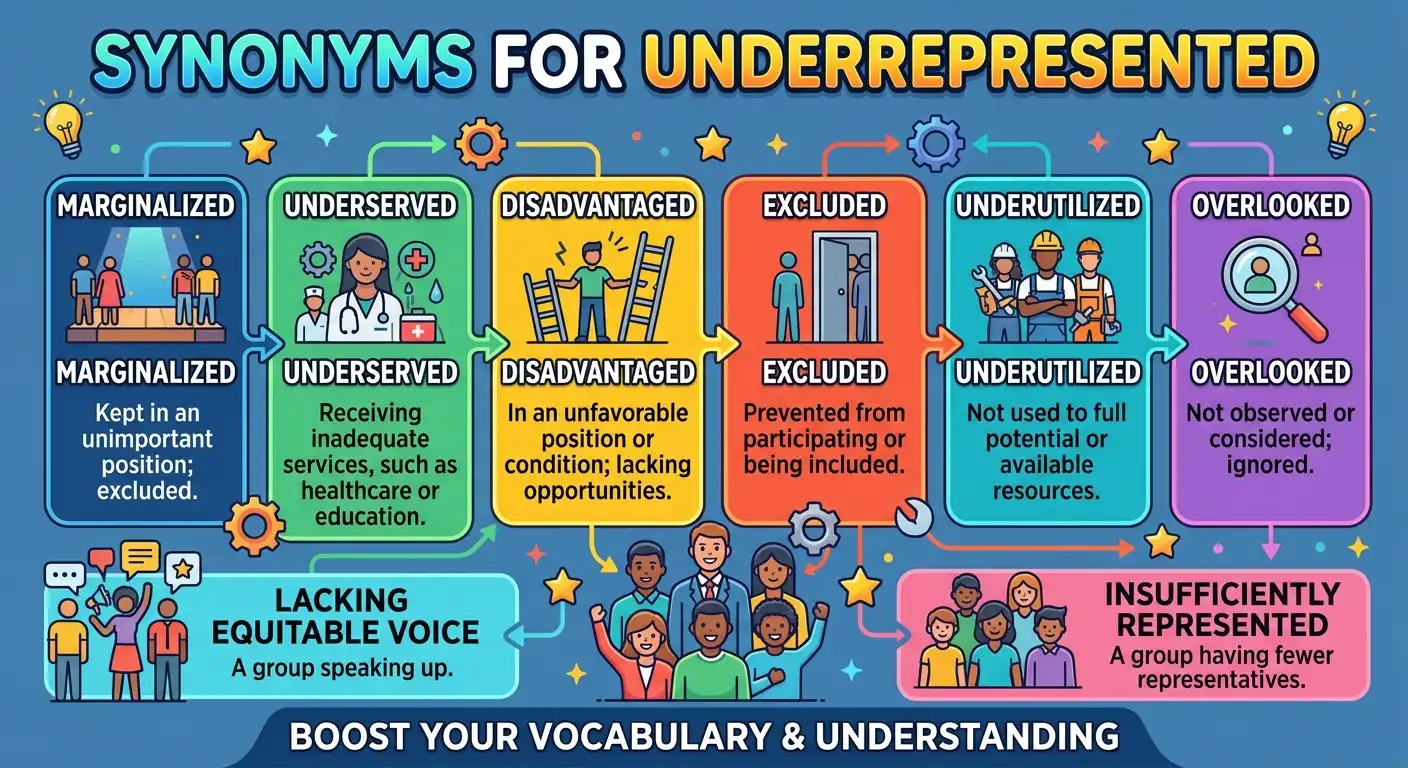
Finding exact synonyms for underrepresented helps you express fairness, diversity, and social topics with total clarity. When you learn diverse synonyms for underrepresented, you can describe small groups, overlooked communities, and unequal settings accurately. Using clear synonyms for underrepresented strengthens your everyday writing and keeps your communication respectful and precise.
Imagine a school principal organizing a community meeting. If the principal keeps repeating the word “underrepresented” to describe small student groups, the speech feels repetitive. Switching to exact words like “marginalized,” “underserved,” or “overlooked” gives real depth and respect to the conversation.
For instance, when a tech company wants to hire workers from backgrounds that rarely get corporate jobs, you can call them an underrepresented group. Choosing clear terms like “disadvantaged” or “sidelined” helps listeners understand your point immediately.
The term underrepresented means having fewer members in a group or institution than expected based on total population size. Expanding your knowledge of synonyms for underrepresented helps many groups of readers:
- Students write thoughtful essays on social studies, history, and civic rights.
- Bloggers write empathetic articles that connect deeply with diverse audiences.
- Content writers increase search traffic with natural, precise phrasing.
- Daily English users speak politely and clearly in modern workplace conversations.
“The right word builds bridges, showing respect and understanding to every group.”
“A rich vocabulary allows us to speak up for fairness with confidence and care.”
Linguistic Breakdown of “Underrepresented”
Connotative Meaning
The word underrepresented carries a thoughtful, analytical, and social awareness connotation. It points out an imbalance in representation, participation, or opportunity without using hostile language.
Etymology
- Under: From Old English under (meaning beneath, below, or insufficiently).
- Represent: From Old French representer and Latin repraesentare (meaning to present again or exhibit).
- Historical Shift: The compound word developed in mid-20th-century sociology and politics to describe groups missing fair participation in public life.
Pronunciation
- US (IPA): /ˌʌn.dɚ.rep.rɪˈzen.t̬ɪd/
- UK (IPA): /ˌʌn.dr̩.rep.rɪˈzen.tɪd/
Syllables & Affixation Pattern
- Syllables: 6 syllables (un-der-rep-re-sent-ed)
- Base Structure: Prefix under- + Root represent + Adjective suffix -ed
- Grammatical Patterns:
- Adjective Form: Underrepresented groups / Underrepresented communities
- Noun Form: Underrepresentation
- Opposite Form: Overrepresented
Comparison Table: Common Synonyms for Underrepresented
| Keyword | Meaning | Usage Type | Context |
| Marginalized | Treated as insignificant or pushed to the edge | Formal / Social | Sociology, Human Rights, & Policy |
| Underserved | Provided with inadequate services or resources | Professional / Formal | Healthcare, Banking, & Education |
| Overlooked | Passed over or not given proper attention | Practical / Casual | Job Hiring, Awards, & Daily Life |
| Disadvantaged | Lacking normal financial or social advantages | Formal / Analytical | Scholarships, Grants, & Public Aid |
| Sidelined | Removed from active participation or power | Casual / Emotional | Sports, Workplace, & Politics |
| Excluded | Kept out of a group, place, or privilege | Direct / Emotional | School, Social Clubs, & Meetings |
| Minority | Representing a smaller number within a whole | Neutral / Official | Census Data, Legal Texts, & Demographics |
50 Best Synonyms for Underrepresented
1. Marginalized
- Pronunciation: US /ˌmɑːr.dʒɪ.nə.laɪzd/ | UK /ˌmɑː.dʒɪ.nəl.aɪzd/
- Meaning: Marginalized means pushed to the edge of society and given little power.
- Examples:
- The charity works to protect marginalized groups in the city.
- Young people in rural areas often feel marginalized.
2. Underserved
- Pronunciation: US /ˌʌn.dɚˈsɝːvd/ | UK /ˌʌn.dəˈsɜːvd/
- Meaning: Underserved means receiving fewer services or care than is needed.
- Examples:
- The new clinic provides free care to underserved families.
- Remote villages remain underserved by public transport.
3. Overlooked
- Pronunciation: US /ˌoʊ.vɚˈlʊkt/ | UK /ˌəʊ.vəˈlʊkt/
- Meaning: Overlooked means not noticed or not given proper attention.
- Examples:
- She was an overlooked candidate for the manager job.
- Simple details are often overlooked in big projects.
4. Disadvantaged
- Pronunciation: US /ˌdɪs.ədˈvæn.t̬ɪdʒd/ | UK /ˌdɪs.ədˈvɑːn.tɪdʒd/
- Meaning: Disadvantaged means having fewer money or social advantages than others.
- Examples:
- The university offers grants for disadvantaged students.
- Kids from disadvantaged homes receive free meals at school.
5. Sidelined
- Pronunciation: US /ˈsaɪd.laɪnd/ | UK /ˈsaɪd.laɪnd/
- Meaning: Sidelined means kept out of active roles or decisions.
- Examples:
- Senior workers felt sidelined during the company update.
- He was sidelined after expressing a different opinion.
6. Excluded
- Pronunciation: US /ɪkˈskluː.dɪd/ | UK /ɪkˈskluː.dɪd/
- Meaning: Excluded means deliberately left out of a group or activity.
- Examples:
- Nobody likes feeling excluded from lunch conversations.
- The old rules excluded women from joining the club.
7. Minority
- Pronunciation: US /maɪˈnɔːr.ə.t̬i/ | UK /maɪˈnɒr.ə.ti/
- Meaning: Minority means forming a smaller part of a larger group.
- Examples:
- Ethnic minority groups added rich traditions to the city.
- Only a small minority voted against the new plan.
8. Ignored
- Pronunciation: US /ɪɡˈnɔːrd/ | UK /ɪɡˈnɔːd/
- Meaning: Ignored means given no attention on purpose.
- Examples:
- Her warning about safety was completely ignored.
- The small town felt ignored by state leaders.
9. Disenfranchised
- Pronunciation: US /ˌdɪs.ɪnˈfræn.tʃaɪzd/ | UK /ˌdɪs.ɪnˈfræn.tʃaɪzd/
- Meaning: Disenfranchised means deprived of rights, privileges, or the right to vote.
- Examples:
- The law left thousands of local voters disenfranchised.
- Youth programs help disenfranchised teenagers find good paths.
10. Unseen
- Pronunciation: US /ʌnˈsiːn/ | UK /ʌnˈsiːn/
- Meaning: Unseen means not noticed or kept out of public view.
- Examples:
- Night cleaners do essential but unseen work in offices.
- Her quiet efforts remained unseen by the manager.
“True inclusion begins when we notice the voices that were once quiet.”
11. Forgotten
- Pronunciation: US /fɚˈɡɑː.t̬ən/ | UK /fəˈɡɒt.ən/
- Meaning: Forgotten means no longer remembered or cared for properly.
- Examples:
- Volunteers brought food to forgotten senior citizens.
- The old library stood forgotten in the city center.
12. Invisible
- Pronunciation: US /ɪnˈvɪz.ə.bəl/ | UK /ɪnˈvɪz.ə.bəl/
- Meaning: Invisible means feeling as though nobody notices your existence.
- Examples:
- The quiet student felt invisible in the large class.
- Homeless people often feel invisible on busy streets.
13. Under-resourced
- Pronunciation: US /ˌʌn.dɚ.rɪˈsɔːrst/ | UK /ˌʌn.də.rɪˈsɔːst/
- Meaning: Under-resourced means lacking adequate money, staff, or materials.
- Examples:
- The local school is severely under-resourced this year.
- Under-resourced hospitals struggle during busy seasons.
14. Vulnerable
- Pronunciation: US /ˈvʌl.nɚ.ə.bəl/ | UK /ˈvʌl.nər.ə.bəl/
- Meaning: Vulnerable means easy to hurt, harm, or neglect.
- Examples:
- The flood affected vulnerable families living near the river.
- We must protect vulnerable children in our town.
15. Suppressed
- Pronunciation: US /səˈprest/ | UK /səˈprest/
- Meaning: Suppressed means forcefully kept down or denied open speech.
- Examples:
- Free speech was suppressed under the old government.
- Their artistic talents were suppressed for many years.
16. Passed over
- Pronunciation: US /pæst ˈoʊ.vɚ/ | UK /pɑːst ˈəʊ.və/
- Meaning: Passed over means ignored when rewards or promotions are given.
- Examples:
- She was passed over for promotion despite top sales.
- Older workers often feel passed over for new projects.
17. Subordinated
- Pronunciation: US /səˈbɔːr.də.neɪ.t̬ɪd/ | UK /səˈbɔː.dɪ.neɪ.tɪd/
- Meaning: Subordinated means treated as lower in rank, power, or importance.
- Examples:
- Local needs were subordinated to national profits.
- Small teams felt subordinated by the main office.
18. Unacknowledged
- Pronunciation: US /ˌʌn.əkˈnɑː.lɪdʒd/ | UK /ˌʌn.əkˈnɒl.ɪdʒd/
- Meaning: Unacknowledged means not praised, recognized, or publicly stated.
- Examples:
- His hard work on the project remained unacknowledged.
- She performed many unacknowledged acts of kindness daily.
19. Underfunded
- Pronunciation: US /ˌʌn.dɚˈfʌn.dɪd/ | UK /ˌʌn.dəˈfʌn.dɪd/
- Meaning: Underfunded means given far less money than is required.
- Examples:
- The public park service is severely underfunded now.
- Art programs in schools are often underfunded.
20. Under-voiced
- Pronunciation: US /ˌʌn.dɚˈvɔɪst/ | UK /ˌʌn.dəˈvɔɪst/
- Meaning: Under-voiced means having very little say in group decisions.
- Examples:
- Workers felt under-voiced in the merger talks.
- Small communities remain under-voiced in state plans.
21. Outcasted
- Pronunciation: US /ˈaʊt.kæs.tɪd/ | UK /ˈaʊt.kɑːs.tɪd/
- Meaning: Outcasted means rejected and driven away by a social group.
- Examples:
- He felt outcasted after moving to the new neighborhood.
- The group outcasted members who broke the main rules.
22. Deprived
- Pronunciation: US /dɪˈpraɪvd/ | UK /dɪˈpraɪvd/
- Meaning: Deprived means lacking basic things needed for a good life.
- Examples:
- Children in deprived regions need clean drinking water.
- The inner-city neighborhood has been deprived of investment.
23. Under-valued
- Pronunciation: US /ˌʌn.dɚˈvæl.juːd/ | UK /ˌʌn.dəˈvæl.juːd/
- Meaning: Under-valued means not appreciated or priced according to true worth.
- Examples:
- Caregivers carry out vital but under-valued work.
- The quiet employee felt under-valued by her boss.
24. Lesser-known
- Pronunciation: US /ˌles.ɚˈnoʊn/ | UK /ˌles.əˈnəʊn/
- Meaning: Lesser-known means not familiar to most people.
- Examples:
- The museum features artworks by lesser-known artists.
- We visited a lesser-known beach to avoid huge crowds.
25. Low-profile
- Pronunciation: US /ˌloʊˈproʊ.faɪl/ | UK /ˌləʊˈprəʊ.faɪl/
- Meaning: Low-profile means attracting very little public attention or fame.
- Examples:
- He maintains a low-profile lifestyle despite his success.
- The charity keeps a low-profile while doing deep work.
26. Under-supported
- Pronunciation: US /ˌʌn.dɚ.səˈpɔːr.t̬ɪd/ | UK /ˌʌn.də.səˈpɔː.tɪd/
- Meaning: Under-supported means receiving insufficient help, encouragement, or backing.
- Examples:
- New teachers felt under-supported during their first year.
- Small startup businesses are often under-supported initially.
27. Unnoticed
- Pronunciation: US /ʌnˈnoʊ.t̬ɪst/ | UK /ʌnˈnəʊ.tɪst/
- Meaning: Unnoticed means seen by nobody or passed by without comment.
- Examples:
- Her soft knock on the door went completely unnoticed.
- Small errors can slip by unnoticed during quick edits.
28. Under-recognized
- Pronunciation: US /ˌʌn.dɚ.rek.əɡˈnaɪzd/ | UK /ˌʌn.də.rek.əɡˈnaɪzd/
- Meaning: Under-recognized means not given full credit or fame for achievements.
- Examples:
- Female scientists were under-recognized in the past century.
- His literary work was under-recognized during his lifetime.
29. Under-counted
- Pronunciation: US /ˌʌn.dɚˈkaʊn.t̬ɪd/ | UK /ˌʌn.dəˈkaʊn.tɪd/
- Meaning: Under-counted means recorded in lower numbers than exist in reality.
- Examples:
- Rural residents are often under-counted in official censuses.
- Stray animals in the area remain under-counted.
30. Left out
- Pronunciation: US /left aʊt/ | UK /left aʊt/
- Meaning: Left out means not included in a game, event, or team.
- Examples:
- The young boy felt left out when no one picked him.
- Make sure no team member is left out of decisions.
31. Displaced
- Pronunciation: US /dɪsˈpleɪst/ | UK /dɪsˈpleɪst/
- Meaning: Displaced means forced out of home or normal position.
- Examples:
- Storms left many families displaced across the valley.
- Workers were displaced by new automatic machines.
32. Secondary
- Pronunciation: US /ˈsek.ən.der.i/ | UK /ˈsek.ən.dr.i/
- Meaning: Secondary means less important than the main thing.
- Examples:
- Cost was a secondary thought compared to safety.
- Her advice played a secondary role in our final choice.
33. Unrepresented
- Pronunciation: US /ˌʌn.rep.rɪˈzen.t̬ɪd/ | UK /ˌʌn.rep.rɪˈzen.tɪd/
- Meaning: Unrepresented means having no lawyer, leader, or delegate to speak for you.
- Examples:
- The tenant went to court unrepresented by a lawyer.
- Remote villages remained unrepresented in the assembly.
34. Under-promoted
- Pronunciation: US /ˌʌn.dɚ.prəˈmoʊ.t̬ɪd/ | UK /ˌʌn.də.prəˈməʊ.tɪd/
- Meaning: Under-promoted means given very little marketing, praise, or advancement.
- Examples:
- The author felt her new book was under-promoted.
- Hardworking staff members felt under-promoted this spring.
35. Under-championed
- Pronunciation: US /ˌʌn.dɚˈtʃæm.pi.ənd/ | UK /ˌʌn.dəˈtʃæm.pi.ənd/
- Meaning: Under-championed means lacking strong leaders or sponsors to support you.
- Examples:
- Local arts remain under-championed by city leaders.
- Great ideas stay hidden when they are under-championed.
36. Off-radar
- Pronunciation: US /ɑːf ˈreɪ.dɑːr/ | UK /ɒf ˈreɪ.dɑː/
- Meaning: Off-radar means not noticed or watched by authorities or public media.
- Examples:
- The small charity operated off-radar for ten years.
- His talents stayed off-radar until the national contest.
37. Under-assisted
- Pronunciation: US /ˌʌn.dɚ.əˈsɪs.tɪd/ | UK /ˌʌn.də.əˈsɪs.tɪd/
- Meaning: Under-assisted means receiving less help than needed to complete tasks.
- Examples:
- Elderly residents felt under-assisted during snowstorms.
- Small farmers remain under-assisted with modern tools.
38. Unheeded
- Pronunciation: US /ʌnˈhiː.dɪd/ | UK /ʌnˈhiː.dɪd/
- Meaning: Unheeded means heard or seen but completely ignored.
- Examples:
- His warning about weather went unheeded by hikers.
- Customer complaints remained unheeded for months.
39. Under-prioritized
- Pronunciation: US /ˌʌn.dɚ.praɪˈɔːr.ə.taɪzd/ | UK /ˌʌn.də.praɪˈɒr.ɪ.taɪzd/
- Meaning: Under-prioritized means given low urgency or importance on a list.
- Examples:
- Road repairs were under-prioritized by city planners.
- Mental health services are often under-prioritized.
40. Less-visible
- Pronunciation: US /les ˈvɪz.ə.bəl/ | UK /les ˈvɪz.ə.bəl/
- Meaning: Less-visible means harder to see or notice in public settings.
- Examples:
- Part-time workers hold less-visible roles in offices.
- Night shifts do vital but less-visible work.
41. Under-rewarded
- Pronunciation: US /ˌʌn.dɚ.rɪˈwɔːr.dɪd/ | UK /ˌʌn.də.rɪˈwɔː.dɪd/
- Meaning: Under-rewarded means receiving low pay or praise for hard work.
- Examples:
- Teachers feel under-rewarded for long work hours.
- Volunteers remain under-rewarded despite huge effort.
42. Under-cared-for
- Pronunciation: US /ˌʌn.dɚˈkerd.fɔːr/ | UK /ˌʌn.dəˈkeəd.fɔː/
- Meaning: Under-cared-for means receiving poor care or attention.
- Examples:
- The old rescue dogs were under-cared-for previously.
- Public gardens look under-cared-for without rain.
43. Uncounted
- Pronunciation: US /ʌnˈkaʊn.t̬ɪd/ | UK /ʌnˈkaʊn.tɪd/
- Meaning: Uncounted means not included in official numbers or totals.
- Examples:
- Thousands of votes remained uncounted overnight.
- Uncounted guests arrived at the public festival.
44. Under-aided
- Pronunciation: US /ˌʌn.dɚˈeɪ.dɪd/ | UK /ˌʌn.dəˈeɪ.dɪd/
- Meaning: Under-aided means receiving insufficient relief or aid during hardship.
- Examples:
- Flood victims were under-aided during the first week.
- Small clinics remain under-aided by medical grants.
45. Silent
- Pronunciation: US /ˈsaɪ.lənt/ | UK /ˈsaɪ.lənt/
- Meaning: Silent means making no public comment or lacking a public voice.
- Examples:
- The quiet group remained silent during town meetings.
- History often keeps silent on everyday heroes.
46. Under-credited
- Pronunciation: US /ˌʌn.dɚˈkred.ɪ.t̬ɪd/ | UK /ˌʌn.dəˈkred.ɪ.tɪd/
- Meaning: Under-credited means not given formal credit for work performed.
- Examples:
- Research assistants felt under-credited on paper drafts.
- Her creative ideas were under-credited by management.
47. Disvalued
- Pronunciation: US /dɪsˈvæl.juːd/ | UK /dɪsˈvæl.juːd/
- Meaning: Disvalued means treated as having low worth or no value.
- Examples:
- Traditional crafts became disvalued in modern markets.
- He felt disvalued after his ideas were dismissed.
48. Under-served
- Pronunciation: US /ˌʌn.dɚˈsɝːvd/ | UK /ˌʌn.dəˈsɜːvd/
- Meaning: Under-served means lacking proper access to public goods and services.
- Examples:
- Rural areas remain under-served by high-speed internet.
- The neighborhood is under-served by grocery stores.
49. Out-of-sight
- Pronunciation: US /aʊt əv saɪt/ | UK /aʊt əv saɪt/
- Meaning: Out-of-sight means kept away from main public spaces or view.
- Examples:
- Storage rooms stay out-of-sight from store customers.
- The factory operated out-of-sight behind high trees.
50. Under-represented
- Pronunciation: US /ˌʌn.dɚ.rep.rɪˈzen.t̬ɪd/ | UK /ˌʌn.dr̩.rep.rɪˈzen.tɪd/
- Meaning: Under-represented means present in smaller proportions than expected.
- Examples:
- Women remain under-represented in executive roles.
- Rural voices were under-represented in national talks.
Antonyms of “Underrepresented”
Knowing opposite terms helps you describe high presence, overabundance, or dominance accurately.
- Overrepresented: Present in larger numbers or proportions than expected.
- Dominant: Exercising main influence, control, or high visibility.
- Majority: Forming the larger part of a whole group.
- Prominent: Easily seen, famous, or holding high public standing.
- Included: Being part of a whole group or event.
- Well-represented: Having plenty of leaders or members showing presence.
Prototype Meaning & Categorization of “Underrepresented”
The primary concept of underrepresented rests on low presence, social imbalance, limited access, and lack of voice. Depending on your intent, these 50 synonyms divide into four clear operational categories:
- Social & Economic Status: Marginalized, underserved, disadvantaged, disenfranchised, deprived, underfunded, under-resourced, vulnerable, suppressed, subordinated.
- Visibility & Attention: Overlooked, unseen, forgotten, invisible, unacknowledged, lesser-known, low-profile, unnoticed, off-radar, less-visible, out-of-sight, uncounted.
- Inclusion & Participation: Excluded, sidelined, minority, passed over, outcasted, left out, displaced, secondary, unrepresented, silent.
- Support & Recognition: Ignored, under-voiced, under-valued, under-supported, under-recognized, under-counted, under-promoted, under-championed, under-assisted, unheeded, under-prioritized, under-rewarded, under-cared-for, under-aided, under-credited, disvalued, under-served, under-represented.
Frequently Asked Questions (FAQs)
1. What is the most formal synonym for “underrepresented”?
In formal, academic, or professional writing, “marginalized,” “underserved,” or “disadvantaged” work best. They clearly express social imbalance with respectful language.
2. What is the main difference between “underrepresented” and “minority”?
“Minority” refers strictly to numbers (being less than half). “Underrepresented” means having fewer members in a specific setting than expected based on wider population numbers.
3. Which synonym should I use in corporate diversity policies?
For workplace policies, terms like “underserved,” “underrepresented,” or “under-recognized” sound professional, respectful, and clear.
4. Can “invisible” be used as a synonym for underrepresented?
Yes, “invisible” works well in creative, emotional, or opinion pieces to describe people or groups that feel ignored by society.
5. Is “disadvantaged” the same as “underrepresented”?
Not completely. “Disadvantaged” focuses on lack of financial or social resources. “Underrepresented” focuses specifically on lack of presence or voice in a group, job, or system.
6. How does using synonyms for “underrepresented” improve SEO?
Using diverse synonyms prevents keyword overuse, satisfies search intent variations, builds semantic connections, and keeps readers engaged longer on your website.
Conclusion
Expanding your collection of synonyms for underrepresented brings clarity, respect, and strength to your language. Replacing repetitive words with exact choices like marginalized, underserved, overlooked, or disadvantaged ensures your message carries real impact every time.
Whether you are writing company diversity reports, crafting academic essays, publishing blog posts, or speaking in daily work chats, precise vocabulary builds instant trust. Clear language removes fluff and turns simple statements into thoughtful, powerful thoughts. Practice using these 50 synonyms today to share your ideas with lasting clarity and empathy.
“Words carry power, and choosing them with care creates a fairer world.”
“Mastering exact terms gives strength to your voice and dignity to your message.”

Robert Hayes is an ESL educator and curriculum developer with over nine years of experience teaching English to beginners and intermediate learners across multiple countries ( Biography ).