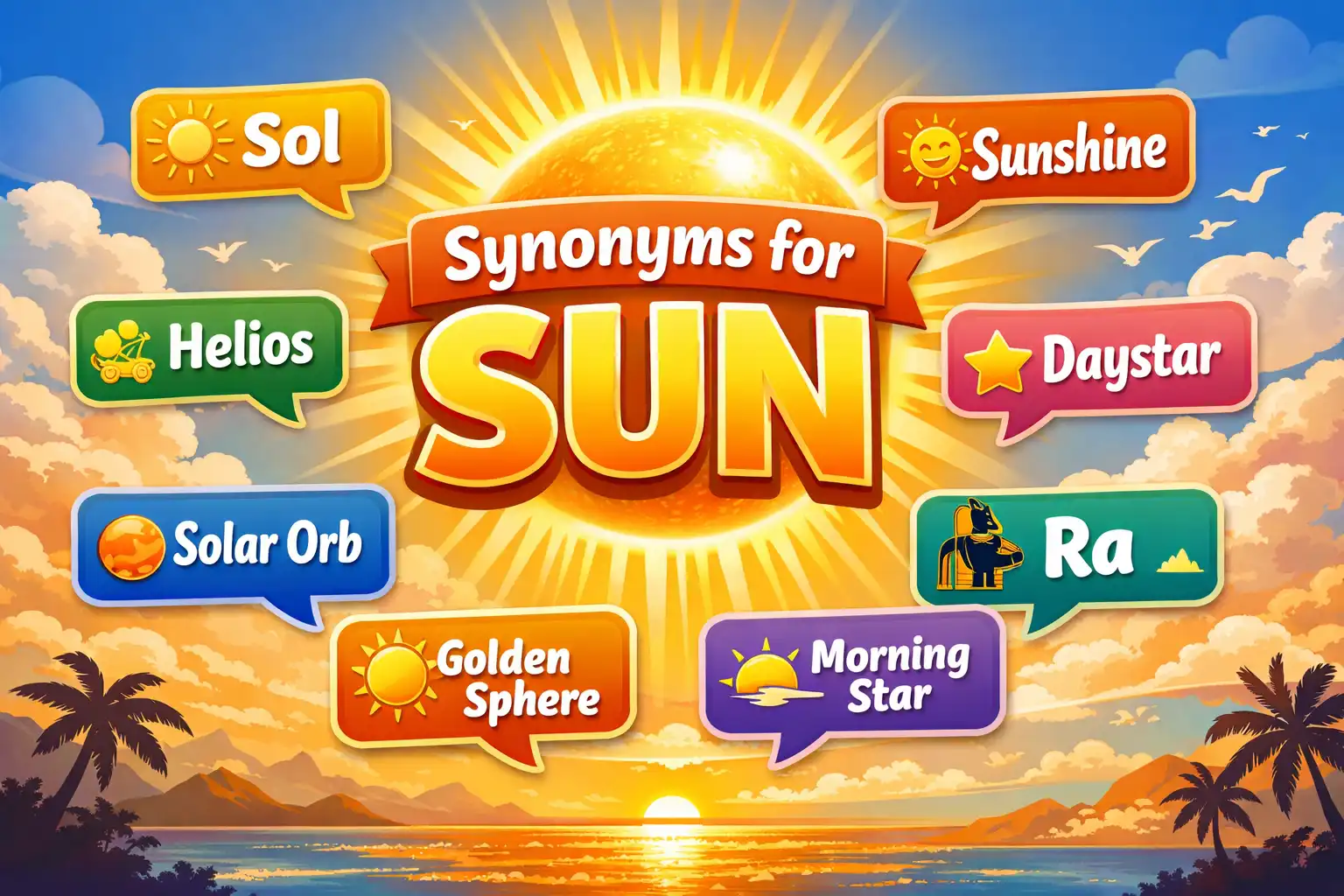
The word sun means the bright star at the center of our solar system — the one that gives us light, heat, and life every single day. Synonyms for sun are other words you can use instead of “sun” to make your writing richer and more interesting. These sun synonyms are useful when you want to describe the sun in a poem, a blog post, a story, or even a simple conversation.
Imagine you are writing a travel blog about a beach holiday. You write “the sun was bright” five times. It starts to sound boring. But if you use words like solar orb, daystar, or golden globe, your writing comes alive. That small change makes a big difference.
“The sun does not shine for a few trees and flowers, but for the wide world’s joy.” — Henry Ward Beecher
Synonyms for sun help students write better essays. They help bloggers write engaging content. They help content writers avoid repeating the same word again and again. And for daily English users, they make speech sound more natural and confident.
“Keep your face to the sunshine and you cannot see a shadow.” — Helen Keller
Connotative Meaning of “Sun”
The word sun carries warm, positive, and life-giving feelings. It often represents hope, energy, happiness, and new beginnings. In literature, the sun is a symbol of power, truth, and clarity.
Etymology of “Sun”
- Old English: sunne
- Proto-Germanic: sunnō
- Proto-Indo-European root: sóh₂wl̥
- Related to Latin: sol, Greek: hēlios
- First recorded use: before 900 AD
Pronunciation of “Sun”
- US English (IPA): /sʌn/
- UK English (IPA): /sʌn/
- Syllables: 1 (sun)
- Affixation Pattern: Base word → sunshine, sunlight, sunflower, sunburn, sundown
Comparison Table: Synonyms for Sun
| Keyword | Meaning | Usage Type | Context |
| Sun | The central star of our solar system | Neutral / Universal | Daily use, science, general writing |
| Sol | Latin name for the sun | Formal / Scientific | Astronomy, literature, poetry |
| Daystar | The sun seen as the star of daytime | Poetic / Literary | Poetry, creative writing |
| Phoebus | Greek sun god; poetic name for the sun | Poetic / Mythological | Classical poetry, mythology |
| Solar orb | The sun as a round, glowing object | Formal / Descriptive | Science writing, journalism |
| Golden globe | The sun described by its color and shape | Descriptive / Casual | Travel blogs, creative writing |
| Helios | Greek personification of the sun | Mythological | Greek mythology, literature |
| Ra | Egyptian sun god | Mythological / Cultural | History writing, cultural contexts |
| Luminary | A source of great light | Formal / Literary | Academic writing, essays |
| Fireball | The sun as an intense ball of fire | Vivid / Casual | Descriptive writing, storytelling |
| Sunlight source | The origin of sunlight | Scientific / Neutral | Educational content |
| Celestial body | Any large natural object in space | Scientific / Formal | Astronomy, research writing |
| Blazing orb | A bright, burning round object | Vivid / Emotional | Fiction, poetry |
| The great light | A grand name for the sun | Poetic / Religious | Religious texts, devotional writing |
| Golden disk | The sun shaped like a golden coin | Visual / Descriptive | Art, travel, storytelling |
50 Synonyms for Sun
1. Sol
Pronunciation: US /sɒl/ · UK /sɒl/
Meaning: Sol is the Latin name for our sun. It is often used in science and poetry to refer to the sun.
Examples:
- Sol rose above the mountains and painted the sky orange.
- Scientists use the word Sol when they study energy from our star.
2. Daystar
Pronunciation: US /ˈdeɪstɑːr/ · UK /ˈdeɪstɑː/
Meaning: Daystar is a poetic word for the sun — the brightest star we see during the day.
Examples:
- The daystar climbed high and chased away the morning chill.
- Poets have called the sun the daystar for hundreds of years.
3. Phoebus
Pronunciation: US /ˈfiːbəs/ · UK /ˈfiːbəs/
Meaning: Phoebus is an old poetic and mythological name for the sun, linked to the Greek god Apollo.
Examples:
- Phoebus spread his golden rays across the sleeping valley.
- In ancient poems, Phoebus was praised as the bringer of light.
4. Helios
Pronunciation: US /ˈhiːliˌɒs/ · UK /ˈhiːlɪɒs/
Meaning: Helios is the Greek god who personified the sun and drove a chariot of fire across the sky.
Examples:
- Helios drove his golden chariot from east to west each day.
- Greek myths describe Helios as the one who lights the whole world.
5. Ra
Pronunciation: US /rɑː/ · UK /rɑː/
Meaning: Ra is the Egyptian sun god. The Egyptians believed Ra ruled the sky and gave life to the world.
Examples:
- The ancient Egyptians built great temples to honor Ra.
- Ra was painted as a man with a sun disk on his head.
6. Luminary
Pronunciation: US /ˈluːmɪˌnɛri/ · UK /ˈluːmɪn(ə)ri/
Meaning: A luminary is a body that gives off great light. It is used for the sun in formal and literary writing.
Examples:
- The luminary above us gave warmth to every living thing on Earth.
- She described the sun as the greatest luminary in our solar system.
7. Solar orb
Pronunciation: US /ˈsoʊlər ɔːrb/ · UK /ˈsəʊlə ɔːb/
Meaning: Solar orb refers to the sun as a perfectly round, glowing ball in the sky.
Examples:
- The solar orb dipped below the sea at the end of a perfect day.
- The sailor watched the solar orb rise slowly through the morning mist.
8. Fireball
Pronunciation: US /ˈfaɪərˌbɔːl/ · UK /ˈfʌɪəbɔːl/
Meaning: Fireball describes the sun as an intense, blazing ball of fire that fills the sky with heat.
Examples:
- The fireball overhead made the desert sand too hot to walk on.
- Children ran inside when the fireball sat straight above their heads at noon.
9. Golden globe
Pronunciation: US /ˈɡoʊldən ɡloʊb/ · UK /ˈɡəʊldən ɡləʊb/
Meaning: Golden globe is a descriptive phrase for the sun based on its warm color and round shape.
Examples:
- The golden globe slipped behind the clouds and left us in soft shadow.
- She painted the golden globe in the corner of her landscape canvas.
10. Blazing orb
Pronunciation: US /ˈbleɪzɪŋ ɔːrb/ · UK /ˈbleɪzɪŋ ɔːb/
Meaning: Blazing orb describes the sun as extremely bright and intensely hot — a fiercely glowing circle.
Examples:
- The blazing orb beat down on the workers all afternoon.
- I shielded my eyes from the blazing orb as I stepped outside.
11. Celestial body
Pronunciation: US /səˈlɛstɪəl ˈbɒdi/ · UK /sɪˈlɛstɪəl ˈbɒdi/
Meaning: A celestial body is any large natural object in outer space. The sun is the most important celestial body for Earth.
Examples:
- No celestial body affects Earth’s climate more than our sun.
- The teacher explained that the sun is the nearest celestial body to our planet.
12. The great light
Pronunciation: US /ðə ɡreɪt laɪt/ · UK /ðə ɡreɪt laɪt/
Meaning: The great light is a majestic, often religious or poetic name for the sun.
Examples:
- The great light appeared on the horizon and turned the world gold.
- Ancient peoples worshipped the great light as a god of life.
13. Sunstar
Pronunciation: US /ˈsʌnstɑːr/ · UK /ˈsʌnstɑː/
Meaning: Sunstar is a creative compound word that combines sun and star to describe the sun’s nature as our nearest star.
Examples:
- The sunstar warmed the earth after a long and cold night.
- She wrote a children’s story where the sunstar smiled down on the village.
14. Star of day
Pronunciation: US /stɑːr əv deɪ/ · UK /stɑː əv deɪ/
Meaning: Star of day is a poetic phrase for the sun — the one star that appears when daylight comes.
Examples:
- The star of day broke through the clouds after a week of rain.
- Sailors once used the star of day to find their direction at sea.
15. Golden disk
Pronunciation: US /ˈɡoʊldən dɪsk/ · UK /ˈɡəʊldən dɪsk/
Meaning: Golden disk describes the sun as a flat, golden circle — the way it appears in the sky.
Examples:
- The golden disk hung low over the hills during the harvest season.
- The artist carved a golden disk in stone to represent the sun god.
16. Titan
Pronunciation: US /ˈtaɪtən/ · UK /ˈtaɪt(ə)n/
Meaning: Titan is a poetic name for the sun, borrowed from the Titans of Greek mythology — powerful ancient gods.
Examples:
- The Titan blazed above the valley, melting the morning frost.
- Poets once called the sun the great Titan of the heavens.
17. Apollo
Pronunciation: US /əˈpɒloʊ/ · UK /əˈpɒləʊ/
Meaning: Apollo is the Greek and Roman god of the sun. His name is often used in literature to mean the sun itself.
Examples:
- Apollo’s light flooded through the open window each morning.
- The poem praised Apollo for warming the cold, dark earth.
18. Sunlight
Pronunciation: US /ˈsʌnlaɪt/ · UK /ˈsʌnlaɪt/
Meaning: Sunlight is the light that comes from the sun. It is also used to refer to the sun itself when describing its glow.
Examples:
- She sat in the warm sunlight and read her book for hours.
- The garden thrived because sunlight poured in all day long.
19. Sunshine
Pronunciation: US /ˈsʌnʃaɪn/ · UK /ˈsʌnʃʌɪn/
Meaning: Sunshine means the direct light and warmth of the sun shining from a clear sky.
Examples:
- The children laughed and played in the afternoon sunshine.
- After the storm, sunshine returned and made everything sparkle.
20. Radiant orb
Pronunciation: US /ˈreɪdiənt ɔːrb/ · UK /ˈreɪdɪənt ɔːb/
Meaning: Radiant orb is a formal and poetic phrase for the sun that emphasizes its glowing brightness.
Examples:
- The radiant orb appeared above the clouds and lit the whole mountain.
- She described the sunset as the radiant orb touching the edge of the sea.
21. Sunbeam source
Pronunciation: US /ˈsʌnbiːm sɔːrs/ · UK /ˈsʌnbiːm sɔːs/
Meaning: Sunbeam source refers to the sun as the origin of all sunbeams and rays of light.
Examples:
- The sunbeam source gave life to every plant in the field.
- Without the sunbeam source, the forest floor would stay cold and dark.
22. Solar flame
Pronunciation: US /ˈsoʊlər fleɪm/ · UK /ˈsəʊlə fleɪm/
Meaning: Solar flame describes the burning, fiery energy that the sun produces and sends outward into space.
Examples:
- Scientists study solar flames to understand how the sun affects Earth’s weather.
- The solar flame lit the upper atmosphere in beautiful colors during sunrise.
23. Noon star
Pronunciation: US /nuːn stɑːr/ · UK /nuːn stɑː/
Meaning: Noon star is a poetic phrase for the sun that highlights how it sits at its highest point at midday.
Examples:
- The noon star burned directly above the market square.
- Farmers rested under shade trees when the noon star climbed high.
24. Light of the world
Pronunciation: US /laɪt əv ðə wɜːrld/ · UK /laɪt əv ðə wɜːld/
Meaning: Light of the world is a deeply meaningful phrase for the sun, often used in religious, poetic, and philosophical writing.
Examples:
- The light of the world rose slowly and turned the river to gold.
- Ancient civilizations praised the light of the world in their morning prayers.
25. Burning star
Pronunciation: US /ˈbɜːrnɪŋ stɑːr/ · UK /ˈbɜːnɪŋ stɑː/
Meaning: Burning star is a vivid description of the sun as a star constantly on fire — which it truly is.
Examples:
- The burning star dried every puddle in the road by mid-morning.
- She gazed at the burning star and felt grateful for its warmth.
26. Heavenly fire
Pronunciation: US /ˈhɛvənli ˈfaɪər/ · UK /ˈhɛv(ə)nli ˈfʌɪə/
Meaning: Heavenly fire is a dramatic and poetic phrase that describes the sun as a divine, celestial source of fire.
Examples:
- The heavenly fire set the clouds ablaze with shades of red and orange.
- Old texts described lightning and sunlight both as forms of heavenly fire.
27. Star of stars
Pronunciation: US /stɑːr əv stɑːrz/ · UK /stɑː əv stɑːz/
Meaning: Star of stars is a superlative phrase for the sun, emphasizing that it is the greatest and most important star in our sky.
Examples:
- The ancient Egyptians called the sun the star of stars in their hymns.
- The star of stars gives more energy in one second than all the other stars visible at night.
28. Dazzling sphere
Pronunciation: US /ˈdæzlɪŋ sfɪr/ · UK /ˈdæzlɪŋ sfɪə/
Meaning: Dazzling sphere describes the sun as a blindingly bright, perfectly round object in the sky.
Examples:
- The dazzling sphere reflected off the lake and made everyone squint.
- She wrote about the dazzling sphere emerging from behind the mountains.
29. Glowing orb
Pronunciation: US /ˈɡloʊɪŋ ɔːrb/ · UK /ˈɡləʊɪŋ ɔːb/
Meaning: Glowing orb describes the sun as a softly luminous, warm ball of light — especially used at dawn or dusk.
Examples:
- The glowing orb rose slowly above the rooftops and filled the street with warm light.
- At sunset, the glowing orb turned the whole sky into a painting.
30. Soleil
Pronunciation: US /sɒˈleɪ/ · UK /sɒˈleɪ/
Meaning: Soleil is the French word for sun, often used in English creative writing to add elegance or romance.
Examples:
- She named her café Soleil because it always felt warm and full of light.
- The painting showed a golden soleil rising above a lavender field.
31. Helio
Pronunciation: US /ˈhiːlɪoʊ/ · UK /ˈhiːlɪəʊ/
Meaning: Helio is a prefix and informal shorthand for the sun, derived from the Greek word for sun (helios).
Examples:
- The word heliocentric means the sun is at the center of our solar system.
- She named her solar energy company Helio to celebrate the power of the sun.
32. Brilliant orb
Pronunciation: US /ˈbrɪljənt ɔːrb/ · UK /ˈbrɪlɪənt ɔːb/
Meaning: Brilliant orb is a descriptive phrase for the sun that highlights its intense brightness and perfectly round shape.
Examples:
- The brilliant orb hung motionless in the clear blue afternoon sky.
- He described the eclipse as the moment the moon covered the brilliant orb.
33. Solar body
Pronunciation: US /ˈsoʊlər ˈbɒdi/ · UK /ˈsəʊlə ˈbɒdi/
Meaning: Solar body is a scientific phrase that describes the sun as the primary body in our solar system.
Examples:
- The solar body at the center of our system contains 99% of all its mass.
- Every planet revolves around the solar body in an orbit of its own.
34. Titan of the sky
Pronunciation: US /ˈtaɪtən əv ðə skaɪ/ · UK /ˈtaɪt(ə)n əv ðə skaɪ/
Meaning: Titan of the sky is a grand, poetic phrase for the sun that gives it the status of a giant, powerful ruler above us.
Examples:
- The titan of the sky melted the snow from the hills within hours.
- Poets have long called the sun the titan of the sky.
35. Celestial fire
Pronunciation: US /səˈlɛstɪəl ˈfaɪər/ · UK /sɪˈlɛstɪəl ˈfʌɪə/
Meaning: Celestial fire is a poetic and powerful phrase that describes the sun as divine fire burning in the heavens above.
Examples:
- The celestial fire warmed the frozen ground and woke the sleeping seeds.
- Ancient myths described lightning as a fragment of celestial fire.
36. Shining star
Pronunciation: US /ˈʃaɪnɪŋ stɑːr/ · UK /ˈʃʌɪnɪŋ stɑː/
Meaning: Shining star is a warm and simple phrase that describes the sun as the brightest and most visible star in our sky.
Examples:
- The shining star appeared through the clouds after three days of rain.
- Children drew the shining star in the corner of every picture.
37. Burning globe
Pronunciation: US /ˈbɜːrnɪŋ ɡloʊb/ · UK /ˈbɜːnɪŋ ɡləʊb/
Meaning: Burning globe describes the sun as a round, fiercely hot object constantly on fire.
Examples:
- The burning globe hung overhead and turned the sand into an oven.
- She described the August afternoon as if the burning globe had forgotten to move.
38. Solaris
Pronunciation: US /soʊˈlɛrɪs/ · UK /sɒˈlɑːrɪs/
Meaning: Solaris is a Latin-rooted word meaning “of or relating to the sun.” It is used in literary and science fiction contexts.
Examples:
- The film Solaris used the sun as a symbol for the unknown.
- She named her solar panel brand Solaris to reflect its purpose.
39. Lightgiver
Pronunciation: US /ˈlaɪtˌɡɪvər/ · UK /ˈlaɪtˌɡɪvə/
Meaning: Lightgiver is a creative compound word for the sun, emphasizing its role as the provider of all natural light on Earth.
Examples:
- The ancient tribe worshipped the lightgiver every morning at dawn.
- She called the sun the lightgiver in her devotional poetry.
40. Life-giver
Pronunciation: US /ˈlaɪfˌɡɪvər/ · UK /ˈlaɪfˌɡɪvə/
Meaning: Life-giver is a meaningful name for the sun that highlights its role in making all life on Earth possible.
Examples:
- Without the life-giver above us, the planet would be frozen and dark.
- Farmers often called the sun the life-giver because it made their crops grow.
41. Glorious star
Pronunciation: US /ˈɡlɔːriəs stɑːr/ · UK /ˈɡlɔːrɪəs stɑː/
Meaning: Glorious star is an admiring and poetic phrase for the sun that praises its splendor and beauty.
Examples:
- The glorious star painted the morning sky in shades of pink and gold.
- She ended her prayer with thanks to the glorious star above.
42. Warmth-bringer
Pronunciation: US /wɔːrmθˈbrɪŋər/ · UK /wɔːmθˈbrɪŋə/
Meaning: Warmth-bringer is a descriptive compound word for the sun that focuses on the heat and comfort it provides.
Examples:
- After a long winter, the warmth-bringer finally returned.
- Children stretched their arms out to greet the warmth-bringer on the first spring day.
43. Solar disk
Pronunciation: US /ˈsoʊlər dɪsk/ · UK /ˈsəʊlə dɪsk/
Meaning: Solar disk is a precise, visual phrase for the sun — describing it exactly as it appears: a flat, glowing circle in the sky.
Examples:
- The solar disk was framed perfectly between two mountain peaks at noon.
- Scientists measured the size of the solar disk to calculate Earth’s distance from the sun.
44. Fiery globe
Pronunciation: US /ˈfaɪəri ɡloʊb/ · UK /ˈfʌɪəri ɡləʊb/
Meaning: Fiery globe is a vivid and energetic phrase for the sun that stresses its intense, burning nature.
Examples:
- The fiery globe above the desert made every step feel like a struggle.
- The horizon caught fire as the fiery globe dipped below the ocean.
45. Surya
Pronunciation: US /ˈsuːrjə/ · UK /ˈsuːrjə/
Meaning: Surya is the Sanskrit and Hindu name for the sun god — one of the most important deities in ancient Indian culture.
Examples:
- Surya is worshipped every morning in many Hindu households.
- The poet called the sun Surya to honor the ancient tradition of sun worship.
46. Orb of day
Pronunciation: US /ɔːrb əv deɪ/ · UK /ɔːb əv deɪ/
Meaning: Orb of day is a classical English phrase for the sun, used widely in older literature and poetry to describe it as the glowing ball of daytime.
Examples:
- The orb of day climbed steadily until it stood directly above the cathedral.
- Shakespeare-era poets often referred to the sun as the orb of day.
47. Helios-fire
Pronunciation: US /ˈhiːliˌɒs ˈfaɪər/ · UK /ˈhiːlɪɒs ˈfʌɪə/
Meaning: Helios-fire is a creative mythological phrase combining the Greek sun god’s name with the element of fire, describing the sun’s burning energy.
Examples:
- She wrote about Helios-fire pouring over the hills at sunrise.
- The ancient Greeks said Helios-fire kept the world alive through every winter.
48. Lamp of heaven
Pronunciation: US /læmp əv ˈhɛvən/ · UK /læmp əv ˈhɛv(ə)n/
Meaning: Lamp of heaven is a beautiful, spiritual phrase for the sun — describing it as a light that hangs in the sky like a great lamp above the earth.
Examples:
- The lamp of heaven flickered through the forest leaves and warmed her face.
- Old English poets called the sun the lamp of heaven in their verses.
49. King of the sky
Pronunciation: US /kɪŋ əv ðə skaɪ/ · UK /kɪŋ əv ðə skaɪ/
Meaning: King of the sky is a majestic and authoritative phrase for the sun — treating it as the ruler and most powerful presence in the sky above.
Examples:
- The king of the sky announced the new day with a burst of golden light.
- She told her daughter that the king of the sky watched over everyone.
50. Light of life
Pronunciation: US /laɪt əv laɪf/ · UK /laɪt əv laɪf/
Meaning: Light of life is a deeply meaningful phrase for the sun that links its light directly to the existence and survival of all living things.
Examples:
- Without the light of life above us, no tree, flower, or creature would survive.
- She began her morning meditation by greeting the light of life as it rose.
“In the middle of difficulty lies opportunity — and in the middle of the sky lies the sun, reminding us both are always there.” — adapted from Albert Einstein
Antonyms of Sun
| Antonym | Meaning |
| Darkness | Complete absence of light |
| Shadow | A dark area where light is blocked |
| Night | The period without sunlight |
| Moon | The body that reflects light at night |
| Eclipse | When the sun’s light is temporarily blocked |
| Blackout | A total loss of light |
| Void | An empty, lightless space |
Prototype Meaning and Categorization of “Sun”
Prototype: The sun is the prototypical light source — the original and most powerful natural provider of light and heat that humans have ever known.
Categories:
- Astronomical category: The sun is a G-type main-sequence star (G2V).
- Mythological category: Worshipped as Ra (Egyptian), Helios (Greek), Surya (Hindu), Apollo (Roman).
- Poetic category: Metaphor for hope, joy, power, and truth.
- Scientific category: The center of our solar system; provides 99.86% of the solar system’s total mass.
- Symbolic category: In many cultures, the sun symbolizes life, energy, clarity, and divine power.
FAQs About Synonyms for Sun
1. What is the most poetic synonym for sun? Daystar and Lamp of heaven are among the most poetic synonyms for sun. They carry a lyrical, timeless quality perfect for poems and literary essays.
2. What is the scientific name for the sun? In science, the sun is often called Sol (its Latin name) or referred to as a G-type main-sequence star. The phrase solar orb and celestial body are also used in formal scientific writing.
3. What are some short synonyms for sun? Short and simple synonyms include Sol, Ra, Helio, and Orb. These are easy to use in headlines and creative writing.
4. Which sun synonym is best for creative writing? Blazing orb, golden globe, lamp of heaven, and Phoebus all work beautifully in creative writing. They add color, emotion, and imagery to any story or poem.
5. Why should I learn synonyms for sun? Learning synonyms for sun makes your writing more varied and engaging. Instead of repeating “sun” every few lines, you can choose a word that fits your tone — formal, poetic, casual, or scientific.
6. Are these sun synonyms used in everyday English? Some, like sunshine and sunlight, are used every day. Others, like Phoebus or Surya, are more specialized for poetry, mythology, or cultural writing. Knowing both types makes you a more versatile writer.
7. Which sun synonym is best for a travel blog? Golden globe, glowing orb, sunshine, and blazing orb are great for travel blogs. They paint a vivid picture for the reader and bring the destination to life.
Conclusion
Learning synonyms for sun is one of the smartest things you can do as a writer, student, or daily English user. When you know many different ways to say the same word, your writing becomes fresh, powerful, and far more enjoyable to read.
Think about it this way: if you are writing a blog post about a summer road trip, using blazing orb, golden globe, and lamp of heaven instead of repeating “sun” three times makes every sentence feel alive. Your reader stays interested. Your content feels original.
“A word is worth a thousand pictures — if you choose the right one.”
Practice these synonyms in your emails, your stories, your morning journal, and your conversations. The more you use them, the more natural they will feel. You do not need to memorize all 50 at once. Start with five. Use them for a week. Then add five more.
“Expand your vocabulary, and you expand your world.”
Every word you learn is a tool. And with 50 powerful synonyms for sun now in your hands, your writing can shine just as brightly as the daystar itself.
“The sun never says to the earth, ‘You owe me.’ Look what happens with a love like that — it lights the whole world.” — Hafiz

Robert Hayes is an ESL educator and curriculum developer with over nine years of experience teaching English to beginners and intermediate learners across multiple countries ( Biography ).