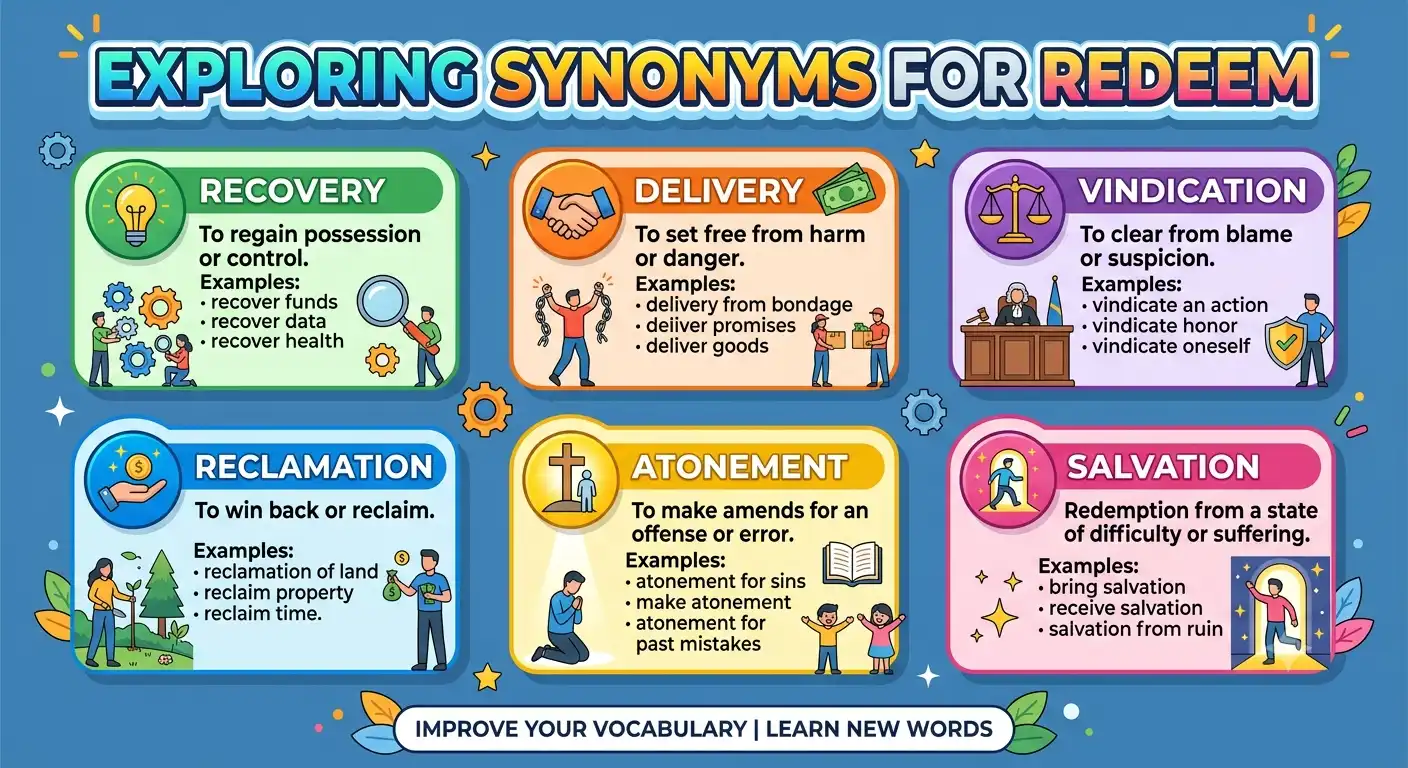
Learning accurate synonyms for redeem helps you describe getting things back, exchanging coupons, or fixing past mistakes with clear precision. When you master different synonyms for redeem, your daily writing and speaking become much more natural and effective. Choosing the right synonyms for redeem allows you to avoid repeating the same word in school essays, business emails, and casual conversations.
Imagine walking up to a coffee shop counter with a paper coupon in your hand. You hand the card to the cashier, and she gives you a fresh hot drink for free. You traded a small piece of paper for something real and valuable. This simple moment is a clear real-life example of how people use the word redeem in everyday life.
In plain English, the word redeem means to trade something in for a reward, to get something back, or to fix a bad situation through good actions. Expanding your vocabulary with strong synonyms gives every English communicator a big advantage:
- Students: Improve classroom essays and test scores by using exact descriptive words.
- Bloggers: Keep your website readers active with fresh and engaging sentence structures.
- Content Writers: Write clear product reviews, marketing offers, and strong headline calls to action.
- Daily English Users: Talk about store rewards, personal choices, and second chances with natural confidence.
“Every mistake is an opportunity to redeem yourself through better choices tomorrow.” – Unknown
“A gift card holds no value until you step forward to redeem its promise.” – Business Saying
Technical & Linguistic Breakdown of “Redeem”
Connotative Meaning
The word redeem carries a positive and restorative connotation. It suggests recovery, improvement, saving value, or earning back trust after a loss. Depending on context, it can describe business reward trades, emotional forgiveness, or financial debt payments.
Etymology of “Redeem”
- Latin Roots: Derived from the Latin verb redimere (meaning “to buy back” or “to ransom”).
- Prefix Component: Built from re- (meaning “back” or “again”).
- Base Verb Component: Combined with emere (meaning “to buy” or “to gain”).
- Middle English Entry: Entered English in the 14th century through Old French redimer, initially used for freeing captives and clearing financial debts.
- Modern Role: Functions as a primary verb across business, everyday speech, law, and literature.
Pronunciation (IPA)
- US IPA: /rɪˈdiːm/
- UK IPA: /rɪˈdiːm/
Syllables & Structure
- Syllables: 2 Syllables (re – deem)
- Stress Pattern: Primary stress on the second syllable (re-DEEM).
Affixation Pattern
- Base Form: Verb (redeem)
- Present Participle: Redeeming
- Past Tense / Participle: Redeemed
- Noun Form: Redemption
- Adjective Form: Redeemable / Redeeming
Quick Comparison Table of Key Synonyms
| Keyword | Meaning | Usage Type | Context |
| Recover | To get back something that was lost or taken | Everyday / Formal | Lost items, health, lost money |
| Reclaim | To demand or take back what belongs to you | Formal / Legal | Property, lost rights, land |
| Cash in | To exchange a ticket or voucher for money or goods | Casual / Business | Gift cards, poker chips, coupons |
| Restore | To bring something back to its original good state | Formal / Emotional | Trust, old buildings, peace |
| Atone | To make up for a past mistake or wrong action | Emotional / Moral | Apologies, relationships, moral errors |
| Retrieve | To find and bring something back from a place | Neutral / Technical | Data files, fetched balls, lost objects |
| Offset | To balance a loss with an equal good effect | Professional / Business | Costs, carbon footprint, errors |
| Liberate | To set someone or something free from control | Formal / Historical | Prisoners, captive animals, nations |
50 Best Synonyms for Redeem
1. Recover
- Pronunciation: US: /rɪˈkʌv.ɚ/ | UK: /rɪˈkʌv.ə/
- Meaning: To get back something that was lost, stolen, or misplaced.
- Examples:
- He managed to recover his lost wallet at the bus station.
- The team worked hard to recover their stolen equipment.
2. Reclaim
- Pronunciation: US: /rɪˈkleɪm/ | UK: /rɪˈkleɪm/
- Meaning: To demand or take back something that belongs to you.
- Examples:
- She went to the lost office to reclaim her coat.
- Farmers plan to reclaim the dry land for planting.
3. Save
- Pronunciation: US: /seɪv/ | UK: /seɪv/
- Meaning: To rescue someone or keep something safe from harm.
- Examples:
- The brave firefighter helped to save the little kitten.
- Good choices will save you from future trouble.
4. Restore
- Pronunciation: US: /rɪˈstɔːr/ | UK: /rɪˈstɔː/
- Meaning: To bring something back to its original good condition.
- Examples:
- The quiet talk helped restore peace between the brothers.
- Workers plan to restore the old wooden house.
5. Retrieve
- Pronunciation: US: /rɪˈtriːv/ | UK: /rɪˈtriːv/
- Meaning: To find and bring something back from a specific place.
- Examples:
- The dog ran fast to retrieve the yellow ball.
- I need to retrieve my files from the laptop.
6. Cash in
- Pronunciation: US: /kæʃ ɪn/ | UK: /kæʃ ɪn/
- Meaning: To trade a paper voucher or ticket for real money or goods.
- Examples:
- You can cash in your reward tickets at the store counter.
- He decided to cash in his winning game prize today.
7. Exchange
- Pronunciation: US: /ɪksˈtʃeɪndʒ/ | UK: /ɪksˈtʃeɪndʒ/
- Meaning: To give one thing in return for another item.
- Examples:
- I want to exchange this shirt for a larger size.
- Kids like to exchange lunch snacks at school.
8. Rescue
- Pronunciation: US: /ˈres.kjuː/ | UK: /ˈres.kjuː/
- Meaning: To save someone from a dangerous or difficult situation.
- Examples:
- The team arrived quickly to rescue the lost hikers.
- A warm coat will rescue you from the freezing wind.
9. Compensate
- Pronunciation: US: /ˈkɑːm.pən.seɪt/ | UK: /ˈkɒm.pən.seɪt/
- Meaning: To pay money or provide something good to make up for a loss.
- Examples:
- The airline will compensate travelers for the delayed flight.
- Extra effort can compensate for a slow start.
10. Repurchase
- Pronunciation: US: /riːˈpɝː.tʃəs/ | UK: /riːˈpɜː.tʃəs/
- Meaning: To buy back an item that you owned before.
- Examples:
- The company decided to repurchase its shares.
- He hoped to repurchase his old childhood bicycle.
11. Offset
- Pronunciation: US: /ˌɑːfˈset/ | UK: /ˈɒf.set/
- Meaning: To balance the effect of something by using an opposite force.
- Examples:
- New solar panels will offset our electric bill costs.
- High sales in summer offset slow winter earnings.
12. Clear
- Pronunciation: US: /klɪr/ | UK: /klɪə/
- Meaning: To pay off a debt or prove that someone is innocent.
- Examples:
- He worked extra hours to clear his bank debt.
- New facts helped clear his name after the mistake.
13. Deliver
- Pronunciation: US: /dɪˈlɪv.ɚ/ | UK: /dɪˈlɪv.ə/
- Meaning: To set free or hand over what was promised.
- Examples:
- The leader promised to deliver the people from danger.
- Store drivers will deliver your package tomorrow.
14. Make up for
- Pronunciation: US: /meɪk ʌp fɔːr/ | UK: /meɪk ʌp fɔː/
- Meaning: To do something good to replace what was lost or damaged.
- Examples:
- She brought flowers to make up for being late.
- Hard work today will make up for lost time.
15. Vindicate
- Pronunciation: US: /ˈvɪn.də.keɪt/ | UK: /ˈvɪn.dɪ.keɪt/
- Meaning: To prove that someone was right or innocent after doubt.
- Examples:
- The test results helped vindicate her science theory.
- He needed clear proof to vindicate his good reputation.
16. Atone
- Pronunciation: US: /əˈtoʊn/ | UK: /əˈtəʊn/
- Meaning: To do something right to show sorrow for a past mistake.
- Examples:
- He tried to atone for his rudeness by sending a note.
- She wanted to atone for forgetting his birthday.
17. Absolve
- Pronunciation: US: /əbˈzɑːlv/ | UK: /əbˈzɒlv/
- Meaning: To state formally that someone is free from blame or guilt.
- Examples:
- The judge decided to absolve the driver of blame.
- A sincere apology can absolve simple mistakes.
18. Liberate
- Pronunciation: US: /ˈlɪb.ə.reɪt/ | UK: /ˈlɪb.ə.reɪt/
- Meaning: To set a person or place free from hard control.
- Examples:
- Soldiers fought to liberate the small town.
- New tools can liberate workers from boring tasks.
19. Free
- Pronunciation: US: /friː/ | UK: /friː/
- Meaning: To release someone from traps, rules, or limits.
- Examples:
- Please free the bird from the tangled net.
- Finishing your homework will free your weekend time.
20. Buy back
- Pronunciation: US: /baɪ bæk/ | UK: /baɪ bæk/
- Meaning: To pay money to get an item back from a seller.
- Examples:
- The shop owner offered to buy back the old guitar.
- He saved money to buy back his family ring.
21. Regain
- Pronunciation: US: /rɪˈɡeɪn/ | UK: /rɪˈɡeɪn/
- Meaning: To take or get back something you lost earlier.
- Examples:
- Rest helped the runner regain her energy.
- The team worked hard to regain first place.
22. Ransom
- Pronunciation: US: /ˈræn.səm/ | UK: /ˈræn.səm/
- Meaning: To pay money to set a captive person free.
- Examples:
- They paid a fee to ransom the captured boat.
- Historical kings used gold to ransom prisoners.
23. Discharge
- Pronunciation: US: /dɪsˈtʃɑːrdʒ/ | UK: /dɪsˈtʃɑːdʒ/
- Meaning: To complete a duty or pay off a debt fully.
- Examples:
- He paid cash to discharge his final loan balance.
- She did discharge her duties with great care.
24. Satisfy
- Pronunciation: US: /ˈsæt̬.ɪs.faɪ/ | UK: /ˈsæt.ɪs.faɪ/
- Meaning: To fulfill a need, claim, or rule completely.
- Examples:
- This payment will satisfy your store bill.
- Clean work will satisfy your teacher’s rules.
25. Fulfill
- Pronunciation: US: /fʊlˈfɪl/ | UK: /fʊlˈfɪl/
- Meaning: To carry out a promise, duty, or contract.
- Examples:
- He worked hard to fulfill his goal of graduating.
- The store will fulfill your online order today.
26. Balance
- Pronunciation: US: /ˈbæl.əns/ | UK: /ˈbæl.əns/
- Meaning: To make things equal so no side has a big advantage.
- Examples:
- You must balance your study time with good sleep.
- A healthy lunch helps balance your daily energy.
27. Recoup
- Pronunciation: US: /rɪˈkuːp/ | UK: /rɪˈkuːp/
- Meaning: To get back money that was spent or lost earlier.
- Examples:
- The movie hopes to recoup its production cost.
- He worked extra days to recoup his vacation spend.
28. Reinstate
- Pronunciation: US: /ˌriː.ɪnˈsteɪt/ | UK: /ˌriː.ɪnˈsteɪt/
- Meaning: To place someone back into their former job or position.
- Examples:
- The manager decided to reinstate the worker today.
- School board members voted to reinstate the sports program.
29. Revive
- Pronunciation: US: /rɪˈvaɪv/ | UK: /rɪˈvaɪv/
- Meaning: To bring something back to life, health, or active use.
- Examples:
- Fresh water will revive the thirsty garden flowers.
- Cold water helped to revive the tired runner.
“True success is not avoiding failure, but learning how to redeem every stumble into strength.” – Anonymous
30. Expiate
- Pronunciation: US: /ˈek.spi.eɪt/ | UK: /ˈek.spi.eɪt/
- Meaning: To make amends or suffer punishment for a wrongdoing.
- Examples:
- He sought to expiate his guilt by giving to charity.
- Community service helped him expiate his minor crime.
31. Extricate
- Pronunciation: US: /ˈek.strə.keɪt/ | UK: /ˈek.strɪ.keɪt/
- Meaning: To free someone or something from a hard trap or trouble.
- Examples:
- He managed to extricate his foot from the thick mud.
- She tried to extricate herself from the silly debate.
32. Cash out
- Pronunciation: US: /kæʃ aʊt/ | UK: /kæʃ aʊt/
- Meaning: To convert game points or investments into actual cash.
- Examples:
- The player chose to cash out after winning the game.
- You can cash out your reward points on the app.
33. Trade in
- Pronunciation: US: /treɪd ɪn/ | UK: /treɪd ɪn/
- Meaning: To give an old item as part of payment for a new one.
- Examples:
- I plan to trade in my old phone for a new model.
- They will trade in their family car next month.
34. Swap
- Pronunciation: US: /swɑːp/ | UK: /swɒp/
- Meaning: To give one thing to someone and receive another item in return.
- Examples:
- Let us swap seats so you can see the board.
- Friends like to swap storybooks on weekends.
35. Convert
- Pronunciation: US: /kənˈvɝːt/ | UK: /kənˈvɜːt/
- Meaning: To change something from one form or purpose into another.
- Examples:
- You can convert your travel points into flight tickets.
- The machine will convert sun light into power.
36. Turn in
- Pronunciation: US: /tɝːn ɪn/ | UK: /tɜːn ɪn/
- Meaning: To hand over a coupon, paper, or item to an authority.
- Examples:
- Please turn in your ticket at the cinema door.
- Students must turn in their test sheets now.
37. Honor
- Pronunciation: US: /ˈɑː.nɚ/ | UK: /ˈɒn.ə/
- Meaning: To accept and fulfill a deal, check, or promise.
- Examples:
- The store will honor this discount card all week.
- Bank clerks will honor your signed payment check.
38. Settle
- Pronunciation: US: /ˈset̬.əl/ | UK: /ˈset.əl/
- Meaning: To pay off a bill or bring an argument to a peaceful end.
- Examples:
- He paid online to settle his monthly phone bill.
- Both sides met to settle their business disagreement.
39. Pay off
- Pronunciation: US: /peɪ ɑːf/ | UK: /peɪ ɒf/
- Meaning: To finish paying all the money that you owe.
- Examples:
- They worked hard to pay off their house loan.
- Daily practice will pay off with great test results.
40. Rehabilitate
- Pronunciation: US: /ˌriː.həˈbɪl.ə.teɪt/ | UK: /ˌriː.həˈbɪl.ɪ.teɪt/
- Meaning: To restore someone or something to good health or respect.
- Examples:
- Exercises helped rehabilitate his injured leg.
- The town plans to rehabilitate the old central park.
41. Fetch back
- Pronunciation: US: /fetʃ bæk/ | UK: /fetʃ bæk/
- Meaning: To go somewhere, pick up an item, and return with it.
- Examples:
- Please go to the desk to fetch back my book.
- He ran home to fetch back his forgotten coat.
42. Win back
- Pronunciation: US: /wɪn bæk/ | UK: /wɪn bæk/
- Meaning: To earn back someone’s trust, love, or lost victory.
- Examples:
- She worked hard to win back her best friend’s trust.
- The team tried to win back the championship trophy.
43. Counterbalance
- Pronunciation: US: /ˌkaʊn.t̬ɚˈbæl.əns/ | UK: /ˌkaʊn.təˈbæl.əns/
- Meaning: To act with equal power against something to maintain balance.
- Examples:
- Good deeds can counterbalance past careless choices.
- Heavy weights help counterbalance the long crane arm.
44. Make good
- Pronunciation: US: /meɪk ɡʊd/ | UK: /meɪk ɡʊd/
- Meaning: To fulfill a promise or pay back a financial loss.
- Examples:
- He promised to make good on his pledge to help.
- The store owner will make good on the damaged item.
45. Re-earn
- Pronunciation: US: /riː ɝːn/ | UK: /riː ɜːn/
- Meaning: To earn something again through hard effort.
- Examples:
- Honest actions helped him re-earn his team’s respect.
- She had to re-earn her driving privilege after the test.
46. Reacquire
- Pronunciation: US: /ˌriː.əˈkwaɪɚ/ | UK: /ˌriː.əˈkwaɪə/
- Meaning: To get possession of something again after losing it.
- Examples:
- The collector hoped to reacquire the rare stamp.
- The company worked to reacquire its original building.
47. Re-establish
- Pronunciation: US: /ˌriː.ɪˈstæb.lɪʃ/ | UK: /ˌriː.ɪˈstæb.lɪʃ/
- Meaning: To build or set up a system or relationship again.
- Examples:
- Phone calls helped re-establish their old friendship.
- They want to re-establish strong trade between cities.
48. Exculpate
- Pronunciation: US: /ˈek.skəl.peɪt/ | UK: /ˈek.skəl.peɪt/
- Meaning: To show or prove that someone is not guilty of a crime.
- Examples:
- Video records helped exculpate the innocent driver.
- The new evidence will exculpate him from all blame.
49. Salvage
- Pronunciation: US: /ˈsæl.vɪdʒ/ | UK: /ˈsæl.vɪdʒ/
- Meaning: To save useful parts or value from a ruined situation.
- Examples:
- Drivers tried to salvage goods from the damaged car.
- We managed to salvage our weekend trip despite rain.
50. Re-collect
- Pronunciation: US: /ˌriː.kəˈlekt/ | UK: /ˌriː.kəˈlekt/
- Meaning: To gather up things that were scattered or lost.
- Examples:
- He had to re-collect his dropped paper notes.
- She paused to re-collect her calm thoughts after the shock.
Antonyms of “Redeem”
Understanding direct opposites of “redeem” helps you describe loss, forfeit, or failure to fulfill agreements:
- Forfeit: To lose or give up something as a penalty for a mistake.
- Abandon: To leave something behind completely without trying to save it.
- Lose: To fail to keep or maintain a valuable possession or right.
- Default: To fail to fulfill an agreement or pay back a debt on time.
- Squander: To waste money, time, or opportunity in a silly way.
- Pawn: To pledge an object for a quick loan with a risk of losing it forever.
Prototype Meaning and Categorization of Redeem
To master these synonyms for redeem, it helps to organize these terms into distinct categories based on financial transactions, personal growth, freedom, and emotional recovery:
Core Prototype Definition
At its core, “redeem” represents any action where a person exchanges an item of symbolic value (like a coupon, ticket, or promise) for real value, or performs an action that restores lost trust, value, or freedom.
1. Financial & Commercial Exchanges
This category covers terms used when trading vouchers, paying debts, or cashing in reward points.
- Primary Focus: Store transactions, banking, rewards, and retail deals.
- Key Synonyms: Cash in, exchange, repurchase, trade in, cash out, turn in, honor, settle, pay off.
- Common Contexts: Grocery shopping, app reward points, bank payments, and retail deals.
2. Physical Recovery & Retrieval
This category includes terms used when getting back lost objects, property, or physical items.
- Primary Focus: Finding lost items, gathering property, and taking back possessions.
- Key Synonyms: Recover, reclaim, retrieve, buy back, regain, fetch back, reacquire, salvage, re-collect.
- Common Contexts: Lost-and-found offices, police property claims, and personal item searches.
3. Moral & Emotional Restoration
These words apply when fixing past mistakes, earning back trust, or apologetically making things right.
- Primary Focus: Personal relationships, apologies, reputation repair, and moral duty.
- Key Synonyms: Restore, compensate, make up for, atone, expiate, win back, make good, re-earn, counterbalance.
- Common Contexts: Family apologies, repairing broken trust, and fixing work errors.
4. Legal & Freedom Release
This category features terms that describe freeing captives, clearing blame, or discharging official duties.
- Primary Focus: Justice, legal exoneration, setting free, and clearing debt duties.
- Key Synonyms: Save, rescue, deliver, vindicate, absolve, liberate, free, ransom, discharge, exculpate.
- Common Contexts: Court rulings, historical rescues, legal contracts, and clearing personal records.
Frequently Asked Questions (FAQs)
1. What is the most common synonym for redeem?
The most common everyday synonym for redeem in store contexts is cash in or exchange. In moral contexts, the word restore or make up for is used most often.
2. Which synonym for redeem works best for gift cards and coupons?
For gift cards, reward points, and discount vouchers, terms like cash in, exchange, trade in, or turn in work best.
3. What is the difference between “redeem” and “recover”?
Redeem usually involves an exchange or positive action to get value back (like trading a ticket or fixing a mistake). Recover simply means finding or getting back something that was lost or stolen.
4. Can “redeem” be used for personal reputation?
Yes. When someone makes a bad mistake and later does something very helpful, people say they redeemed themselves or regained trust.
5. What does “atone” mean compared to “redeem”?
Atone specifically means showing sorrow and making amends for a bad action or sin. Redeem is broader and includes financial trades, physical retrieval, and setting free.
6. Which synonym for redeem is best for formal essays?
In formal essays, use precise options like vindicate, atone, liberate, compensate, or reclaim.
Conclusion
Learning versatile synonyms for redeem will greatly improve your writing, blogging, public speaking, and overall communication skills. Expanding your vocabulary allows you to select exact words that suit your precise tone and message. Whether you are writing a school essay, publishing a blog article, drafting a professional email, or chatting with friends, using diverse words keeps your language clear, natural, and engaging.
When you replace repetitive words with rich choices like reclaim, atone, vindicate, or cash in, your content becomes far more interesting for readers. Try incorporating 2 or 3 new terms each week into your work emails, class assignments, and daily conversations. Regular practice builds natural confidence in English vocabulary.
“Words carry the power to restore what was broken and redeem what was lost.” – English Saying
“Careful vocabulary choice opens the door to precise thought and meaningful human connection.” – Unknown

Robert Hayes is an ESL educator and curriculum developer with over nine years of experience teaching English to beginners and intermediate learners across multiple countries ( Biography ).