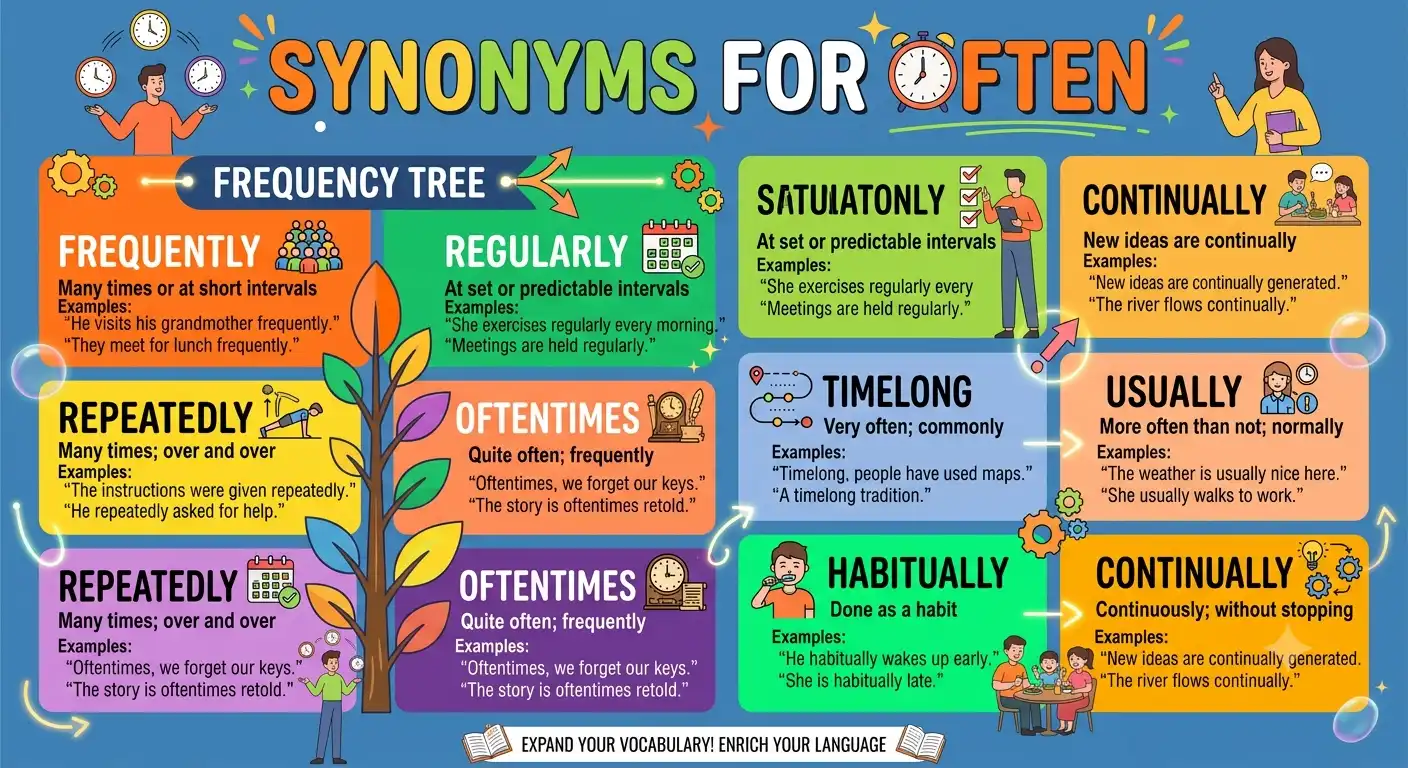
Finding clear synonyms for often helps you describe frequency and daily habits with great precision. When you learn different synonyms for often, you can make your writing and speaking sound smooth and natural. Choosing proper synonyms for often allows you to avoid repeating the same word in essays and everyday conversations.
A runner puts on her shoes every morning before sunrise. She runs along the park path five times a week without fail. When someone asks how many times she exercises, she can say she runs frequently, regularly, or time after time. This simple routine is a clear real-life example of doing something often.
In plain English, the word often means many times or on many occasions. Understanding varied vocabulary choices gives every communicator a big advantage:
- Students: Improve school papers and vocabulary tests by using rich action words.
- Bloggers: Keep your online readers interested by varying your daily language.
- Content Writers: Craft sharp articles, email newsletters, and landing pages.
- Daily English Users: Express your daily schedules and personal habits with confidence.
“Repetition is the mother of learning, the father of action, which makes it the architect of accomplishment.” – Zig Ziglar
“We are what we repeatedly do. Excellence, then, is not an act, but a habit.” – Will Durant
Technical & Linguistic Breakdown of “Often”
Connotative Meaning
The word often carries a neutral and descriptive connotation. It simply indicates high frequency without implying good or bad feelings. However, surrounding words can give it a positive tone (e.g., often helps others) or a negative tone (e.g., often forgets keys).
Etymology of “Often”
- Old English Root: Derived from oft (meaning “frequently or repeatedly”).
- Middle English Shift: Expanded to often during the 14th century by adding the suffix -en.
- Phonetic Shift: The silent letter “t” became common in standard English, though both pronunciations remain correct today.
- Modern English Entry: Used across formal, informal, and literary contexts to express high frequency.
Pronunciation (IPA)
- US IPA: /ˈɑːf.ən/ or /ˈɑːft.ən/
- UK IPA: /ˈɒf.ən/ or /ˈɒft.ən/
Syllables & Structure
- Syllables: 2 Syllables (of – ten)
- Stress Pattern: Primary stress on the first syllable (OF-ten).
Affixation Pattern
- Base Form: Oft (Archaic Adverb)
- Standard Adverb: Often
- Comparative Form: More often
- Superlative Form: Most often
- Antonym Form: Seldom / Rarely
Quick Comparison Table of Key Synonyms
| Keyword | Meaning | Usage Type | Context |
| Frequently | Happening many times at short intervals | Professional / Academic | Schedules, research, daily tasks |
| Regularly | Happening at fixed or predictable times | Professional / Personal | Habits, meetings, workouts |
| Repeatedly | Happening again and again many times | Emotional / Strong | Warnings, mistakes, attempts |
| Commonly | Done or found by many people in general | Informal / Academic | General facts, trends, customs |
| Usually | Happening under normal or customary conditions | Casual / Daily | Routines, preferences, weather |
| Habitually | Done as a automatic personal habit | Personal / Behavioral | Personal traits, morning routines |
| Routinely | Done as part of a fixed procedure | Workplace / Formal | Office work, medical checks |
| Typically | Happening as a normal feature or example | Academic / Professional | Rules, patterns, observations |
50 Best Synonyms for Often
1. Frequently
- Pronunciation: US: /ˈfriː.kwənt.li/ | UK: /ˈfriː.kwənt.li/
- Meaning: Something happens many times within a short period.
- Examples:
- She frequently visits the local library on weekends.
- Buses run frequently along this busy street.
2. Regularly
- Pronunciation: US: /ˈreɡ.jə.lɚ.li/ | UK: /ˈreɡ.jə.lə.li/
- Meaning: Something happens at fixed or steady times.
- Examples:
- He drinks water regularly throughout the day.
- Our team holds meetings regularly every Monday.
3. Repeatedly
- Pronunciation: US: /rɪˈpiː.t̬ɪd.li/ | UK: /rɪˈpiː.tɪd.li/
- Meaning: Something happens again and again many times over.
- Examples:
- The teacher repeatedly asked for quiet in class.
- He repeatedly tried to fix the broken toy.
4. Commonly
- Pronunciation: US: /ˈkɑː.mən.li/ | UK: /ˈkɒm.ən.li/
- Meaning: Something is seen or done by many people.
- Examples:
- Apples are commonly grown in cool climates.
- People commonly drink warm tea during winter.
5. Usually
- Pronunciation: US: /ˈjuː.ʒu.ə.li/ | UK: /ˈjuː.ʒu.ə.li/
- Meaning: Something happens under normal everyday conditions.
- Examples:
- I usually wake up at seven in the morning.
- She usually takes the bus to work.
6. Habitually
- Pronunciation: US: /həˈbɪtʃ.u.ə.li/ | UK: /həˈbɪtʃ.u.ə.li/
- Meaning: Something is done out of an automatic personal habit.
- Examples:
- He habitually checks his phone after waking up.
- She habitually smiles when greeting new guests.
7. Routinely
- Pronunciation: US: /ruːˈtiːn.li/ | UK: /ruːˈtiːn.li/
- Meaning: Something is done as part of a regular plan or rule.
- Examples:
- Nurses routinely check patient health charts.
- Pilots routinely inspect planes before takeoff.
8. Typically
- Pronunciation: US: /ˈtɪp.ɪ.kəl.i/ | UK: /ˈtɪp.ɪ.kəl.i/
- Meaning: Something happens as a standard or normal pattern.
- Examples:
- It typically rains during the spring months.
- Store doors typically open at nine sharp.
9. Continuously
- Pronunciation: US: /kənˈtɪn.ju.əs.li/ | UK: /kənˈtɪn.ju.əs.li/
- Meaning: Something happens without any breaks or stopping.
- Examples:
- Water flowed continuously from the mountain spring.
- The machine operates continuously night and day.
10. Constantly
- Pronunciation: US: /ˈkɑːn.stənt.li/ | UK: /ˈkɒn.stənt.li/
- Meaning: Something happens all the time without changing.
- Examples:
- Stars shine constantly in the deep night sky.
- She is constantly learning new English words.
11. Always
- Pronunciation: US: /ˈɑːl.weɪz/ | UK: /ˈɔːl.weɪz/
- Meaning: Something happens every single time without exception.
- Examples:
- Sun rises always in the eastern sky.
- He always says thank you to the driver.
12. Periodically
- Pronunciation: US: /ˌpɪr.iˈɑː.dɪk.li/ | UK: /ˌpɪə.riˈɒd.ɪk.li/
- Meaning: Something happens at regular spaced time intervals.
- Examples:
- You should periodically save your computer work.
- The bell rings periodically during class hours.
13. Recurrently
- Pronunciation: US: /rɪˈkɝː.ənt.li/ | UK: /rɪˈkʌr.ənt.li/
- Meaning: Something happens again after disappearing for a while.
- Examples:
- The warm feeling returned recurrently during his trip.
- Rain fell recurrently throughout the spring afternoon.
14. Time and again
- Pronunciation: US: /taɪm ænd əˈɡen/ | UK: /taɪm ænd əˈɡen/
- Meaning: Something happens on many separate past occasions.
- Examples:
- He proved his honesty time and again.
- She won the gold medal time and again.
15. Again and again
- Pronunciation: US: /əˈɡen ænd əˈɡen/ | UK: /əˈɡen ænd əˈɡen/
- Meaning: Something is repeated many times in a short space.
- Examples:
- He practiced the song again and again.
- The child threw the ball again and again.
16. Unceasingly
- Pronunciation: US: /ʌnˈsiː.sɪŋ.li/ | UK: /ʌnˈsiː.sɪŋ.li/
- Meaning: Something happens without ever coming to an end.
- Examples:
- Ocean waves crash unceasingly on the sand.
- The wind blew unceasingly across the plains.
17. Perpetually
- Pronunciation: US: /pɚˈpetʃ.u.əl.i/ | UK: /pəˈpetʃ.u.əl.i/
- Meaning: Something seems to go on forever without pausing.
- Examples:
- The cold mountain peak is perpetually snow-covered.
- He walked with a perpetually happy smile.
18. Incessantly
- Pronunciation: US: /ɪnˈses.ənt.li/ | UK: /ɪnˈses.ənt.li/
- Meaning: Something continues in an annoying or non-stop way.
- Examples:
- The phone rang incessantly all morning long.
- Crickets chirped incessantly in the tall grass.
19. Day after day
- Pronunciation: US: /deɪ ˈæf.tɚ deɪ/ | UK: /deɪ ˈɑːf.tə deɪ/
- Meaning: Something repeats every daily morning without change.
- Examples:
- He worked in the garden day after day.
- She studied hard day after day for exams.
20. Time after time
- Pronunciation: US: /taɪm ˈæf.tɚ taɪm/ | UK: /taɪm ˈɑːf.tə taɪm/
- Meaning: Something happens repeatedly over a long period.
- Examples:
- She showed great courage time after time.
- The clock struck twelve time after time.
21. Much of the time
- Pronunciation: US: /mʌtʃ ʌv ðə taɪm/ | UK: /mʌtʃ ɒv ðə taɪm/
- Meaning: Something occurs during a large part of the day.
- Examples:
- He spends much of the time reading books.
- Cats sleep during much of the time outdoors.
22. More often than not
- Pronunciation: US: /mɔːr ˈɑːf.ən ðæn nɑːt/ | UK: /mɔː ˈɒf.ən ðæn nɒt/
- Meaning: Something happens in most real situations.
- Examples:
- More often than not, he arrives on time.
- More often than not, hard work leads to success.
23. Most times
- Pronunciation: US: /moʊst taɪmz/ | UK: /məʊst taɪmz/
- Meaning: Something occurs on the majority of occasions.
- Examples:
- Most times, she orders a cold salad.
- Most times, the store has fresh bread ready.
24. As a rule
- Pronunciation: US: /æz ə ruːl/ | UK: /æz ə ruːl/
- Meaning: Something usually happens as a general standard habit.
- Examples:
- As a rule, we eat dinner together at six.
- As a rule, he walks to school every day.
25. Ordinarily
- Pronunciation: US: /ˌɔːr.dənˈer.əl.i/ | UK: /ˈɔː.dən.rəl.i/
- Meaning: Something happens under normal or everyday circumstances.
- Examples:
- Ordinarily, the shop closes early on Sunday.
- She is ordinarily very quiet in group meetings.
“Small deeds done are better than great deeds planned.” – Peter Marshall
26. Generally
- Pronunciation: US: /ˈdʒen.ər.əl.i/ | UK: /ˈdʒen.ər.əl.i/
- Meaning: Something is true or occurs in most cases.
- Examples:
- Summer weather is generally warm and sunny.
- Children generally love playing in green parks.
27. Normally
- Pronunciation: US: /ˈnɔːr.mə.li/ | UK: /ˈnɔː.mə.li/
- Meaning: Something happens as expected in standard situations.
- Examples:
- Normally, train service starts at five AM.
- She normally drinks water with her lunch.
28. Customarily
- Pronunciation: US: /ˌkʌs.təˈmer.əl.i/ | UK: /ˈkʌs.tə.mrəl.i/
- Meaning: Something happens according to established family or community customs.
- Examples:
- People customarily shake hands when meeting friends.
- Families customarily share gifts during holiday celebrations.
29. Continually
- Pronunciation: US: /kənˈtɪn.ju.ə.li/ | UK: /kənˈtɪn.ju.ə.li/
- Meaning: Something happens repeatedly with small pauses in between.
- Examples:
- He continually asks helpful questions during class.
- The chef continually checks the soup taste.
30. Steady
- Pronunciation: US: /ˈsted.i/ | UK: /ˈsted.i/
- Meaning: Something happens in a regular and unchanging way.
- Examples:
- She maintained a steady pace during the run.
- The clock keeps a steady rhythm all night.
31. Ever and anon
- Pronunciation: US: /ˈev.ɚ ænd əˈnɑːn/ | UK: /ˈev.ər ænd əˈnɒn/
- Meaning: Something happens now and then from time to time.
- Examples:
- Birds sang ever and anon in the peaceful garden.
- Ships passed ever and anon along the sea line.
32. Off and on
- Pronunciation: US: /ɑːf ænd ɑːn/ | UK: /ɒf ænd ɒn/
- Meaning: Something happens with short breaks between occurrences.
- Examples:
- It rained off and on throughout the night.
- He worked on the puzzle off and on all day.
33. Day in and day out
- Pronunciation: US: /deɪ ɪn ænd deɪ aʊt/ | UK: /deɪ ɪn ænd deɪ aʊt/
- Meaning: Something happens every day without any variation.
- Examples:
- He trains at the gym day in and day out.
- She reads news articles day in and day out.
34. Nonstop
- Pronunciation: US: /ˌnɑːnˈstɑːp/ | UK: /ˌnɒnˈstɒp/
- Meaning: Something happens without taking any rest or break.
- Examples:
- The train ran nonstop from city to city.
- Children played nonstop during the party hours.
35. Uninterruptedly
- Pronunciation: US: /ˌʌn.ɪn.t̬əˈrʌp.tɪd.li/ | UK: /ˌʌn.ɪn.təˈrʌp.tɪd.li/
- Meaning: Something proceeds without any disturbance or break.
- Examples:
- He slept uninterruptedly for eight full hours.
- The sun shone uninterruptedly all afternoon long.
36. Endlessly
- Pronunciation: US: /ˈend.ləs.li/ | UK: /ˈend.ləs.li/
- Meaning: Something seems to continue without an end point.
- Examples:
- The ocean stretches endlessly toward the horizon.
- They talked endlessly about their summer trips.
37. Evermore
- Pronunciation: US: /ˌev.ɚˈmɔːr/ | UK: /ˌev.əˈmɔː/
- Meaning: Something continues forever into the future time.
- Examples:
- The story will be remembered evermore.
- Peace remained in the valley evermore.
38. Over and over
- Pronunciation: US: /ˈoʊ.vɚ ænd ˈoʊ.vɚ/ | UK: /ˈəʊ.və ænd ˈəʊ.və/
- Meaning: Something repeats many times in clear succession.
- Examples:
- He sang his favorite song over and over.
- She read the letter over and over again.
39. Like clockwork
- Pronunciation: US: /laɪk ˈklɑːk.wɝːk/ | UK: /laɪk ˈklɒk.wɜːk/
- Meaning: Something happens regularly with absolute precision.
- Examples:
- The morning train arrives like clockwork.
- He feeds his cat at six like clockwork.
40. Systematically
- Pronunciation: US: /ˌsɪs.təˈmæt̬.ɪk.li/ | UK: /ˌsɪs.təˈmæt.ɪk.li/
- Meaning: Something is carried out according to a step-by-step system.
- Examples:
- She checked every page systematically for errors.
- He cleaned the room systematically top to bottom.
41. Chronically
- Pronunciation: US: /ˈkrɑː.nɪk.li/ | UK: /ˈkrɒn.ɪk.li/
- Meaning: Something happens continuously or recurs over long periods.
- Examples:
- He is chronically late for morning meetings.
- The old engine was chronically short on oil.
42. Monotonously
- Pronunciation: US: /məˈnɑː.t̬ən.əs.li/ | UK: /məˈnɒt.ən.əs.li/
- Meaning: Something repeats in a dull, unchanging tone.
- Examples:
- The clock ticked monotonously in the quiet room.
- Rain tapped monotonously against the window glass.
43. Persistently
- Pronunciation: US: /pɚˈsɪs.tənt.li/ | UK: /pəˈsɪs.tənt.li/
- Meaning: Something continues firmly despite obstacles or time.
- Examples:
- She persistently pursued her dream of writing.
- He knocked persistently until the door opened.
44. Relentlessly
- Pronunciation: US: /rɪˈlent.ləs.li/ | UK: /rɪˈlent.ləs.li/
- Meaning: Something continues with full power without easing up.
- Examples:
- The team worked relentlessly to meet the deadline.
- The sun shone down relentlessly at midday.
45. Standardly
- Pronunciation: US: /ˈstæn.dɚd.li/ | UK: /ˈstæn.dəd.li/
- Meaning: Something happens according to established rules or forms.
- Examples:
- Reports are standardly filed before Friday afternoon.
- Breakfast is standardly served at eight AM.
46. Predominantly
- Pronunciation: US: /prɪˈdɑː.mə.nənt.li/ | UK: /prɪˈdɒm.ɪ.nənt.li/
- Meaning: Something occurs for the largest part of the time.
- Examples:
- The population is predominantly young and energetic.
- The forest consists predominantly of pine trees.
47. Chiefly
- Pronunciation: US: /ˈtʃiːf.li/ | UK: /ˈtʃiːf.li/
- Meaning: Something happens mainly or primarily.
- Examples:
- The city relies chiefly on solar power energy.
- He writes chiefly about sports and nature topics.
48. Mainly
- Pronunciation: US: /ˈmeɪn.li/ | UK: /ˈmeɪn.li/
- Meaning: Something occurs for the most important part.
- Examples:
- We visit the beach mainly during warm summer days.
- She reads mainly historical fiction books.
49. Mostly
- Pronunciation: US: /ˈmoʊst.li/ | UK: /ˈməʊst.li/
- Meaning: Something happens on almost all occasions.
- Examples:
- The sky remained mostly clear all day long.
- He spends his weekends mostly with family.
50. On many occasions
- Pronunciation: US: /ɑːn ˈmen.i əˈkeɪ.ʒənz/ | UK: /ɒn ˈmen.i əˈkeɪ.ʒənz/
- Meaning: Something occurs across numerous individual events.
- Examples:
- On many occasions, he offered free help to neighbors.
- On many occasions, she won top athletic prizes.
Antonyms of “Often”
Understanding the direct opposites of “often” helps you describe rare events or things that seldom happen:
- Rarely: Seldom happening or occurring only a few times.
- Seldom: Almost never or on very few occasions.
- Infrequently: Happening at long and unusual intervals.
- Hardly ever: Almost never occurring in daily life.
- Occasionally: Happening only from time to time.
- Never: Not at any time or under any circumstance.
Prototype Meaning and Categorization of Often
To master these synonyms for often, it helps to understand the core prototype of “frequency” and organize these words into distinct categories based on fixed schedules, continuous action, general habits, and occasional patterns:
Core Prototype Definition
At its core, “often” describes a state of high frequency where an event repeats multiple times across a measured timeframe.
1. Fixed Schedule and High Regularity
This category includes terms that describe events occurring on a predictable timetable or according to strict routines.
- Primary Focus: Predictable schedules, clockwork precision, and fixed routines.
- Key Synonyms: Regularly, routinely, periodically, like clockwork, systematically, standardly.
- Common Contexts: Office timetables, medical routines, public transport, and workout plans.
2. High Frequency and Common Occurrence
This category covers general words that describe events happening many times without requiring strict timing.
- Primary Focus: High repetition, general trends, and common occurrences.
- Key Synonyms: Frequently, commonly, repeatedly, time and again, on many occasions, time after time.
- Common Contexts: Daily conversations, essays, news reports, and general storytelling.
3. Normal Habits and Standard Rules
This category features words that describe what usually happens under standard conditions or personal habits.
- Primary Focus: General rules, expected outcomes, and automatic habits.
- Key Synonyms: Usually, typically, habitually, generally, normally, customarily, as a rule, mostly.
- Common Contexts: Personal preferences, cultural customs, weather summaries, and daily habits.
4. Non-Stop and Endless Continuances
These terms apply when an action happens without pauses, rest breaks, or interruption.
- Primary Focus: Continuous movement, relentless action, and endless flow.
- Key Synonyms: Constantly, continuously, incessantly, unceasingly, non-stop, relentlessly, endlessly.
- Common Contexts: Weather events, machine operations, ocean waves, and persistent efforts.
Frequently Asked Questions (FAQs)
1. What is the most common synonym for often?
The most common everyday synonym for often is frequently. It carries the exact same basic meaning in both spoken and written English.
2. Which synonym for often is best for a formal resume or business letter?
In formal business writing, terms like regularly, routinely, systematically, or frequently sound professional and clear.
3. What is the difference between “often” and “usually”?
Often means happening many times. Usually means happening in most normal cases or as a standard rule.
4. Is the letter “t” silent in “often”?
Both pronunciations /ˈɑːf.ən/ (silent t) and /ˈɑːft.ən/ (pronounced t) are correct in English today.
5. What does “like clockwork” mean?
“Like clockwork” is an idiom that means something happens with complete regularity and exact timing every single time.
6. Can “frequently” replace “often” in every sentence?
Yes, frequently can almost always replace often without changing the meaning of your sentence.
Conclusion
Learning dynamic synonyms for often will greatly enrich your writing, blogging, public speaking, and everyday communication skills. Expanding your vocabulary allows you to pick exact words that match your specific context and tone. Whether you are drafting a job email, writing a blog post, working on a school essay, or chatting with friends, using diverse words makes your message smooth and clear.
When you replace basic words with rich choices like frequently, routinely, systematically, or like clockwork, your sentences come alive for every reader. Try incorporating 2 or 3 new terms each week into your work emails, class essays, and daily conversations. Daily practice with varied vocabulary builds long-term speaking confidence.
“Excellence is not a single act, but a habit. You are what you repeatedly do.” – Aristotle
“Words are the leaves on the tree of language; choose them with care and purpose.” – Unknown

Robert Hayes is an ESL educator and curriculum developer with over nine years of experience teaching English to beginners and intermediate learners across multiple countries ( Biography ).