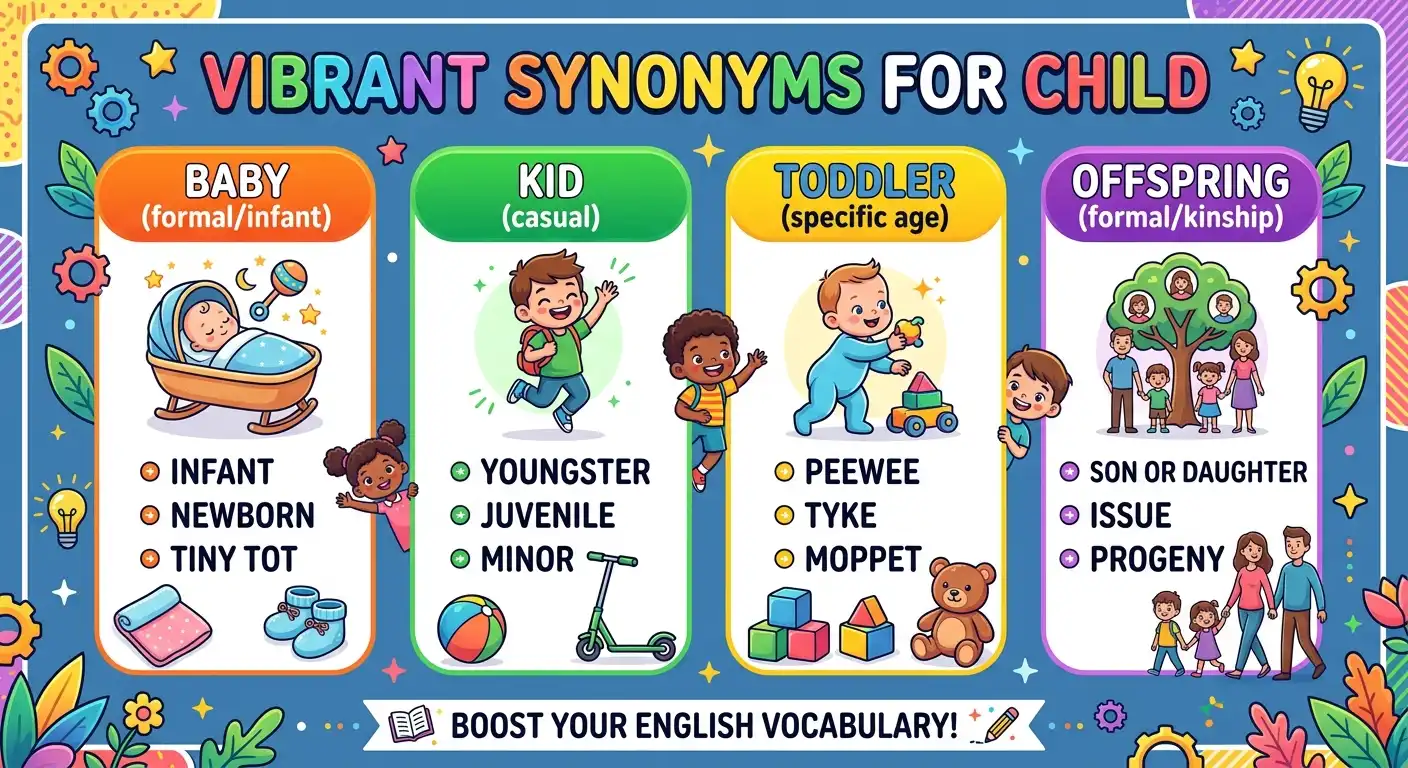
Finding exact synonyms for child helps you express ideas about young people with clarity and grace. When you learn diverse synonyms for child, you can describe different age groups, family relationships, and personality traits without repeating yourself. Using precise synonyms for child keeps your speech interesting and improves your everyday writing.
Imagine a school teacher writing a progress report for a family. If the report repeats the word “child” in every single sentence, the text feels dull and flat. Switching to specific words like “youngster,” “student,” or “little one” makes the message warm and easy to read.
For example, when a mother takes her three-year-old to the neighborhood park, she might call her a toddler. Using accurate words like “preschooler” or “kid” helps listeners picture the exact age and setting instantly.
The search for synonyms for child leads to alternative words that describe young humans from birth through early youth. Expanding your vocabulary with these terms helps many groups of readers:
- Students write better essays and creative stories for class.
- Bloggers write engaging posts about parenting and family life.
- Content writers increase search visibility with natural, varied language.
- Daily English users speak smoothly and comfortably in everyday chats.
“Choosing the right word for a young person makes every story come alive.”
“A rich vocabulary helps us share human experiences with warmth and accuracy.”
Linguistic Breakdown of “Child”
Connotative Meaning
The word child carries neutral, warm, and protective connotations. It represents innocence, potential, family connection, and the early stages of human growth.
Etymology
- Origin: Derived from Old English cild (meaning fetus, infant, or unborn offspring).
- Plural Evolution: The original plural was cildru, which later evolved into children.
- Historical Context: Originally referred to a babe in the womb or a newborn, before broadening to cover all ages before adulthood.
Pronunciation
- US (IPA): /tʃaɪld/
- UK (IPA): /tʃaɪld/
Syllables & Affixation Pattern
- Syllables: 1 syllable (child)
- Base Structure: Monosyllabic noun
- Grammatical Patterns:
- Plural Form: Children
- Adjective Form: Childish / Childlike
- Noun Compound: Childcare / Childhood
Comparison Table: Common Synonyms for Child
| Keyword | Meaning | Usage Type | Context |
| Kid | A young person or child | Casual / Conversational | Daily Talks, Family, & Friends |
| Toddler | A young child who is learning to walk | Descriptive / Specific | Parenting, Healthcare, & Daycare |
| Juvenile | A young person not yet an adult | Formal / Legal | Law, Official Reports, & Science |
| Offspring | A person’s child or children | Formal / Biological | Science, Family Trees, & Genetics |
| Little one | A very young child | Emotional / Endearing | Family Life, Home, & Stories |
| Minor | A person under the legal age | Formal / Professional | Law, Business, & School Rules |
| Youth | A young person in early life | General / Social | Sports, Community, & Education |
50 Best Synonyms for Child
1. Kid
- Pronunciation: US /kɪd/ | UK /kɪd/
- Meaning: Kid is a friendly and casual word for a young child.
- Examples:
- The kid ran across the park to play on the swings.
- My brother has two kids who love reading storybooks.
2. Youngster
- Pronunciation: US /ˈjʌŋ.stɚ/ | UK /ˈjʌŋ.stə/
- Meaning: Youngster means a young person or child in early life.
- Examples:
- Several youngsters joined the summer art club today.
- The coach praised the youngster for playing a great game.
3. Toddler
- Pronunciation: US /ˈtɑːd.lɚ/ | UK /ˈtɒd.lə/
- Meaning: Toddler means a small child who is just learning to walk.
- Examples:
- The toddler took three careful steps toward her father.
- Our local library offers a weekly story hour for toddlers.
4. Infant
- Pronunciation: US /ˈɪn.fənt/ | UK /ˈɪn.fənt/
- Meaning: Infant means a very young child or baby.
- Examples:
- The sleeping infant rested quietly in the stroller.
- Pediatricians monitor the growth of every newborn infant.
5. Juvenile
- Pronunciation: US /ˈdʒuː.və.nəl/ | UK /ˈdʒuː.vən.aɪl/
- Meaning: Juvenile means a young person who is not yet a legal adult.
- Examples:
- The city opened a new recreation hall for juvenile sports.
- The book series is written for juvenile readers.
6. Minor
- Pronunciation: US /ˈmaɪ.nɚ/ | UK /ˈmaɪ.nə/
- Meaning: Minor means anyone under the official legal age of adulthood.
- Examples:
- Passengers who are minors must travel with an adult guide.
- The law protects the rights of every minor in school.
7. Youth
- Pronunciation: US /juːθ/ | UK /juːθ/
- Meaning: Youth means a young person between childhood and adult age.
- Examples:
- The local center organizes healthy activities for neighborhood youth.
- She spent her youth living in a small coastal town.
8. Tyke
- Pronunciation: US /taɪk/ | UK /taɪk/
- Meaning: Tyke is an affectionate word for a small or active child.
- Examples:
- The little tyke wore a red coat to school today.
- That cheerful tyke always smiles at the grocery clerk.
9. Tot
- Pronunciation: US /tɑːt/ | UK /tɒt/
- Meaning: Tot is a short and sweet word for a tiny child.
- Examples:
- The tot sat happily in the sandbox with a plastic bucket.
- We bought soft shoes for the tiny tot.
10. Little one
- Pronunciation: US /ˈlɪt̬.əl wʌn/ | UK /ˈlɪt.əl wʌn/
- Meaning: Little one is a loving term for a young child.
- Examples:
- The mother tucked her little one into bed at night.
- Is your little one ready for preschool next month?
“Simple words expressed with affection shape the happiest memories of youth.”
11. Offspring
- Pronunciation: US /ˈɑːf.sprɪŋ/ | UK /ˈɒf.sprɪŋ/
- Meaning: Offspring means the child or children born to a person.
- Examples:
- The proud parents shared news of their offspring’s success.
- Birds work hard to feed and protect their young offspring.
12. Newborn
- Pronunciation: US /ˈnuː.bɔːrn/ | UK /ˈnjuː.bɔːn/
- Meaning: Newborn means a baby that was recently born.
- Examples:
- The hospital room was quiet while the newborn slept peacefully.
- They received many warm gifts for their newborn daughter.
13. Babe
- Pronunciation: US /beɪb/ | UK /beɪb/
- Meaning: Babe is a classic word used for a very young baby.
- Examples:
- The babe cried softly until her grandmother held her.
- Early morning light filled the nursery where the babe slept.
14. Baby
- Pronunciation: US /ˈbeɪ.bi/ | UK /ˈbeɪ.bi/
- Meaning: Baby means a very young child who cannot yet talk or walk.
- Examples:
- The baby laughed aloud when playing peek-a-boo.
- We bought a sturdy crib for the new baby.
15. Adolescent
- Pronunciation: US /ˌæd.əˈles.ənt/ | UK /ˌæd.əˈles.ənt/
- Meaning: Adolescent means a young person growing into an adult.
- Examples:
- Most adolescents enjoy spending free time with their classmates.
- The clinic offers health programs designed for adolescents.
16. Teenager
- Pronunciation: US /ˈtiːn.eɪ.dʒɚ/ | UK /ˈtiːn.eɪ.dʒə/
- Meaning: Teenager means a young person between thirteen and nineteen years old.
- Examples:
- The teenager volunteered to help clean the city park.
- Learning to drive is an exciting step for a teenager.
17. Schoolchild
- Pronunciation: US /ˈskuːl.tʃaɪld/ | UK /ˈskuːl.tʃaɪld/
- Meaning: Schoolchild means a child who attends primary or secondary school.
- Examples:
- Every schoolchild put on a yellow vest for the safety walk.
- The library provides study space for every local schoolchild.
18. Schoolboy
- Pronunciation: US /ˈskuːl.bɔɪ/ | UK /ˈskuːl.bɔɪ/
- Meaning: Schoolboy means a young boy who goes to school.
- Examples:
- The young schoolboy packed his lunch box before leaving home.
- A cheerful schoolboy helped carry the books inside.
19. Schoolgirl
- Pronunciation: US /ˈskuːl.ɡɝːl/ | UK /ˈskuːl.ɡɜːl/
- Meaning: Schoolgirl means a young girl who goes to school.
- Examples:
- The schoolgirl drew a bright picture in her art notebook.
- Three schoolgirls waited at the corner for the yellow bus.
20. Tiny
- Pronunciation: US /ˈtaɪ.ni/ | UK /ˈtaɪ.ni/
- Meaning: Tiny is an informal word used for a very small child.
- Examples:
- The tinies sat in a circle for song time at daycare.
- We watched the tinies learn how to kick a ball.
21. Preschooler
- Pronunciation: US /ˈpriː.skuː.lɚ/ | UK /ˈpriː.skuː.lə/
- Meaning: Preschooler means a child who attends a nursery school.
- Examples:
- The preschooler painted a blue sky on large paper.
- Building blocks help a preschooler practice motor skills.
22. Cherub
- Pronunciation: US /ˈtʃer.əb/ | UK /ˈtʃer.əb/
- Meaning: Cherub means a sweet and innocent-looking young child.
- Examples:
- The curly-haired cherub smiled sweetly for the family photo.
- Every cherub in the choir sang with pure delight.
23. Angel
- Pronunciation: US /ˈeɪn.dʒəl/ | UK /ˈeɪn.dʒəl/
- Meaning: Angel is a warm term for a well-behaved child.
- Examples:
- The little angel helped clear the lunch dishes from the table.
- Thank you for watching my daughter; she was a complete angel.
24. Darling
- Pronunciation: US /ˈdɑːr.lɪŋ/ | UK /ˈdɑː.lɪŋ/
- Meaning: Darling means a loved and deeply cherished child.
- Examples:
- Their little darling clapped her hands at the puppet show.
- Good night my darling, sleep tight until morning.
25. Mite
- Pronunciation: US /maɪt/ | UK /maɪt/
- Meaning: Mite is an affectionate term for a small child.
- Examples:
- The poor little mite looked cold in the winter rain.
- That tiny mite carried a school bag bigger than himself.
26. Small fry
- Pronunciation: US /smɑːl fraɪ/ | UK /smɔːl fraɪ/
- Meaning: Small fry is a playful term for small or young children.
- Examples:
- The coach gathered all the small fry for soccer practice.
- Let the small fry eat their ice cream at the outdoor table.
27. Rugrat
- Pronunciation: US /ˈrʌɡ.ræt/ | UK /ˈrʌɡ.ræt/
- Meaning: Rugrat is an informal word for a crawling baby or young child.
- Examples:
- The energetic rugrats played with plastic trucks on the carpet.
- We spent the afternoon watching the rugrats race across the grass.
28. Youngling
- Pronunciation: US /ˈjʌŋ.lɪŋ/ | UK /ˈjʌŋ.lɪŋ/
- Meaning: Youngling means a young person or child.
- Examples:
- The wise elder shared stories with the attentive younglings.
- Forest creatures protect their younglings from harsh weather.
29. Stripling
- Pronunciation: US /ˈstrɪp.lɪŋ/ | UK /ˈstrɪp.lɪŋ/
- Meaning: Stripling means a youth or young boy growing rapidly.
- Examples:
- The tall stripling helped his uncle harvest the wheat field.
- He was just a stripling when he first joined the farm crew.
30. Lad
- Pronunciation: US /læd/ | UK /læd/
- Meaning: Lad is an informal word for a young boy or young man.
- Examples:
- The helpful lad opened the heavy door for his teacher.
- He was a bright young lad with a great interest in science.
31. Lass
- Pronunciation: US /læs/ | UK /læs/
- Meaning: Lass is an informal word for a young girl.
- Examples:
- The cheerful lass sang a traditional song during class.
- A young lass led the horse across the green meadow.
32. Waif
- Pronunciation: US /weɪf/ | UK /weɪf/
- Meaning: Waif means a homeless, neglected, or thin young child.
- Examples:
- The historic story tells of a lost waif in the big city.
- Kind neighbors offered food and shelter to the small waif.
33. Orphan
- Pronunciation: US /ˈɔːr.fən/ | UK /ˈɔː.fən/
- Meaning: Orphan means a child whose biological parents have passed away.
- Examples:
- The community center provides grants for every local orphan.
- The young orphan found a loving home with her aunt.
34. Foundling
- Pronunciation: US /ˈfaʊnd.lɪŋ/ | UK /ˈfaʊnd.lɪŋ/
- Meaning: Foundling means an abandoned infant found and cared for by others.
- Examples:
- The classic novel centers on the life of a brave foundling.
- A kind family took in the foundling and raised him as their own.
35. Ward
- Pronunciation: US /wɔːrd/ | UK /wɔːd/
- Meaning: Ward means a child placed under the legal care of a guardian or court.
- Examples:
- The judge appointed a trusted relative as guardian of the ward.
- The young ward lived in a quiet house near the coastline.
36. Descendant
- Pronunciation: US /dɪˈsen.dənt/ | UK /dɪˈsen.dənt/
- Meaning: Descendant means a person related to a specific ancestor.
- Examples:
- The family tree lists every descendant of the original pioneer.
- She is a direct descendant of the town’s first mayor.
37. Heir
- Pronunciation: US /er/ | UK /eə/
- Meaning: Heir means a child entitled to receive family property or title.
- Examples:
- The young heir learned how to manage the historic family estate.
- She named her eldest child as the primary heir.
38. Scion
- Pronunciation: US /ˈsaɪ.ən/ | UK /ˈsaɪ.ən/
- Meaning: Scion means a young descendant of a notable or wealthy family.
- Examples:
- The scion of the founding family attended the factory opening.
- He grew up as the youngest scion of a famous musical family.
39. Progeny
- Pronunciation: US /ˈprɑː.dʒə.ni/ | UK /ˈprɒdʒ.ə.ni/
- Meaning: Progeny means the children or descendants of a person or family.
- Examples:
- They built a strong family business for their future progeny.
- The ancient monument was preserved for all progeny to admire.
40. Issue
- Pronunciation: US /ˈɪʃ.uː/ | UK /ˈɪs.juː/
- Meaning: Issue is a legal term for a person’s offspring or children.
- Examples:
- The land document stated that property passes to her lawful issue.
- He died without issue, leaving his books to the public library.
41. Newborn baby
- Pronunciation: US /ˈnuː.bɔːrn ˈbeɪ.bi/ | UK /ˈnjuː.bɔːn ˈbeɪ.bi/
- Meaning: Newborn baby means a child in the first few weeks of life.
- Examples:
- The nurse weighed the newborn baby before resting her in the bassinet.
- A newborn baby requires gentle care and regular feeding.
42. Preteen
- Pronunciation: US /ˌpriːˈtiːn/ | UK /ˌpriːˈtiːn/
- Meaning: Preteen means a child between nine and twelve years old.
- Examples:
- The preteen saved her allowance money to buy a new bicycle.
- Summer camps offer fun sports programs for preteens.
43. Firstborn
- Pronunciation: US /ˈfɝːst.bɔːrn/ | UK /ˈfɜːst.bɔːn/
- Meaning: Firstborn means the eldest child in a family.
- Examples:
- Their firstborn child started middle school this September.
- The firstborn often takes on a protective role with younger siblings.
44. Young person
- Pronunciation: US /jʌŋ ˈpɝː.sən/ | UK /jʌŋ ˈpɜː.sən/
- Meaning: Young person means a youth or individual who is not yet an adult.
- Examples:
- Every young person in the town was invited to the career fair.
- The mentor offered useful advice to the young person.
45. Brat
- Pronunciation: US /bræt/ | UK /bræt/
- Meaning: Brat is an informal term for a noisy or ill-behaved child.
- Examples:
- The spoiled brat threw a tantrum when denied a second toy.
- He realized his action was wrong and stopped acting like a brat.
46. Imp
- Pronunciation: US /ɪmp/ | UK /ɪmp/
- Meaning: Imp means a playful or mischievous young child.
- Examples:
- That little imp hid behind the curtain to surprise her brother.
- The teacher smiled at the mischievous imp in the front row.
47. Rascal
- Pronunciation: US /ˈræs.kəl/ | UK /ˈrɑː.skəl/
- Meaning: Rascal is a playful term for a cheeky or naughty child.
- Examples:
- The little rascal ate the last chocolate chip cookie.
- Come back here, you cheeky rascal, and put on your shoes!
48. Munchkin
- Pronunciation: US /ˈmʌntʃ.kɪn/ | UK /ˈmʌntʃ.kɪn/
- Meaning: Munchkin is an endearing term for a sweet, small child.
- Examples:
- The aunt hugged her little munchkin as soon as she arrived.
- Look at those munchkins wearing matching party hats!
49. Whippersnapper
- Pronunciation: US /ˈwɪp.ɚ.snæp.ɚ/ | UK /ˈwɪp.ə.snæp.ə/
- Meaning: Whippersnapper is an old-fashioned term for an overly confident young person.
- Examples:
- The old grandfather chuckled at the bold young whippersnapper.
- Don’t talk back to your elders, young whippersnapper!
50. Bambino
- Pronunciation: US /bæmˈbiː.noʊ/ | UK /bæmˈbiː.nəʊ/
- Meaning: Bambino is an informal word borrowed from Italian for a baby or child.
- Examples:
- The family celebrated the arrival of their new bambino.
- She held the sweet bambino in her arms during the picnic.
Antonyms of “Child”
Knowing opposite terms helps you contrast youth with adulthood, maturity, and elder status accurately.
- Adult: A person who has reached full physical growth and legal age.
- Grown-up: An informal term for an adult person.
- Elder: An older person who holds wisdom and status within a family or community.
- Parent: A father or mother who cares for offspring.
- Senior: An elderly person who has reached retirement age.
- Ancestor: A family member from a past generation from whom one descends.
Prototype Meaning & Categorization of “Child”
The primary concept of child centers on youth, small physical stature, growth, family connection, and dependence. Depending on your intent, these 50 synonyms divide into four main operational categories:
- Age-Based & Developmental Stages: Toddler, infant, newborn, baby, adolescent, teenager, schoolchild, preschooler, preteen, newborn baby, firstborn.
- Legal, Official & Biological Terms: Juvenile, minor, offspring, descendant, heir, scion, progeny, issue, ward, orphan, waif, foundling.
- Endearing & Family Terms: Kid, youngster, little one, tyke, tot, cherub, angel, darling, mite, small fry, rugrat, munchkin, bambino.
- Playful & Character Descriptions: Youngling, stripling, lad, lass, tiny, young person, brat, imp, rascal, whippersnapper.
Frequently Asked Questions (FAQs)
1. What is the most formal synonym for “child”?
In formal, legal, or official writing, “minor,” “juvenile,” or “offspring” work best. They accurately describe young people without using conversational language.
2. Which synonym for “child” should I use in casual conversations?
For everyday casual talk, terms like “kid,” “youngster,” or “little one” sound natural, warm, and friendly.
3. What is the difference between “child” and “kid”?
“Child” is standard English appropriate for any context. “Kid” is an informal synonym used widely in conversation and informal writing.
4. Is “minor” used for infants and babies?
Yes, in legal contexts, any person below the age of majority is classified as a “minor,” regardless of whether they are a newborn, toddler, or teenager.
5. Why are words like “brats” or “imps” categorized differently?
Terms like “brat” or “imp” carry specific emotional connotations related to behavior, describing a child who is mischievous, naughty, or spoiled.
6. How does using diverse synonyms for “child” help SEO?
Using varied synonyms satisfies different user search queries, prevents keyword stuffing, improves content readability, and keeps readers engaged longer on your website.
Conclusion
Expanding your collection of synonyms for child brings color, variety, and precision to your language. Replacing repetitive terms with exact words like youngster, toddler, minor, or little one ensures your message connects with your readers every time.
Whether you are drafting academic essays, writing family blog posts, composing business emails, or speaking in daily conversations, using exact vocabulary builds instant clarity. Varied language removes dull repetition and turns simple sentences into engaging expressions. Practice using these 50 synonyms today to share your ideas with warmth and confidence.
“Varied words paint clearer pictures in the minds of our readers.”
“Mastering simple vocabulary opens doors to meaningful communication every day.”

Robert Hayes is an ESL educator and curriculum developer with over nine years of experience teaching English to beginners and intermediate learners across multiple countries ( Biography ).