Learning clear synonyms for threat helps you talk about danger, risks, and warnings with total confidence. When you use accurate synonyms for threat, you can easily explain potential harm in security reports, school essays, and news stories. Knowing helpful synonyms for threat keeps your vocabulary active and makes your daily writing more precise.
Picture a cybersecurity officer explaining a new computer virus to the office team. If the officer uses the word “threat” in every single sentence, the message feels dull and repetitive. Switching to strong words like “hazard,” “risk,” or “menace” makes the warning clear, urgent, and direct.
For instance, when dark clouds gather before a storm, calling it a severe weather hazard explains the danger right away. Using exact words like “peril” or “warning” helps everyone take action quickly.
The word threat means a sign, statement, or condition that indicates trouble, injury, or harm might happen soon. Expanding your collection of synonyms for threat offers clear benefits for four main reader groups:
- Students describe safety topics, history wars, and science risks clearly in class papers.
- Bloggers write urgent articles that keep readers informed and safe.
- Content writers improve search scores with natural, rich phrasing.
- Daily English users share safety warnings smoothly during regular meetings.
“The right word turns a quiet warning into clear protection.”
“A strong vocabulary brings clarity, courage, and confidence to every speech.”
Linguistic Breakdown of “Threat”
Connotative Meaning
The word threat carries negative, cautionary, urgent, and protective connotations. It signals impending harm, conflict, risk, or psychological pressure.
Etymology
- Origin: Derived from Old English þrēat (meaning crowd, troop, pressure, or oppression).
- Root Words: Related to Proto-Germanic þrauta- (meaning pressure or hardship).
- Historical Shift: Shifted in Middle English from describing coercive physical force to indicating a spoken promise of harm or an imminent danger.
Pronunciation
- US (IPA): /θret/
- UK (IPA): /θret/
Syllables & Affixation Pattern
- Syllables: 1 syllable (threat)
- Base Structure: Root noun and verb
- Grammatical Patterns:
- Adjective form: Threatening
- Adverb form: Threateningly
- Verb form: Threaten
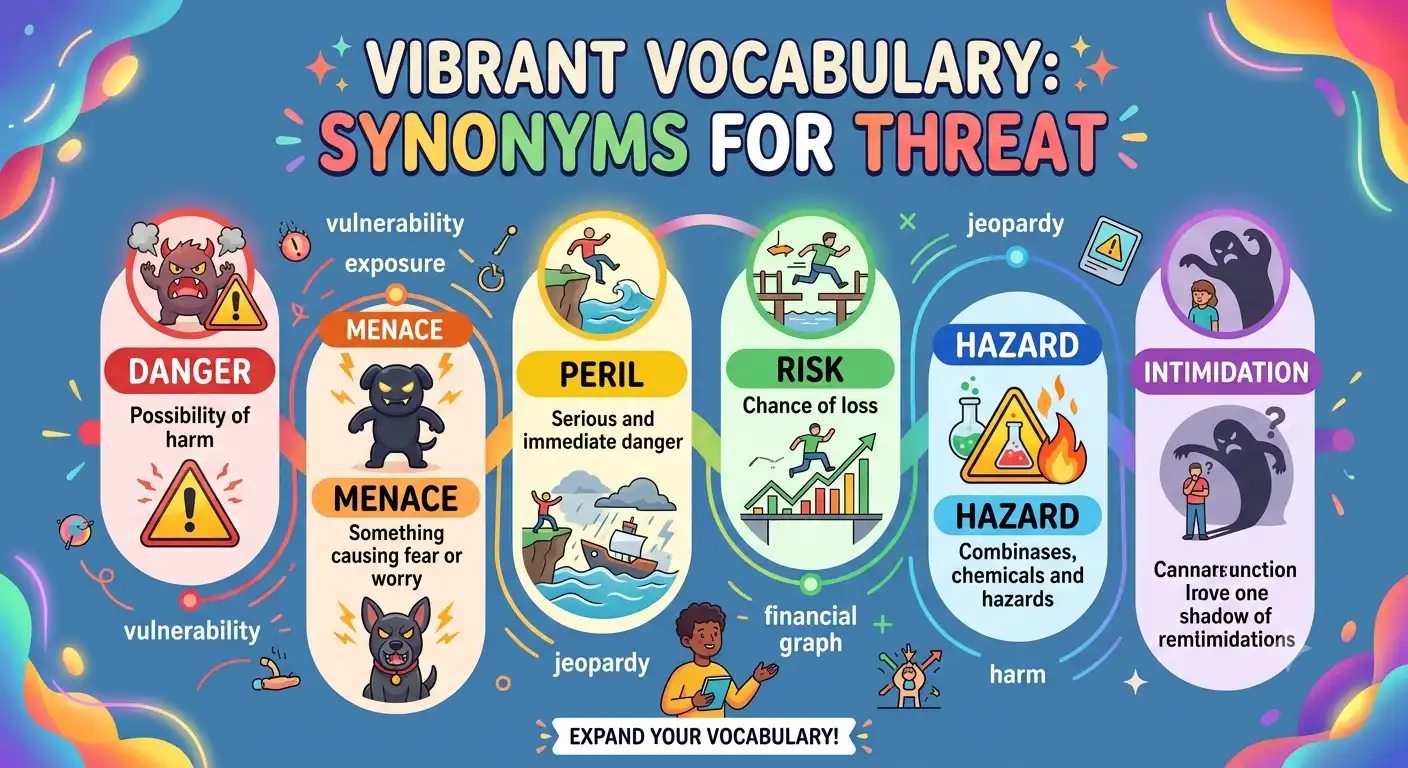
Comparison Table: Common Synonyms for Threat
| Keyword | Meaning | Usage Type | Context |
| Danger | Possibility of suffering harm or injury | General / Everyday | Physical safety, traffic, & natural events |
| Risk | Exposure to danger, loss, or chance | Analytical / Business | Investments, health choices, & planning |
| Hazard | A source of danger or potential harm | Official / Technical | Workplaces, chemical safety, & travel |
| Menace | A person or thing likely to cause trouble | Expressive / Descriptive | Crime, pests, & severe weather |
| Peril | Serious and immediate danger | Formal / Literary | Extreme weather, sea trips, & emergencies |
| Warning | A statement or event indicating danger | Practical / Official | Weather alerts, alarms, & safety signs |
| Intimidation | Forcing action through fear or threats | Legal / Psychological | Workplace behavior, law, & disputes |
50 Best Synonyms for Threat
1. Danger
- Pronunciation: US /ˈdeɪn.dʒɚ/ | UK /ˈdeɪn.dʒə/
- Meaning: Danger means the possibility that someone may be hurt or killed.
- Examples:
- High ocean waves pose a serious danger to small boats.
- Smoke jumping out of the house signaled immediate danger.
2. Risk
- Pronunciation: US /rɪsk/ | UK /rɪsk/
- Meaning: Risk means the chance that something bad or harmful may happen.
- Examples:
- Eating bad food increases the risk of stomach pain.
- Driving fast on wet roads is a major risk.
3. Hazard
- Pronunciation: US /ˈhæz.ɚd/ | UK /ˈhæz.əd/
- Meaning: Hazard means a physical danger or source of harm in an area.
- Examples:
- Ice on the front steps is a winter hazard.
- Broken glass on the park grass creates a hazard.
4. Menace
- Pronunciation: US /ˈmen.əs/ | UK /ˈmen.əs/
- Meaning: Menace means something that causes harm or creates persistent trouble.
- Examples:
- Loud street racing became a public menace at night.
- Heavy rain proved to be a menace to local crops.
5. Peril
- Pronunciation: US /ˈper.əl/ | UK /ˈper.əl/
- Meaning: Peril means extreme and immediate danger to safety or life.
- Examples:
- The lost hikers faced great peril in the snow storm.
- Firefighters put themselves in peril to save the family.
6. Warning
- Pronunciation: US /ˈwɔːr.nɪŋ/ | UK /ˈwɔː.nɪŋ/
- Meaning: Warning means a notice or sign that alerts people to danger ahead.
- Examples:
- The siren gave a loud warning before the storm hit.
- She took the doctor’s advice as a serious health warning.
7. Intimidation
- Pronunciation: US /ɪnˌtɪm.əˈdeɪ.ʃən/ | UK /ɪnˌtɪm.ɪˈdeɪ.ʃən/
- Meaning: Intimidation means making someone fearful to force them to act.
- Examples:
- The bully used intimidation to steal school lunches.
- Clear rules stop harassment and intimidation in office spaces.
8. Jeopardy
- Pronunciation: US /ˈdʒep.ɚ.di/ | UK /ˈdʒep.ə.di/
- Meaning: Jeopardy means a state of being in real danger of loss or harm.
- Examples:
- Bad grades put his athletic scholarship in jeopardy.
- Wild forest fires put local wildlife in deep jeopardy.
9. Pitfall
- Pronunciation: US /ˈpɪt.fɑːl/ | UK /ˈpɪt.fɔːl/
- Meaning: Pitfall means an unseen danger or hidden trap in a situation.
- Examples:
- Lack of planning is a common pitfall for new businesses.
- Watching out for online scams helps you avoid a pitfall.
10. Vulnerability
- Pronunciation: US /ˌvʌl.nɚ.əˈbɪl.ə.t̬i/ | UK /ˌvʌl.nər.əˈbɪl.ə.ti/
- Meaning: Vulnerability means a weakness that leaves someone open to harm.
- Examples:
- The old password was a security vulnerability on his phone.
- Open windows created a vulnerability during the storm.
11. Ultimatum
- Pronunciation: US /ˌʌl.təˈmeɪ.t̬əm/ | UK /ˌʌl.tɪˈmeɪ.təm/
- Meaning: Ultimatum means a final warning that demands action to avoid bad results.
- Examples:
- The boss gave an ultimatum to finish work by noon.
- She received an ultimatum to pay rent or move out.
12. Harassment
- Pronunciation: US /həˈræs.mənt/ | UK /ˈhær.əs.mənt/
- Meaning: Harassment means repeated unwanted behavior that causes fear or distress.
- Examples:
- The police worked to stop online harassment fast.
- Workers reported verbal harassment to the company manager.
13. Terror
- Pronunciation: US /ˈter.ɚ/ | UK /ˈter.ə/
- Meaning: Terror means extreme fear caused by violent danger or threats.
- Examples:
- The sudden loud earthquake filled the town with terror.
- Night nightmares can cause real terror in young kids.
14. Alarm
- Pronunciation: US /əˈlɑːrm/ | UK /əˈlɑːm/
- Meaning: Alarm means sudden fear or worry caused by unexpected danger.
- Examples:
- The smoke detector sounded an alarm in the hallway.
- The news created public alarm across the entire city.
15. Extortion
- Pronunciation: US /ɪkˈstɔːr.ʃən/ | UK /ɪkˈstɔː.ʃən/
- Meaning: Extortion means taking money or goods from people using force or threats.
- Examples:
- The criminal faced jail time for business extortion.
- Gangs used extortion to demand cash from shop owners.
16. Blackmail
- Pronunciation: US /ˈblæk.meɪl/ | UK /ˈblæk.meɪl/
- Meaning: Blackmail means demanding payment by threatening to reveal secrets.
- Examples:
- He went to the police after facing digital blackmail.
- The letter was a clear attempt at financial blackmail.
17. Exposure
- Pronunciation: US /ɪkˈspoʊ.ʒɚ/ | UK /ɪkˈspəʊ.ʒə/
- Meaning: Exposure means being left without protection from danger or cold.
- Examples:
- Prolonged exposure to cold wind causes severe sickness.
- Data exposure puts customer account passwords at risk.
18. Trouble
- Pronunciation: US /ˈtrʌb.əl/ | UK /ˈtrʌb.əl/
- Meaning: Trouble means problems, difficulty, or situations containing danger.
- Examples:
- Ignoring oil leaks will lead to engine trouble.
- Dark clouds signal coming weather trouble for sailors.
19. Violence
- Pronunciation: US /ˈvaɪ.ə.ləns/ | UK /ˈvaɪ.ə.ləns/
- Meaning: Violence means physical force intended to hurt or destroy things.
- Examples:
- The city police work hard to prevent street violence.
- The movie contained scenes of heavy martial violence.
20. Aggression
- Pronunciation: US /əˈɡreʃ.ən/ | UK /əˈɡreʃ.ən/
- Meaning: Aggression means forceful, angry, or attack-like behavior toward others.
- Examples:
- The dog showed sudden aggression toward the mailman.
- Strict laws protect citizens against unprovoked military aggression.
21. Pressure
- Pronunciation: US /ˈpreʃ.ɚ/ | UK /ˈpreʃ.ə/
- Meaning: Pressure means strong persuasion or stress used to force an action.
- Examples:
- Peer pressure can force teenagers into making bad choices.
- He resigned due to heavy pressure from company directors.
22. Coercion
- Pronunciation: US /koʊˈɝː.ʃən/ | UK /kəʊˈɜː.ʃən/
- Meaning: Coercion means using threats or force to make someone obey.
- Examples:
- The suspect signed the paper under police coercion.
- True agreement cannot happen through physical coercion.
23. Hostility
- Pronunciation: US /hɑːˈstɪl.ə.t̬i/ | UK /hɒsˈtɪl.ə.ti/
- Meaning: Hostility means unfriendly, angry, or warlike behavior.
- Examples:
- The referee faced hostility from the angry stadium crowd.
- Border guards noticed increasing hostility between the two nations.
24. Trap
- Pronunciation: US /træp/ | UK /træp/
- Meaning: Trap means a dangerous situation that is difficult to escape.
- Examples:
- Taking high-interest debt is a severe financial trap.
- Hikers got caught in a snow trap on the mountain.
25. Snare
- Pronunciation: US /sner/ | UK /sneə/
- Meaning: Snare means a hidden trick or trap designed to catch someone.
- Examples:
- Fake email links act as a digital snare for users.
- The buyer avoided the legal snare in the contract.
“Spotting danger early turns potential harm into simple safety.”
26. Harm
- Pronunciation: US /hɑːrm/ | UK /hɑːm/
- Meaning: Harm means physical, mental, or material injury and damage.
- Examples:
- Wearing seatbelts protects drivers from severe body harm.
- Spreading false news causes real harm to reputation.
27. Injury
- Pronunciation: US /ˈɪn.dʒɚ.i/ | UK /ˈɪn.dʒər.i/
- Meaning: Injury means damage to a person’s body caused by accidents or force.
- Examples:
- The fallen player suffered a minor leg injury.
- Safety helmets prevent head injury on build sites.
28. Destruction
- Pronunciation: US /dɪˈstrʌk.ʃən/ | UK /dɪˈstrʌk.ʃən/
- Meaning: Destruction means the act of damaging something so badly it ends.
- Examples:
- The fierce tornado brought widespread home destruction.
- Termites cause slow destruction to wooden houses.
29. Attack
- Pronunciation: US /əˈtæk/ | UK /əˈtæk/
- Meaning: Attack means an act of violent force against a person or system.
- Examples:
- The company stopped a cyber attack on its main server.
- Guard dogs protect sheep from a wolf attack.
30. Omen
- Pronunciation: US /ˈoʊ.mən/ | UK /ˈəʊ.mən/
- Meaning: Omen means a sign or event believed to predict future trouble.
- Examples:
- Dark black birds were seen as a bad omen long ago.
- The sudden sales drop proved an omen of company failure.
31. Precursor
- Pronunciation: US /prɪˈkɝː.sɚ/ | UK /prɪˈkɜː.sə/
- Meaning: Precursor means an early event that leads directly to future harm.
- Examples:
- Small tremors are often a precursor to major earthquakes.
- High fever serves as a precursor to serious illness.
32. Foreboding
- Pronunciation: US /fɔːrˈboʊ.dɪŋ/ | UK /fɔːˈbəʊ.dɪŋ/
- Meaning: Foreboding means a strong feeling that something bad will happen.
- Examples:
- She entered the dark alley with a sense of deep foreboding.
- Strange silent skies gave a foreboding of heavy rain.
33. Challenge
- Pronunciation: US /ˈtʃæl.ɪndʒ/ | UK /ˈtʃæl.ɪndʒ/
- Meaning: Challenge means a difficult problem that tests strength or safety.
- Examples:
- Rising ocean levels present a severe environmental challenge.
- The long race was a major physical challenge for runners.
34. Liability
- Pronunciation: US /ˌlaɪ.əˈbɪl.ə.t̬i/ | UK /ˌlaɪ.əˈbɪl.ə.ti/
- Meaning: Liability means something or someone that causes trouble or risk.
- Examples:
- An broken floor tile is a legal liability for shop owners.
- Loose truck cargo creates a driver liability on highways.
35. Weakness
- Pronunciation: US /ˈwiːk.nəs/ | UK /ˈwiːk.nəs/
- Meaning: Weakness means a lack of strength that exposes you to danger.
- Examples:
- A weak fence proved a security weakness for the yard.
- System bugs expose the program to software weakness.
36. Scare
- Pronunciation: US /sker/ | UK /skeə/
- Meaning: Scare means a sudden period of alarm or health danger.
- Examples:
- The store had a temporary fire scare yesterday.
- Bad food caused a quick health scare among tourists.
37. Deterrent
- Pronunciation: US /dɪˈtɝː.ənt/ | UK /dɪˈter.ənt/
- Meaning: Deterrent means a threat or barrier designed to prevent bad actions.
- Examples:
- High security cameras act as a strong crime deterrent.
- Loud dog barks work as an effective home intruder deterrent.
38. Disturbance
- Pronunciation: US /dɪˈstɝː.bəns/ | UK /dɪˈstɜː.bəns/
- Meaning: Disturbance means an interruption of peace, safety, or order.
- Examples:
- Police responded to a noise disturbance on main street.
- Strong winds caused a severe flight schedule disturbance.
39. Invasion
- Pronunciation: US /ɪnˈveɪ.ʒən/ | UK /ɪnˈveɪ.ʒən/
- Meaning: Invasion means entering an area with force to cause damage or control.
- Examples:
- Farmers fought an insect invasion in their corn fields.
- Army units protected coastal borders against enemy invasion.
40. Emergency
- Pronunciation: US /ɪˈmɝː.dʒən.si/ | UK /ɪˈmɜː.dʒən.si/
- Meaning: Emergency means a dangerous situation needing quick official help.
- Examples:
- Call local police immediately during a home emergency.
- The hospital opened new rooms for patient emergency care.
41. Crisis
- Pronunciation: US /ˈkraɪ.sɪs/ | UK /ˈkraɪ.sɪs/
- Meaning: Crisis means a time of intense difficulty, danger, or trouble.
- Examples:
- Clean water shortage created a severe health crisis.
- The company managed its financial crisis with expert help.
42. Instability
- Pronunciation: US /ˌɪn.stəˈbɪl.ə.t̬i/ | UK /ˌɪn.stəˈbɪl.ə.ti/
- Meaning: Instability means a state of being unpredictable, unsafe, or weak.
- Examples:
- Market instability makes stock investment unpredictable.
- Political instability causes safety worry for citizens.
43. Breach
- Pronunciation: US /briːtʃ/ | UK /briːtʃ/
- Meaning: Breach means breaking through a wall, defense line, or security rule.
- Examples:
- Hackers caused a major data breach at the bank.
- Flood water created a dike breach near the river town.
44. Compromise
- Pronunciation: US /ˈkɑːm.prə.maɪz/ | UK /ˈkɒm.prə.maɪz/
- Meaning: Compromise means exposing safety or secrets to risk and damage.
- Examples:
- Sharing passwords creates a security compromise.
- A leak in the pipe led to a structure compromise.
45. Nuisance
- Pronunciation: US /ˈnuː.səns/ | UK /ˈnjuː.səns/
- Meaning: Nuisance means a person, thing, or action causing persistent trouble.
- Examples:
- Mosquitoes are a constant outdoor summer nuisance.
- Stolen street signs created a public navigation nuisance.
46. Bad sign
- Pronunciation: US /bæd saɪn/ | UK /bæd saɪn/
- Meaning: Bad sign means an indicator that future trouble is coming.
- Examples:
- Engine rattling sounds are a bad sign for car safety.
- Dark smoke from the roof was a bad sign.
47. Red flag
- Pronunciation: US /red flæɡ/ | UK /red flæɡ/
- Meaning: Red flag means a warning signal pointing to hidden danger or deception.
- Examples:
- Unusually low online prices are a red flag for scams.
- Asking for bank details by mail is a big red flag.
48. Shadow
- Pronunciation: US /ˈʃæd.oʊ/ | UK /ˈʃæd.əʊ/
- Meaning: Shadow means a dark looming presence of danger or sadness.
- Examples:
- War cast a long shadow over the entire valley.
- Disease left a dark shadow on the local village.
49. Spectre
- Pronunciation: US /ˈspek.tɚ/ | UK /ˈspek.tə/
- Meaning: Spectre means a lingering fear of something unpleasant or harmful.
- Examples:
- The spectre of job loss worried factory workers.
- Drought raised the spectre of food shortages again.
50. Bane
- Pronunciation: US /beɪn/ | UK /beɪn/
- Meaning: Bane means a cause of great distress, ruin, or ongoing harm.
- Examples:
- Plant weeds are the bane of every home gardener.
- Traffic jams are the bane of daily morning drives.
Antonyms of “Threat”
Knowing opposite terms helps you express safety, protection, and peaceful conditions accurately.
- Safety: Freedom from danger, risk, or physical injury.
- Protection: Preservation from harm, damage, or attack.
- Security: State of being free from danger or threat.
- Assurance: A positive declaration intended to give confidence.
- Shield: Something that protects or defends against danger.
- Relief: Feeling of reassurance after worry or danger ends.
Prototype Meaning & Categorization of “Threat”
The core concept of threat rests on imminent danger, warning signs, force, and risk exposure. Depending on your essay or conversation context, these 50 synonyms divide into four clear categories:
- Direct Danger & Physical Risks: Danger, risk, hazard, peril, jeopardy, pitfall, vulnerability, exposure, trouble, trap, snare, harm, injury, destruction, attack, challenge, liability, weakness, disturbance, breach, compromise.
- Coercion & Psychological Pressure: Menace, intimidation, ultimatum, harassment, terror, alarm, extortion, blackmail, violence, aggression, pressure, coercion, hostility, scare, deterrent, invasion, nuisance.
- Warnings & Predictive Signals: Warning, omen, precursor, foreboding, bad sign, red flag, shadow, spectre.
- Emergency & System Instability: Emergency, crisis, instability, bane.
Frequently Asked Questions (FAQs)
1. What is the most common formal synonym for “threat” in essays?
In formal academic writing, terms like “hazard,” “risk,” or “vulnerability” work best. They describe potential dangers and safety issues clearly without sounding dramatic.
2. Is “risk” the exact same thing as “threat”?
Not completely. A “threat” is the external factor or event that can cause harm. A “risk” is the likelihood or chance that the threat will actually cause damage.
3. Which synonym for “threat” works best in cybersecurity articles?
In digital security, words like “vulnerability,” “breach,” “compromise,” or “attack” describe technical system hazards with complete accuracy.
4. Can I use “red flag” instead of “threat” in formal reports?
“Red flag” is best for describing warning signs of danger. In formal corporate reports, use “indicator of risk,” “warning sign,” or “hazard.”
5. How does learning synonyms for “threat” improve SEO content?
Using diverse synonyms prevents word repetition, matches various reader search queries, and helps search engines understand the exact context of your safety guide.
6. What is a synonym for a “spoken threat”?
A spoken threat can be called an “ultimatum,” “intimidation,” “coercion,” or “verbal harassment.”
Conclusion
Expanding your collection of synonyms for threat brings precision, urgency, and clarity to your daily communication. Replacing overused words with exact choices like hazard, risk, menace, or vulnerability ensures your safety message connects clearly with every reader.
Whether you write academic essays, publish cybersecurity blogs, draft official safety reports, or speak in daily team meetings, using exact words builds trust and authority. Varied vocabulary removes repetitive phrasing and transforms basic warnings into clear, memorable ideas. Practice these 50 synonyms today to express safety topics with total confidence.
“Clear words turn hidden risks into actionable solutions.”
“Mastering strong vocabulary gives protective power to every sentence you speak.”

Robert Hayes is an ESL educator and curriculum developer with over nine years of experience teaching English to beginners and intermediate learners across multiple countries ( Biography ).