Introduction
Synonyms for championed are words that describe supporting, backing, or fighting for a cause, person, or idea. When you look for synonyms for championed, you are usually searching for a fresh way to say that someone stood up for something they believed in. This word shows up everywhere, from news articles to job resumes, and knowing its synonyms for championed helps you avoid sounding repetitive.
Picture this. Your manager writes in your performance review, “Sarah championed the new client onboarding system.” It sounds strong, right? But what happens when you need to describe five different people who all championed different projects in the same report? Repeating the same word again and again makes your writing feel flat and lazy. This is exactly why smart writers keep a list of strong alternatives ready.
Championed means to support or defend something with energy and enthusiasm. It is a simple word, but it carries a lot of weight. Think of a small business owner who championed local farmers by buying only from them. That one word tells us she supported them strongly, publicly, and consistently.
“The people who champion a cause with their whole heart are the ones who change the world.”
Learning strong word choices like this matters for many people. Students need them for essays that stand out. Bloggers need them to keep readers engaged. Content writers need them to avoid keyword repetition that search engines flag. And daily English users need them to sound sharp in conversations and emails. Once you master these synonyms for championed, your writing becomes more colorful and confident.
“Words are the tools of thought, and the right word can turn a good sentence into a great one.”
Connotative Meaning, Etymology, Pronunciation & Structure
Connotative Meaning: The word “championed” carries a positive and heroic feeling. It suggests bravery, loyalty, and strong belief. When someone champions a cause, they are seen as a protector or hero for that cause, not just a passive supporter.
Etymology (Short History):
- Comes from the Old French word champion, meaning “fighter” or “combatant”
- Rooted in Late Latin campio, meaning “fighter in the arena”
- Originally used for knights who fought in battle for a cause or person
- Evolved by the 1800s to mean anyone who actively supports a cause
Pronunciation (US & UK – IPA):
- US: /ˈtʃæm.pi.ənd/
- UK: /ˈtʃæm.pi.ənd/
Syllables: Cham‧pi‧oned (3 syllables)
Affixation Pattern:
- Base word: champion (noun/verb)
- Suffix: -ed (past tense marker)
- Related forms: champion (noun), championing (present participle), championship (noun)
Comparison Table: Synonyms for Championed
| Keyword | Meaning | Usage Type | Context |
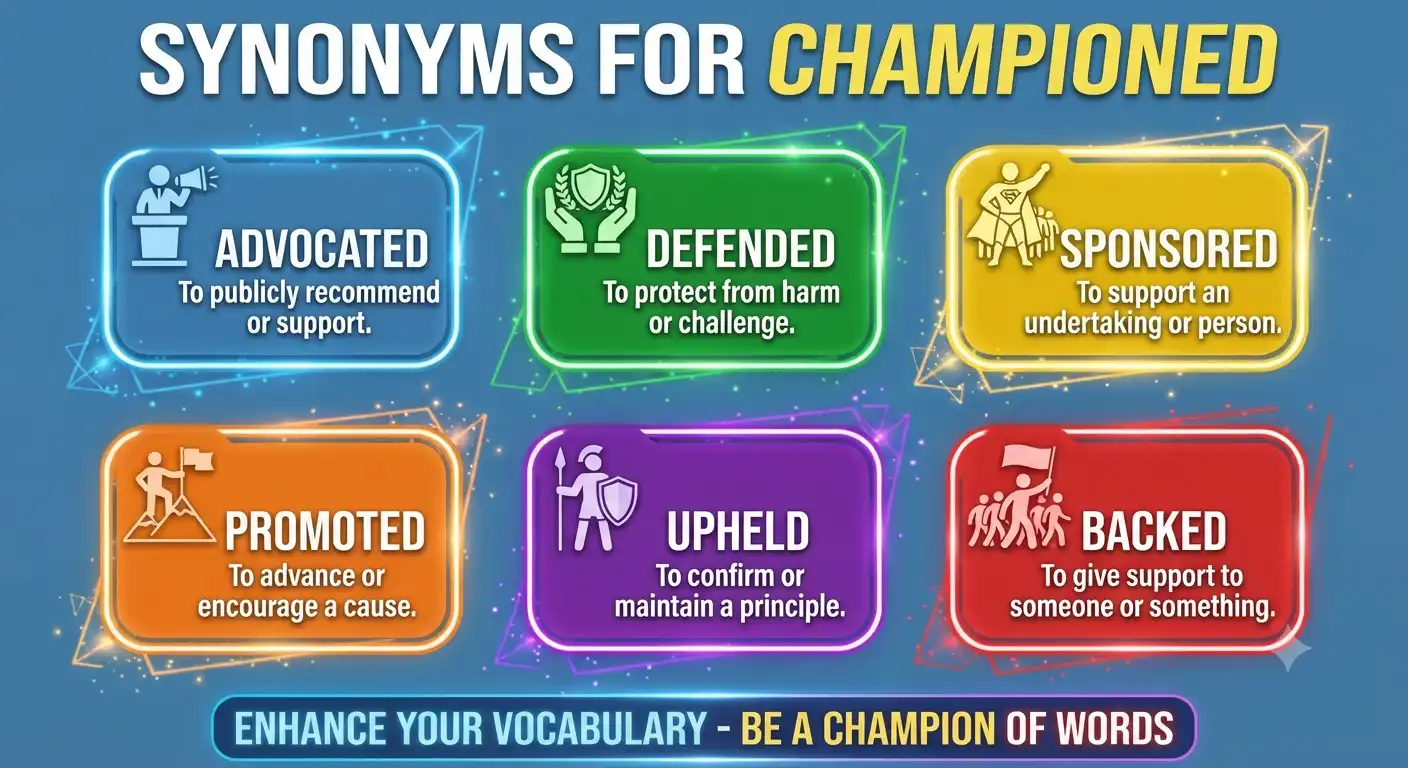
| Advocated | Spoke in support of something | Formal | Workplace, legal |
| Backed | Gave support or approval | Casual | Daily use, business |
| Supported | Helped or agreed with a cause | Neutral | Everyday, professional |
| Endorsed | Publicly approved of something | Formal | Business, politics |
| Promoted | Helped something grow or succeed | Professional | Marketing, career |
| Defended | Protected something from criticism | Emotional | Relationships, debates |
| Upheld | Kept a standard or belief alive | Formal | Legal, moral |
| Sponsored | Financially or officially supported | Professional | Events, business |
| Fought for | Struggled hard to achieve something | Emotional | Personal causes |
| Spearheaded | Led a project or movement | Professional | Workplace, leadership |
50 Synonyms for Championed
1. Advocated
Pronunciation: US: /ˈæd.və.keɪ.tɪd/ UK: /ˈæd.və.keɪ.tɪd/
Meaning: To advocate means to speak up in favor of something.
Examples:
- She advocated for better school lunches every single meeting.
- The doctor advocated for more sleep and less stress.
2. Backed
Pronunciation: US: /bækt/ UK: /bækt/
Meaning: Backed means you gave your support to a plan or person.
Examples:
- The whole team backed the new marketing idea.
- My father backed my decision to study art.
3. Supported
Pronunciation: US: /səˈpɔːr.tɪd/ UK: /səˈpɔː.tɪd/
Meaning: Supported means you helped or agreed with someone’s idea.
Examples:
- The city supported the new park project with extra funds.
- Her friends supported her through the tough exam week.
4. Endorsed
Pronunciation: US: /ɪnˈdɔːrst/ UK: /ɪnˈdɔːst/
Meaning: Endorsed means you publicly said something is good or true.
Examples:
- The coach endorsed the new training program.
- Many doctors endorsed the healthy eating guide.
5. Promoted
Pronunciation: US: /prəˈmoʊ.tɪd/ UK: /prəˈməʊ.tɪd/
Meaning: Promoted means you helped something become more popular or known.
Examples:
- The store promoted local artists every weekend.
- She promoted kindness in her small community group.
6. Defended
Pronunciation: US: /dɪˈfɛn.dɪd/ UK: /dɪˈfɛn.dɪd/
Meaning: Defended means you protected an idea or person from attack.
Examples:
- He defended his sister when others made fun of her.
- The lawyer defended the small business against a big lawsuit.
7. Upheld
Pronunciation: US: /ʌpˈhɛld/ UK: /ʌpˈhɛld/
Meaning: Upheld means you kept a rule or value strong and alive.
Examples:
- The judge upheld the original court decision.
- The team upheld their promise to donate every month.
8. Sponsored
Pronunciation: US: /ˈspɑːn.sərd/ UK: /ˈspɒn.səd/
Meaning: Sponsored means you gave money or support to help something happen.
Examples:
- The company sponsored the youth soccer league.
- She sponsored a child’s education in another country.
9. Fought for
Pronunciation: US: /fɔːt fɔːr/ UK: /fɔːt fɔː/
Meaning: Fought for means you worked very hard to get or protect something.
Examples:
- The workers fought for fair pay for two years.
- She fought for her right to speak at the meeting.
10. Stood up for
Pronunciation: US: /stʊd ʌp fɔːr/ UK: /stʊd ʌp fɔː/
Meaning: Stood up for means you defended someone bravely, even under pressure.
Examples:
- He stood up for the new student on his first day.
- The manager stood up for her team during the review.
11. Campaigned for
Pronunciation: US: /kæmˈpeɪnd fɔːr/ UK: /kæmˈpeɪnd fɔː/
Meaning: Campaigned for means you worked over time to gain support for a cause.
Examples:
- The group campaigned for cleaner rivers for three years.
- She campaigned for better wages at the factory.
12. Rallied for
Pronunciation: US: /ˈræ.lid fɔːr/ UK: /ˈræ.lid fɔː/
Meaning: Rallied for means you gathered people together to support a cause.
Examples:
- The neighbors rallied for a new safe crosswalk.
- Students rallied for more funding for the library.
13. Spearheaded
Pronunciation: US: /ˈspɪr.hɛd.ɪd/ UK: /ˈspɪə.hɛd.ɪd/
Meaning: Spearheaded means you led the very first steps of a new plan.
Examples:
- She spearheaded the recycling program at school.
- He spearheaded a food drive during the winter.
14. Pioneered
Pronunciation: US: /ˌpaɪ.əˈnɪrd/ UK: /ˌpaɪ.əˈnɪəd/
Meaning: Pioneered means you were the first to try or support a new idea.
Examples:
- The scientist pioneered a new way to clean water.
- Their store pioneered same-day delivery in the town.
15. Advanced
Pronunciation: US: /ədˈvænst/ UK: /ədˈvɑːnst/
Meaning: Advanced means you helped move an idea forward.
Examples:
- Her research advanced our understanding of the disease.
- The new law advanced worker safety across the state.
16. Furthered
Pronunciation: US: /ˈfɜːr.ðərd/ UK: /ˈfɜː.ðəd/
Meaning: Furthered means you helped a cause grow or succeed further.
Examples:
- The grant furthered the goals of the small charity.
- His speech furthered the case for renewable energy.
17. Propelled
Pronunciation: US: /prəˈpɛld/ UK: /prəˈpɛld/
Meaning: Propelled means you pushed something forward with strong energy.
Examples:
- Her hard work propelled the project to success.
- The team’s passion propelled the plan into action.
18. Encouraged
Pronunciation: US: /ɪnˈkɜːr.ɪdʒd/ UK: /ɪnˈkʌr.ɪdʒd/
Meaning: Encouraged means you gave someone hope or support to keep going.
Examples:
- She encouraged the young writer to finish her book.
- Coaches encouraged the players before the big game.
19. Embraced
Pronunciation: US: /ɪmˈbreɪst/ UK: /ɪmˈbreɪst/
Meaning: Embraced means you accepted and supported an idea fully.
Examples:
- The team embraced the new work schedule right away.
- She embraced the change with a positive attitude.
20. Favored
Pronunciation: US: /ˈfeɪ.vərd/ UK: /ˈfeɪ.vəd/
Meaning: Favored means you liked and supported one choice over others.
Examples:
- The board favored the smaller, safer plan.
- Most voters favored the new park proposal.
21. Espoused
Pronunciation: US: /ɪˈspaʊzd/ UK: /ɪˈspaʊzd/
Meaning: Espoused means you strongly adopted a belief as your own.
Examples:
- The teacher espoused kindness as a classroom rule.
- He espoused a simple, honest way of doing business.
22. Adopted
Pronunciation: US: /əˈdɑːp.tɪd/ UK: /əˈdɒp.tɪd/
Meaning: Adopted means you chose to support and follow an idea.
Examples:
- The city adopted a new plan for clean energy.
- She adopted a healthier morning routine last year.
23. Vindicated
Pronunciation: US: /ˈvɪn.dɪ.keɪ.tɪd/ UK: /ˈvɪn.dɪ.keɪ.tɪd/
Meaning: Vindicated means you proved that a person or idea was right.
Examples:
- The test results vindicated her original theory.
- His years of work were finally vindicated by the award.
24. Protected
Pronunciation: US: /prəˈtɛk.tɪd/ UK: /prəˈtɛk.tɪd/
Meaning: Protected means you kept something safe from harm.
Examples:
- The new law protected small farms from unfair pricing.
- She protected her friend’s reputation during the rumor.
25. Guarded
Pronunciation: US: /ˈɡɑːr.dɪd/ UK: /ˈɡɑː.dɪd/
Meaning: Guarded means you watched over and kept something safe.
Examples:
- He guarded the old family recipe like a secret.
- The team guarded their small budget very carefully.
26. Shielded
Pronunciation: US: /ˈʃiːl.dɪd/ UK: /ˈʃiːl.dɪd/
Meaning: Shielded means you protected something from criticism or harm.
Examples:
- The manager shielded her staff from the angry client.
- Parents shielded the kids from the bad news.
27. Recommended
Pronunciation: US: /ˌrɛk.əˈmɛn.dɪd/ UK: /ˌrɛk.əˈmɛn.dɪd/
Meaning: Recommended means you told others that something is good.
Examples:
- The nurse recommended the new health app to patients.
- She recommended the small bakery to all her friends.
28. Aided
Pronunciation: US: /ˈeɪ.dɪd/ UK: /ˈeɪ.dɪd/
Meaning: Aided means you helped make something succeed.
Examples:
- Volunteers aided the food bank during the holidays.
- Her notes aided the whole class before the test.
29. Assisted
Pronunciation: US: /əˈsɪs.tɪd/ UK: /əˈsɪs.tɪd/
Meaning: Assisted means you gave direct help to a person or cause.
Examples:
- He assisted the charity with its yearly fundraiser.
- The intern assisted the team during the busy season.
30. Boosted
Pronunciation: US: /ˈbuːs.tɪd/ UK: /ˈbuːs.tɪd/
Meaning: Boosted means you gave something extra energy or support.
Examples:
- The ad campaign boosted sales of the new product.
- Her kind words boosted his confidence before the interview.
31. Bolstered
Pronunciation: US: /ˈboʊl.stərd/ UK: /ˈbəʊl.stəd/
Meaning: Bolstered means you made something stronger with support.
Examples:
- The new data bolstered the team’s whole argument.
- Her support bolstered his courage to try again.
32. Fostered
Pronunciation: US: /ˈfɑː.stərd/ UK: /ˈfɒ.stəd/
Meaning: Fostered means you helped something grow with care over time.
Examples:
- The teacher fostered a love of reading in her class.
- The program fostered new friendships between neighbors.
33. Nurtured
Pronunciation: US: /ˈnɜːr.tʃərd/ UK: /ˈnɜː.tʃəd/
Meaning: Nurtured means you helped something grow with gentle care.
Examples:
- She nurtured the small startup for many years.
- The mentor nurtured his young student’s talent.
34. Cultivated
Pronunciation: US: /ˈkʌl.tɪ.veɪ.tɪd/ UK: /ˈkʌl.tɪ.veɪ.tɪd/
Meaning: Cultivated means you worked patiently to help something grow.
Examples:
- The company cultivated strong ties with local farmers.
- She cultivated a habit of writing every morning.
35. Propagated
Pronunciation: US: /ˈprɑː.pə.geɪ.tɪd/ UK: /ˈprɒ.pə.geɪ.tɪd/
Meaning: Propagated means you spread and supported an idea widely.
Examples:
- The group propagated the idea of shared community gardens.
- His writing propagated new thoughts about clean energy.
36. Batted for
Pronunciation: US: /ˈbæt.ɪd fɔːr/ UK: /ˈbæt.ɪd fɔː/
Meaning: Batted for means you strongly supported someone’s side or cause.
Examples:
- She always batted for the underdog in every debate.
- The lawyer batted for the small farmer against the big firm.
37. Rooted for
Pronunciation: US: /ˈruː.tɪd fɔːr/ UK: /ˈruː.tɪd fɔː/
Meaning: Rooted for means you cheered and hoped for someone’s success.
Examples:
- The whole town rooted for the local team.
- Her parents rooted for her during the big race.
38. Cheered on
Pronunciation: US: /tʃɪrd ɑːn/ UK: /tʃɪəd ɒn/
Meaning: Cheered on means you gave loud support and encouragement.
Examples:
- Fans cheered on the runner until the finish line.
- Friends cheered on her new business idea.
39. Lobbied for
Pronunciation: US: /ˈlɑː.bid fɔːr/ UK: /ˈlɒ.bid fɔː/
Meaning: Lobbied for means you tried to convince leaders to support something.
Examples:
- The group lobbied for cleaner air laws in the city.
- She lobbied for more school funding at the meeting.
40. Crusaded for
Pronunciation: US: /kruːˈseɪ.dɪd fɔːr/ UK: /kruːˈseɪ.dɪd fɔː/
Meaning: Crusaded for means you fought with strong passion for a cause.
Examples:
- He crusaded for animal rights his whole life.
- The reporter crusaded for honesty in local government.
41. Took up the cause of
Pronunciation: US: /tʊk ʌp ðə kɔːz ʌv/ UK: /tʊk ʌp ðə kɔːz ɒv/
Meaning: Took up the cause of means you began supporting a cause strongly.
Examples:
- She took up the cause of homeless families in the city.
- He took up the cause of small local shops.
42. Stood behind
Pronunciation: US: /stʊd bɪˈhaɪnd/ UK: /stʊd bɪˈhaɪnd/
Meaning: Stood behind means you fully supported a person or decision.
Examples:
- The board stood behind the manager’s tough choice.
- Her family stood behind her new career plan.
43. Backed up
Pronunciation: US: /bækt ʌp/ UK: /bækt ʌp/
Meaning: Backed up means you gave strong support with proof or presence.
Examples:
- His coworkers backed up his side of the story.
- The data backed up her claim about the results.
44. Upheld the rights of
Pronunciation: US: /ʌpˈhɛld ðə raɪts ʌv/ UK: /ʌpˈhɛld ðə raɪts ɒv/
Meaning: Upheld the rights of means you protected someone’s fair treatment.
Examples:
- The court upheld the rights of the young workers.
- She upheld the rights of every student in her class.
45. Pushed for
Pronunciation: US: /pʊʃt fɔːr/ UK: /pʊʃt fɔː/
Meaning: Pushed for means you kept trying hard to make something happen.
Examples:
- The team pushed for a shorter work week.
- She pushed for more parks in the small town.
46. Argued for
Pronunciation: US: /ˈɑːr.gjuːd fɔːr/ UK: /ˈɑː.gjuːd fɔː/
Meaning: Argued for means you gave strong reasons to support an idea.
Examples:
- He argued for a longer lunch break at work.
- The teacher argued for smaller class sizes.
47. Pleaded for
Pronunciation: US: /ˈpliː.dɪd fɔːr/ UK: /ˈpliː.dɪd fɔː/
Meaning: Pleaded for means you asked with strong feeling for support.
Examples:
- The mother pleaded for help from the neighbors.
- She pleaded for more time to finish the project.
48. Represented
Pronunciation: US: /ˌrɛp.rɪˈzɛn.tɪd/ UK: /ˌrɛp.rɪˈzɛn.tɪd/
Meaning: Represented means you spoke or acted for someone else’s cause.
Examples:
- The lawyer represented the small family in court.
- She represented her town at the state event.
49. Upheld the banner of
Pronunciation: US: /ʌpˈhɛld ðə ˈbæn.ər ʌv/ UK: /ʌpˈhɛld ðə ˈbæ.nə ɒv/
Meaning: Upheld the banner of means you proudly carried on a cause or belief.
Examples:
- He upheld the banner of fair pay for years.
- The group upheld the banner of clean water rights.
50. Stood for
Pronunciation: US: /stʊd fɔːr/ UK: /stʊd fɔː/
Meaning: Stood for means you believed in and supported an idea firmly.
Examples:
- She always stood for honesty, even when it was hard.
- The company stood for fair treatment of every worker.
“To stand for something is to give your voice to those who need it most.”
Antonyms of Championed
- Opposed
- Rejected
- Ignored
- Abandoned
- Undermined
- Discouraged
- Dismissed
- Betrayed
Prototype Meaning and Categorization of Championed
The prototype meaning of championed centers on active, public support for a cause, person, or idea. It falls under the verb category of advocacy and support, closely tied to leadership, protection, and encouragement. In everyday use, it almost always carries a positive, brave, and selfless tone, unlike neutral words such as “mentioned” or “noted.”
FAQ
1. What is the best synonym for championed? “Advocated” and “backed” are two of the strongest and most common synonyms for championed in everyday writing.
2. Is championed a formal or casual word? It works well in both. It sounds strong in formal writing like resumes and also fits casual talk about supporting a friend’s idea.
3. Can championed be used for people and ideas? Yes. You can champion a person, a cause, a policy, or even a small local business.
4. What part of speech is championed? It is the past tense form of the verb “champion.”
5. Is champion only a noun? No. Champion can be a noun (a winner) or a verb (to support strongly).
6. What is a simple definition of championed? It means you supported or defended something with strong energy and belief.
7. Are there British and American differences in pronunciation? No major difference. Both US and UK pronounce it as /ˈtʃæm.pi.ənd/.
Conclusion
Learning synonyms for championed does more than add new words to your vocabulary. It sharpens your writing, adds color to your blogging, improves your speaking, and makes your daily communication feel fresh and confident. When you know fifty ways to say the same idea, you never feel stuck searching for the right word again.
Try using these words in your next email at work, your next school essay, or even a simple daily conversation with a friend. Small changes like swapping “supported” for “spearheaded” or “backed” can make your message land with more impact. Practice makes these words feel natural instead of forced.
“The words you choose shape how strongly your message is heard.”
Keep this list close, and return to it whenever your writing feels repetitive. Over time, these words will become part of your natural vocabulary, and your writing will show it.
“Great writers are not born with a big vocabulary. They build it, one word at a time.”
“Every new word you learn is a new door your ideas can walk through.”

Robert Hayes is an ESL educator and curriculum developer with over nine years of experience teaching English to beginners and intermediate learners across multiple countries ( Biography ).