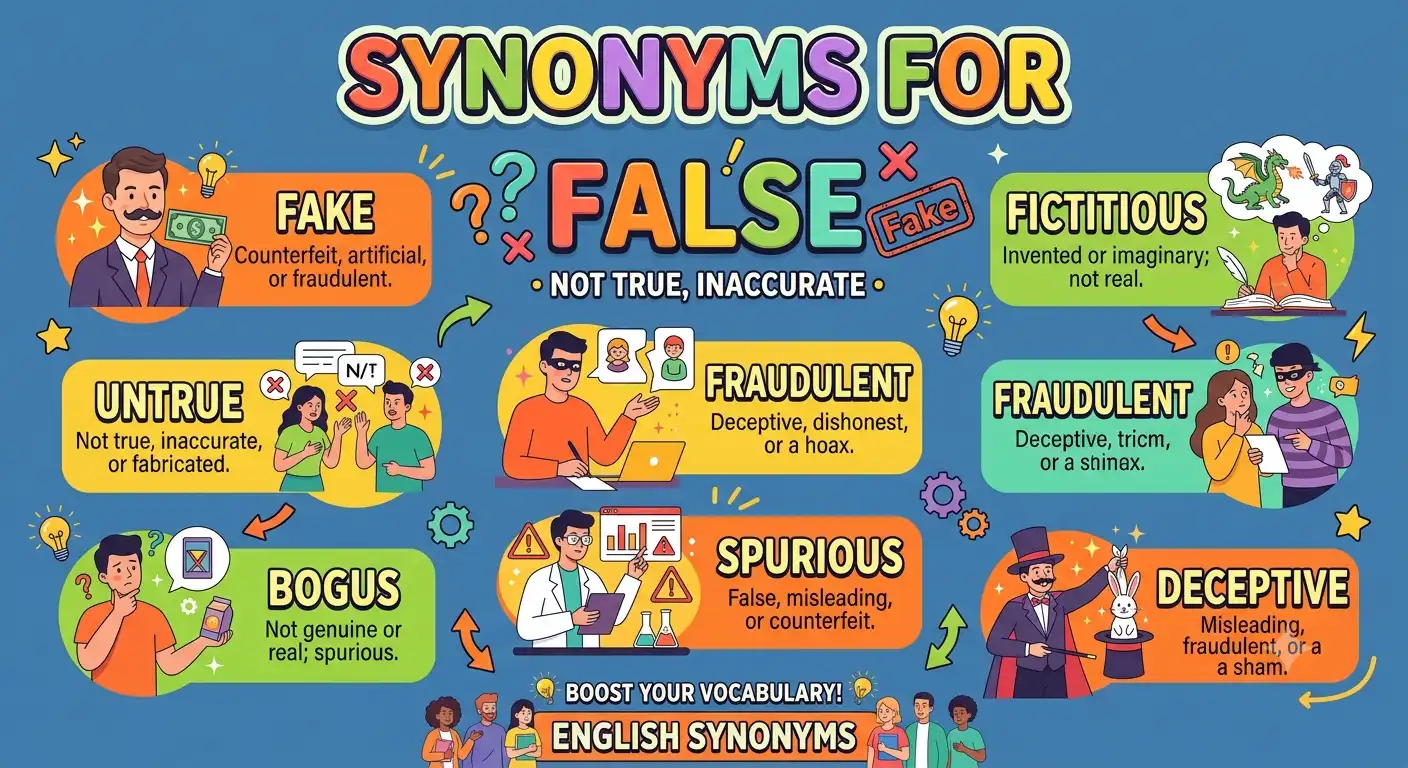
Finding exact synonyms for false helps you express truth, spot mistakes, and describe deceptive claims clearly. When you use diverse synonyms for false, your speech becomes accurate, powerful, and persuasive. Learning clean synonyms for false sharpens your daily vocabulary and elevates your writing across all types of projects.
Imagine a student named Sam writing a news report on fake online reviews. He uses the word “false” six times in one paragraph. His article begins to sound repetitive and plain. Replacing that single word with exact alternatives like “misleading,” “erroneous,” or “fraudulent” immediately makes his writing sound sharper and more authoritative.
For example, when someone shares a story that is not true, calling it an inaccurate claim clears up confusion fast. Using precise words like “untrue” or “fake” helps listeners get your point right away.
The term synonyms for false refers to alternative words and phrases that describe things that are incorrect, fake, disloyal, or dishonest. Mastering these strategic options brings strong benefits to four key groups of readers:
- Students write better essays and avoid repeating simple words in academic papers.
- Bloggers keep readers interested by using clear, vivid proofs and descriptions.
- Content writers build trust and improve search rankings with precise vocabulary.
- Daily English users express opinions clearly and communicate accurately in daily life.
“Choosing the right word turns a basic statement into a powerful truth.”
“A rich vocabulary brings total clarity and confidence to every sentence.”
Linguistic Breakdown of “False”
Connotative Meaning
The word false carries negative, deceptive, or incorrect connotations. It signals that an item, statement, or action strays from reality, lacks honesty, or contains mistakes.
Etymology
- Origin: Derived from Old English fals (fake or deceitful) and Latin falsus (deceived, mistaken, or pretended).
- Root Action: From fallere (to deceive or trip up).
- Historical Shift: Originally used to describe dishonest people or fake coins, then expanded to mean any factually incorrect statement or belief.
Pronunciation
- US (IPA): /fɑːls/
- UK (IPA): /fɔːls/
Syllables & Affixation Pattern
- Syllables: 1 syllable (false)
- Base Structure: Adjective root (false)
- Grammatical Patterns:
- Adverb form: Falsely
- Noun form: Falseness / Falsity
- Verb form: Falsify
Comparison Table: Common Synonyms for False
| Keyword | Meaning | Usage Type | Context |
| Untrue | Not agreeing with facts or truth | General / Casual | Everyday talks, simple stories, & notes |
| Incorrect | Containing a mistake or error | Formal / Neutral | Tests, math problems, & work reports |
| Fake | Made to look real to trick people | Casual / Direct | Products, reviews, & online news |
| Fraudulent | Done by cheating or breaking laws | Legal / Professional | Business deals, contracts, & finance |
| Misleading | Giving a wrong impression or idea | Analytical / Clear | Ads, news articles, & debate topics |
| Erroneous | Based on wrong information or logic | Academic / Formal | Essays, research, & scientific studies |
| Fake / Phony | Not genuine or sincere in feeling | Expressive / Casual | Personal relationships & social habits |
50 Best Synonyms for False
1. Untrue
- Pronunciation: US /ʌnˈtruː/ | UK /ʌnˈtruː/
- Meaning: Untrue means not matching real facts or actual events.
- Examples:
- The rumor about the school closing was completely untrue.
- He made an untrue statement during the class discussion.
2. Incorrect
- Pronunciation: US /ˌɪn.kəˈrekt/ | UK /ˌɪn.kərˈekt/
- Meaning: Incorrect means having a mistake or not being right.
- Examples:
- She gave an incorrect answer on the math quiz.
- The phone number on the poster was incorrect.
3. Wrong
- Pronunciation: US /rɑːŋ/ | UK /rɒŋ/
- Meaning: Wrong means not correct in fact, action, or judgment.
- Examples:
- Taking the left turn was the wrong choice.
- His guess about the movie ending was wrong.
4. Fake
- Pronunciation: US /feɪk/ | UK /feɪk/
- Meaning: Fake means made to look real in order to fool people.
- Examples:
- He bought a fake watch at the street market.
- The story on that website was totally fake.
5. Counterfeit
- Pronunciation: US /ˈkaʊn.t̬ɚ.fɪt/ | UK /ˈkaʊn.tə.fɪt/
- Meaning: Counterfeit means made illegally to pass as genuine money or goods.
- Examples:
- The bank clerk spotted a counterfeit hundred-dollar bill.
- Selling counterfeit shoes is against the law.
6. Fraudulent
- Pronunciation: US /ˈfrɑː.dʒə.lənt/ | UK /ˈfrɔː.dʒə.lənt/
- Meaning: Fraudulent means intended to cheat people out of money or rights.
- Examples:
- The police stopped a fraudulent scheme targeting shoppers.
- She reported a fraudulent charge on her credit card.
7. Bogus
- Pronunciation: US /ˈboʊ.nəs/ | UK /ˈbəʊ.ɡəs/
- Meaning: Bogus means not genuine and worthless.
- Examples:
- He tried to enter the building with a bogus pass.
- The company received bogus claims for free prizes.
8. Spurious
- Pronunciation: US /ˈspjʊr.i.əs/ | UK /ˈspjʊə.ri.əs/
- Meaning: Spurious means based on false reasoning or fake facts.
- Examples:
- The lawyer rejected the spurious arguments in court.
- Don’t rely on spurious claims without clear proof.
9. Synthetic
- Pronunciation: US /sɪnˈθet.ɪk/ | UK /sɪnˈθet.ɪk/
- Meaning: Synthetic means made by humans rather than natural processes.
- Examples:
- This coat is made from synthetic fur.
- The lab created a synthetic compound for the test.
10. Artificial
- Pronunciation: US /ˌɑːr.t̬əˈfɪʃ.əl/ | UK /ˌɑː.tɪˈfɪʃ.əl/
- Meaning: Artificial means made by people and not occurring naturally.
- Examples:
- The cake contains artificial flavors and colors.
- They put artificial grass in the small backyard.
11. Sham
- Pronunciation: US /ʃæm/ | UK /ʃæm/
- Meaning: Sham means something fake that pretends to be real.
- Examples:
- Their friendly smile was just a complete sham.
- The election was criticized as a total sham.
12. Deceptive
- Pronunciation: US /dɪˈsep.tɪv/ | UK /dɪˈsep.tɪv/
- Meaning: Deceptive means giving a wrong impression to hide the truth.
- Examples:
- The calm sea was deceptive before the big storm hit.
- The ad used deceptive words to hide extra fees.
13. Misleading
- Pronunciation: US /ˌmɪsˈliː.dɪŋ/ | UK /ˌmɪsˈliː.dɪŋ/
- Meaning: Misleading means causing someone to believe something that is not true.
- Examples:
- The headline was misleading and confused many readers.
- Maps with missing roads can be very misleading.
14. Fallacious
- Pronunciation: US /fəˈleɪ.ʃəs/ | UK /fəˈleɪ.ʃəs/
- Meaning: Fallacious means based on a mistaken idea or bad logic.
- Examples:
- The theory rests on fallacious assumptions about nature.
- He realized his reasoning was fallacious after checking the data.
15. Erroneous
- Pronunciation: US /ɪˈroʊ.ni.əs/ | UK /ɪˈrəʊ.ni.əs/
- Meaning: Erroneous means containing errors or incorrect facts.
- Examples:
- The report contained erroneous sales figures for March.
- Her conclusion was based on erroneous lab results.
16. Inaccurate
- Pronunciation: US /ɪnˈæk.jɚ.ət/ | UK /ɪnˈæk.jər.ət/
- Meaning: Inaccurate means not exact or full of errors.
- Examples:
- The weather forecast was inaccurate yesterday afternoon.
- An inaccurate clock made us late for class.
17. Phony
- Pronunciation: US /ˈfoʊ.ni/ | UK /ˈfəʊ.ni/
- Meaning: Phony means fake, insincere, or not real.
- Examples:
- He apologized with a phony smile on his face.
- She knew the caller was using a phony name.
18. Mock
- Pronunciation: US /mɑːk/ | UK /mɒk/
- Meaning: Mock means set up as an imitation for practice or trial.
- Examples:
- Students took a mock exam to prepare for finals.
- The soldiers held a mock battle in the field.
19. Simulated
- Pronunciation: US /ˈsɪm.jə.leɪ.t̬ɪd/ | UK /ˈsɪm.jə.leɪ.tɪd/
- Meaning: Simulated means created to look or feel like the real thing.
- Examples:
- Drivers practice in a simulated vehicle cabin.
- The jacket features simulated leather trim.
20. Pseudo
- Pronunciation: US /ˈsuː.doʊ/ | UK /ˈsjuː.dəʊ/
- Meaning: Pseudo means pretend, fake, or insincere.
- Examples:
- He shared pseudo facts that were not based on science.
- She acts with pseudo kindness when bosses are around.
21. Feigned
- Pronunciation: US /feɪnd/ | UK /feɪnd/
- Meaning: Feigned means pretended or put on to trick others.
- Examples:
- He showed feigned surprise when opening his present.
- She had a feigned cough to skip school today.
22. Pretend
- Pronunciation: US /prɪˈtend/ | UK /prɪˈtend/
- Meaning: Pretend means imagined or not real.
- Examples:
- Kids love playing in their pretend kitchen set.
- He put on a pretend brave face during the doctor visit.
23. Dishonest
- Pronunciation: US /dɪsˈɑː.nɪst/ | UK /dɪsˈɒn.ɪst/
- Meaning: Dishonest means lacking honesty, truth, or fairness.
- Examples:
- Telling a lie is a dishonest thing to do.
- The store lost customers due to dishonest prices.
24. Insincere
- Pronunciation: US /ˌɪn.sɪnˈsɪr/ | UK /ˌɪn.sɪnˈsɪə/
- Meaning: Insincere means not saying or showing true feelings.
- Examples:
- His apology sounded cold and insincere.
- Insincere praise does not help anyone improve.
25. Treacherous
- Pronunciation: US /ˈtretʃ.ɚ.əs/ | UK /ˈtretʃ.ər.əs/
- Meaning: Treacherous means guilty of betrayal or hidden danger.
- Examples:
- The icy roads created treacherous driving conditions.
- He felt hurt by his friend’s treacherous actions.
“Truth stands firm on facts, while false words quickly fall apart.”
26. Deceitful
- Pronunciation: US /dɪˈsiːt.fəl/ | UK /dɪˈsiːt.fəl/
- Meaning: Deceitful means behaving in a way that hides the truth.
- Examples:
- A deceitful answer will break trust between friends.
- The article exposed the company’s deceitful habits.
27. Duplicitous
- Pronunciation: US /duːˈplɪs.ə.t̬əs/ | UK /dʒuːˈplɪs.ɪ.təs/
- Meaning: Duplicitous means acting in two different ways to deceive.
- Examples:
- His duplicitous behavior hurt both of his teams.
- She avoided the duplicitous manager at work.
28. Unfaithful
- Pronunciation: US /ʌnˈfeɪθ.fəl/ | UK /ʌnˈfeɪθ.fəl/
- Meaning: Unfaithful means not loyal or faithful to a promise or person.
- Examples:
- An unfaithful friend will betray your private secrets.
- He was unfaithful to his work commitments.
29. Disloyal
- Pronunciation: US /dɪsˈlɔɪ.əl/ | UK /dɪsˈlɔɪ.əl/
- Meaning: Disloyal means failing to support a friend, team, or group.
- Examples:
- Sharing company secrets is disloyal behavior.
- She refused to listen to disloyal comments about her sister.
30. Untruthful
- Pronunciation: US /ʌnˈtruːθ.fəl/ | UK /ʌnˈtruːθ.fəl/
- Meaning: Untruthful means not telling the real truth.
- Examples:
- The witness gave untruthful testimony in court.
- An untruthful claim destroys personal credibility fast.
31. Fabricated
- Pronunciation: US /ˈfæb.rɪ.keɪ.t̬ɪd/ | UK /ˈfæb.rɪ.keɪ.tɪd/
- Meaning: Fabricated means made up or invented to deceive others.
- Examples:
- He gave a fabricated story about why he was late.
- The evidence turned out to be completely fabricated.
32. Invented
- Pronunciation: US /ɪnˈven.t̬ɪd/ | UK /ɪnˈven.tɪd/
- Meaning: Invented means created from imagination rather than real facts.
- Examples:
- She wrote about an invented kingdom in her tale.
- His excuse for missing practice was invented.
33. Mythical
- Pronunciation: US /ˈmɪθ.ɪ.kəl/ | UK /ˈmɪθ.ɪ.kəl/
- Meaning: Mythical means existing only in ancient stories or imagination.
- Examples:
- Dragons are mythical creatures found in old books.
- The secret treasure map was just a mythical tale.
34. Fictitious
- Pronunciation: US /fɪkˈtɪʃ.əs/ | UK /fɪkˈtɪʃ.əs/
- Meaning: Fictitious means created or assumed for a story or trick.
- Examples:
- The author used a fictitious name for her main character.
- He created a fictitious account to test the system.
35. Groundless
- Pronunciation: US /ˈɡraʊnd.ləs/ | UK /ˈɡraʊnd.ləs/
- Meaning: Groundless means lacking any real proof or good reason.
- Examples:
- Her fears about the trip proved to be groundless.
- The judge dismissed the groundless charges immediately.
36. Unfounded
- Pronunciation: US /ʌnˈfaʊn.dɪd/ | UK /ʌnˈfaʊn.dɪd/
- Meaning: Unfounded means not based on real facts or solid evidence.
- Examples:
- The news report was based on unfounded rumors.
- His worries about losing the key were unfounded.
37. Illusory
- Pronunciation: US /ɪˈluː.sɚ.i/ | UK /ɪˈluː.sər.i/
- Meaning: Illusory means based on an illusion and not real.
- Examples:
- Wealth from quick tricks is often purely illusory.
- The quiet peace in the room was illusory.
38. Invalid
- Pronunciation: US /ɪnˈvæl.ɪd/ | UK /ɪnˈvæl.ɪd/
- Meaning: Invalid means not legally binding or factually sound.
- Examples:
- The ticket was invalid because the date passed.
- His argument was invalid due to missing proof.
39. Flawed
- Pronunciation: US /flɑːd/ | UK /flɔːd/
- Meaning: Flawed means having defects or mistakes that ruin quality.
- Examples:
- The plan was flawed from the very start.
- She returned the flawed vase to the store.
40. Imitation
- Pronunciation: US /ˌɪm.əˈteɪ.ʃən/ | UK /ˌɪm.ɪˈteɪ.ʃən/
- Meaning: Imitation means copied from an original item and not genuine.
- Examples:
- She wore an imitation pearl necklace to the dinner.
- The restaurant serves imitation crab meat in salads.
41. Forged
- Pronunciation: US /fɔːrʒd/ | UK /fɔːdʒd/
- Meaning: Forged means copied illegally to trick people into trusting it.
- Examples:
- The thief tried to cash a forged check.
- The painting was a forged copy of an old masterwork.
42. Spoofed
- Pronunciation: US /spuːft/ | UK /spuːft/
- Meaning: Spoofed means altered to fake the real origin of a message or call.
- Examples:
- He received a call from a spoofed phone number.
- The system blocked a spoofed email address today.
43. Double-dealing
- Pronunciation: US /ˌdʌb.əlˈdiː.lɪŋ/ | UK /ˌdʌb.əlˈdiː.lɪŋ/
- Meaning: Double-dealing means practicing deceit in business or personal agreements.
- Examples:
- The partner was caught in double-dealing practices.
- Double-dealing ruins business connections very quickly.
44. Hollow
- Pronunciation: US /ˈhɑː.loʊ/ | UK /ˈhɒl.əʊ/
- Meaning: Hollow means lacking real value, truth, or true meaning.
- Examples:
- His victory felt hollow without fair play.
- She ignored his hollow promises of help.
45. Meretricious
- Pronunciation: US /ˌmer.əˈtrɪʃ.əs/ | UK /ˌmer.ɪˈtrɪʃ.əs/
- Meaning: Meretricious means attractive on the surface but having no real worth.
- Examples:
- The cheap toy had a meretricious shine that faded fast.
- He saw through the meretricious offer right away.
46. Specious
- Pronunciation: US /ˈspiː.ʃəs/ | UK /ˈspiː.ʃəs/
- Meaning: Specious means seeming right at first but actually wrong.
- Examples:
- The ad made specious claims about instant weight loss.
- She spotted the specious argument in the essay.
47. Hypocritical
- Pronunciation: US /ˌhɪp.əˈkrɪt̬.ɪ.kəl/ | UK /ˌhɪp.əˈkrɪt.ɪ.kəl/
- Meaning: Hypocritical means pretending to have good beliefs that you do not follow.
- Examples:
- It is hypocritical to tell others not to litter while dropping trash yourself.
- Her hypocritical advice was ignored by the team.
48. Unsound
- Pronunciation: US /ʌnˈsaʊnd/ | UK /ʌnˈsaʊnd/
- Meaning: Unsound means not safe, solid, or logically correct.
- Examples:
- The old wooden bridge was declared structurally unsound.
- Building a plan on rumors is logically unsound.
49. Misguided
- Pronunciation: US /ˌmɪsˈɡaɪ.dɪd/ | UK /ˌmɪsˈɡaɪ.dɪd/
- Meaning: Misguided means led by wrong ideas, poor judgment, or mistaken beliefs.
- Examples:
- His misguided efforts caused more work for everyone.
- She realized her trust in the rumor was misguided.
50. Faulty
- Pronunciation: US /ˈfɑːl.t̬i/ | UK /ˈfɔːl.ti/
- Meaning: Faulty means having errors, defects, or bad connections.
- Examples:
- The house had faulty wiring that needed fixing.
- His faulty logic led to the wrong answer.
Antonyms of “False”
Knowing opposite words helps you highlight truth, accuracy, and genuine quality in writing.
- True: Agreeing with real facts, actual events, or reality.
- Accurate: Free from mistakes or errors; exact in detail.
- Genuine: Real, authentic, and not fake or copied.
- Honest: Free of deceit; truthful and sincere in character.
- Valid: Well-grounded, sound, and legally or logically correct.
- Authentic: Real, original, and true to its source.
Prototype Meaning & Categorization of “False”
The core concept of false rests on factual error, intentional trickery, fake appearance, and disloyalty. Depending on your essay or conversation context, these 50 synonyms divide into four main groups:
- Factually Incorrect & Logical Errors: Untrue, incorrect, wrong, erroneous, fallacious, inaccurate, groundless, unfounded, invalid, flawed, unsound, misguided, faulty, specious.
- Deceptive, Fake & Counterfeit Items: Fake, counterfeit, fraudulent, bogus, spurious, synthetic, artificial, sham, mock, simulated, pseudo, fabricated, imitation, forged, spoofed, meretricious.
- Dishonest & Insincere Personal Traits: Phony, feigned, pretend, dishonest, insincere, deceitful, duplicitous, double-dealing, hollow, hypocritical, misleading, deceptive.
- Disloyal & Betraying Behavior: Treacherous, unfaithful, disloyal, untruthful, invented, mythical, fictitious, illusory.
Frequently Asked Questions (FAQs)
1. What is the most formal synonym for “false” in academic essays?
In formal college research papers and essays, “erroneous,” “inaccurate,” and “fallacious” are top choices. They describe logical errors or wrong facts without sounding informal.
2. Can I use “fake” instead of “false” in official reports?
“Fake” works best in casual writing, reviews, or news stories about counterfeit products. In official or business reports, terms like “fraudulent,” “counterfeit,” or “inaccurate” are much better.
3. What is the main difference between “false” and “misleading”?
Something that is false is entirely incorrect or untrue. Something that is misleading might contain a small real fact but is presented in a way that tricks readers into drawing a wrong conclusion.
4. Which synonym for “false” works best for fake products?
When describing fake physical items like bags, shoes, or money, use “counterfeit,” “imitation,” or “forged.”
5. What does “specious” mean when replacing “false”?
“Specious” describes an argument or statement that looks correct at first glance but turns out to be completely false upon closer study.
6. How does varying synonyms for “false” improve SEO content?
Using diverse synonyms prevents repetitive language penalties, satisfies user search intent across different query types, and helps search engines understand the exact topic of your article.
Conclusion
Expanding your collection of synonyms for false brings clarity, precision, and confidence to your language. Replacing overused words with exact choices like untrue, erroneous, fraudulent, or misleading ensures your points hit home with total accuracy.
Whether you write academic essays, publish engaging blog posts, compose business emails, or speak in daily conversations, choosing exact vocabulary builds instant credibility. Varied words clear away vague phrasing and transform basic statements into strong, persuasive arguments. Start practicing these 50 synonyms today to elevate your written and spoken English.
“Clear word choices bring quiet strength and authority to every message.”
“Mastering exact vocabulary turns simple thoughts into powerful expressions.”

Robert Hayes is an ESL educator and curriculum developer with over nine years of experience teaching English to beginners and intermediate learners across multiple countries ( Biography ).