Quick Introduction
The word horizon appears in daily speech, travel writing, poetry, and academic texts. It can describe what we see in the distance or future possibilities. Learning synonyms helps you express ideas more clearly and avoid repetition.
Direct Answer
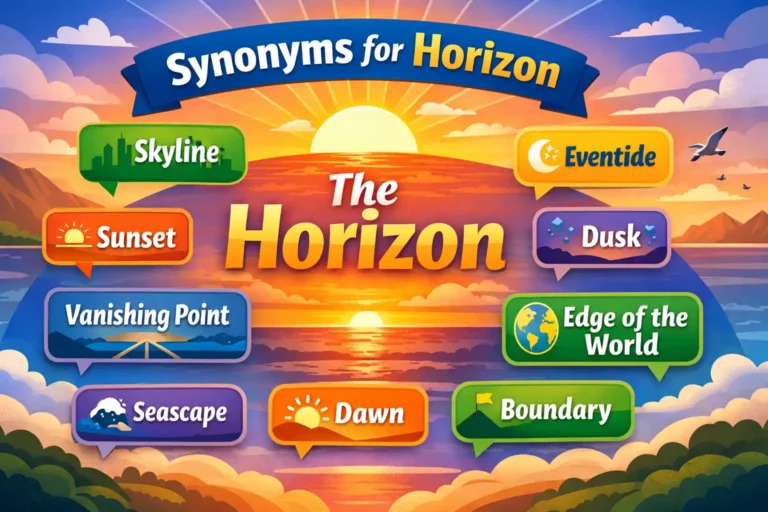
Synonyms for horizon include words that describe the visible line where the earth and sky meet or the idea of future possibilities.
- Skyline
- Horizon line
- Vista
- Outlook
- Prospect
- Frontier
- Verge
- Brink
Meaning of Horizon
The horizon is the line where the earth or sea appears to meet the sky. It can also mean the limit of what someone knows or the future that lies ahead.
Example: We watched the sun disappear below the horizon.
Categories of Synonyms
1. Physical View or Landscape
These words describe what you can see in the distance, especially in nature or scenery.
2. Future Possibilities or Opportunities
These synonyms focus on progress, growth, or something new that may happen.
3. Limits or Boundaries
Some alternatives emphasize the edge or limit of knowledge, experience, or space.
Synonyms Table (Corrected with Closest Meaning)
| Word | Closest Meaning | Simple Meaning | Example Sentence |
| Skyline | Physical horizon (city context) | The outline where buildings meet the sky | The sunset looked amazing against the skyline. |
| Horizon line | Exact match (technical) | The visible line where earth and sky meet | The artist carefully drew the horizon line. |
| Vista | Scenic view / distant view | A wide, beautiful view into the distance | The hill offered a breathtaking vista. |
| Outlook | Future horizon (figurative) | What may happen in the future | The economic outlook looks positive. |
| Prospect | Future possibility | The chance of something happening | The job prospect excited her. |
| Frontier | New future area / progress | A new area for exploration or growth | Technology is the next frontier. |
| Verge | Point just before something | The moment before change happens | The company is on the verge of success. |
| Brink | Edge before an event | A critical moment before change | They stood on the brink of discovery. |
| Distance | Far visible area | A place far away that you can see | Mountains appeared in the distance. |
| Expanse | Wide open view | A large, open area | We admired the expanse of the ocean. |
Master Synonyms List (Grouped by Level)
Beginner / Simple
Boundary — a line that marks an ending point
Example: The trees marked the boundary of the field.
Edge — the outer part of something
Example: The boat moved toward the edge of the lake.
Limit — the farthest point possible
Example: The city lights faded at the limit of vision.
Intermediate
Panorama — a wide, impressive view
Example: The mountain peak revealed a stunning panorama.
Distance — a faraway area you can see
Example: A storm formed in the distance.
Expanse — a large, open space
Example: The travelers crossed the sandy expanse.
Advanced / Formal
Periphery (Formal) — the outer edge of an area or field
Example: The village lay on the periphery of the forest.
Extent (Formal) — the range or scope of something
Example: We could not see the full extent of the valley.
Fringe (Formal/Neutral) — the outer border of something
Example: Small houses stood on the fringe of town.
Formal vs Informal Synonyms
Some synonyms fit casual conversation, while others suit formal writing.
- Informal / Everyday: edge, distance, outlook
- Neutral: boundary, panorama, prospect
- Formal: periphery, extent, frontier
Choose based on your audience. Academic or business writing often needs more formal vocabulary.
Real-Life Usage Examples
Conversation
“I saw dark clouds forming on the horizon.”
Academic Writing
“The discovery expanded the scientific horizon of the field.”
Business Writing
“New markets are on the company’s horizon.”
Blogging
“Travel opens your horizon and changes how you see the world.”
Emotional Expression
“Hope appeared on her horizon after months of struggle.”
Similar Words Comparison
Horizon vs Skyline
- Horizon refers to the natural meeting line of earth and sky.
- Skyline usually describes the outline of buildings in a city.
Example:
We watched the sunset on the horizon.
The city skyline looked beautiful at night.
Horizon vs Frontier
- Horizon often suggests something visible or future possibilities.
- Frontier means a new area for exploration or development.
Example:
New opportunities appeared on his horizon.
Space exploration is the next frontier.
Example Sentences (Corrected & Natural)
- The ship disappeared beyond the horizon. ✅
- A new career path appeared on her horizon. ✅ (figurative, natural)
- Birds flew across the distant skyline. ✅
- We admired the vast panorama from the tower. ✅
- The desert stretched toward the horizon without end. ✅ (fixed for clarity)
- Opportunity was on the brink of becoming reality. ✅
- The research pushed the frontier of science forward. ✅
- Mountains appeared faintly in the distance. ✅ (corrected wording)
- He stared toward the horizon, lost in thought. ✅ (more natural)
- The ocean looked endless across the expanse. ✅
- The sun rose slowly above the horizon line. ✅
- The company’s outlook improved after the merger. ✅ (figurative only — corrected)
- The project was on the verge of completion. ✅
- Her knowledge expanded beyond her previous horizons. ✅ (natural plural figurative use)
- City lights glowed along the skyline at night. ✅
Common Mistakes
1. Using “skyline” for nature scenes incorrectly
Skyline often refers to buildings, not oceans or mountains.
2. Confusing “frontier” with physical views
Frontier usually means new development or exploration, not scenery.
3. Overusing one synonym repeatedly
Repeating the same word reduces clarity and variety.
4. Choosing overly formal words in casual speech
Words like periphery may sound unnatural in conversation.
Tips / Best Practices
- Consider tone: Formal writing needs precise vocabulary.
- Check context: Physical scenery vs future metaphor matters.
- Match formality: Choose words your audience understands.
- Keep clarity first: Simple words often work best.
- Avoid overuse: Do not repeat the same synonym too often.
When NOT to Use Horizon
Do not use horizon when you mean a close or immediate object. It describes distance or future possibilities, not nearby items.
Incorrect: The book was on the horizon of the table.
Correct: The book was on the edge of the table.
Opposite Words (Antonyms)
These words describe things that are close instead of far away, which contrasts with the distant nature of a horizon.
- Foreground — the area closest to the viewer
- Proximity — nearness in distance or space
- Nearby — close to your current location
- Close-up — a very near view of something
- Immediate surroundings — the area around you
FAQs
What does horizon mean?
It is the line where the earth or sea seems to meet the sky, or it can mean future possibilities.
Is horizon formal or informal?
It is neutral and works in both casual and formal contexts.
How can I use it in conversation?
You can say, “I see better opportunities on the horizon.”
What is the best synonym for horizon?
It depends on context. Vista works for scenery, while prospect works for future possibilities.
Can horizon be replaced with skyline?
Only when talking about the outline of buildings, not natural scenery.
Conclusion
Learning synonyms for horizon improves both writing and speaking. You gain flexibility, avoid repetition, and communicate ideas more clearly. Strong vocabulary also helps in academic and professional settings.
Try using three new synonyms in your next sentence to build confidence and fluency.

Danial Karter is a research-focused language writer specializing in word meaning, semantic comparison, and precise usage in modern English. His work centers on helping readers understand subtle differences between similar words, phrases, and expressions so they can communicate more clearly and accurately. With a background in editorial research and reference-based writing, Danial has spent years studying how vocabulary evolves across academic, professional, and everyday contexts.
His approach combines linguistic research, dictionary-level verification, and real-world usage analysis. Rather than relying on opinion or simplified definitions, Danial examines how words function in context — including tone, connotation, grammatical role, and situational appropriateness. This method allows readers to see not only what words mean, but when and why one term is more suitable than another.
Danial’s work focuses heavily on synonym comparison, commonly confused words, and semantic clarity. He is particularly interested in the relationship between language precision and reader understanding, ensuring that explanations remain accessible without sacrificing accuracy. His writing style reflects editorial standards commonly used in reference publishing: clear structure, neutral tone, and evidence-based explanations.
Through research-based informational content, Danial helps students, writers, professionals, and language learners make confident vocabulary choices. His articles are designed to answer specific search questions about word differences while providing reliable linguistic context that supports long-term learning.
As part of an editorial content team dedicated to language accuracy, Danial contributes to maintaining consistency, factual correctness, and clarity across educational resources focused on English synonyms and meaning distinctions. His work supports readers who value careful wording, informed communication, and dependable explanations of language use.