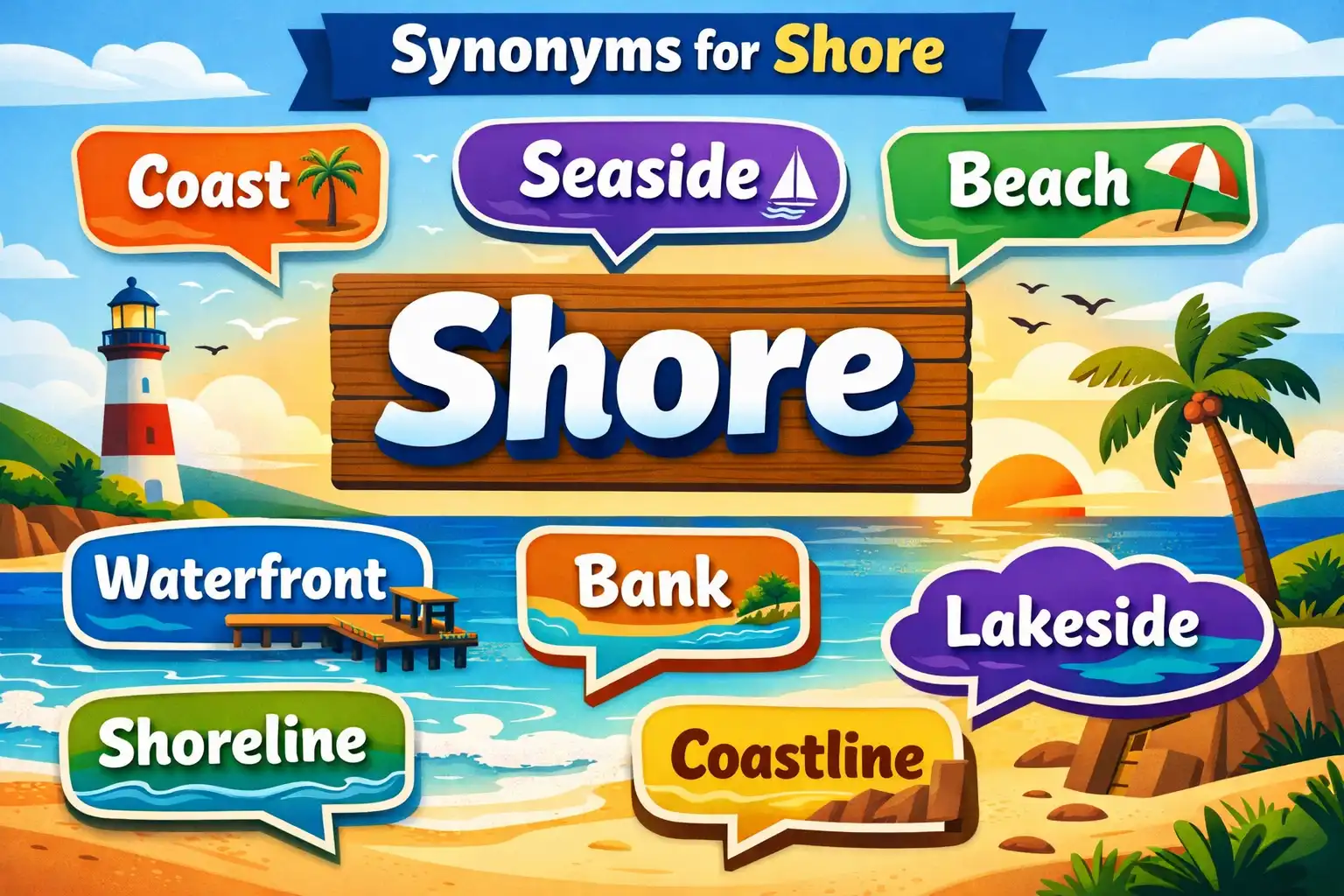
Finding dynamic synonyms for shore is the perfect way to breathe new life into your descriptive writing. When you use diverse synonyms for shore, you avoid sounding repetitive and give your readers a clearer mental picture of where the water meets the dry land. Knowing a variety of synonyms for shore allows you to accurately describe any waterfront setting, from a rugged oceanic cliff to a peaceful lakeside edge.
Picture a travel blogger writing a review about an island trip: “We walked down to the shore, sat on the shore, and watched the boats leave the shore.” Reading that feels incredibly flat and repetitive! By swapping out those words for rich alternatives, your text immediately becomes more captivating. In very basic terms, a shore is simply the land that sits right along the edge of an ocean, sea, lake, or large river.
This specific vocabulary set is highly valuable across many daily activities. Students can use these descriptive terms to score higher marks on creative writing assignments and essays. Bloggers and content writers will boost their organic search visibility while keeping their audiences reading for longer. Even daily English users can benefit by sounding more expressive during casual vacation storytelling or professional workplace presentations.
“The voice of the sea speaks to the soul.” — Kate Chopin
“To vocabulary, every word added is a brand-new window opened to look at the wide world.” — Unknown
Word Profile: Shore
Connotative Meaning
The literal meaning of shore is land touching a body of water, but its deeper connotation evokes feelings of peace, safety, boundaries, and arrival. Historically, reaching the shore meant surviving a difficult sea voyage. Today, it frequently brings to mind relaxation, summer vacations, and the restorative power of nature.
Etymology
- Middle English: Evolved from the word schore, indicating a brink, edge, or rugged coast.
- Middle Low German: Closely tied to the word schore, meaning a coast or land projecting into the sea.
- Proto-Germanic: Traced back to *skura-, which relates to the concept of cutting or shearing, as the land appears cut off by the water.
Pronunciation & Linguistics
- US Pronunciation (IPA): /ʃɔr/
- UK Pronunciation (IPA): /ʃɔː/
- Syllables: 1 syllable (shore)
- Affixation Pattern: It is a base root morpheme. It easily takes affixes to form compound nouns or verbs like shoreline, offshore, and onshore.
Prototype Meaning and Categorization
The prototype of a shore is a flat, sandy, or pebbly edge of an ocean where small waves continuously crash. Structurally, it falls under the category of a concrete noun, though it can sometimes act as a transitive verb when meaning to support something.
Core Comparison Table
This easy-to-read comparison table shows how common words differ in meaning, tone, and everyday usage.
| Keyword | Meaning | Usage Type | Context |
|---|---|---|---|
| Shore | Land along the edge of a body of water | Neutral | Daily use, geography, travel writing |
| Coast | Large land area next to the sea | Professional | Weather reports, maps, legal boundaries |
| Beach | Sandy or pebbly sloping water edge | Casual | Vacations, relationships, relaxation |
| Bank | Sloping ground alongside a river | Casual / Professional | Fishing, environment, daily chats |
| Waterfront | Part of a town that faces the water | Professional | Real estate, workplace, business |
| Strand | An old-fashioned term for a beach | Formal / Emotional | Poetry, literature, creative design |
| Brink | The extreme edge before a steep drop | Emotional | Dramatic stories, relationships, warnings |
| Lakeside | The specific land surrounding a lake | Casual | Camping, holidays, real estate |
“A clear difference between the right word and the almost right word is the difference between lightning and a lightning bug.” — Mark Twain
50 Synonyms for Shore
1. Coast
- Pronunciation: US: /koʊst/ | UK: /əʊst/
- Meaning: The large stretch of land that sits right next to the open sea.
- Examples:
- We love to drive along the rocky coast.
- The cold wind blew in from the coast.
2. Beach
- Pronunciation: US: /bitʃ/ | UK: /biːtʃ/
- Meaning: A sandy or pebbly strip of land right by the water.
- Examples:
- The children built a sandcastle on the warm beach.
- We walked along the sunny beach all morning.
3. Shoreline
- Pronunciation: US: /ˈʃɔrˌlaɪn/ | UK: /ˈʃɔːlaɪn/
- Meaning: The exact edge line where the water meets the dry land.
- Examples:
- You can see birds flying all along the shoreline.
- The rising tide hid the sandy shoreline completely.
4. Coastline
- Pronunciation: US: /ˈkoʊstˌlaɪn/ | UK: /ˈəʊstlaɪn/
- Meaning: The overall shape or physical outline of a country’s coast.
- Examples:
- This map outlines the long coastline of the island.
- The rugged coastline has many hidden caves.
5. Bank
- Pronunciation: US: /bæŋk/ | UK: /bæŋk/
- Meaning: The sloping ground that runs alongside a moving river or stream.
- Examples:
- He sat quietly on the river bank to fish.
- Green grass grows thick on the muddy bank.
6. Seaboard
- Pronunciation: US: /ˈsiˌbɔrd/ | UK: /ˈsiːbɔːd/
- Meaning: The continuous region of land that runs along the sea.
- Examples:
- Major shipping cities sit on the eastern seaboard.
- A massive storm hit the entire Atlantic seaboard.
7. Seaside
- Pronunciation: US: /ˈsiˌsaɪd/ | UK: /ˈsiːsaɪd/
- Meaning: A vacation area or small town right next to the ocean.
- Examples:
- They spent their summer at a quiet seaside cottage.
- I love the smell of fresh seaside air.
8. Waterfront
- Pronunciation: US: /ˈwɔtərˌfrʌnt/ | UK: /ˈwɔːtəfrʌnt/
- Meaning: The section of a city or town that directly faces the water.
- Examples:
- We ate dinner at a nice restaurant on the waterfront.
- The city built a new park along the busy waterfront.
9. Strand
- Pronunciation: US: /strænd/ | UK: /strænd/
- Meaning: A literary or old word for a long beach or shore.
- Examples:
- The white strand stretched out for miles ahead.
- Seaweed washed up onto the lonely strand.
10. Littoral
- Pronunciation: US: /ˈlɪtərəl/ | UK: /ˈlɪtərəl/
- Meaning: The technical zone of land that lies close to a shore.
- Examples:
- Scientists study the plants in the littoral zone.
- Crabs live happily in this wet littoral habitat.
11. Edge
- Pronunciation: US: /ɛdʒ/ | UK: /ɛdʒ/
- Meaning: The outer boundary line where a piece of land stops.
- Examples:
- Do not stand too close to the water’s edge.
- He dropped a small rock over the sharp edge.
12. Border
- Pronunciation: US: /ˈbɔrdər/ | UK: /ˈbɔːdə/
- Meaning: The dividing line or margin that surrounds an area of land.
- Examples:
- Trees grow thick along the lake’s outer border.
- We set up our camp near the water border.
13. Margin
- Pronunciation: US: /ˈmɑrdʒən/ | UK: /ˈmɑːdʒɪn/
- Meaning: The narrow strip of land forming the outer limit of a lake.
- Examples:
- Wild flowers grow nicely along the river margin.
- Frogs jumped out from the muddy water margin.
14. Brink
- Pronunciation: US: /brɪŋk/ | UK: /brɪŋk/
- Meaning: The very edge of a high bank or steep cliff over water.
- Examples:
- The deer stood nervously on the brink of the river.
- He looked over the dangerous brink into the crashing waves.
15. Verges
- Pronunciation: US: /vɜrdʒɪz/ | UK: /vɜːdʒɪz/
- Meaning: The narrow borders or edges that frame a body of water.
- Examples:
- Thick green moss covered the watery verges.
- They walked carefully along the grassy verges of the canal.
16. Lakeside
- Pronunciation: US: /ˈleɪkˌsaɪd/ | UK: /ˈleɪksaɪd/
- Meaning: The pleasant land that surrounds the perimeter of a lake.
- Examples:
- We rented a small log cabin on the lakeside.
- The children love playing on the grassy lakeside.
17. Riverside
- Pronunciation: US: /ˈrɪvərˌsaɪd/ | UK: /ˈrɪvəsaɪd/
- Meaning: The strip of land located directly beside a running river.
- Examples:
- They enjoyed a slow afternoon walk along the riverside.
- The old path follows the winding riverside closely.
18. Oceanfront
- Pronunciation: US: /ˈoʊʃənˌfrʌnt/ | UK: /ˈəʊʃənfrʌnt/
- Meaning: Land or property that faces the open ocean directly.
- Examples:
- The expensive oceanfront hotels offer a beautiful view.
- We watched the morning sunrise from our oceanfront deck.
19. Beachside
- Pronunciation: US: /ˈbitʃˌsaɪd/ | UK: /ˈbiːtʃsaɪd/
- Meaning: The area located immediately next to a sandy beach.
- Examples:
- They sell cold ice cream at the beachside shop.
- We stayed in a lovely beachside resort last week.
20. Water’s Edge
- Pronunciation: US: /ˈwɔtərz ɛdʒ/ | UK: /ˈwɔːtəz ɛdʒ/
- Meaning: The precise physical line where water kisses the dry land.
- Examples:
- The small boat pulled up right to the water’s edge.
- Little sea shells scattered all along the water’s edge.
21. Plage
- Pronunciation: US: /plɑːʒ/ | UK: /plɑːʒ/
- Meaning: A foreign or sophisticated word used to describe a public resort beach.
- Examples:
- The wealthy travelers relaxed on the sunny French plage.
- Colorful umbrellas covered the beautiful seaside plage.
22. Foreshore
- Pronunciation: US: /ˈfɔrˌʃɔr/ | UK: /ˈfɔːʃɔː/
- Meaning: The specific part of a shore that lies between the high and low water marks.
- Examples:
- The wet foreshore is full of small tide pools.
- You can hunt for smooth rocks on the rocky foreshore.
23. Intertidal Zone
- Pronunciation: US: /ˌɪntərˈtaɪdəl zoʊn/ | UK: /ˌɪntəˈtaɪdəl zəʊn/
- Meaning: The strip of shore that is exposed to air at low tide and underwater at high tide.
- Examples:
- Starfish live inside the rocky intertidal zone.
- The ocean water floods the intertidal zone twice every day.
24. Sea Edge
- Pronunciation: US: /si ɛdʒ/ | UK: /siː ɛdʒ/
- Meaning: The basic geographic point where the open sea ends and ground begins.
- Examples:
- Tall, dark cliffs look down upon the windy sea edge.
- We set up our cameras right at the stormy sea edge.
25. Sand
- Pronunciation: US: /sænd/ | UK: /sænd/
- Meaning: The loose granular substance forming the surface of many shores.
- Examples:
- The hot sand burned the bottoms of my feet.
- We brushed the soft sand off our beach towels.
26. Sands
- Pronunciation: US: /sændz/ | UK: /sændz/
- Meaning: A plural poetic expression used to describe a vast area of beach shore.
- Examples:
- The golden sands of the desert meet the blue sea.
- They ran barefoot across the smooth, open sands.
27. Shingle
- Pronunciation: US: /ˈʃɪŋɡəl/ | UK: /ˈʃɪŋɡəl/
- Meaning: A stony or pebbly beach surface without much sand.
- Examples:
- The heavy waves rattled the loose stones on the shingle.
- Walking on the steep shingle beach is hard work.
28. Waterfront Strip
- Pronunciation: US: /ˈwɔtərˌfrʌnt strɪp/ | UK: /ˈwɔːtəfrʌnt strɪp/
- Meaning: A long, narrow line of land facing a lake or sea harbor.
- Examples:
- Bright neon signs lit up the local waterfront strip.
- Many gift stores operate along the crowded waterfront strip.
29. Embankment
- Pronunciation: US: /ɛmˈbæŋkmənt/ | UK: /ɪmˈbæŋkmənt/
- Meaning: A man-made wall of earth or stone built to keep water back.
- Examples:
- People walked their dogs along the stone embankment.
- The rising river almost spilled over the high embankment.
30. Levee
- Pronunciation: US: /ˈlɛvi/ | UK: /ˈlɛvi/
- Meaning: An artificial bank built alongside a river to prevent dangerous flooding.
- Examples:
- The water level rose up close to the dirt levee.
- Engineers checked the concrete levee for structural cracks.
31. Pier Edge
- Pronunciation: US: /pɪr ɛdʒ/ | UK: /pɪər ɛdʒ/
- Meaning: The dry walking space directly bordering a wooden pier structure.
- Examples:
- Fishermen stood patiently near the deep pier edge.
- Small boats tied up tight to the wooden pier edge.
32. Slipway
- Pronunciation: US: /ˈslɪpˌweɪ/ | UK: /ˈslɪpweɪ/
- Meaning: A sloped stone shore area used for launching boats into water.
- Examples:
- They backed the car trailer down the wet slipway.
- Green slime made the old boat slipway very slippery.
33. Front
- Pronunciation: US: /frʌnt/ | UK: /frʌnt/
- Meaning: A short term for a seaside promenade or town road facing water.
- Examples:
- We took a fast evening walk down along the sea front.
- Crowds gathered on the front to see the fireworks.
34. Promenade
- Pronunciation: US: /ˌprɑməˈneɪd/ | UK: /ˌprɒməˈnɑːd/
- Meaning: A wide paved public path designed for walking along a shore.
- Examples:
- Couples walked slowly along the concrete ocean promenade.
- Bicycles are not allowed on the busy seaside promenade.
35. Broadwalk
- Pronunciation: US: /ˈbrɔdˌwɔk/ | UK: /ˈbrɔːdwɔːk/
- Meaning: A wooden path built for walking over sandy beach shores.
- Examples:
- The lively broadwalk is packed with summer tourists.
- We bought tasty popcorn on the ocean broadwalk.
36. Sea Margin
- Pronunciation: US: /si /ˈmɑrdʒən/ | UK: /siː /ˈmɑːdʒɪn/
- Meaning: A poetic description for the boundary where the ocean finishes.
- Examples:
- Gulls searched for small fish along the quiet sea margin.
- The sun dropped down low past the distant sea margin.
37. Lake Margin
- Pronunciation: US: /leɪk /ˈmɑrdʒən/ | UK: /leɪk /ˈmɑːdʒɪn/
- Meaning: The soft earth border surrounding a flat lake body.
- Examples:
- Tall reeds grow heavily along the muddy lake margin.
- Wild ducks nested safely inside the lake margin.
38. Quay Edge
- Pronunciation: US: /ki ɛdʒ/ | UK: /kiː ɛdʒ/
- Meaning: The solid stone surface of a wharf where ships load cargo.
- Examples:
- Large crates sat waiting right on the stone quay edge.
- The sailor stepped off his boat onto the dry quay edge.
39. Wharfside
- Pronunciation: US: /ˈhwɔrfˌsaɪd/ | UK: /ˈwɔːfsaɪd/
- Meaning: The land area running directly adjacent to a ship loading wharf.
- Examples:
- Workers operated loud cranes on the busy wharfside.
- The historic restaurant sits on the old wooden wharfside.
40. Dockside
- Pronunciation: US: /ˈdɑkˌsaɪd/ | UK: /ˈdɒksaɪd/
- Meaning: The industrial or commercial ground immediately surrounding ship docks.
- Examples:
- Heavy trucks moved cargo across the wet dockside area.
- The police officer patrolled the dark dockside streets.
41. Marina Border
- Pronunciation: US: /məˈrinə ˈbɔrdər/ | UK: /məˈriːnə ˈbɔːdə/
- Meaning: The built walking edge enclosing a luxury boat harbor.
- Examples:
- Expensive yachts parked neatly by the marina border.
- We strolled past beautiful boats along the marina border.
42. Coast Margin
- Pronunciation: US: /koʊst /ˈmɑrdʒən/ | UK: /əʊst /ˈmɑːdʒɪn/
- Meaning: The outer geographic belt of a continent touching water.
- Examples:
- Dense pine forests run directly down to the coast margin.
- Fog covered the cold coast margin early this morning.
43. Riparian Strip
- Pronunciation: US: /raɪˈpɛriən strɪp/ | UK: /raɪˈpeərɪən strɪp/
- Meaning: The legal or scientific name for land lining a freshwater bank.
- Examples:
- Protecting the riparian strip keeps river water clean.
- Many rare birds live inside this green riparian strip.
44. Delta Edge
- Pronunciation: US: /ˈdɛltə ɛdʒ/ | UK: /ˈdɛltə ɛdʒ/
- Meaning: The muddy land points where a splitting river reaches the sea.
- Examples:
- Silt builds up quickly along the shallow delta edge.
- Local fishermen navigate the channels near the delta edge.
45. Estuary Bank
- Pronunciation: US: /ˈɛstʃuˌɛri bæŋk/ | UK: /ˈɛstjʊəri bæŋk/
- Meaning: The earth sides of a wide tidal river mouth area.
- Examples:
- Tides push salt water high up the estuary bank.
- Many wading birds look for food along the muddy estuary bank.
46. Mudflats
- Pronunciation: US: /ˈmʌdˌflæts/ | UK: /ˈmʌdflæts/
- Meaning: Flat muddy areas of shore that show during low tides.
- Examples:
- The retreating ocean left wide mudflats behind.
- Be careful not to get stuck out on the wet mudflats.
47. Pebble Beach
- Pronunciation: US: /ˈpɛbəl bitʃ/ | UK: /ˈpɛbəl biːtʃ/
- Meaning: A waterfront shore comprised entirely of small rounded stones.
- Examples:
- The incoming waves made a loud grinding noise on the pebble beach.
- We collected smooth purple stones on the pebble beach.
48. Lakeside Strip
- Pronunciation: US: /ˈleɪkˌsaɪd strɪp/ | UK: /ˈleɪksaɪd strɪp/
- Meaning: A small stretch of public land touching a fresh lake.
- Examples:
- They bought a narrow lakeside strip of land to park their boat.
- A paved walking path runs down the lakeside strip.
49. Sea Border
- Pronunciation: US: /si ˈbɔrdər/ | UK: /siː ˈbɔːdə/
- Meaning: The maritime line where a landmass terminates against salt water.
- Examples:
- The ancient kingdom guarded its rocky sea border well.
- Light houses illuminate the dangerous island sea border.
50. Pool Margin
- Pronunciation: US: /pul /ˈmɑrdʒən/ | UK: /puːl /ˈmɑːdʒɪn/
- Meaning: The physical edge surrounding a small rock pool or pond.
- Examples:
- Tiny crabs scrambled along the wet pool margin.
- Green moss grew around the cool pool margin.
Antonyms of Land
- Open Ocean: The deep, vast, main body of salt water away from land.
- Deep Sea: The lowest, darkest water layers located far from any shore.
- Mid-stream: The center or deepest part of a flowing river currents.
Prototype Meaning and Categorization of Shore
The mental prototype of a shore features a clear, sandy beach setting where small ocean waves lap against the dry earth under a bright sun. Lexically, the word acts as a noun to label geographical coastal zones, and as a verb when paired with “up” to represent structural reinforcement.
Frequently Asked Questions
1. What is the difference between a shore and a coast?
A shore is the specific narrow strip of land that touches the water directly. A coast refers to a much larger geographic region of land near the sea, often including nearby towns and fields.
2. Can you use “bank” for an ocean setting?
No. A bank is a term saved specifically for the land borders running along freshwater rivers, streams, or creeks.
3. Is “strand” used in common daily conversation?
Not usually. Strand is an older, poetic word mostly found in historical novels, classic literature, and traditional poetry.
4. Which synonym works best for commercial real estate?
Terms like waterfront, oceanfront, and dockside are highly professional and standard within property sales and business writing.
5. What exactly is a foreshore?
The foreshore is the precise technical zone of a beach that is covered by water during high tide but left completely dry when low tide arrives.
6. Are “shore” and “shoreline” completely identical?
Not quite. Shore represents the general land area next to water, while shoreline specifically means the literal line where wet water meets dry earth.
Conclusion
Learning various synonyms for shore is a simple yet effective strategy to instantly level up your overall linguistic skills. Whether you are standardizing a school presentation, typing up a descriptive travel blog, or simply catching up with friends about your recent summer holidays, dropping accurate vocabulary keeps your audience interested. Using specialized terms paints a clearer mental picture and helps you express subtle differences in the natural scenery.
When you take the time to eliminate dry, repetitive phrasing, your prose naturally becomes more compelling and descriptive. I highly encourage you to try out these new words today! Experiment by swapping basic words out for precise choices like waterfront, strand, or embankment in your next email, creative story, or casual chat. Your personal vocabulary has a massive impact on your communication success, so challenge yourself to select the perfect word every single time you write.
“Good words are worth much, and cost little.” — George Herbert
“Think like a wise man but communicate in the language of the people.” — William Butler Yeats
“Words create worlds.” — Abraham Joshua Heschel

Robert Hayes is an ESL educator and curriculum developer with over nine years of experience teaching English to beginners and intermediate learners across multiple countries ( Biography ).