
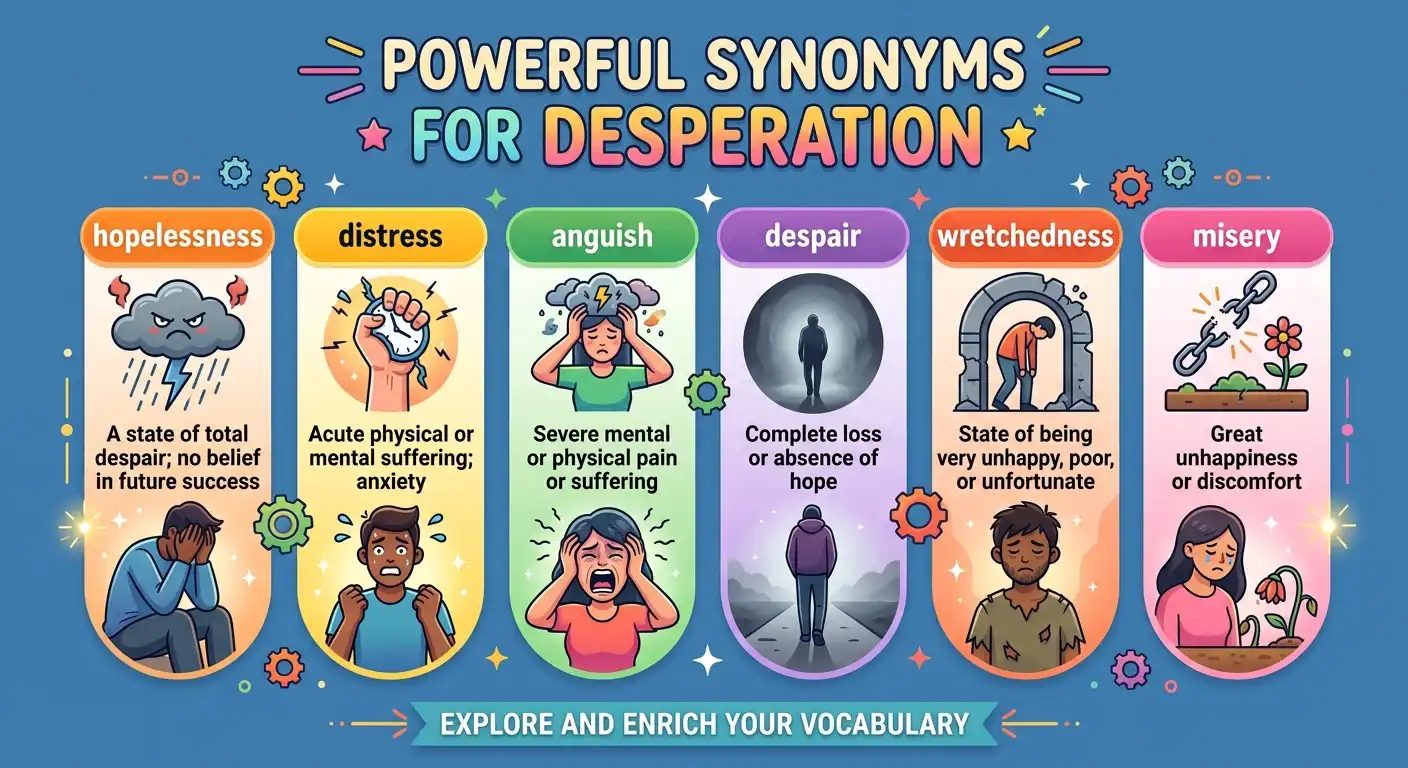
Learning exact synonyms for desperation allows you to describe feelings of extreme worry, urgency, and hopelessness with great accuracy. When you explore rich synonyms for desperation, you can easily match the right emotional tone in your writing. Using diverse synonyms for desperation keeps your stories fresh and makes your essays far more compelling.
Imagine a character trapped in a burning building as time quickly runs out. If you only say they felt “desperation,” the narrative feels flat and ordinary. Calling their state “panic,” “agony,” or “frenzy” paints a vivid picture for your audience.
For example, when a student loses their final project file minutes before class, they experience a sharp wave of fear. Using exact choices like “distress” or “helplessness” helps listeners understand that stressful moment right away.
The word desperation means a strong feeling of sadness, fear, or worry when you feel you have no good options left. Expanding your knowledge of synonyms for desperation helps many groups of readers:
- Students write better narrative essays and literary analysis papers.
- Bloggers publish engaging stories that keep readers on the page.
- Content writers create emotional copy that connects with target audiences.
- Daily English users share personal feelings with total confidence.
“Choosing the right word transforms a basic feeling into a vivid human story.”
“A rich vocabulary gives voice to our deepest emotions with total clarity.”
Linguistic Breakdown of “Desperation”
Connotative Meaning
The word desperation carries a strong negative and intense emotional connotation. It describes an overwhelming loss of hope, extreme mental strain, or a state where someone takes wild risks out of utter helplessness.
Etymology
- Origin: From Latin desperatio (a state of hopeless despair).
- Root Words: De- (down from or away) + sperare (to hope).
- Historical Shift: Passed into Anglo-French as desperacioun before becoming the modern English noun desperation.
Pronunciation
- US (IPA): /ˌdes.pəˈreɪ.ʃən/
- UK (IPA): /ˌdes.pəˈreɪ.ʃən/
Syllables & Affixation Pattern
- Syllables: 4 syllables (des-per-a-tion)
- Base Structure: Root verb desperate + Noun suffix -ion
- Grammatical Patterns:
- Noun Form: In desperation / Driven by desperation
- Adjective Form: Desperate measure / Desperate action
- Adverb Form: Desperately trying / Desperately seeking
Comparison Table: Common Synonyms for Desperation
| Keyword | Meaning | Usage Type | Context |
| Hopelessness | A feeling that things will never improve | Emotional / Formal | Personal Hardship & Sadness |
| Despair | Complete loss of hope or courage | Formal / Dramatic | Severe Loss & Life Crises |
| Panic | Sudden uncontrollable fear and confusion | Conversational / Urgent | Emergencies & Sudden Danger |
| Anguish | Severe mental or physical pain | Emotional / Expressive | Grief, Heartbreak, & Loss |
| Recklessness | Wild behavior without care for danger | Behavioral / Action | Risky Decisions & Crisis |
| Urgency | A state needing immediate action | Professional / Functional | Deadlines & Important Tasks |
| Distress | Deep pain, anxiety, or hardship | General / Clinical | Mental Health & Hard Times |
50 Best Synonyms for Desperation
1. Hopelessness
- Pronunciation: US /ˈhoʊp.ləs.nəs/ | UK /ˈhəʊp.ləs.nəs/
- Meaning: Hopelessness is a strong feeling that good things will not happen.
- Examples:
- She felt a deep sense of hopelessness after losing her job.
- The dark rain added to his feeling of hopelessness.
2. Despair
- Pronunciation: US /dɪˈsper/ | UK /dɪˈspeər/
- Meaning: Despair means the total loss of all hope.
- Examples:
- He cried out in despair when the ship sailed away.
- Her heart was filled with despair during the long winter.
3. Panic
- Pronunciation: US /ˈpæn.ɪk/ | UK /ˈpæn.ɪk/
- Meaning: Panic is a sudden fear that stops you from thinking clearly.
- Examples:
- A wave of panic hit the crowd during the fire alarm.
- She tried to hide her panic when she lost her keys.
4. Anguish
- Pronunciation: US /ˈæŋ.ɡwɪʃ/ | UK /ˈæŋ.ɡwɪʃ/
- Meaning: Anguish means extreme pain of the mind or body.
- Examples:
- The parent suffered great anguish while searching for the child.
- His voice showed deep anguish after the sad news.
5. Recklessness
- Pronunciation: US /ˈrek.ləs.nəs/ | UK /ˈrek.ləs.nəs/
- Meaning: Recklessness is wild action taken without thinking about safety.
- Examples:
- Driving fast in heavy rain was pure recklessness.
- His recklessness caused many problems for the team.
6. Distress
- Pronunciation: US /dɪˈstres/ | UK /dɪˈstres/
- Meaning: Distress is great stress, pain, or danger.
- Examples:
- The lost hiker sent a signal of distress to the rescue crew.
- Seeing her pet sick caused her real distress.
7. Urgency
- Pronunciation: US /ˈɝː.dʒən.si/ | UK /ˈɜː.dʒən.si/
- Meaning: Urgency means a state where fast action is needed right away.
- Examples:
- He spoke with urgency because the bus was leaving.
- The doctor handled the patient with great urgency.
8. Misery
- Pronunciation: US /ˈmɪz.ɚ.i/ | UK /ˈmɪz.ər.i/
- Meaning: Misery is a state of great suffering or sadness.
- Examples:
- Living in the cold shelter brought them much misery.
- He wanted to end his personal misery as quickly as possible.
9. Agony
- Pronunciation: US /ˈæɡ.ə.ni/ | UK /ˈæɡ.ə.ni/
- Meaning: Agony means extreme physical or mental suffering.
- Examples:
- Waiting for the exam results was pure agony for the class.
- He fell to the ground in agony after hurting his ankle.
10. Desolation
- Pronunciation: US /ˌdes.əˈleɪ.ʃən/ | UK /ˌdes.əˈleɪ.ʃən/
- Meaning: Desolation means great loneliness and complete sadness.
- Examples:
- The lonely cabin gave him a strong feeling of desolation.
- She felt utter desolation after her best friend moved away.
“The perfect synonym brings instant emotional truth to every sentence.”
11. Gloom
- Pronunciation: US /ɡluːm/ | UK /ɡluːm/
- Meaning: Gloom is a dark state of sadness and low spirits.
- Examples:
- A cloud of gloom hung over the office after the bad news.
- He walked home in the rain with deep gloom in his heart.
12. Frenzy
- Pronunciation: US /ˈfren.zi/ | UK /ˈfren.zi/
- Meaning: Frenzy is a state of wild excitement or uncontrolled activity.
- Examples:
- The shoppers ran in a frenzy when the doors opened.
- She searched for her missing passport in a quiet frenzy.
13. Heartbreak
- Pronunciation: US /ˈhɑːrt.breɪk/ | UK /ˈhɑːt.breɪk/
- Meaning: Heartbreak is deep grief or sorrow caused by tragic loss.
- Examples:
- Losing the championship game brought heartbreak to the team.
- Time helped ease the heartbreak of saying goodbye.
14. Frustration
- Pronunciation: US /frʌsˈtreɪ.ʃən/ | UK /frʌsˈtreɪ.ʃən/
- Meaning: Frustration is annoyance caused by being unable to change things.
- Examples:
- He slammed the door out of deep frustration.
- Long traffic jams cause daily frustration for city drivers.
15. Fear
- Pronunciation: US /fɪr/ | UK /fɪər/
- Meaning: Fear is a strong emotion felt when danger is present.
- Examples:
- The loud thunder filled the young child with fear.
- She overcame her fear of public speaking today.
16. Anxiety
- Pronunciation: US /æŋˈzaɪ.ə.t̬i/ | UK /æŋˈzaɪ.ə.ti/
- Meaning: Anxiety is a nervous feeling about what might happen next.
- Examples:
- Taking tests always gives him a lot of anxiety.
- Walking in the dark street increased her inner anxiety.
17. Dread
- Pronunciation: US /dred/ | UK /dred/
- Meaning: Dread is extreme fear about something that will happen.
- Examples:
- She woke up with a feeling of dread on Monday morning.
- He looked at the dentist chair with total dread.
18. Sorrow
- Pronunciation: US /ˈsɑːr.oʊ/ | UK /ˈsɒr.əʊ/
- Meaning: Sorrow is deep sadness caused by loss or misfortune.
- Examples:
- The entire town shared in the family’s sorrow.
- Her gentle eyes were filled with quiet sorrow.
19. Wretchedness
- Pronunciation: US /ˈretʃ.ɪd.nəs/ | UK /ˈretʃ.ɪd.nəs/
- Meaning: Wretchedness is a terrible condition of poor health or bad luck.
- Examples:
- The poor storm conditions increased the wretchedness of the trip.
- He felt the full wretchedness of his mistake.
20. Torment
- Pronunciation: US /ˈtɔːr.ment/ | UK /ˈtɔː.ment/
- Meaning: Torment is intense mental or physical suffering.
- Examples:
- Loud noises kept him in constant mental torment.
- Her bad toothache caused her hours of torment.
21. Helplessness
- Pronunciation: US /ˈhelp.ləs.nəs/ | UK /ˈhelp.ləs.nəs/
- Meaning: Helplessness is the feeling that you cannot control a situation.
- Examples:
- Seeing the car break down created a sense of helplessness.
- She fought against the feeling of total helplessness.
22. Dejection
- Pronunciation: US /dɪˈdʒek.ʃən/ | UK /dɪˈdʒek.ʃən/
- Meaning: Dejection is a sad state caused by failure or rejection.
- Examples:
- He walked off the field in utter dejection.
- Her face showed dejection when she missed the train.
23. Melancholy
- Pronunciation: US /ˈmel.ən.kɑː.li/ | UK /ˈmel.ən.kɒl.i/
- Meaning: Melancholy is a long feeling of quiet sadness without clear cause.
- Examples:
- Soft piano music always brings a sweet melancholy.
- He sat by the window in a mood of deep melancholy.
24. Alarm
- Pronunciation: US /əˈlɑːrm/ | UK /əˈlɑːm/
- Meaning: Alarm is a sudden feeling of fear that danger is near.
- Examples:
- The sudden smoke filled the workers with alarm.
- She raised her hands in alarm when the dog barked.
25. Hysteria
- Pronunciation: US /hɪˈstɪr.i.ə/ | UK /hɪˈstɪə.ri.ə/
- Meaning: Hysteria is wild fear that makes people lose all emotional control.
- Examples:
- The bad news created hysteria among the townspeople.
- She tried to stop the spreading hysteria in the room.
26. Rashness
- Pronunciation: US /ˈræʃ.nəs/ | UK /ˈræʃ.nəs/
- Meaning: Rashness means acting too fast without thinking of consequences.
- Examples:
- Buying the expensive car was pure rashness on his part.
- Her rashness led to major mistakes during the game.
27. Despondency
- Pronunciation: US /dɪˈspɑːn.dən.si/ | UK /dɪˈspɒn.dən.si/
- Meaning: Despondency is a deep feeling of low spirits and loss of hope.
- Examples:
- After three failed tries, he sank into despondency.
- The long winter days added to her despondency.
28. Woefulness
- Pronunciation: US /ˈwoʊ.fəl.nəs/ | UK /ˈwəʊ.fəl.nəs/
- Meaning: Woefulness is a condition marked by deep sorrow and trouble.
- Examples:
- The sad play moved the audience through its woefulness.
- He told his story of woefulness to the kind listener.
29. Agitation
- Pronunciation: US /ˌædʒ.əˈteɪ.ʃən/ | UK /ˌædʒ.ɪˈteɪ.ʃən/
- Meaning: Agitation is a restless state of nervous worry and excitement.
- Examples:
- She paced back and forth in visible agitation.
- His voice shook with inner agitation during the speech.
30. Tribulation
- Pronunciation: US /ˌtrɪb.jəˈleɪ.ʃən/ | UK /ˌtrɪb.jəˈleɪ.ʃən/
- Meaning: Tribulation is great trouble, suffering, or severe trial.
- Examples:
- The family stayed strong through years of tribulation.
- Every new project brings its own set of tribulations.
31. Consternation
- Pronunciation: US /ˌkɑːn.stɚˈneɪ.ʃən/ | UK /ˌkɒn.stəˈneɪ.ʃən/
- Meaning: Consternation is sudden feeling of anxiety or confusion caused by shock.
- Examples:
- To the teacher’s consternation, no one did the reading.
- The power failure caused major consternation at the hospital.
32. Trepidation
- Pronunciation: US /ˌtrep.əˈdeɪ.ʃən/ | UK /ˌtrep.ɪˈdeɪ.ʃən/
- Meaning: Trepidation is a feeling of fear or worry about a future event.
- Examples:
- He stepped onto the stage with real trepidation.
- She opened the dark basement door with trepidation.
33. Grief
- Pronunciation: US /ɡriːf/ | UK /ɡriːf/
- Meaning: Grief is intense sorrow caused by the death of someone loved.
- Examples:
- The community united to support the family in their grief.
- Expressing your grief helps your heart heal over time.
34. Disquiet
- Pronunciation: US /dɪsˈkwaɪ.ət/ | UK /dɪsˈkwaɪ.ət/
- Meaning: Disquiet is a feeling of mild anxiety or lack of peace.
- Examples:
- Strange rumors created disquiet among the office workers.
- She felt a subtle disquiet before starting her journey.
35. Wildness
- Pronunciation: US /ˈwaɪld.nəs/ | UK /ˈwaɪld.nəs/
- Meaning: Wildness is an uncontrolled state of mind or wild action.
- Examples:
- There was a wildness in his eyes during the storm.
- Panic brought out a sense of wildness in the team.
36. Distraction
- Pronunciation: US /dɪˈstræk.ʃən/ | UK /dɪˈstræk.ʃən/
- Meaning: Distraction can mean extreme confusion caused by deep emotional pain.
- Examples:
- She wept to the point of utter distraction.
- His mental distraction made it hard to drive safely.
37. Stress
- Pronunciation: US /stres/ | UK /stres/
- Meaning: Stress is mental or emotional tension caused by difficult circumstances.
- Examples:
- Long work hours create heavy stress for young staff.
- Daily exercise helps reduce body and mind stress.
38. Strain
- Pronunciation: US /streɪn/ | UK /streɪn/
- Meaning: Strain is force or pressure that creates great difficulty or worry.
- Examples:
- Financial strain made paying monthly bills difficult.
- The long argument put a major strain on their friendship.
39. Tension
- Pronunciation: US /ˈten.ʃən/ | UK /ˈten.ʃən/
- Meaning: Tension is a feeling of fear and distrust between people or groups.
- Examples:
- You could feel the high tension inside the quiet room.
- Soft laughter helped ease the tension during the meeting.
40. Overwhelm
- Pronunciation: US /ˌoʊ.vɚˈwelm/ | UK /ˌəʊ.vəˈwelm/
- Meaning: Overwhelm is a state where emotions feel too strong to manage.
- Examples:
- She felt a huge overwhelm from all her school deadlines.
- Deep rest is the best cure for mental overwhelm.
41. Extremity
- Pronunciation: US /ɪkˈstrem.ə.t̬i/ | UK /ɪkˈstrem.ə.ti/
- Meaning: Extremity means reaching the most intense or severe degree of hardship.
- Examples:
- In times of extremity, people often help each other.
- His severe actions showed the extremity of his situation.
42. Neediness
- Pronunciation: US /ˈniː.di.nəs/ | UK /ˈniː.di.nəs/
- Meaning: Neediness is a state of urgent desire for help, care, or resources.
- Examples:
- The flood victims showed urgent financial neediness.
- His emotional neediness pushed his close friends away.
43. Direness
- Pronunciation: US /ˈdaɪr.nəs/ | UK /ˈdaɪə.nəs/
- Meaning: Direness is a terrible quality of being very serious or dangerous.
- Examples:
- The doctor warned the family about the direness of the illness.
- They understood the direness of running out of clean water.
44. Madness
- Pronunciation: US /ˈmæd.nəs/ | UK /ˈmæd.nəs/
- Meaning: Madness means extremely foolish behavior driven by extreme stress.
- Examples:
- Running into the burning house was complete madness.
- The wild traffic in the city felt like pure madness.
45. Impatience
- Pronunciation: US /ɪmˈpeɪ.ʃəns/ | UK /ɪmˈpeɪ.ʃəns/
- Meaning: Impatience is an irritated feeling caused by waiting or slow progress.
- Examples:
- He tapped his foot in rising impatience at the red light.
- Her impatience grew as the bus fell behind schedule.
46. Fearfulness
- Pronunciation: US /ˈfɪr.fəl.nəs/ | UK /ˈfɪə.fəl.nəs/
- Meaning: Fearfulness is a state of being full of anxiety and worry.
- Examples:
- The dark shadow filled the young dog with fearfulness.
- She overcame her fearfulness and stepped onto the stage.
47. Gloominess
- Pronunciation: US /ˈɡluː.mi.nəs/ | UK /ˈɡluː.mi.nəs/
- Meaning: Gloominess is a state of dark, sad, and low mood.
- Examples:
- Rainy gray weather often brings a feeling of gloominess.
- His natural gloominess lifted when his friend arrived.
48. Discomfort
- Pronunciation: US /dɪsˈkʌm.fɚt/ | UK /dɪsˈkʌm.fət/
- Meaning: Discomfort is a feeling of mild physical or emotional pain.
- Examples:
- The hard wooden chair caused her physical discomfort.
- He felt social discomfort during the awkward dinner.
49. Sadness
- Pronunciation: US /ˈsæd.nəs/ | UK /ˈsæd.nəs/
- Meaning: Sadness is an unhappy emotional state caused by loss or regret.
- Examples:
- Tears streamed down her face out of deep sadness.
- The sad movie brought a feeling of warmth and sadness.
50. Perturbation
- Pronunciation: US /ˌpɝː.tɚˈbeɪ.ʃən/ | UK /ˌpɜː.təˈbeɪ.ʃən/
- Meaning: Perturbation is mental worry or disturbance that disrupts calm.
- Examples:
- The bad economic news caused great perturbation in the market.
- She tried to hide her mental perturbation behind a small smile.
Antonyms of “Desperation”
Knowing opposite words helps you describe peace, calm, and confidence accurately.
- Hope: A positive belief that good things will happen in the future.
- Peace: A state of quiet calm free from worry, war, or disruption.
- Calm: A peaceful state without fear, noise, or wild emotion.
- Confidence: A firm belief in your own ability or a positive outcome.
- Serenity: A clean, quiet state of calm mind and emotional peace.
- Composure: A cool, self-controlled state during stressful times.
Prototype Meaning & Categorization of “Desperation”
The core concept of desperation relies on loss of hope, urgent emotional stress, and drastic risk-taking. Depending on your goal, these 50 synonyms divide into four clear groups:
- Deep Hopelessness & Severe Sorrow: Hopelessness, despair, anguish, misery, desolation, gloom, heartbreak, wretchedness, dejection, melancholy, despondency, woefulness, grief, doom, gloominess, sadness.
- Panic & Agitated States: Panic, frenzy, hysteria, agitation, alarm, consternation, disquiet, wildness, perturbation, distraction, madness.
- Urgency & Risky Behavior: Recklessness, urgency, rashness, impatience, extremity, neediness, direness, strain.
- General Anxiety & Stress: Distress, frustration, fear, anxiety, dread, torment, helplessness, tribulation, trepidation, stress, tension, overwhelm, fearfulness, discomfort.
Frequently Asked Questions (FAQs)
1. What is the most common formal synonym for “desperation”?
In formal and academic writing, “despair” or “hopelessness” work best. They describe severe loss of hope without sounding overly dramatic or casual.
2. Which synonym for “desperation” should I use for sudden fear?
When describing sudden, uncontrollable fear caused by immediate danger, use “panic” or “alarm.”
3. What is the difference between “despair” and “desperation”?
“Despair” is a passive feeling of complete hopelessness where a person gives up. “Desperation” often drives an active, wild, or reckless attempt to fix a terrible situation.
4. Can “urgency” replace “desperation” in business emails?
Yes. In professional settings, “urgency” is far more appropriate than “desperation.” It shows that something requires fast action without sounding weak or unstable.
5. Why is learning synonyms for “desperation” good for storytellers?
Using varied synonyms allows storytellers to build tension step-by-step. You can show a character moving from slight “anxiety” to “distress,” and finally into full “frenzy.”
6. Is “recklessness” always a synonym for “desperation”?
“Recklessness” becomes a synonym when dangerous, careless actions are directly caused by a feeling of having nothing left to lose.
Conclusion
Expanding your collection of synonyms for desperation brings deep emotion, precision, and authority to your vocabulary. Replacing repetitive words with exact choices like despair, anguish, panic, or urgency ensures your writing connects with readers on every page.
Whether you are crafting narrative essays, publishing blog articles, writing emails, or sharing stories in daily speech, exact words build instant trust. Strong vocabulary removes repetitive fluff and transforms basic sentences into memorable human thoughts. Start practicing these 50 synonyms today to express life’s most intense moments with lasting clarity.
“Mastering emotional words turns simple stories into unforgettable human experiences.”
“Clear expression builds strong connections and opens doors in every conversation.”

Robert Hayes is an ESL educator and curriculum developer with over nine years of experience teaching English to beginners and intermediate learners across multiple countries ( Biography ).