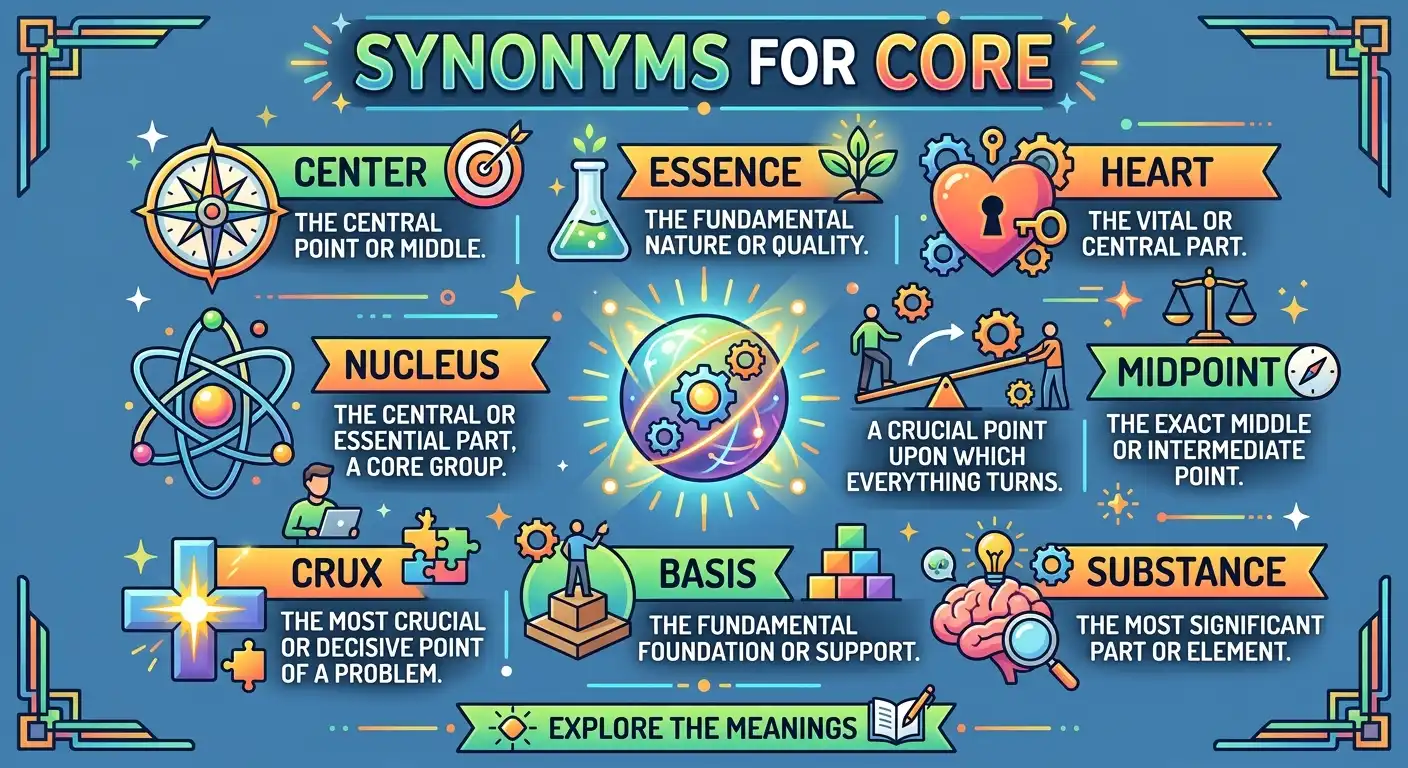
Learning precise synonyms for core helps you describe essential parts, central ideas, and important truths in simple words. When you master diverse synonyms for core, you can talk about main points, strong foundations, and central hubs with complete confidence. Expanding your range of synonyms for core strengthens your daily speaking and makes your writing clear for every reader.
Imagine a group of project managers discussing a company plan. One manager says that teamwork is the “core” of the strategy, while customer satisfaction is the “core” of the mission. Repeating the same word over and over makes the message sound dull. Choosing distinct options like “foundation,” “heart,” or “cornerstone” gives your words natural variety and strong energy.
For example, when you explain how a computer engine works, you can call the processor its central unit. Using exact words like “nucleus” or “hub” helps people picture your idea instantly.
The word core refers to the central, innermost, or most essential part of an object, system, or idea. Understanding versatile synonyms for core benefits many everyday communicators:
- Students explain main arguments clearly in school essays.
- Bloggers craft sharp, readable headings that catch reader interest.
- Content writers improve search rankings with natural vocabulary choices.
- Daily English users speak smoothly and directly in work conversations.
“The right central word brings immediate focus and strength to every thought.”
“A rich vocabulary helps you express complex ideas with total ease and clarity.”
Linguistic Breakdown of “Core”
Connotative Meaning
The word core carries positive, strong, and stable connotations. It suggests strength, central importance, truth, and fundamental support across physical objects and abstract ideas.
Etymology
- Origin: From Old French coer or cur (meaning heart).
- Latin Root: Derived from Latin cor (meaning heart).
- Historical Shift: First used in English to describe the hard central seed case of an apple, then expanded to mean the main central part of anything.
Pronunciation
- US (IPA): /kɔːr/
- UK (IPA): /kɔː/
Syllables & Affixation Pattern
- Syllables: 1 syllable (core)
- Base Structure: Monosyllabic noun/adjective root
- Grammatical Patterns:
- Noun: The core of the matter / Outer core
- Adjective: Core values / Core duties
- Verb form: Cored (as in coring an apple)
Comparison Table: Common Synonyms for Core
| Keyword | Meaning | Usage Type | Context |
| Center | The middle point or chief place of activity | Neutral / General | Geometry, Cities, & Daily Life |
| Heart | The central or vital part of an idea or area | Emotional / Expressive | Relationships, City Centers, & Main Ideas |
| Nucleus | The central part around which others group | Technical / Professional | Science, Teams, & Small Groups |
| Essence | The intrinsic nature or indispensable quality | Formal / Abstract | Philosophy, Art, & Character |
| Foundation | The solid base that supports a whole structure | Professional / Practical | Buildings, Business Plans, & Knowledge |
| Crux | The most important or difficult point at issue | Formal / Analytical | Debates, Legal Matters, & Problems |
| Cornerstone | A vital feature on which everything depends | Professional / Strategic | Policies, Beliefs, & Long-term Goals |
26 Best Synonyms for Core
1. Center
- Pronunciation: US /ˈsen.t̬ɚ/ | UK /ˈsen.tə/
- Meaning: Center means the middle point of an object or the main place of action.
- Examples:
- They met near the city center for afternoon lunch.
- Put the red flower right in the center of the table.
2. Heart
- Pronunciation: US /hɑːrt/ | UK /hɑːt/
- Meaning: Heart means the central and most important part of something.
- Examples:
- Honesty remains at the heart of our group policy.
- The market stands at the heart of the old town.
3. Nucleus
- Pronunciation: US /ˈnuː.kli.əs/ | UK /ˈnjuː.kli.əs/
- Meaning: Nucleus means a central group or part that holds things together.
- Examples:
- A small nucleus of workers stayed late to finish up.
- The seed forms the central nucleus of the plant cell.
4. Essence
- Pronunciation: US /ˈes.əns/ | UK /ˈes.əns/
- Meaning: Essence means the basic and most real nature of an idea or thing.
- Examples:
- Kindness is the true essence of good friendship.
- The poem captures the essence of spring weather.
5. Kernel
- Pronunciation: US /ˈkɝː.nəl/ | UK /ˈkɜː.nəl/
- Meaning: Kernel means the central grain or the main useful part of a thought.
- Examples:
- There is a small kernel of truth in his story.
- She ate a sweet corn kernel during dinner.
6. Hub
- Pronunciation: US /hʌb/ | UK /hʌb/
- Meaning: Hub means the active center point of a travel network or system.
- Examples:
- The airport serves as a major regional travel hub.
- Our library is the social hub for local students.
7. Crux
- Pronunciation: US /krʌks/ | UK /krʌks/
- Meaning: Crux means the most vital or puzzling part of a situation.
- Examples:
- The cost of repairs was the real crux of the issue.
- Finding water was the crux of their trip plan.
8. Foundation
- Pronunciation: US /faʊnˈdeɪ.ʃən/ | UK /faʊnˈdeɪ.ʃən/
- Meaning: Foundation means the solid bottom structure that supports everything else.
- Examples:
- Trust forms a solid foundation for any team.
- Builders laid the stone foundation for the house.
9. Base
- Pronunciation: US /beɪs/ | UK /beɪs/
- Meaning: Base means the lowest supporting layer or main starting point.
- Examples:
- The mountain base was covered in green grass.
- Knowledge is the base of all skill learning.
10. Gist
- Pronunciation: US /dʒɪst/ | UK /dʒɪst/
- Meaning: Gist means the main idea or general meaning of a long speech.
- Examples:
- I understood the general gist of her talk.
- He gave me the main gist of the morning news.
“Choosing precise words turns basic ideas into memorable and convincing statements.”
11. Root
- Pronunciation: US /ruːt/ | UK /ruːt/
- Meaning: Root means the deep primary cause or origin of something.
- Examples:
- Poor sleep was the root of his daily fatigue.
- We must find the root cause of the error.
12. Interior
- Pronunciation: US /ɪnˈtɪr.i.ɚ/ | UK /ɪnˈtɪə.ri.ə/
- Meaning: Interior means the inner side or inside central part of something.
- Examples:
- The house interior stayed warm during the winter.
- Explorers traveled deep into the forest interior.
13. Focal point
- Pronunciation: US /ˈfoʊ.kəl pɔɪnt/ | UK /ˈfəʊ.kəl pɔɪnt/
- Meaning: Focal point means the center of clear attention or main interest.
- Examples:
- The large fireplace was the focal point of the room.
- Safety remained the focal point of the meeting.
14. Backbone
- Pronunciation: US /ˈbæk.boʊn/ | UK /ˈbæk.bəʊn/
- Meaning: Backbone means the main supportive spine or strength of a team.
- Examples:
- Small farms are the economic backbone of the area.
- Her strong resolve gave the team its main backbone.
15. Key
- Pronunciation: US /kiː/ | UK /kiː/
- Meaning: Key means the primary element that opens or solves a problem.
- Examples:
- Daily practice is the key to mastering sports.
- Good food is a key part of health.
16. Substance
- Pronunciation: US /ˈsʌb.stəns/ | UK /ˈsʌb.stəns/
- Meaning: Substance means the real, solid, or meaningful material in a speech.
- Examples:
- Her short talk was full of real substance.
- The report lacked solid substance and detail.
17. Mainstay
- Pronunciation: US /ˈmeɪn.steɪ/ | UK /ˈmeɪn.steɪ/
- Meaning: Mainstay means the chief support or main part that keeps things going.
- Examples:
- Rice is the mainstay of their daily diet.
- He is the main mainstay of our local business.
18. Pith
- Pronunciation: US /pɪθ/ | UK /pɪθ/
- Meaning: Pith means the essential core or central point of an argument.
- Examples:
- She cut straight to the pith of the problem.
- The speech was short but packed with real pith.
19. Pillar
- Pronunciation: US /ˈpɪl.ɚ/ | UK /ˈpɪl.ə/
- Meaning: Pillar means a tall strong support or vital value in a system.
- Examples:
- Equal treatment is a central pillar of justice.
- She acts as a pillar of strength for her group.
20. Anchor
- Pronunciation: US /ˈæŋ.kɚ/ | UK /ˈæŋ.kə/
- Meaning: Anchor means a central heavy object or person that keeps things steady.
- Examples:
- Hope acts as an anchor in hard times.
- The store was the main anchor of the mall.
21. Middle
- Pronunciation: US /ˈmɪd.əl/ | UK /ˈmɪd.əl/
- Meaning: Middle means the central point equal distance from all sides.
- Examples:
- He stood in the middle of the quiet room.
- We stopped to rest in the middle of the day.
22. Seat
- Pronunciation: US /siːt/ | UK /siːt/
- Meaning: Seat means the central place where official power or activity stays.
- Examples:
- The capital city is the main seat of government.
- The town became the seat of local trade.
23. Axis
- Pronunciation: US /ˈæk.sɪs/ | UK /ˈæk.sɪs/
- Meaning: Axis means the central line around which an object or system turns.
- Examples:
- The Earth spins smoothly on its central axis.
- Customer needs became the axis of company plans.
24. Cornerstone
- Pronunciation: US /ˈkɔːr.nɚ.stoʊn/ | UK /ˈkɔː.nə.stəʊn/
- Meaning: Cornerstone means the primary building block that holds everything up.
- Examples:
- Reading daily is a cornerstone of early education.
- Hard work is the cornerstone of his success.
25. Soul
- Pronunciation: US /soʊl/ | UK /səʊl/
- Meaning: Soul means the deep living spirit or essential central nature.
- Examples:
- Music is the real soul of this coastal city.
- She put her heart and soul into the painting.
26. Bedrock
- Pronunciation: US /ˈbed.rɑːk/ | UK /ˈbed.rɒk/
- Meaning: Bedrock means the solid rock bottom or basic principle supporting a system.
- Examples:
- Honest dealing is the bedrock of good business.
- Science provides the bedrock for modern medical care.
Antonyms of “Core”
Knowing opposite words helps you describe outer parts, surface levels, or minor details accurately.
- Periphery: The outer edge or boundary away from the central part.
- Exterior: The outside surface or outer appearance of an object.
- Border: The outer line that surrounds a territory or shape.
- Surface: The top layer of something rather than its deep inside.
- Margin: The blank space or outer edge along a page or system.
- Trifle: A minor detail or thing of very little central importance.
Prototype Meaning & Categorization of “Core”
The primary concept of core centers on central location, essential value, fundamental support, and primary truth. Depending on your intent, these 26 synonyms divide into four operational groups:
- Central Physical Location: Center, middle, interior, hub, nucleus, seat, axis.
- Essential Truth & Meaning: Heart, essence, crux, gist, kernel, pith, substance, soul.
- Structural Support & Foundation: Foundation, base, backbone, mainstay, pillar, anchor, cornerstone, bedrock.
- Primary Drivers & Key Factors: Root, key, focal point.
Frequently Asked Questions (FAQs)
1. What is the most formal synonym for “core”?
In formal, academic, or professional settings, “essence,” “cornerstone,” or “foundation” work best. They express central importance clearly without sounding informal.
2. What is the difference between “core” and “periphery”?
“Core” means the main central part or essential element. “Periphery” refers to the outer edges, margins, or less important outer areas.
3. Which synonym for “core” should I use in business writing?
In professional reports, terms like “cornerstone,” “focal point,” “foundation,” or “backbone” sound polished and outcome-oriented.
4. Is “gist” the same as “core”?
“Gist” specifically refers to the main idea or summary of a speech or text, while “core” can refer to physical objects, ideas, or organizations.
5. Why is “heart” used as a synonym for “core”?
“Heart” carries a natural metaphor for the vital center of a living being. Calling something the “heart” emphasizes that it gives life and energy to the whole system.
6. How does using diverse synonyms for “core” help SEO?
Using varied synonyms prevents keyword repetition, satisfies user search variations, builds semantic topical authority, and keeps readers engaged longer on your website.
Conclusion
Expanding your collection of synonyms for core brings clarity, precision, and confidence to your daily language. Replacing repetitive terms with exact words like center, essence, cornerstone, or foundation ensures your message reaches readers with clear power every single time.
Whether you are writing professional business emails, drafting school essays, publishing blog posts, or talking in daily work discussions, exact vocabulary builds instant trust. Clear vocabulary removes fluff and turns basic statements into persuasive thoughts. Practice using these 26 synonyms today to share your central ideas with lasting clarity.
“Clear word choices give your central message lasting power and authority.”
“Mastering exact vocabulary turns simple thoughts into clear statements of value.”
“A strong focus on exact language brings quiet confidence to every sentence.”

Robert Hayes is an ESL educator and curriculum developer with over nine years of experience teaching English to beginners and intermediate learners across multiple countries ( Biography ).