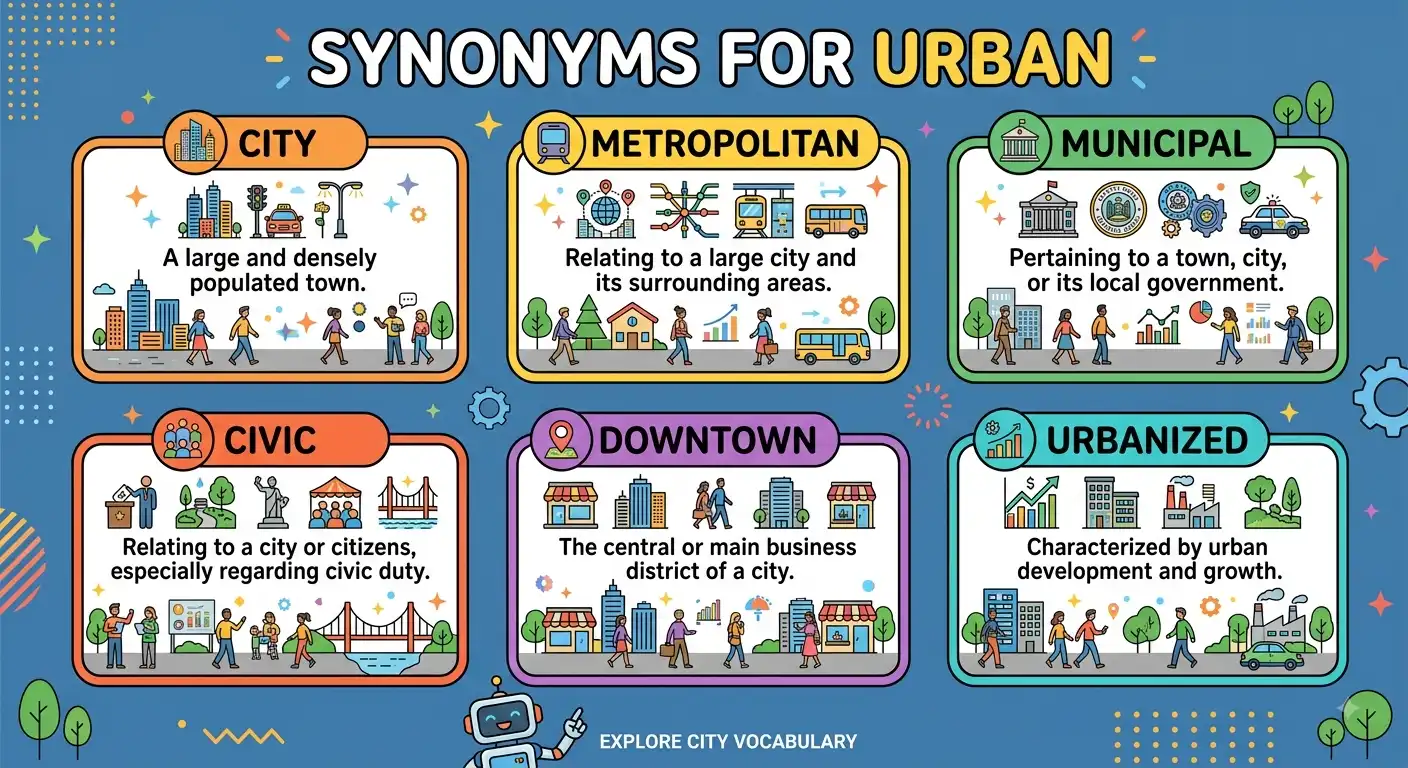
Exploring exact synonyms for urban helps you describe city life, buildings, and local culture with total accuracy. When you learn diverse synonyms for urban, you can easily discuss city planning, modern lifestyles, and local communities. Using clear synonyms for urban keeps your writing fresh, vivid, and engaging for every reader.
Imagine a travel writer describing a bustling downtown district during evening rush hour. If they repeat the word “urban” in every sentence, the article quickly loses its charm. Switching to rich alternatives like metropolitan, downtown, or cosmopolitan brings instant life and realism to the scene.
For example, when describing new apartments near a train station, using a word like municipal or built-up fits best. Choosing exact words helps readers visualize the exact setting without confusion.
The word urban means relating to, belonging to, or located within a city or town. Learning synonyms for urban offers practical benefits for four key groups of writers:
- Students write better geography essays and social studies reports.
- Bloggers draft exciting travel guides and city lifestyle reviews.
- Content writers improve search rankings with natural, varied terms.
- Daily English users express location and environment clearly in conversations.
“The right word paints a clear picture of city life in every reader’s mind.”
“Expanding your vocabulary gives you precise tools to describe every location.”
Linguistic Breakdown of “Urban”
Connotative Meaning
The word urban carries modern, active, and crowded connotations. It describes developed areas with high population density, concrete infrastructure, and vibrant social activity.
Etymology
- Origin: Derived from Latin urbanus (belonging to a city or characteristic of city life).
- Root Words: Latin urbs (city or walled town).
- Historical Shift: Entered Middle English through Old French, maintaining its exact reference to city environments and civil life.
Pronunciation
- US (IPA): /ˈɝː.bən/
- UK (IPA): /ˈɜː.bən/
Syllables & Affixation Pattern
- Syllables: 2 syllables (ur-ban)
- Base Structure: Root noun/adjective urban
- Grammatical Patterns:
- Adjective Form: Urban
- Noun Form: Urbanite / Urbanization
- Verb Form: Urbanize
Comparison Table: Common Synonyms for Urban
| Keyword | Meaning | Usage Type | Context |
| Metropolitan | Relating to a large city and its surrounding areas | Professional / Formal | City Planning, Business, & Geography |
| Municipal | Related to local city government and public services | Formal / Official | Local Government, Public Works, & Taxes |
| Downtown | Located in the main central business district of a town | Casual / Conversational | Shopping, Dining, & Nightlife |
| Civic | Relating to a city or citizen duties | Formal / Respectful | Community Work, Voting, & Public Parks |
| Cosmopolitan | Containing people and features from many countries | Expressive / Descriptive | Culture, Fashion, & Food |
| Built-up | Covered with many houses and buildings | Descriptive / Practical | Real Estate, Housing, & Development |
| Citified | Adapted to city habits, fashions, or culture | Informal / Playful | Lifestyle, Fashion, & Personal Traits |
“Clear and varied vocabulary turns routine descriptions into engaging stories.”
50 Best Synonyms for Urban
1. Metropolitan
- Pronunciation: US /ˌmet.rəˈpɑː.lə.tən/ | UK /ˌmet.rəˈpɒl.ɪ.tən/
- Meaning: Metropolitan means relating to a large, busy city and its surrounding areas.
- Examples:
- The metropolitan subway train carries thousands of workers every morning.
- They moved to a large metropolitan region to find better jobs.
2. Municipal
- Pronunciation: US /mjuːˈnɪs.ə.pəl/ | UK /mjuːˈnɪs.ɪ.pəl/
- Meaning: Municipal means related to the local government of a city or town.
- Examples:
- The municipal park offers free sports equipment for kids.
- Local workers repaired the municipal water line yesterday.
3. Downtown
- Pronunciation: US /ˌdaʊnˈtaʊn/ | UK /ˌdaʊnˈtaʊn/
- Meaning: Downtown means located in the central business hub of a town.
- Examples:
- We met at a small downtown cafe for lunch.
- High office towers line the main downtown streets.
4. Civic
- Pronunciation: US /ˈsɪv.ɪk/ | UK /ˈsɪv.ɪk/
- Meaning: Civic means connected to a city or citizen duties in a community.
- Examples:
- Voting in local elections is an important civic duty.
- The mayor spoke at the new civic center this morning.
5. Cosmopolitan
- Pronunciation: US /ˌkɑːz.məˈpɑː.lə.tən/ | UK /ˌkɒz.məˈpɒl.ɪ.tən/
- Meaning: Cosmopolitan means filled with diverse people and ideas from around the world.
- Examples:
- London is a cosmopolitan city with many cultures.
- The night market offers a cosmopolitan mix of delicious food.
6. Built-up
- Pronunciation: US /ˌbɪltˈʌp/ | UK /ˌbɪltˈʌp/
- Meaning: Built-up means an area covered with many roads and tall buildings.
- Examples:
- Drive slowly because this is a built-up neighborhood.
- Concrete towers replaced green fields in the built-up district.
7. Citywide
- Pronunciation: US /ˌsɪt.iˈwaɪd/ | UK /ˌsɪt.iˈwaɪd/
- Meaning: Citywide means happening across or including an entire town.
- Examples:
- The school announced a citywide cleanup project for Saturday.
- Police led a citywide safety drive this month.
8. Inner-city
- Pronunciation: US /ˌɪn.ɚˈsɪt.i/ | UK /ˌɪn.əˈsɪt.i/
- Meaning: Inner-city means located near the central, older parts of a large city.
- Examples:
- The charity built a new playground for inner-city children.
- New bus lines connect inner-city areas to suburban malls.
9. Central
- Pronunciation: US /ˈsen.trəl/ | UK /ˈsen.trəl/
- Meaning: Central means located right in the middle of a town or city.
- Examples:
- We stayed at a central hotel near the main train station.
- The central library stays open late on weekdays.
10. Citylike
- Pronunciation: US /ˈsɪt.i.laɪk/ | UK /ˈsɪt.i.laɪk/
- Meaning: Citylike means having features or qualities typical of a crowded town.
- Examples:
- The growing port developed a noisy, citylike feel.
- Tall brick houses give the village a citylike look.
11. High-density
- Pronunciation: US /haɪ ˈden.sə.t̬i/ | UK /haɪ ˈden.sɪ.ti/
- Meaning: High-density means containing a large number of people or homes in a small space.
- Examples:
- High-density housing helps house many families near workplaces.
- The city planner favored high-density apartment blocks near transit stops.
12. Citified
- Pronunciation: US /ˈsɪt̬.ə.faɪd/ | UK /ˈsɪt.ɪ.faɪd/
- Meaning: Citified means adapted to the customs, fashion, or style of city life.
- Examples:
- After living in Chicago, he became quite citified in his style.
- Her citified habits made farm life feel very different.
13. Conurban
- Pronunciation: US /kɑːnˈɝː.bən/ | UK /kɒnˈɜː.bən/
- Meaning: Conurban means relating to a continuous spread of connected towns and cities.
- Examples:
- Fast trains link the entire conurban network together.
- Factories line the main roads across the conurban region.
14. Non-rural
- Pronunciation: US /nɑːnˈrʊr.əl/ | UK /nɒnˈrʊə.rəl/
- Meaning: Non-rural means not belonging to the countryside or farming areas.
- Examples:
- Most non-rural areas have access to high-speed internet.
- The study focuses on non-rural health centers.
15. Megalopolitan
- Pronunciation: US /ˌmeɡ.ə.ləˈpɑː.lə.tən/ | UK /ˌmeɡ.ə.ləˈpɒl.ɪ.tən/
- Meaning: Megalopolitan means belonging to a huge cluster of interconnected cities.
- Examples:
- Millions of commuters travel daily through the megalopolitan belt.
- Heavy traffic is common across megalopolitan highway routes.
16. Town-based
- Pronunciation: US /taʊn beɪst/ | UK /taʊn beɪst/
- Meaning: Town-based means operating or located within a specific town.
- Examples:
- The town-based sports league plays every Sunday morning.
- She works for a town-based community newspaper.
17. Dense
- Pronunciation: US /dens/ | UK /dens/
- Meaning: Dense means closely packed together with buildings or people.
- Examples:
- Narrow lanes run through the dense historic quarter.
- Public transit works best in dense urban neighborhoods.
18. Populous
- Pronunciation: US /ˈpɑː.pjə.ləs/ | UK /ˈpɒp.jə.ləs/
- Meaning: Populous means full of many people or residents.
- Examples:
- Tokyo is one of the most populous cities on earth.
- Local stores thrive in populous residential streets.
19. Public
- Pronunciation: US /ˈpʌb.lɪk/ | UK /ˈpʌb.lɪk/
- Meaning: Public means open to or provided for all people in a city.
- Examples:
- Children play freely in the public plaza after school.
- Taking public buses helps reduce road pollution.
20. Residential
- Pronunciation: US /ˌrez.əˈden.ʃəl/ | UK /ˌrez.ɪˈden.ʃəl/
- Meaning: Residential means designed or used mainly for homes rather than stores.
- Examples:
- Trees line the calm residential streets near our house.
- Speed limits stay low across residential zones.
21. Commercial
- Pronunciation: US /kəˈmɝː.ʃəl/ | UK /kəˈmɜː.ʃəl/
- Meaning: Commercial means related to stores, shopping, and business trade.
- Examples:
- The commercial street is packed with clothing stores and banks.
- Land values remain high in commercial districts.
22. Industrial
- Pronunciation: US /ɪnˈdʌs.tri.əl/ | UK /ɪnˈdʌs.tri.əl/
- Meaning: Industrial means filled with factories, warehouses, and heavy machinery.
- Examples:
- Trucks move goods daily through the industrial park.
- Smoke rose gently above the industrial zone.
23. Developed
- Pronunciation: US /dɪˈvel.əpt/ | UK /dɪˈvel.əpt/
- Meaning: Developed means equipped with modern roads, buildings, and utilities.
- Examples:
- The town council turned vacant lots into developed parks.
- Highly developed areas attract new tech firms.
24. Paved
- Pronunciation: US /peɪvd/ | UK /peɪvd/
- Meaning: Paved means covered with hard surfaces like asphalt or concrete roads.
- Examples:
- Smooth paved roads make cycling easy in the town.
- The city crew repaired paved walkways near the park.
25. Concrete
- Pronunciation: US /ˈkɑːn.kriːt/ | UK /ˈkɒŋ.kriːt/
- Meaning: Concrete means built with solid manufactured building blocks and cement.
- Examples:
- Tall concrete buildings block the afternoon wind.
- Modern concrete plazas hold huge weekend crowds.
26. Streetwise
- Pronunciation: US /ˈstriːt.waɪz/ | UK /ˈstriːt.waɪz/
- Meaning: Streetwise means knowing how to manage yourself safely in a city.
- Examples:
- Living in New York made her smart and streetwise.
- A streetwise guide showed us around the hidden alleys.
27. Trendy
- Pronunciation: US /ˈtren.di/ | UK /ˈtren.di/
- Meaning: Trendy means modern, fashionable, and popular in city culture.
- Examples:
- Young artists love hanging out in trendy downtown cafes.
- The warehouse was rebuilt into a trendy art space.
28. Chic
- Pronunciation: US /ʃiːk/ | UK /ʃiːk/
- Meaning: Chic means stylish, elegant, and sophisticated in urban fashion.
- Examples:
- She bought a coat at a chic city boutique.
- The hotel features a chic modern lobby design.
29. Modern
- Pronunciation: US /ˈmɑː.dɚn/ | UK /ˈmɒd.ən/
- Meaning: Modern means designed with updated styles, technology, and ideas.
- Examples:
- Modern glass towers brighten the city skyline.
- The station uses a modern digital ticket gate.
30. Sophisticated
- Pronunciation: US /səˈfɪs.də.keɪ.t̬ɪd/ | UK /səˈfɪs.tɪ.keɪ.tɪd/
- Meaning: Sophisticated means complex, cultured, and refined through city exposure.
- Examples:
- The museum offers a sophisticated look at modern art.
- City dining options are varied and sophisticated.
31. Fast-paced
- Pronunciation: US /ˌfæstˈpeɪst/ | UK /ˌfɑːstˈpeɪst/
- Meaning: Fast-paced means moving, changing, or happening very quickly every day.
- Examples:
- Working on Wall Street requires a fast-paced work style.
- Many people love the fast-paced energy of big towns.
32. Bustling
- Pronunciation: US /ˈbʌs.lɪŋ/ | UK /ˈbʌs.lɪŋ/
- Meaning: Bustling means full of busy activity, noise, and moving crowds.
- Examples:
- Vendors shout cheerfully in the bustling street market.
- Morning train platforms stay bustling all year round.
33. Crowded
- Pronunciation: US /ˈkraʊ.dɪd/ | UK /ˈkraʊ.dɪd/
- Meaning: Crowded means filled with many people leaving little free space.
- Examples:
- Crowded buses move slowly during afternoon traffic.
- The main square gets crowded during holiday parades.
34. Urbanized
- Pronunciation: US /ˈɝː.bə.naɪzd/ | UK /ˈɜː.bən.aɪzd/
- Meaning: Urbanized means changed into a developed city environment over time.
- Examples:
- The quiet fishing village grew into an urbanized town.
- Highly urbanized countries invest heavily in public rail.
35. Incorporated
- Pronunciation: US /ɪnˈkɔːr.pə.reɪ.t̬ɪd/ | UK /ɪnˈkɔː.pər.eɪ.tɪd/
- Meaning: Incorporated means officially formed into a legal town or city unit.
- Examples:
- The settlement became an incorporated town in 1910.
- Incorporated municipalities manage their own police forces.
36. Local
- Pronunciation: US /ˈloʊ.kəl/ | UK /ˈləʊ.kəl/
- Meaning: Local means belonging to a specific town neighborhood or area.
- Examples:
- Neighbors buy fresh bread at the local bakery.
- The local council voted to build a new library.
37. Communal
- Pronunciation: US /kəˈmjuː.nəl/ | UK /kəˈmjuː.nəl/
- Meaning: Communal means shared by all members of a city community.
- Examples:
- Residents tend vegetables in the communal garden.
- The town plaza serves as a communal gathering place.
38. Civil
- Pronunciation: US /ˈsɪv.əl/ | UK /ˈsɪv.əl/
- Meaning: Civil means related to ordinary citizens and public town affairs.
- Examples:
- Civil engineers design strong bridges for city traffic.
- The group works to protect civil rights in towns.
39. District-wide
- Pronunciation: US /ˌdɪs.trɪktˈwaɪd/ | UK /ˌdɪs.trɪktˈwaɪd/
- Meaning: District-wide means affecting or extending across an entire city zone.
- Examples:
- The city announced district-wide road maintenance work.
- Schools participate in a district-wide art contest.
40. Borough-level
- Pronunciation: US /ˈbɝː.oʊ ˌlev.əl/ | UK /ˈbʌr.ə ˌlev.əl/
- Meaning: Borough-level means managed within a specific administrative city division.
- Examples:
- Borough-level officers handle neighborhood garbage collection.
- Community meetings take place at the borough-level office.
41. Capital
- Pronunciation: US /ˈkæp.ə.t̬əl/ | UK /ˈkæp.ɪ.təl/
- Meaning: Capital means relating to the primary governing city of a state.
- Examples:
- Wide avenues cross the capital city near government halls.
- Tourists visit historical monuments across the capital.
42. Metro
- Pronunciation: US /ˈmet.roʊ/ | UK /ˈmet.rəʊ/
- Meaning: Metro means short for metropolitan or city underground transit systems.
- Examples:
- Taking the metro train avoids heavy highway traffic.
- The metro area added three new bus routes this year.
43. High-rise
- Pronunciation: US /ˈhaɪ.raɪz/ | UK /ˈhaɪ.raɪz/
- Meaning: High-rise means describing tall buildings with many floors and elevators.
- Examples:
- She lives on the twentieth floor of a high-rise building.
- New high-rise apartments line the river bay.
44. Grid-based
- Pronunciation: US /ɡrɪd beɪst/ | UK /ɡrɪd beɪst/
- Meaning: Grid-based means arranged in neat square street patterns typical of towns.
- Examples:
- Navigating a grid-based city plan is easy for visitors.
- The town layout uses a classic grid-based design.
45. Pedestrian
- Pronunciation: US /pəˈdes.tri.ən/ | UK /pəˈdes.tri.ən/
- Meaning: Pedestrian means designed for people walking on foot along city streets.
- Examples:
- Cars are not allowed inside the downtown pedestrian zone.
- A wide pedestrian bridge spans the busy boulevard.
46. Transit-oriented
- Pronunciation: US /ˈtræn.sɪt ˌɔːr.i.en.t̬ɪd/ | UK /ˈtræn.zɪt ˌɔː.ri.en.tɪd/
- Meaning: Transit-oriented means built close to train stations and bus lines.
- Examples:
- Transit-oriented apartments let workers commute without owning cars.
- City planners favor transit-oriented development designs.
47. Multi-story
- Pronunciation: US /ˌmʌl.tiˈstɔːr.i/ | UK /ˌmʌl.tiˈstɔː.ri/
- Meaning: Multi-story means having several levels or floors above ground level.
- Examples:
- A new multi-story garage opened near the stadium.
- Multi-story shopping malls hold hundreds of stores.
48. Asphalt
- Pronunciation: US /ˈæs.fɑːlt/ | UK /ˈæs.fælt/
- Meaning: Asphalt means covered with black stone mixture used for city paving.
- Examples:
- Steam rose from the hot asphalt after summer rain.
- Road crews poured fresh asphalt on main avenues.
49. City-center
- Pronunciation: US /ˌsɪt.iˈsen.t̬ɚ/ | UK /ˌsɪt.iˈsen.tə/
- Meaning: City-center means located in the heart of a town’s primary district.
- Examples:
- Historic statues stand inside the city-center square.
- City-center shops draw thousands of shoppers every weekend.
50. Urbanite-style
- Pronunciation: US /ˈɝː.bə.naɪt staɪl/ | UK /ˈɜː.bən.aɪt staɪl/
- Meaning: Urbanite-style means reflecting the modern lifestyle traits of city residents.
- Examples:
- The loft features a clean urbanite-style interior decor.
- Coffee shops match the relaxed urbanite-style culture.
Antonyms of “Urban”
Knowing opposite terms helps you describe rural landscapes, quiet countryside, and farm regions accurately:
- Rural: Relating to the quiet countryside, farms, and open green spaces.
- Rustic: Simple, charming, and typical of country life away from towns.
- Pastoral: Related to farm animals, peaceful fields, and green countryside scenery.
- Agrarian: Related to cultivated land, farming, and agricultural communities.
- Sylvan: Associated with woods, peaceful forests, and natural trees.
- Countrified: Adapted to or showing rural tastes, manners, and village living.
Prototype Meaning & Categorization of “Urban”
The primary concept of urban focuses on settlement density, developed infrastructure, and city culture. Depending on your goals, these 50 synonyms divide into four main operational categories:
- Government & Regional Administration: Metropolitan, municipal, civic, citywide, incorporated, district-wide, borough-level, capital, local, conurban, megalopolitan.
- Infrastructure & Physical Environment: Built-up, high-density, non-rural, dense, developed, paved, concrete, high-rise, grid-based, multi-story, asphalt, transit-oriented, pedestrian.
- Culture, Lifestyle & Fashion: Cosmopolitan, citified, streetwise, trendy, chic, modern, sophisticated, fast-paced, urbanite-style, public, communal, civil.
- District Locations & Commerce: Downtown, inner-city, central, citylike, populous, residential, commercial, industrial, metro, city-center, town-based.
Frequently Asked Questions (FAQs)
1. What is the most common formal synonym for “urban”?
The most popular formal synonym for “urban” is “metropolitan.” It is widely used in news reports, city planning, official government records, and academic essays.
2. What is the main difference between “urban” and “municipal”?
Urban describes the physical environment, population density, and lifestyle of a city. Municipal specifically refers to the local government, official administration, and city services.
3. Which synonym for “urban” works best for travel blogs?
For travel and lifestyle writing, terms like “downtown,” “cosmopolitan,” “bustling,” and “trendy” work best because they evoke energy and style.
4. Can “suburban” be used as a direct synonym for “urban”?
No, “suburban” describes residential areas located on the outer edge of a city. While close to an urban area, suburban settings have lower density and a quieter pace.
5. What does “urbanized” mean in geography essays?
In geography, “urbanized” describes land or a region that has transformed from rural farming countryside into a developed city environment with buildings and roads.
6. How does using varied synonyms for “urban” improve SEO writing?
Using diverse synonyms prevents repetitive keyword use, satisfies different search intents, matches long-tail search queries, and keeps readers engaged longer on your website.
Conclusion
Mastering a rich collection of synonyms for urban brings precision, variety, and vitality to your writing and communication. Replacing basic terms with exact words like metropolitan, municipal, downtown, or cosmopolitan ensures your message fits the exact context you need.
Whether you are writing geography papers, publishing travel blog posts, drafting property listings, or chatting with friends, using exact vocabulary builds instant clarity. Varied language removes boring repetition and helps readers picture every scene with complete ease. Practice using these 50 synonyms today to elevate your communication skills.
“Choosing exact vocabulary turns simple descriptions into unforgettable stories.”
“Mastering language gives you the power to express every setting with total clarity.”

Robert Hayes is an ESL educator and curriculum developer with over nine years of experience teaching English to beginners and intermediate learners across multiple countries ( Biography ).