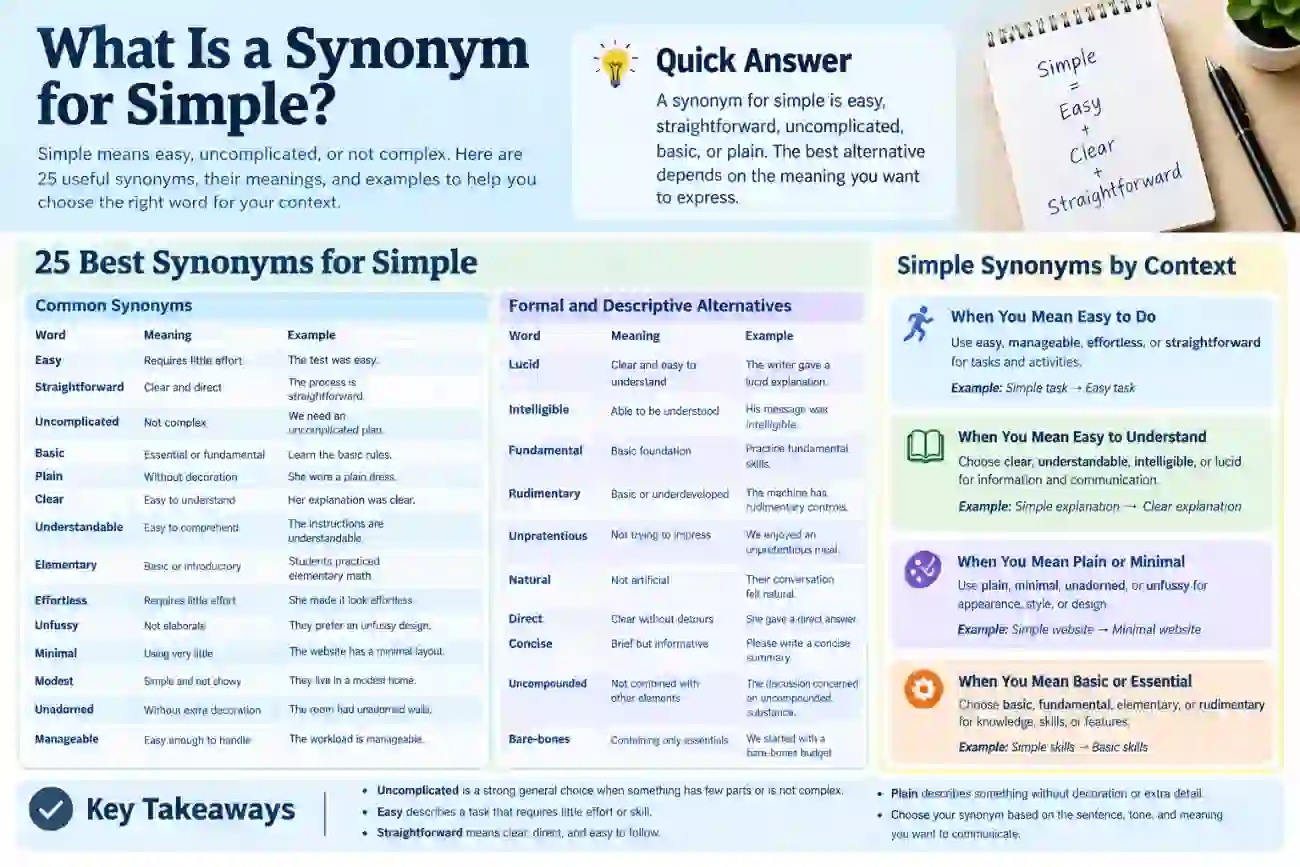
A synonym for simple is easy, straightforward, uncomplicated, basic, or plain. The best alternative depends on the meaning you want to express.
Use easy for something that requires little effort, straightforward for something clear and direct, basic for something essential, and plain for something without decoration.
Key Takeaways
- Uncomplicated is a strong choice when something has few parts or is not complex.
- Easy describes a task that requires little effort or skill.
- Straightforward means clear, direct, and easy to follow.
- Plain describes something without extra decoration or detail.
- Choose your synonym based on the sentence, tone, and meaning you want to communicate.
What Does Simple Mean?
The word simple describes something that is easy to understand, do, or use. It can also describe something with few parts, little decoration, or a basic design.
For example, a simple recipe may have only a few steps, while a simple explanation uses clear language that readers can understand.
According to established dictionary and thesaurus usage, simple has several related meanings, so its best synonym changes with the context.

Cambridge English+1
Here are three examples:
- Easy: The homework was simple enough to finish in 20 minutes.
- Plain: She wore a simple black dress to the party.
- Straightforward: The instructions were simple and easy to follow.
Understanding these differences helps you choose a word that sounds natural and communicates your exact meaning.
25 Best Synonyms for Simple
If you need another word for simple, start with these useful alternatives. Each word has a slightly different meaning, so consider the context before replacing the original word.
| Synonym | Meaning | Example |
|---|---|---|
| Easy | Requiring little effort | The test was easy. |
| Straightforward | Clear and direct | The process is straightforward. |
| Uncomplicated | Not complex | We need an uncomplicated plan. |
| Basic | Essential or fundamental | Learn the basic rules first. |
| Plain | Without decoration | He chose a plain white shirt. |
| Clear | Easy to understand | Her explanation was clear. |
| Understandable | Easy to comprehend | The instructions are understandable. |
| Elementary | Basic or introductory | Students practiced elementary math. |
| Effortless | Requiring little apparent effort | She made the task look effortless. |
| Unfussy | Not elaborate or demanding | They prefer an unfussy design. |
| Minimal | Using very little | The website has a minimal layout. |
| Modest | Simple and not showy | They live in a modest home. |
| Unadorned | Without extra decoration | The room had unadorned walls. |
| Uncomplicated | Easy to follow or manage | It was an uncomplicated arrangement. |
| Manageable | Easy enough to handle | The workload is manageable. |
| Lucid | Clear and easy to understand | The writer gave a lucid explanation. |
| Intelligible | Able to be understood | His message was intelligible. |
| Fundamental | Forming the basic foundation | Practice fundamental skills. |
| Rudimentary | Basic or not fully developed | The machine has rudimentary controls. |
| Unpretentious | Not trying to impress | We enjoyed an unpretentious meal. |
| Natural | Not artificial or forced | Their conversation felt natural. |
| Direct | Clear without unnecessary detours | She gave a direct answer. |
| Concise | Brief but informative | Please write a concise summary. |
| Uncompounded | Not combined with other elements | The technical discussion concerned an uncompounded substance. |
| Bare-bones | Containing only essentials | We started with a bare-bones budget. |
Some alternatives, such as uncompounded, are useful in specialized contexts rather than everyday conversation. For most general writing, easy, clear, basic, plain, and straightforward are more practical choices.
Common Synonyms
These five alternatives work well in many everyday situations.
1. Easy: Use this when something does not require much effort or skill.
Example: “The assignment was simple.” → “The assignment was easy.”
2. Straightforward: Use this when a task or explanation is clear and direct.
Example: “The application process is simple.” → “The application process is straightforward.”
3. Uncomplicated: Use this when something has few difficulties or parts.
Example: “We need a simple solution.” → “We need an uncomplicated solution.”
4. Basic: Use this when you mean the essential features or starting level of something.
Example: “She learned simple computer skills.” → “She learned basic computer skills.”
5. Plain: Use this when describing something without decoration, extra features, or elaborate details.
Example: “He selected a simple design.” → “He selected a plain design.”
Formal and Descriptive Alternatives
For professional emails, reports, essays, and presentations, consider these words:
- Clear: Best for explanations, instructions, and communication.
- Concise: Best for writing that communicates information in few words.
- Lucid: Best for explanations that are especially clear and easy to follow.
- Fundamental: Best for essential principles, skills, or ideas.
- Minimal: Best for designs or approaches that use very little.
- Uncomplicated: Best for describing a process with few difficulties.
For example, instead of writing “The report gives a simple explanation,” you could write, “The report provides a clear explanation.”
This revision sounds professional without making the sentence unnecessarily complicated.
Simple Synonyms by Context
The most effective synonym depends on what simple describes. Here is how to choose the right word for different situations.
When You Mean Easy to Do
Use easy, manageable, effortless, or straightforward when describing tasks, activities, or processes.
Examples:
- Simple task → Easy task
- Simple instructions → Straightforward instructions
- Simple workload → Manageable workload
- Simple movement → Effortless movement
Notice that these words do not always mean exactly the same thing. A manageable task may still require effort, while an effortless task appears to require almost none.
When You Mean Easy to Understand
Choose clear, understandable, intelligible, or lucid when describing information or communication.
Examples:
- Simple explanation → Clear explanation
- Simple language → Understandable language
- Simple presentation → Lucid presentation
- Simple message → Clear message
For everyday writing, clear is often the most natural choice. In academic or professional writing, lucid can be useful when you want to emphasize how easily readers can follow an explanation.
When You Mean Plain or Minimal
Use plain, minimal, unadorned, or unfussy when discussing appearance, style, or design.
Examples:
- Simple dress → Plain dress
- Simple website → Minimal website
- Simple decoration → Unadorned decoration
- Simple furniture → Unfussy furniture
These words describe appearance rather than difficulty. A minimal website, for example, may still contain advanced technology behind its clean design.
When You Mean Basic or Essential
Choose basic, fundamental, elementary, or rudimentary when referring to foundational knowledge, skills, or features.
Examples:
- Simple mathematics → Elementary mathematics
- Simple principles → Fundamental principles
- Simple computer skills → Basic computer skills
- Simple equipment → Rudimentary equipment
Be careful with rudimentary. It can suggest that something is underdeveloped or limited, so it may sound less positive than basic.
Simple vs. Easy vs. Basic vs. Plain
Although these words are related, they emphasize different ideas.
| Word | Main meaning | Best use |
|---|---|---|
| Simple | Not complex or elaborate | General descriptions |
| Easy | Requires little effort | Tasks and activities |
| Basic | Essential or introductory | Skills, features, and knowledge |
| Plain | Lacking decoration or extras | Clothing, design, and appearance |
| Straightforward | Clear and direct | Instructions and processes |
| Uncomplicated | Having few difficulties | Plans, systems, and situations |
Consider the sentence, “We need a simple website.”
You could replace simple with easy if you mean the website is easy to use. You could use minimal if you mean the design has few visual elements. Your could use straightforward if you mean visitors can navigate it without confusion.
The right word depends on the message you want to convey.
How to Choose the Best Synonym for Simple
Follow these four steps to select a suitable alternative.
Step 1: Identify what you are describing.
Is it a task, an explanation, an object, a design, or an idea? The subject will help narrow your options.
Step 2: Decide what simple means in your sentence.
Does it mean easy, clear, basic, or plain? Identify the intended meaning before replacing the word.
Step 3: Match the tone.
Use familiar words such as easy and clear in casual writing. Choose concise, fundamental, or lucid when the context calls for a more formal style.
Step 4: Read the revised sentence.
Check whether the new word preserves the original meaning and sounds natural.
For example:
Original: “The teacher gave us a simple explanation.”
Better: “The teacher gave us a clear explanation.”
The replacement works because the sentence emphasizes understanding, not necessarily the difficulty of the topic.
Common Mistakes to Avoid
Choosing a synonym without considering its meaning can make your writing less accurate. Watch out for these common mistakes.
- Using “easy” for every meaning: A simple design is not necessarily easy to create. Minimal or unadorned may be more accurate.
- Confusing “simple” with “simplistic”: Simplistic often suggests that something ignores important details or makes an issue seem easier than it really is.
- Using “basic” when you mean “clear”: Basic information may still be difficult to understand. Use clear when readability is your main concern.
- Choosing overly formal vocabulary: Words such as lucid and uncompounded may sound unnatural in casual conversations.
- Ignoring sentence context: A synonym that works for a recipe may not work for a business report or a clothing description.
The goal is not to use the most complicated alternative. It is to choose the word that communicates your meaning most accurately.
Frequently Asked Questions
What is the best synonym for simple?
Uncomplicated is an excellent general alternative when something is not complex. However, easy works better for tasks, clear for explanations, basic for essential features, and plain for appearance. The best choice depends on what you are describing and the tone of your writing.
What is another word for simple and easy?
Words such as straightforward, uncomplicated, and effortless may work, depending on the context. Use straightforward for a clear process, uncomplicated for something without complexity, and effortless when an activity requires little apparent effort.
What is a formal word for simple?
Lucid, uncomplicated, concise, and straightforward are useful alternatives in formal writing. For example, “a simple explanation” could become “a clear explanation” or “a lucid explanation.” Choose the word that best expresses the intended meaning rather than selecting a formal term simply because it sounds sophisticated.
What is a synonym for simple to understand?
Clear, understandable, intelligible, and lucid are suitable choices. For most everyday sentences, clear is the most natural option. For example, “The instructions are simple to understand” can become “The instructions are clear.”
What is the opposite of simple?
Common antonyms include complex, complicated, difficult, intricate, and elaborate. The right opposite depends on the context. A difficult task contrasts with an easy one, while an elaborate design contrasts with a plain or minimal design.
Cambridge English+1
What is a good synonym for a simple person?
If you mean someone who is honest and unpretentious, consider sincere, modest, genuine, or unpretentious. Be careful with the phrase simple person, because it can sometimes imply a lack of intelligence. Choose a more precise and respectful word to communicate your intended meaning.
Conclusion
If you are wondering what is a synonym for simple, start with uncomplicated, easy, straightforward, basic, or plain. Each word offers a slightly different meaning.
Use easy for tasks, clear for explanations, basic for essential features, and plain for appearance. By considering the context, you can make your writing more precise, natural, and engaging without using unnecessary words.

Robert Hayes is an ESL educator and curriculum developer with over nine years of experience teaching English to beginners and intermediate learners across multiple countries ( Biography ).