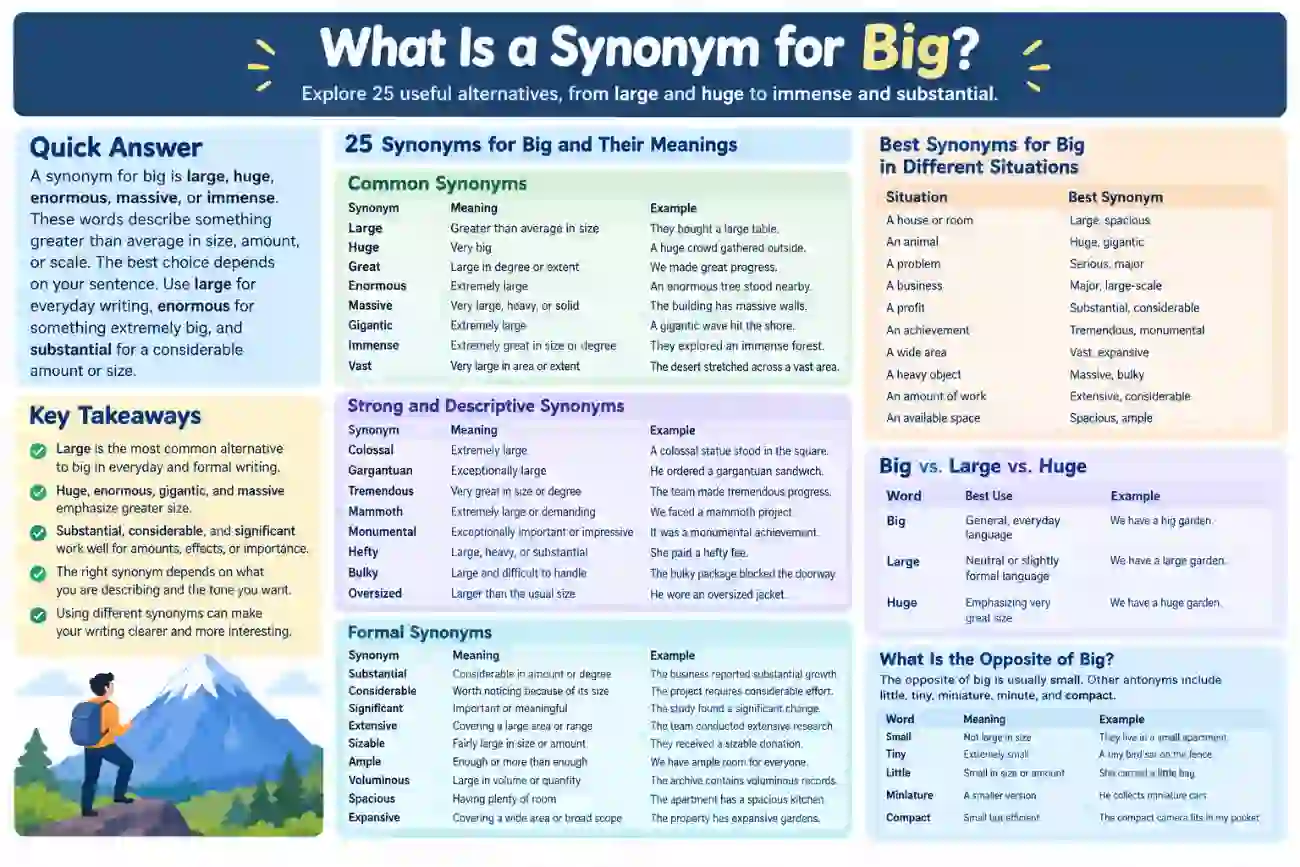
A synonym for big is large, huge, enormous, massive, or immense. These words describe something greater than average in size, amount, or scale.
The best choice depends on your sentence. Use large for everyday writing, enormous for something extremely big, and substantial for a considerable amount or size.
Key Takeaways
- Large is the most common alternative to big in everyday and formal writing.
- Huge, enormous, gigantic, and massive emphasize greater size.
- Substantial, considerable, and significant work well when discussing amounts, effects, or importance.
- The right synonym depends on what you are describing and the tone you want.
- Using different synonyms can make your writing clearer and more interesting.
What Does Big Mean?
The word big is an adjective that describes something large in size, height, weight, amount, or extent. It can also describe something important, serious, or influential.
For example, you might talk about a big house, a big meal, a big decision, or a big opportunity. Although the same word appears in each phrase, its meaning changes slightly with the context.

Dictionary.com+1
Writers often look for another word for big to make their sentences more precise. Instead of saying, “The company made a big profit,” you could write, “The company made a substantial profit.”
Both sentences communicate a similar idea, but the second sounds more formal and specific.
25 Synonyms for Big and Their Meanings
Here are 25 useful synonyms for big, including simple alternatives, powerful descriptive words, and formal vocabulary.
Common Synonyms
These words are suitable for everyday conversations, school assignments, emails, and general writing.
| Synonym | Meaning | Example |
|---|---|---|
| Large | Greater than average in size | They bought a large table. |
| Huge | Very big | A huge crowd gathered outside. |
| Great | Large in degree or extent | We made great progress. |
| Enormous | Extremely large | An enormous tree stood nearby. |
| Massive | Very large, heavy, or solid | The building has massive walls. |
| Gigantic | Extremely large | A gigantic wave hit the shore. |
| Immense | Extremely great in size or degree | They explored an immense forest. |
| Vast | Very large in area or extent | The desert stretched across a vast area. |
These are among the most useful alternatives for describing objects, places, amounts, and experiences. However, not every word fits every sentence. For example, vast works naturally with an area or amount of knowledge, while massive often describes something heavy, solid, or extensive.
Cambridge English+1
Strong and Descriptive Synonyms
Use these words when you want to create a stronger image or emphasize just how big something is.
| Synonym | Meaning | Example |
|---|---|---|
| Colossal | Extremely large | A colossal statue stood in the square. |
| Gargantuan | Exceptionally large | He ordered a gargantuan sandwich. |
| Tremendous | Very great in size or degree | The team made tremendous progress. |
| Mammoth | Extremely large or demanding | We faced a mammoth project. |
| Monumental | Exceptionally important or impressive | It was a monumental achievement. |
| Hefty | Large, heavy, or substantial | She paid a hefty fee. |
| Bulky | Large and difficult to handle | The bulky package blocked the doorway. |
| Oversized | Larger than the usual size | He wore an oversized jacket. |
Some of these words describe physical size, while others emphasize scale, effort, or importance. For example, a monumental achievement is significant rather than physically large.
Formal Synonyms
These alternatives are especially useful for professional emails, academic writing, reports, and business communication.
| Synonym | Meaning | Example |
|---|---|---|
| Substantial | Considerable in amount or degree | The business reported substantial growth. |
| Considerable | Worth noticing because of its size or extent | The project requires considerable effort. |
| Significant | Important or meaningful | The study found a significant change. |
| Extensive | Covering a large area or range | The team conducted extensive research. |
| Sizable | Fairly large in size or amount | They received a sizable donation. |
| Ample | Enough or more than enough | We have ample room for everyone. |
| Voluminous | Large in volume or quantity | The archive contains voluminous records. |
| Spacious | Having plenty of room | The apartment has a spacious kitchen. |
| Expansive | Covering a wide area or showing a broad scope | The property has expansive gardens. |
Choose formal words according to the meaning you need. Significant usually emphasizes importance, extensive emphasizes range or coverage, and ample means sufficient or plentiful rather than simply large.
Cambridge English+1
Best Synonyms for Big in Different Situations
The best synonym for big depends on what you want to describe. Use this quick guide to select a word that sounds natural.
| Situation | Best synonym | Example |
|---|---|---|
| A house or room | Large, spacious | They moved into a spacious home. |
| An animal | Huge, gigantic | A huge elephant crossed the road. |
| A problem | Serious, major | We need to solve a serious problem. |
| A business | Major, large-scale | She works for a major company. |
| A profit | Substantial, considerable | The store earned a substantial profit. |
| An achievement | Tremendous, monumental | Winning was a monumental achievement. |
| A wide area | Vast, expansive | They traveled across a vast region. |
| A heavy object | Massive, bulky | The massive desk was hard to move. |
| An amount of work | Extensive, considerable | The task requires extensive preparation. |
| An available space | Spacious, ample | The room offers ample storage. |
Remember that a synonym should preserve your intended meaning. For instance, a major problem emphasizes importance, while a huge box emphasizes physical size.
Big vs. Large vs. Huge: What Is the Difference?
Big, large, and huge are closely related, but they differ in tone and emphasis.
| Word | Best use | Example |
|---|---|---|
| Big | General, everyday language | We have a big garden. |
| Large | Neutral or slightly more formal language | We have a large garden. |
| Huge | Emphasizing very great size | We have a huge garden. |
It works in conversations and expressions such as “a big day” or “a big mistake.”
Large is often a good choice in professional or informational writing. You might write “a large population” or “a large quantity of water.”
Huge adds emphasis. It suggests that something is much larger than expected or ordinary.
There is no universal rule that makes one word better than the others. The best option depends on your audience, tone, and intended meaning.
Thesaurus.com+1
Examples of Big Synonyms in Sentences
Seeing synonyms in complete sentences makes it easier to understand how to use them correctly.
Here are eight original examples:
- Large: Our school has a large library with thousands of books.
- Enormous: An enormous storm covered the coastal town.
- Massive: Workers moved a massive stone into position.
- Vast: The researchers studied a vast collection of historical records.
- Substantial: The family saved a substantial amount of money.
- Considerable: Finishing the assignment required considerable patience.
- Gigantic: A gigantic balloon floated above the festival.
- Significant: The new policy brought a significant change to the workplace.
Notice how each word fits a different situation. Physical objects often work well with large, enormous, and gigantic, while money, effort, and changes often work better with substantial, considerable, and significant.
How to Replace Big in Your Writing
Try replacing general phrases with more precise alternatives.
- “We have a big problem.” → “We have a serious problem.”
- “She made a big improvement.” → “She made a significant improvement.”
- “They live in a big house.” → “They live in a spacious house.”
- “The project needs big changes.” → “The project needs substantial changes.”
- “He carried a big box.” → “He carried a bulky box.”
These changes help readers understand exactly what you mean. However, keep big when it sounds more natural, especially in casual conversations or familiar expressions.
What Is the Opposite of Big?
The opposite of big is usually small. Other antonyms include little, tiny, miniature, minute, and compact.
The most suitable opposite depends on the context.
| Word | Meaning | Example |
|---|---|---|
| Small | Not large in size | They live in a small apartment. |
| Tiny | Extremely small | A tiny bird sat on the fence. |
| Little | Small in size or amount | She carried a little bag. |
| Miniature | A smaller version of something | He collects miniature cars. |
| Compact | Small but arranged efficiently | The compact camera fits in my pocket. |
When big means important rather than physically large, its opposite may be minor or insignificant.
For example, a big decision can be described as a major decision, while a decision with little importance might be called a minor decision.
Cambridge English+1
Frequently Asked Questions
What is the best synonym for big?
Large is often the best general synonym for big because it works in many everyday and formal sentences. However, huge or enormous may be better when you want to emphasize extreme size, while substantial works well for amounts and quantities.
What is a stronger word for big?
Words such as huge, enormous, gigantic, colossal, and gargantuan express greater size or stronger emphasis. For example, “a big building” can become “a gigantic building” when you want readers to imagine something exceptionally large.
What is a formal word for big?
Substantial, considerable, extensive, and significant are useful formal alternatives. Use substantial for amounts or growth, extensive for broad coverage, and significant when the main idea is importance or impact.
What is a fancy word for big?
Colossal, gargantuan, immense, and mammoth are more expressive alternatives to big. They can make creative writing more vivid, but they may sound exaggerated in ordinary professional communication.
Can significant be used as a synonym for big?
Yes, when big refers to importance, impact, or degree rather than physical size. For example, “a big improvement” can become “a significant improvement.” However, significant is not usually a direct replacement for big when describing an object’s physical dimensions.
Conclusion
If you are wondering what is a synonym for big, large, huge, enormous, massive, and immense are excellent starting points. For formal writing, consider substantial, considerable, or extensive, depending on the context.
The key is to choose a word that communicates your meaning clearly. A precise synonym makes your writing more natural, helps avoid repetition, and gives readers a better understanding of what you want to say.

Lily Parker edits and reviews language comparison content to maintain accuracy and readability.