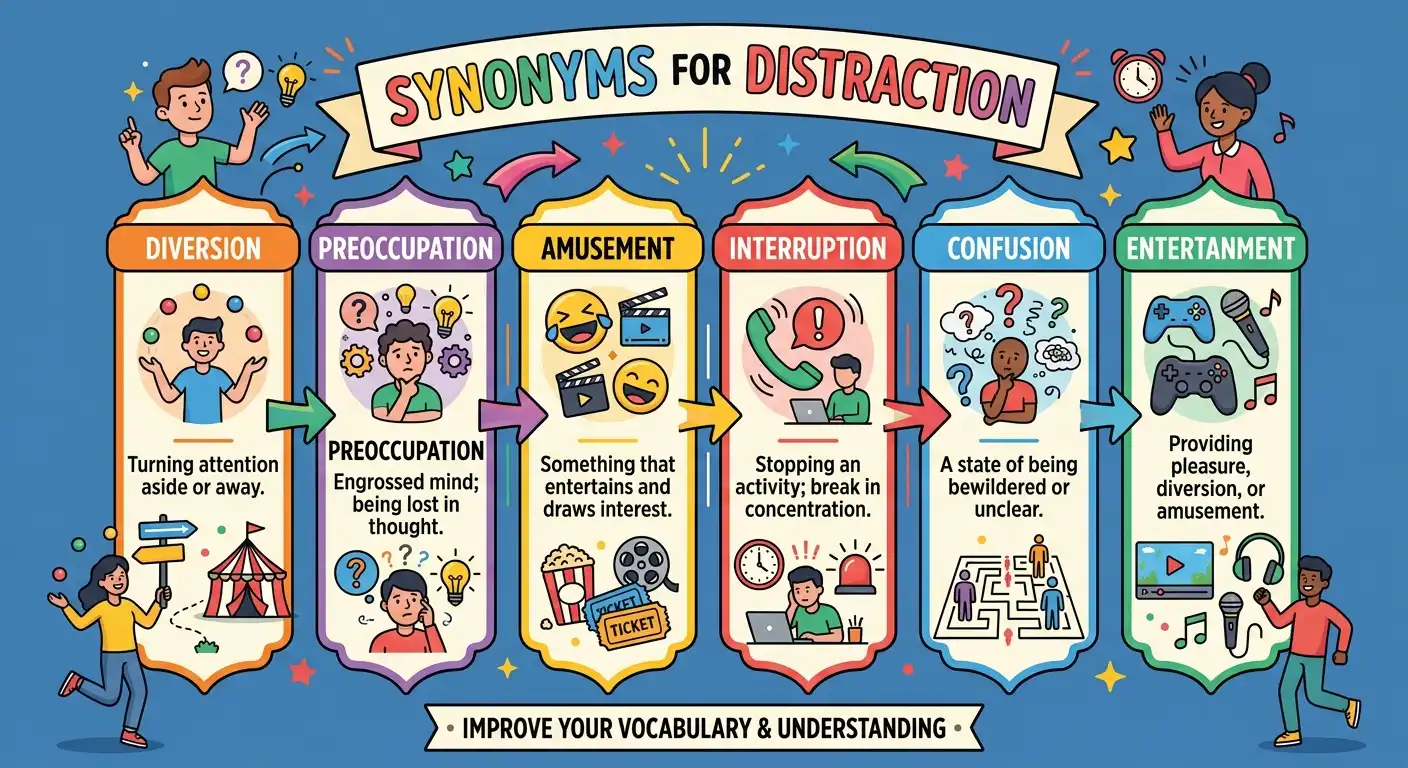
Finding exact synonyms for distraction helps you describe lost focus and unexpected interruptions with total accuracy. When you learn clear synonyms for distraction, you can express work delays, mental diversions, and daily noise effortlessly. Using accurate synonyms for distraction improves your daily conversations and elevates your vocabulary.
Imagine a student sitting down at a desk to study for a big history exam. A phone screen suddenly lights up with a loud text chime, pulling their attention away from the textbook. That quick phone text acts as a sudden disturbance that ruins deep focus.
In simple terms, a distraction is anything that takes your mind away from what you should be doing. Learning various synonyms for distraction helps four main groups of readers:
- Students explain study challenges clearly in school essays and class talks.
- Bloggers write engaging productivity guides that keep readers focused.
- Content writers boost search traffic with precise, high-value vocabulary.
- Daily English users speak with confidence and clarity in work and home life.
“The right word brings instant focus and clarity to every thought.”
“A strong vocabulary turns simple ideas into powerful expressions.”
Linguistic Breakdown of “Distraction”
Connotative Meaning
The word distraction carries slightly negative to neutral connotations. It often implies a loss of attention, a break in focus, or a pleasant diversion from hard work.
Etymology
- Origin: From Latin distractio (meaning pulling apart or separation).
- Root Words: Dis- (away or apart) + trahere (to drag or pull).
- Historical Shift: First used in English to describe physical separation, later shifting to mental loss of attention or entertaining diversion.
Pronunciation
- US (IPA): /dɪˈstræk.ʃən/
- UK (IPA): /dɪˈstræk.ʃən/
Syllables & Affixation Pattern
- Syllables: 3 syllables (dis-trac-tion)
- Base Structure: Verb root distract + Noun suffix -ion
- Grammatical Patterns:
- Active Verb Form: Distracts / Distracted
- Adjective Form: Distracting / Distracted
- Noun Form: Distraction / Distractions
Comparison Table: Common Synonyms for Distraction
| Keyword | Meaning | Usage Type | Context |
| Diversion | Turning attention to something else | Professional / Formal | Work Breaks, Traffic, & Entertainment |
| Interruption | A sudden break in an ongoing activity | Casual / Professional | Office Meetings, Phone Calls, & Study |
| Disturbance | An event that disrupts peace or order | Casual / Emotional | Loud Noise, Crowds, & Sleep |
| Interference | Unwanted involvement blocking progress | Formal / Analytical | Sports, Technology, & Work Projects |
| Side-attraction | A secondary event taking focus | Casual / Conversational | Events, Fairs, & Travel Trips |
| Preoccupation | Being totally lost in deep thoughts | Emotional / Personal | Worry, Daydreaming, & Mental Stress |
| Sidetrack | Directing attention away from main topic | Casual / Workplace | Team Talks, Arguments, & Speeches |
50 Best Synonyms for Distraction
1. Diversion
- Pronunciation: US /daɪˈvɝː.ʒən/ | UK /daɪˈvɜː.ʃən/
- Meaning: Diversion means something that turns your attention away from your main task.
- Examples:
- Playing a quick video game gave him a fun diversion from study.
- Road work caused a short traffic diversion near the school.
2. Interruption
- Pronunciation: US /ˌɪn.t̬əˈrʌp.ʃən/ | UK /ˌɪn.təˈrʌp.ʃən/
- Meaning: Interruption means a sudden break that stops what you are doing.
- Examples:
- Loud phone calls caused a constant interruption during our meeting.
- She finished her math task without a single interruption.
3. Disturbance
- Pronunciation: US /dɪˈstɝː.bəns/ | UK /dɪˈstɜː.bəns/
- Meaning: Disturbance means a noise or event that ruins your peace and focus.
- Examples:
- Barking dogs created a noisy disturbance in the quiet neighborhood.
- He left the library to avoid any further disturbance.
4. Interference
- Pronunciation: US /ˌɪn.t̬ɚˈfɪr.əns/ | UK /ˌɪn.təˈfɪə.rəns/
- Meaning: Interference means an unwanted thing that gets in the way of progress.
- Examples:
- Bad radio signal caused static interference on the call.
- Heavy rain proved to be a major interference for the game.
5. Disruption
- Pronunciation: US /dɪsˈrʌp.ʃən/ | UK /dɪsˈrʌp.ʃən/
- Meaning: Disruption means an event that completely stops normal activity.
- Examples:
- A sudden power outage caused a major disruption at the office.
- The storm created severe flight disruption at the airport.
6. Detour
- Pronunciation: US /ˈdiː.tʊr/ | UK /ˈdiː.tʊə/
- Meaning: Detour means a longer route taken to avoid an obstacle or problem.
- Examples:
- We took a short detour around the flooded highway.
- Talking about food was an unplanned detour from our topic.
7. Side-attraction
- Pronunciation: US /saɪd əˈtræk.ʃən/ | UK /saɪd əˈtræk.ʃən/
- Meaning: Side-attraction means an extra event that pulls interest away from the main event.
- Examples:
- The juggler was a fun side-attraction at the street fair.
- A gift shop acted as a side-attraction for museum visitors.
8. Amusement
- Pronunciation: US /əˈmjuːz.mənt/ | UK /əˈmjuːz.mənt/
- Meaning: Amusement means an activity that provides fun and keeps your mind light.
- Examples:
- Watching funny cat clips brought simple amusement to the team.
- The board game provided hours of evening amusement.
9. Preoccupation
- Pronunciation: US /priːˌɑː.kjəˈpeɪ.ʃən/ | UK /priːˌɒk.jəˈpeɪ.ʃən/
- Meaning: Preoccupation means a strong thought that completely fills your mind.
- Examples:
- Her main preoccupation was passing the final driving test.
- He missed the turn because of his heavy preoccupation.
10. Digression
- Pronunciation: US /daɪˈɡreʃ.ən/ | UK /daɪˈɡreʃ.ən/
- Meaning: Digression means moving away from the main subject while speaking or writing.
- Examples:
- The teacher apologized for a long digression during history class.
- Telling that short joke was a harmless speech digression.
“Choosing exact words turns basic choices into clear statements of value.”
11. Tangent
- Pronunciation: US /ˈtæn.dʒənt/ | UK /ˈtæn.dʒənt/
- Meaning: Tangent means sudden talk about a subject completely different from the main point.
- Examples:
- He went off on a long tangent about his new pet dog.
- Try not to go on a tangent during your presentation.
12. Sidetrack
- Pronunciation: US /ˈsaɪd.træk/ | UK /ˈsaɪd.træk/
- Meaning: Sidetrack means directing someone away from their main task or goal.
- Examples:
- Loud social media alerts easily sidetrack young students.
- Do not let minor details sidetrack your main project work.
13. Bother
- Pronunciation: US /ˈbɑː.ðɚ/ | UK /ˈbɒð.ər/
- Meaning: Bother means a small trouble or thing that annoys your mind.
- Examples:
- A buzzing fly was a annoying bother in the kitchen.
- Forget about that small mistake because it is no bother.
14. Nuisance
- Pronunciation: US /ˈnuː.səns/ | UK /ˈnjuː.səns/
- Meaning: Nuisance means a person, thing, or situation that causes annoying trouble.
- Examples:
- Loud lawn mowers early in the morning are a total nuisance.
- Spam messages in your email inbox are a daily nuisance.
15. Intrusion
- Pronunciation: US /ɪnˈtruː.ʒən/ | UK /ɪnˈtruː.ʒən/
- Meaning: Intrusion means an uninvited arrival that breaks privacy or focus.
- Examples:
- Pop-up ads feel like an annoying intrusion while reading news.
- He felt the sudden phone visit was a unnecessary intrusion.
16. Complication
- Pronunciation: US /ˌkɑːm.pləˈkeɪ.ʃən/ | UK /ˌkɒm.plɪˈkeɪ.ʃən/
- Meaning: Complication means an unexpected problem that makes a task harder.
- Examples:
- Bad weather added a new complication to our travel plan.
- Software errors caused a costly work complication.
17. Obstacle
- Pronunciation: US /ˈɑːb.stə.kəl/ | UK /ˈɒb.stə.kəl/
- Meaning: Obstacle means something that blocks your movement or forward path.
- Examples:
- Fallen tree limbs formed a road obstacle for commuters.
- Lack of time remains the biggest obstacle for gym goals.
18. Hindrance
- Pronunciation: US /ˈhɪn.drəns/ | UK /ˈhɪn.drəns/
- Meaning: Hindrance means a person or thing that slows down progress.
- Examples:
- Dark clouds proved to be a severe hindrance for stars.
- Slow internet service is a major hindrance for remote jobs.
19. Impairment
- Pronunciation: US /ɪmˈper.mənt/ | UK /ɪmˈpeə.mənt/
- Meaning: Impairment means a loss or weakness in function or mental clear focus.
- Examples:
- Extreme fatigue causes severe impairment of study focus.
- Loud room sounds lead to clear speech hearing impairment.
20. Inattention
- Pronunciation: US /ˌɪn.əˈten.ʃən/ | UK /ˌɪn.əˈten.ʃən/
- Meaning: Inattention means failing to give proper care or focus to a task.
- Examples:
- Simple typos often occur due to momentary inattention.
- Driver inattention remains a leading cause of auto accidents.
21. Mind-wandering
- Pronunciation: US /maɪnd ˈwɑːn.dɚ.ɪŋ/ | UK /maɪnd ˈwɒn.dər.ɪŋ/
- Meaning: Mind-wandering means letting your thoughts drift away from your active work.
- Examples:
- Long quiet lectures often trigger instant mind-wandering.
- Mind-wandering happens when you read boring text pages.
22. Daydream
- Pronunciation: US /ˈdeɪ.driːm/ | UK /ˈdeɪ.driːm/
- Meaning: Daydream means pleasant thoughts that take your mind away from reality.
- Examples:
- He fell into a peaceful daydream about summer beach trips.
- A sweet daydream stopped her from writing her assignment.
23. Noise
- Pronunciation: US /nɔɪz/ | UK /nɔɪz/
- Meaning: Noise means unwanted sound that disturbs concentration and work.
- Examples:
- Street construction noise made office study impossible.
- Put on headphones to block out background room noise.
24. Clutter
- Pronunciation: US /ˈklʌt̬.ɚ/ | UK /ˈklʌt.ər/
- Meaning: Clutter means a messy collection of things that distracts visual focus.
- Examples:
- Clearing desk clutter helps improve your daily work focus.
- Digital file clutter makes finding reports very hard.
25. Commotion
- Pronunciation: US /kəˈmoʊ.ʃən/ | UK /kəˈməʊ.ʃən/
- Meaning: Commotion means a sudden period of noisy excitement and confusion.
- Examples:
- A loud dog fight caused a quick commotion in the park.
- The sudden glass break started a brief kitchen commotion.
26. Ruckus
- Pronunciation: US /ˈrʌk.əs/ | UK /ˈrʌk.əs/
- Meaning: Ruckus means a noisy fight, argument, or disorderly disturbance.
- Examples:
- The cheering fans raised a big ruckus inside the stadium.
- My pet parrot makes a loud ruckus every morning.
27. Tumult
- Pronunciation: US /ˈtuː.mʌlt/ | UK /ˈtjuː.mʌlt/
- Meaning: Tumult means a loud confused noise made by a large crowd of people.
- Examples:
- The victory party created a joyful tumult in town streets.
- He tried to sleep despite the outdoor street tumult.
28. Turmoil
- Pronunciation: US /ˈtɝː.mɔɪl/ | UK /ˈtɜː.mɔɪl/
- Meaning: Turmoil means a state of great disturbance, confusion, or uncertainty.
- Examples:
- Mental turmoil makes making simple life choices hard.
- The sudden office manager change caused team turmoil.
29. Agitation
- Pronunciation: US /ˌædʒ.əˈteɪ.ʃən/ | UK /ˌædʒ.ɪˈteɪ.ʃən/
- Meaning: Agitation means a state of nervous worry and inner mind disturbance.
- Examples:
- Deep breathing exercises help calm sudden mental agitation.
- She paced the room in quiet physical agitation.
30. Unrest
- Pronunciation: US /ʌnˈrest/ | UK /ʌnˈrest/
- Meaning: Unrest means a general state of trouble or disturbed peace.
- Examples:
- Price hikes caused widespread political unrest in town.
- Workplace changes generated brief employee unrest.
31. Excitement
- Pronunciation: US /ɪkˈsaɪt.mənt/ | UK /ɪkˈsaɪt.mənt/
- Meaning: Excitement means strong feelings of enthusiasm that take over focus.
- Examples:
- The upcoming holiday trip generated intense child excitement.
- Game day excitement kept students from study tasks.
32. Divertissement
- Pronunciation: US /dɪˈvɝː.t̬əs.mənt/ | UK /dɪˈvɜː.tɪs.mənt/
- Meaning: Divertissement means a short entertainment that distracts your mind nicely.
- Examples:
- The musical interlude offered a charming divertissement.
- Short puppet shows provided total park divertissement.
33. Pastime
- Pronunciation: US /ˈpæs.taɪm/ | UK /ˈpɑːs.taɪm/
- Meaning: Pastime means an enjoyable activity done to spend spare time nicely.
- Examples:
- Reading mystery books remains a classic relaxing pastime.
- Gardening is his favorite weekend outdoor pastime.
34. Recreation
- Pronunciation: US /ˌrek.riˈeɪ.ʃən/ | UK /ˌrek.riˈeɪ.ʃən/
- Meaning: Recreation means activity done for enjoyment when one is not working.
- Examples:
- The local city park offers space for outdoor recreation.
- Swimming provides great summer fitness and recreation.
35. Entertainment
- Pronunciation: US /en.t̬ɚˈteɪn.mənt/ | UK /en.təˈteɪn.mənt/
- Meaning: Entertainment means shows or events that hold interest and give pleasure.
- Examples:
- Movies remain a primary source of home entertainment.
- Live musical acts offered wonderful evening entertainment.
36. Game
- Pronunciation: US /ɡeɪm/ | UK /ɡeɪm/
- Meaning: Game means a playful activity with rules that distracts you from routine.
- Examples:
- Playing a quick chess game relaxed his tired mind.
- The family enjoyed a fun board game after dinner.
37. Hobby
- Pronunciation: US /ˈhɑː.bi/ | UK /ˈhɒb.i/
- Meaning: Hobby means an activity done regularly in one’s leisure time for pleasure.
- Examples:
- Painting landscapes is her favorite weekend creative hobby.
- Stamp collection is a quiet and educational home hobby.
38. Novelty
- Pronunciation: US /ˈnɑː.vəl.ti/ | UK /ˈnɒv.əl.ti/
- Meaning: Novelty means the quality of being new, original, or unusual.
- Examples:
- The fun desk toy was a temporary work novelty.
- The novelty of working from home wore off quickly.
39. Attraction
- Pronunciation: US /əˈtræk.ʃən/ | UK /əˈtræk.ʃən/
- Meaning: Attraction means a feature or place that draws people’s active attention.
- Examples:
- The tall Ferris wheel was the main park attraction.
- Bright bakery windows are a strong street attraction.
40. Curiosity
- Pronunciation: US /ˌkjʊr.iˈɑː.sə.ti/ | UK /ˌkjʊə.riˈɒs.ə.ti/
- Meaning: Curiosity means a strong desire to know or learn something new.
- Examples:
- Natural child curiosity leads to active learning steps.
- The weird package aroused instant neighbor curiosity.
41. Temptation
- Pronunciation: US /tempˈteɪ.ʃən/ | UK /tempˈteɪ.ʃən/
- Meaning: Temptation means a desire to do something, especially something wrong or unwise.
- Examples:
- Warm chocolate cake proved to be a sweet temptation.
- Checking phone texts during class remains a strong temptation.
42. Lure
- Pronunciation: US /lʊr/ | UK /lʊər/
- Meaning: Lure means something that tempts or attracts with the promise of pleasure.
- Examples:
- The bright city lights acted as a strong job lure.
- Low prices served as a powerful store lure for shoppers.
43. Enticement
- Pronunciation: US /ɪnˈtaɪs.mənt/ | UK /ɪnˈtaɪs.mənt/
- Meaning: Enticement means something used to attract or tempt someone convincingly.
- Examples:
- Free coffee offered a sweet enticement to early buyers.
- High bonus pay was a key employee recruitment enticement.
44. Trap
- Pronunciation: US /træp/ | UK /træp/
- Meaning: Trap means a tricky situation that catches and holds your focus unhelpfully.
- Examples:
- Endless video scrolling is a total digital time trap.
- Do not fall into the perfection trap while drafting essays.
45. Snare
- Pronunciation: US /sner/ | UK /sneər/
- Meaning: Snare means something that entangles or catches you unexpectedly.
- Examples:
- Unnecessary gossip is a snare for productive team offices.
- Online pop-ups are a hidden snare for focused study.
46. Time-waster
- Pronunciation: US /ˈtaɪmˌweɪ.stɚ/ | UK /ˈtaɪmˌweɪ.stər/
- Meaning: Time-waster means an activity or object that uses up time uselessly.
- Examples:
- Checking junk emails is a major morning time-waster.
- Playing silly mobile app games can be a huge time-waster.
47. Time-killer
- Pronunciation: US /ˈtaɪmˌkɪl.ɚ/ | UK /ˈtaɪmˌkɪl.ər/
- Meaning: Time-killer means an activity used to pass time quickly while waiting.
- Examples:
- Crossword puzzles serve as a quiet train time-killer.
- Reading magazine articles is a nice airport time-killer.
48. Disconnection
- Pronunciation: US /ˌdɪs.kəˈnek.ʃən/ | UK /ˌdɪs.kəˈnek.ʃən/
- Meaning: Disconnection means a break in connection between thoughts or focus points.
- Examples:
- Mental disconnection leads to missing important lecture facts.
- A brief wifi disconnection disrupted our online conference.
49. Divergence
- Pronunciation: US /daɪˈvɝː.dʒəns/ | UK /daɪˈvɜː.dʒəns/
- Meaning: Divergence means moving away from a central standard or main topic path.
- Examples:
- Their views showed a sharp divergence during the debate.
- Topic divergence made the book chapter hard to follow.
50. Abstraction
- Pronunciation: US /æbˈstræk.ʃən/ | UK /æbˈstræk.ʃən/
- Meaning: Abstraction means a state of being lost in thought and unaware of surroundings.
- Examples:
- Deep mental abstraction caused him to miss his bus stop.
- Her smile showed a state of dreamy artistic abstraction.
Antonyms of “Distraction”
Knowing opposite terms helps you express sharp focus, deep attention, and pure concentration accurately.
- Focus: The center of interest or activity with clear mental concentration.
- Attention: Notice taken of someone or something; total mental application.
- Concentration: The action or power of focusing all one’s attention.
- Absorption: State of being completely engaged or engrossed in an activity.
- Mindfulness: The quality or state of being conscious or aware of the present.
- Single-mindedness: Complete dedication to one single goal or main task.
Prototype Meaning & Categorization of “Distraction”
The core concept of distraction centers on loss of focus, mental diversion, uninvited disturbance, and light entertainment. Depending on your intent, these 50 synonyms divide into four clear groups:
- Unwanted Disruptions & Obstacles: Interruption, disturbance, interference, disruption, bother, nuisance, intrusion, complication, obstacle, hindrance, noise, clutter, commotion, ruckus, tumult, turmoil, agitation, unrest, snare, trap.
- Topic & Path Shifts: Diversion, detour, side-attraction, digression, tangent, sidetrack, inattention, mind-wandering, disconnection, divergence, abstraction.
- Mental States & Preoccupations: Preoccupation, impairment, daydream, curiosity, temptation, lure, enticement, excitement, novelty.
- Hobbies, Fun & Leisure: Amusement, divertissement, pastime, recreation, entertainment, game, hobby, attraction, time-waster, time-killer.
Frequently Asked Questions (FAQs)
1. What is the most common formal synonym for “distraction”?
In formal and academic writing, “diversion,” “interruption,” or “disruption” work best. They explain a loss of focus clearly without using casual slang.
2. What is the main difference between “distraction” and “diversion”?
A distraction usually interrupts focus unhelpfully. A diversion can be a planned, pleasant break or entertainment that gives your mind rest.
3. Which synonym for “distraction” should I use in business emails?
In professional office emails, terms like “interruption,” “interference,” or “unplanned delay” sound polite, constructive, and clear.
4. Can “hobby” be considered a synonym for “distraction”?
Yes, in a positive context, a hobby acts as a healthy mental distraction from daily work stress and routine duties.
5. Is “sidetrack” appropriate for formal essays?
While “sidetrack” is fine in conversational contexts, terms like “digression” or “divergence” sound better in academic essays.
6. How does learning synonyms for “distraction” boost SEO?
Using rich synonyms prevents repetitive keyword use, meets varied search intents, strengthens context signals, and keeps visitors reading longer.
Conclusion
Expanding your vocabulary with synonyms for distraction brings clarity, variety, and precision to your communication. Replacing repetitive terms with exact choices like diversion, interruption, nuisance, or preoccupation ensures your writing hits the mark every single time.
Whether you are writing business emails, drafting academic essays, publishing blog posts, or chatting in daily life, precise words build instant confidence. Clear vocabulary removes fluff and turns basic thoughts into memorable arguments. Start practicing these 50 synonyms today to express focus and diversions with lasting power.
“Mastering exact vocabulary turns simple thoughts into powerful expressions.”
“Clear word choices bring quiet strength and authority to every message.”

Robert Hayes is an ESL educator and curriculum developer with over nine years of experience teaching English to beginners and intermediate learners across multiple countries ( Biography ).