Better Words for “Valley” (With Examples for Writing & Speaking)
Learning synonyms for valley helps you describe land more clearly in speaking and writing. You may see this word in geography books, travel blogs, or daily conversation. Using different words improves your vocabulary and avoids repetition.
This guide explains simple alternatives, examples, and correct usage.
Direct Answer: Best Synonyms for Valley
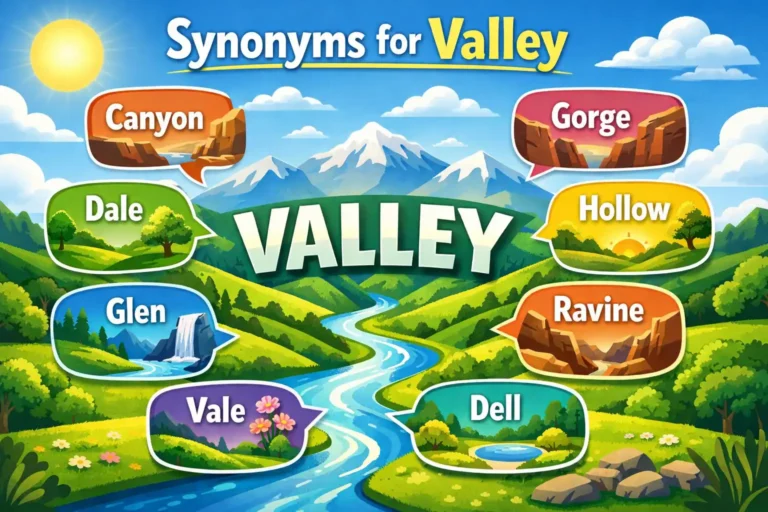
A valley is a low area of land between hills or mountains. Common synonyms for valley include:
- Dale
- Canyon
- Gorge
- Basin
- Hollow
- Glen
- Ravine
- Trough
- Vale
Meaning of Valley
A valley is a low area of land that lies between higher areas such as hills or mountains. Rivers often flow through valleys.
Example:
We walked through the valley between the two mountains.
Types of Valley Synonyms (By Landform Shape & Depth)
1. Small or Gentle Land Areas
These words describe softer, greener, or less steep land areas.
Examples: dale, glen, vale, hollow.
2. Deep or Narrow Land Areas
These words describe steep, rocky, or dramatic landscapes.
Examples: canyon, gorge, ravine.
3. Wide or Geographic Land Forms
These words describe large land depressions or broader areas.
Examples: basin, trough.
Synonyms Table
| Word | Simple Meaning | Example Sentence |
| Dale | Small valley, often rural | The sheep grazed in the dale. |
| Canyon | Deep valley with steep sides | The hikers explored the canyon. |
| Gorge | Narrow valley with cliffs | A river runs through the gorge. |
| Basin | Wide low land area | The lake sits in a large basin. |
| Hollow | Small low area in land | The cabin stood in a quiet hollow. |
| Glen | Narrow valley, often Scottish | They camped in a peaceful glen. |
| Ravine | Deep narrow valley | Rainwater filled the ravine. |
| Trough | Long low area between hills | The road runs through the trough. |
| Vale | Poetic word for valley | The village lies in a green vale. |
Valley Synonyms List (Easy, Medium, Advanced)
Beginner / Simple
Dale
Small valley in the countryside.
The cows rested in the dale.
Hollow
Low land area surrounded by hills.
The house sits in a hollow near the forest.
Basin
Wide area of low land.
The town grew inside the river basin.
Intermediate
Canyon
Deep valley with steep rock sides.
Tourists photographed the massive canyon.
Gorge
Narrow valley with cliffs.
The bridge crosses a deep gorge.
Ravine
Deep, narrow valley formed by water.
Heavy rain widened the ravine.
Trough
Long low area between hills or waves.
The wind moved through the mountain trough.
Advanced / Formal
Glen
Scottish term for narrow valley (Informal in modern English).
They built a cottage in the quiet glen.
Vale
Poetic or literary word for valley (Formal).
Mist covered the peaceful vale.
Formal vs Informal Synonyms
Some synonyms for valley sound more formal or literary.
- Vale is poetic and often appears in literature.
- Glen is common in Scotland but sounds traditional elsewhere.
- Canyon and ravine are neutral and used in daily speech.
- Basin is common in geography and academic writing.
Choose your word based on context and audience.
Real-Life Usage Examples
Conversation
We drove through a beautiful valley during our trip.
Academic Writing
The river system shaped the basin over thousands of years.
Business Writing
The project site lies within a protected valley region.
Blogging
Sunrise over the canyon looked unforgettable.
Emotional Expression
The fog resting in the vale felt peaceful and calm.
Similar Words Comparison
Valley vs Canyon
A valley can be wide or gentle.
A canyon is usually deeper and has steep rock walls.
Example:
The valley was full of farms.
The canyon had sharp cliffs and rocky paths.
Valley vs Gorge
A gorge is narrower and steeper than a valley.
Valley is more general and flexible.
Example:
The hikers walked along the valley floor.
They avoided the steep gorge nearby.
Example Sentences
- The river flows through the valley each spring.
- Snow covered the mountain valley.
- Farmers built homes inside the basin.
- The canyon walls rose high above us.
- The narrow ravine filled with rainwater.
- A small village rests in the dale.
- They planted trees across the hollow.
- The road curves through the glen.
- Mist settled over the vale at dawn.
- A bridge spans the deep gorge.
- The trough stretches between two ridges.
- The valley becomes green in summer.
- Wildlife thrives in the quiet basin.
- The canyon attracts many visitors each year.
Common Mistakes
1. Using Canyon for Any Valley
Not every valley is a canyon. Canyons are deep and rocky.
2. Using Vale in Casual Speech
Vale sounds poetic. Avoid it in simple conversation.
3. Confusing Basin with Bowl
Basin describes land geography, not kitchen objects.
4. Overusing One Word
Repeating valley many times weakens writing. Use suitable alternatives.
Tips for Choosing the Right Synonym
- Consider tone. Use vale for poetic writing.
- Check the context. Use canyon for rocky landscapes.
- Match the formality level to your audience.
- Keep sentences clear and natural.
- Avoid overuse. Do not repeat the same synonym too often.
When NOT to Use Valley
Do not use valley when describing flat open land with no higher sides.
Avoid it when referring to emotional ups and downs. That requires a different word such as low point.
Related Opposites / Higher Landforms
Valley does not have a strict opposite word. Instead, English uses related landforms that describe higher or elevated ground.
These words contrast with a valley in terms of height and position:
- Mountain – a very high natural landform
- Hill – raised land, lower than a mountain
- Peak – the highest point of a mountain
- Summit – the top or highest part of a hill or mountain
- Ridge – a long narrow elevated area of land
These terms help explain elevation differences but are not exact opposites in meaning.
FAQs
What does valley mean?
A valley is a low area of land between hills or mountains, often with a river flowing through it.
Is valley a noun or a verb?
Valley is a noun. It names a landform and is not used as a verb in standard English.
Is valley formal or informal?
Valley is a neutral word. It works well in daily conversation, academic writing, and professional texts.
What is the most common synonym for valley?
The most common synonym depends on context. Canyon is common for deep rocky areas, while dale is common for small rural valleys.
Can valley be replaced with basin?
Sometimes. Use basin only when referring to a wide, low land area that collects water, not narrow valleys.
What is the difference between valley and canyon?
A valley can be wide or gentle. A canyon is usually much deeper with steep rock walls.
Is gorge the same as valley?
No. A gorge is a narrow, steep valley, often with cliffs. Valley is a broader and more general term.
Can valley be used in emotional or figurative meaning?
Yes, but carefully. Valley can describe a low point in life, but this use is more literary than conversational.
What synonym for valley sounds poetic?
Vale is the most poetic synonym and is mainly used in literature or descriptive writing.
Is glen used in American English?
Glen is understood in American English but is more commonly used in Scottish or literary contexts.
Should I avoid repeating valley in writing?
Yes. Repeating valley too often reduces clarity. Use suitable synonyms when the meaning stays accurate.
How can ESL learners choose the right synonym?
Focus on land shape, size, and context. When unsure, valley is always the safest choice.
Conclusion
Now you understand that a valley is a low area of land between higher ground, but not all valleys look the same. Some are wide and gentle, like a basin or dale. Others are deep and dramatic, like a canyon or gorge. Choosing the right synonym depends on size, shape, and tone.
Quick Pick Guide
- Use valley when you want a safe, general word.
- Choose canyon for deep, rocky landscapes.
- Pick gorge for narrow, steep landforms.
- Use basin for wide, low areas that collect water.
- Select vale only in poetic or literary writing.
Strong vocabulary improves your writing, speaking, and clarity. The right word creates a clear mental image for your reader.
Try using three new synonyms in your next paragraph and notice how your description becomes more precise and vivid.

Ethan Collins is a research-focused language writer specializing in word meaning, semantic comparison, and precise usage in modern English. His work centers on helping readers understand subtle differences between similar words, phrases, and expressions through structured analysis and reliable linguistic references. With a background in editorial research and informational content development, he has contributed extensively to educational resources that prioritize clarity, accuracy, and reader comprehension.
Collins’ writing approach is grounded in careful vocabulary study, contextual analysis, and the practical application of language in everyday communication. He focuses on explaining how words function in real usage rather than relying solely on dictionary definitions. By comparing synonyms, examining tone and context, and highlighting usage patterns, he helps readers make confident word choices in both academic and professional writing.
Over the years, Collins has developed experience in research-based informational publishing, particularly in content designed to simplify complex language concepts for general readers. His work emphasizes verification, consistency, and linguistic accuracy, ensuring that explanations remain useful for students, writers, and English learners alike.
As an author in the word-synonym and language-reference space, Collins contributes to building reliable educational content that aligns with modern search standards and reader intent. His editorial process prioritizes clarity, structured formatting, and meaningful examples that support understanding without unnecessary complexity.
Through his writing, Ethan Collins helps readers navigate English vocabulary with greater precision, enabling them to distinguish between closely related words and use language more effectively. His work reflects a commitment to research-driven content, editorial integrity, and the practical value of clear communication.