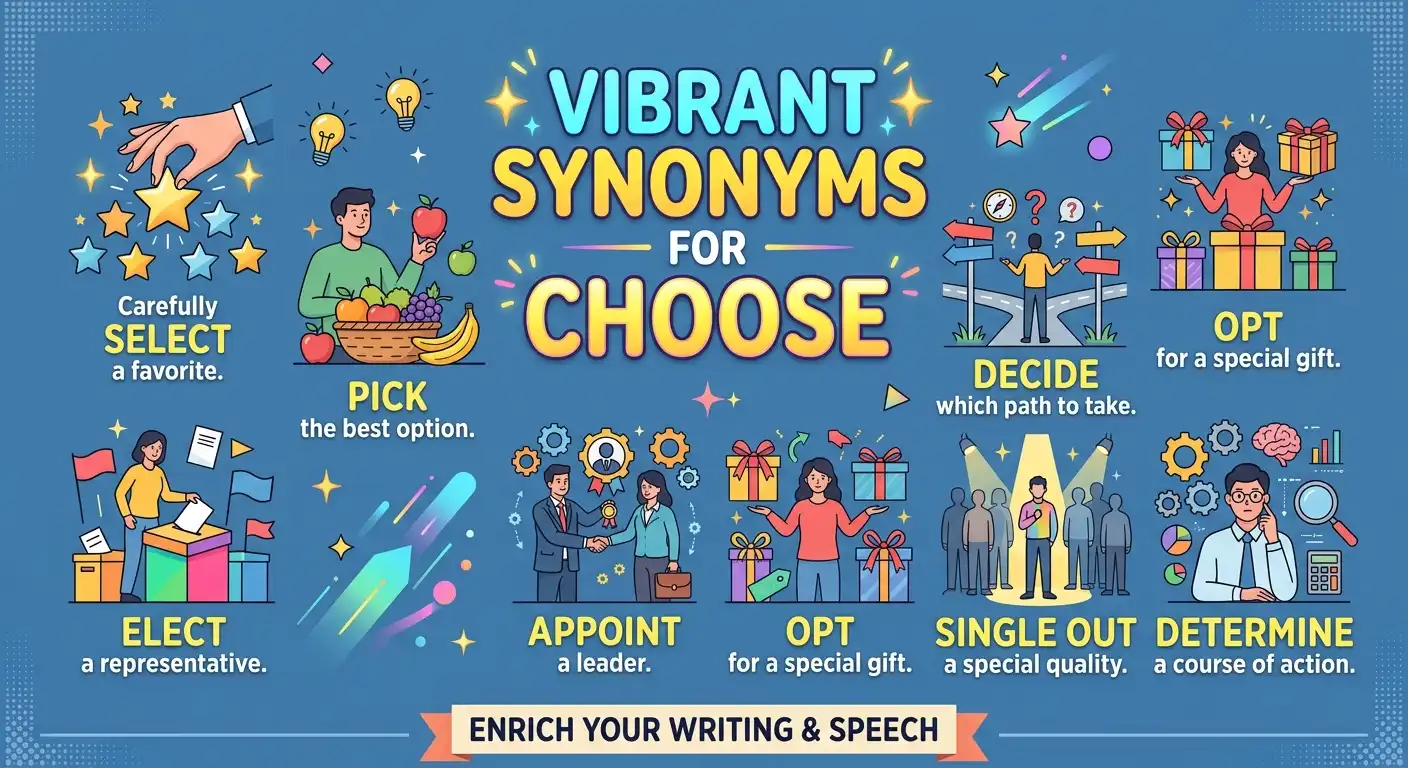
Finding exact synonyms for choose helps you share your decisions clearly and confidently. Learning diverse synonyms for choose allows you to explain options, highlight preferences, and describe important decisions without repeating the same word. Using precise synonyms for choose keeps your sentences active, fresh, and engaging.
Imagine sitting at a restaurant with a huge menu full of delicious options. You stare at the dishes for five minutes before telling the server what you want. Instead of saying you chose the pasta, you can say you selected the pasta or opted for the chef’s special.
For instance, when a manager picks a new leader for a project, saying they designated or appointed someone adds clear meaning to the decision.
The word choose means to pick out one person, item, or option from two or more possibilities. Learning different synonyms for choose is helpful for many readers:
- Students write clearer essays when explaining choices and decisions.
- Bloggers keep readers interested by using fresh words in product guides.
- Content writers improve search rankings by using natural keyword variations.
- Daily English users speak smoothly and naturally in everyday conversations.
“The right word turns a routine choice into a clear declaration.”
“A rich vocabulary gives you the freedom to express every decision clearly.”
Linguistic Breakdown of “Choose”
Connotative Meaning
The word choose carries active, intentional, and empowering connotations. It implies free will, personal choice, and thoughtful judgment when selecting between options.
Etymology
- Origin: Derived from Old English ceōsan (to choose, seek, test, or accept).
- Proto-Germanic Root: From kiusan (to test, taste, or choose).
- Historical Shift: Maintained its core meaning of active personal selection across centuries of English usage.
Pronunciation
- US (IPA): /tʃuːz/
- UK (IPA): /tʃuːz/
Syllables & Affixation Pattern
- Syllables: 1 syllable (choose)
- Base Structure: Root verb
- Grammatical Patterns:
- Present Tense: Choose / Chooses
- Past Tense: Chose
- Past Participle: Chosen
- Continuous Form: Choosing
Comparison Table: Common Synonyms for Choose
| Keyword | Meaning | Usage Type | Context |
| Select | To pick carefully from a group | Formal / Professional | Official Decisions, Forms, & Shopping |
| Pick | To choose informally or quickly | Casual / Everyday | Daily Choices, Games, & Food |
| Opt | To make a specific choice or decision | Practical / Neutral | Plans, Offers, & Daily Habits |
| Prefer | To like one option more than another | Personal / Emotional | Likes, Dislikes, & Opinions |
| Decide | To make a firm choice after thinking | General / Logical | Career, Goals, & Final Plans |
| Designate | To select someone for a special duty | Formal / Official | Workplace, Roles, & Business |
| Handpick | To choose someone very carefully | Thoughtful / Selective | Hiring, Teams, & Special Gifts |
21 Best Synonyms for Choose
1. Select
- Pronunciation: US /səˈlekt/ | UK /səˈlekt/
- Meaning: Select means to pick out the best item or option carefully from a group.
- Examples:
- Please select your favorite color from the list.
- She was thrilled to select her new bicycle.
2. Pick
- Pronunciation: US /pɪk/ | UK /pɪk/
- Meaning: Pick means to choose something quickly or casually in daily life.
- Examples:
- Pick any seat you like in the theater.
- He helped his sister pick a toy at the store.
3. Opt
- Pronunciation: US /ɑːpt/ | UK /ɒpt/
- Meaning: Opt means to make a clear choice between two or more possibilities.
- Examples:
- Many workers opt to take the morning train.
- They decided to opt for the cheaper hotel room.
4. Prefer
- Pronunciation: US /prɪˈfɝː/ | UK /prɪˈfɜː/
- Meaning: Prefer means to choose one thing over another because you like it more.
- Examples:
- I prefer green tea over morning coffee.
- She prefers reading books on quiet afternoons.
5. Decide
- Pronunciation: US /dɪˈsaɪd/ | UK /dɪˈsaɪd/
- Meaning: Decide means to make a firm choice after thinking about your options.
- Examples:
- We need to decide where to go this weekend.
- He took time to decide on his college major.
6. Elect
- Pronunciation: US /iˈlekt/ | UK /iˈlekt/
- Meaning: Elect means to choose someone for a position by voting.
- Examples:
- The citizens will elect a new mayor tomorrow.
- Classmates met to elect their student leader.
7. Single out
- Pronunciation: US /ˈsɪŋ.ɡəl aʊt/ | UK /ˈsɪŋ.ɡəl aʊt/
- Meaning: Single out means to choose one person or thing for special attention.
- Examples:
- The coach wanted to single out the top runner.
- Do not single out one student for criticism.
8. Settle on
- Pronunciation: US /ˈset̬.əl ɑːn/ | UK /ˈset.əl ɒn/
- Meaning: Settle on means to make a final choice after looking at many options.
- Examples:
- They finally managed to settle on a paint color.
- The team met to settle on a project launch date.
9. Favor
- Pronunciation: US /ˈfeɪ.vɚ/ | UK /ˈfeɪ.və/
- Meaning: Favor means to prefer or support one particular choice over others.
- Examples:
- Most voters favor the new city park plan.
- She tends to favor simple clothes for daily work.
“Choosing exact words turns basic decisions into powerful statements.”
10. Nominate
- Pronunciation: US /ˈnɑː.mə.neɪt/ | UK /ˈnɒm.ɪ.neɪt/
- Meaning: Nominate means to formally suggest someone for a job, award, or position.
- Examples:
- Members decided to nominate her for team captain.
- They plan to nominate two teachers for the award.
11. Designate
- Pronunciation: US /ˈdez.ɪɡ.neɪt/ | UK /ˈdez.ɪɡ.neɪt/
- Meaning: Designate means to officially choose someone or something for a specific role.
- Examples:
- The boss will designate a leader for the project.
- Signs clearly designate the parking area for guests.
12. Adopt
- Pronunciation: US /əˈdɑːpt/ | UK /əˈdɒpt/
- Meaning: Adopt means to choose to accept or start using a new idea or plan.
- Examples:
- The company chose to adopt a flexible work plan.
- Schools often adopt new methods for teaching math.
13. Determine
- Pronunciation: US /dɪˈtɝː.mɪn/ | UK /dɪˈtɜː.mɪn/
- Meaning: Determine means to decide something officially after examining facts carefully.
- Examples:
- Tests help doctors determine the right medical treatment.
- Judges will determine the winner of the contest.
14. Embrace
- Pronunciation: US /ɪmˈbreɪs/ | UK /ɪmˈbreɪs/
- Meaning: Embrace means to choose and welcome an idea or change with enthusiasm.
- Examples:
- Young companies embrace new digital tools quickly.
- She decided to embrace healthy habits this year.
15. Screen
- Pronunciation: US /skriːn/ | UK /skriːn/
- Meaning: Screen means to examine options carefully to choose only suitable ones.
- Examples:
- Managers screen job applicants before setting interviews.
- The filter helps screen out junk emails automatically.
16. Tap
- Pronunciation: US /tæp/ | UK /tæp/
- Meaning: Tap means to select someone for a special task or promotion.
- Examples:
- The board plans to tap him as the new manager.
- She was tapped to lead the charity campaign.
17. Cherry-pick
- Pronunciation: US /ˈtʃer.i.pɪk/ | UK /ˈtʃer.i.pɪk/
- Meaning: Cherry-pick means to choose only the very best items or options available.
- Examples:
- Buyers like to cherry-pick the freshest fruit at the market.
- Do not cherry-pick facts to fit your argument.
18. Plump for
- Pronunciation: US /plʌmp fɚ/ | UK /plʌmp fə/
- Meaning: Plump for means to choose one option after some thought or debate.
- Examples:
- I think I will plump for the chocolate dessert.
- After much discussion, they plumped for the seaside town.
19. Handpick
- Pronunciation: US /ˈhænd.pɪk/ | UK /ˈhænd.pɪk/
- Meaning: Handpick means to choose someone or something with special personal care.
- Examples:
- The director chose to handpick every member of the team.
- She likes to handpick flowers for her dinner table.
20. Appoint
- Pronunciation: US /əˈpɔɪnt/ | UK /əˈpɔɪnt/
- Meaning: Appoint means to officially choose someone for an important job or duty.
- Examples:
- The committee decided to appoint a new leader.
- He was appointed to manage the new branch office.
21. Specify
- Pronunciation: US /ˈspes.ə.faɪ/ | UK /ˈspes.ɪ.faɪ/
- Meaning: Specify means to choose and state an exact requirement or option clearly.
- Examples:
- Please specify which size you need on the order form.
- The contract will specify the delivery date for goods.
Antonyms of “Choose”
Knowing opposite words helps you describe refusal, rejection, or lack of choice accurately.
- Reject: To refuse to accept or choose something.
- Decline: To politely refuse an offer or choice.
- Dismiss: To decide that something is not worth choosing or considering.
- Ignore: To pay no attention to available options or choices.
- Discard: To throw away or remove an option you do not want.
- Pass over: To skip or fail to choose someone or something.
Prototype Meaning & Categorization of “Choose”
The central meaning of choose involves intentional selection, preference, and personal judgment. Depending on your intent, these 21 synonyms divide into four operational groups:
- General & Daily Choices: Select, pick, opt, decide, plump for, settle on.
- Personal Preferences & Acceptance: Prefer, favor, adopt, embrace, cherry-pick, handpick.
- Official & Business Decisions: Nominate, designate, determine, appoint, specify, elect.
- Selective Screening & Roles: Single out, screen, tap.
Frequently Asked Questions (FAQs)
1. What is the most formal synonym for “choose”?
In formal, business, or official writing, “select,” “designate,” or “determine” work best. They show careful thought and professional judgment.
2. Which synonym for “choose” should I use in casual conversations?
For everyday conversations, terms like “pick,” “opt,” or “settle on” sound natural and comfortable.
3. What is the difference between “choose” and “select”?
“Choose” is a general word used for any act of picking. “Select” implies choosing more carefully from a group based on specific standards.
4. Can “handpick” be used in business writing?
Yes, “handpick” works well in professional settings when you want to highlight that people or items were chosen with exceptional care and attention.
5. Why does learning synonyms for “choose” help SEO?
Using varied synonyms prevents repetitive writing, helps search engines understand your context better, and matches different search queries from readers.
6. What is the past tense of “choose”?
The past tense of “choose” is “chose” (e.g., Yesterday, I chose the blue shirt). The past participle is “chosen” (e.g., I have chosen my path).
Conclusion
Expanding your collection of synonyms for choose brings clarity, freshness, and authority to your communication. Replacing repetitive words with exact terms like select, opt, designate, or handpick ensures your message comes through clearly every time.
Whether you write business emails, post blogs, draft essays, or chat in daily conversations, using exact vocabulary builds instant confidence. Strong word choices remove repetitive language and make your ideas sound decisive. Practice using these 21 synonyms today to share your decisions with total clarity.
“Clear words make every decision stronger and every thought clearer.”
“Mastering synonyms gives you the power to speak and write with absolute clarity.”

Robert Hayes is an ESL educator and curriculum developer with over nine years of experience teaching English to beginners and intermediate learners across multiple countries ( Biography ).