Introduction
Finding the right synonyms for tedious helps you write clear and lively sentences every day. When a task feels long, boring, and tiring, using synonyms for tedious keeps your readers interested and engaged. Learning these synonyms for tedious makes your writing stand out in emails, essays, and blog posts.
Imagine sitting at a desk for three hours entering numbers into a spreadsheet. Your eyes grow heavy, and the clock seems to stop moving. That slow, boring chore is the perfect example of a tedious job. Instead of using the same word again and again, you can choose better options to describe boring moments.
Students, bloggers, content writers, and daily English speakers need a strong vocabulary to explain feelings accurately. Writers who use fresh words hold reader attention longer. Bloggers improve their readers’ experience, and students earn better marks on essays.
“Varied words turn plain writing into a joyful journey for every reader.”
“Choosing the precise word at the right moment makes your ideas shine.”
Linguistic Breakdown of Tedious
Connotative Meaning
The word tedious carries a strong negative emotion. It does not just mean boring. It describes something that causes mental weariness because it lasts too long or repeats too much.
Etymology
- Origin: Derived from Latin taediosus.
- Root Word: From taedium, which means weariness or disgust.
- Middle English Entry: Entered the English language in the late 14th century.
Pronunciation (IPA)
- US IPA: /ˈtiː.di.əs/
- UK IPA: /ˈtiː.di.əs/
Syllables
- Count: 3 Syllables
- Breakdown: te-di-ous
Affixation Pattern
- Root: Tedium (Noun)
- Suffix: -ous (Adjective marker meaning “full of”)
Comparison Table of Key Synonyms
| Keyword | Meaning | Usage Type | Context |
| Boring | Not interesting or exciting | Casual | Daily conversations and quick chats |
| Monotonous | Dull because of no change | Formal / Technical | Repetitive tasks and speeches |
| Dull | Lacking shine, life, or interest | Casual / Professional | Movies, lectures, and weather |
| Tiresome | Causing feeling of annoyance | Emotional | Difficult behavior and endless chores |
| Mind-numbing | So boring your brain feels numb | Casual | Data entry and endless paper filling |
| Arduous | Needing hard work and effort | Formal | Heavy physical or mental work |
| Mundane | Ordinary and not special | Professional | Daily routines and simple tasks |
50 Best Synonyms for Tedious
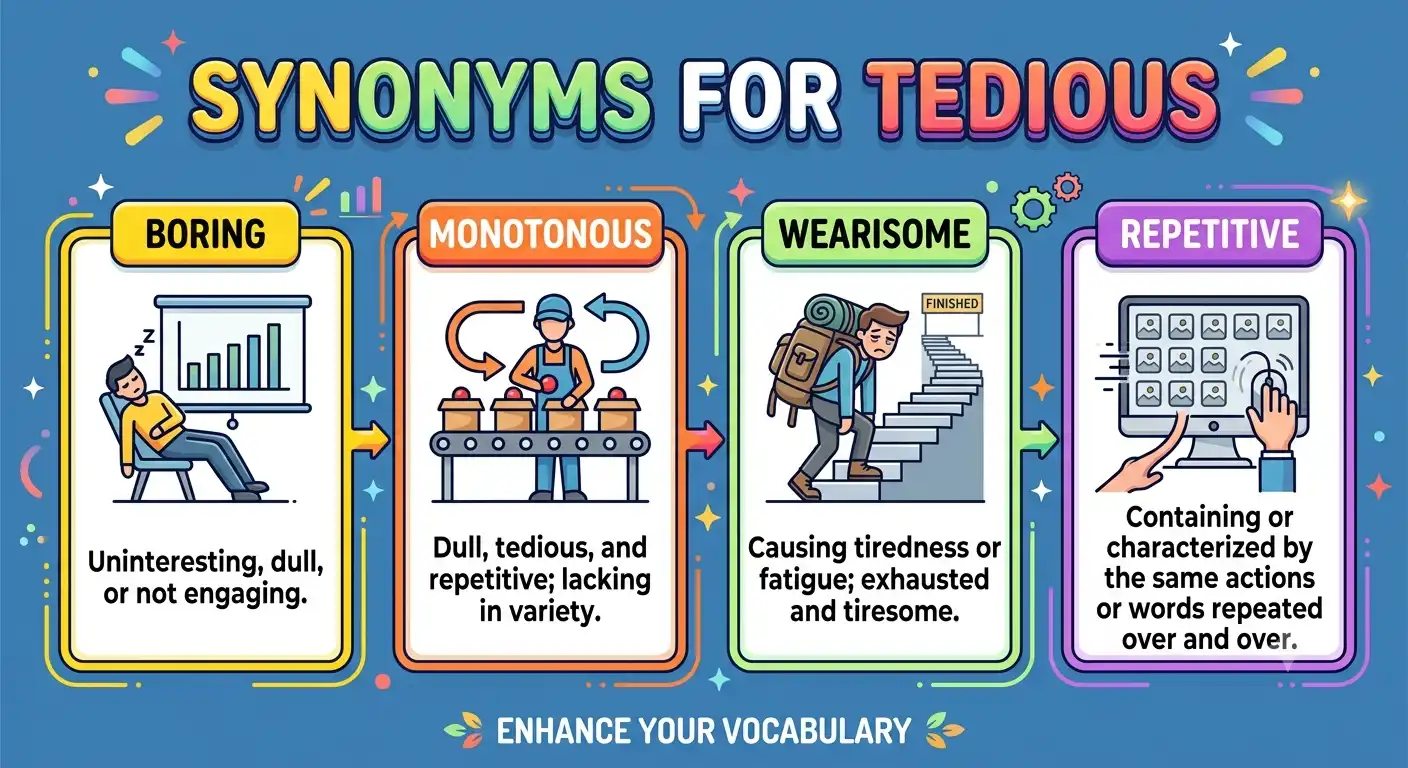
1. Boring
- Pronunciation: US: /ˈbɔːr.ɪŋ/ | UK: /ˈbɔː.rɪŋ/
- Meaning: Lacking interest or excitement in any way.
- Examples:
- The long movie was very boring.
- He told a boring story about his walk.
2. Monotonous
- Pronunciation: US: /məˈnɑː.t̬ən.əs/ | UK: /məˈnɒt.ən.əs/
- Meaning: Sounding or repeating the same way without changing.
- Examples:
- The worker heard a monotonous sound all day.
- She spoke in a calm but monotonous voice.
3. Dull
- Pronunciation: US: /dʌl/ | UK: /dʌl/
- Meaning: Not sharp, bright, or interesting.
- Examples:
- Today is a dull and rainy day.
- The book had a very dull start.
4. Tiresome
- Pronunciation: US: /ˈtaɪər.səm/ | UK: /ˈtaɪə.səm/
- Meaning: Making you feel tired and annoyed.
- Examples:
- Waiting in line for hours is tiresome.
- Fixing old mistakes is a tiresome task.
5. Mind-numbing
- Pronunciation: US: /ˈmaɪndˌnʌm.ɪŋ/ | UK: /ˈmaɪndˌnʌm.ɪŋ/
- Meaning: Extremely boring and tiring for your mind.
- Examples:
- Sorting paper clips is mind-numbing work.
- The speech was long and mind-numbing.
6. Repetitive
- Pronunciation: US: /rɪˈpet̬.ə.t̬ɪv/ | UK: /rɪˈpet.ət.ɪv/
- Meaning: Happening again and again many times.
- Examples:
- Factory workers do repetitive jobs.
- Practice involves repetitive movements every day.
7. Wearisome
- Pronunciation: US: /ˈwɪr.i.səm/ | UK: /ˈwɪə.ri.səm/
- Meaning: Causing you to feel sleepy or worn out.
- Examples:
- It was a wearisome trip across the hot desert.
- Cleaning the dirty room was wearisome work.
8. Dreary
- Pronunciation: US: /ˈdrɪr.i/ | UK: /ˈdrɪə.ri/
- Meaning: Sad, dull, and gloomy to see or experience.
- Examples:
- Look out at the dreary winter sky.
- He spent a dreary afternoon alone at home.
9. Humdrum
- Pronunciation: US: /ˈhʌm.drʌm/ | UK: /ˈhʌm.drʌm/
- Meaning: Regular and lacking excitement or change.
- Examples:
- They live a quiet and humdrum life.
- She wanted a break from her humdrum work routine.
10. Irksome
- Pronunciation: US: /ˈɝːk.səm/ | UK: /ˈɜːk.səm/
- Meaning: Annoying and causing small irritation.
- Examples:
- Losing keys is an irksome problem.
- Filling out forms can be very irksome.
11. Dry
- Pronunciation: US: /draɪ/ | UK: /draɪ/
- Meaning: Lacking humor, feeling, or exciting detail.
- Examples:
- The history lesson was dry and slow.
- He gave a dry report about factory sales.
12. Uninteresting
- Pronunciation: US: /ʌnˈɪn.trɪ.stɪŋ/ | UK: /ʌnˈɪn.trəs.tɪŋ/
- Meaning: Not grabbing or holding your attention.
- Examples:
- The lesson felt dry and uninteresting to the class.
- He left the uninteresting show early.
13. Lifeless
- Pronunciation: US: /ˈlaɪf.ləs/ | UK: /ˈlaɪf.ləs/
- Meaning: Lacking energy, enthusiasm, or movement.
- Examples:
- The actor gave a lifeless performace.
- The room felt cold and lifeless.
14. Drab
- Pronunciation: US: /dræb/ | UK: /dræb/
- Meaning: Dull in appearance and color.
- Examples:
- She wore a drab gray coat to work.
- The office wall had a drab paint color.
15. Soul-crushing
- Pronunciation: US: /ˈsoʊlˌkrʌʃ.ɪŋ/ | UK: /ˈsəʊlˌkrʌʃ.ɪŋ/
- Meaning: So hard and dull that it destroys happiness.
- Examples:
- He quit his soul-crushing job yesterday.
- Sitting in heavy traffic feels soul-crushing.
16. Arduous
- Pronunciation: US: /ˈɑːr.dʒu.əs/ | UK: /ˈɑː.dju.əs/
- Meaning: Requiring a lot of hard effort and strength.
- Examples:
- Climbing the tall mountain was arduous.
- They finished an arduous day of hard labor.
17. Laborious
- Pronunciation: US: /ləˈbɔːr.i.əs/ | UK: /ləˈbɔː.ri.əs/
- Meaning: Needing a huge amount of time and physical work.
- Examples:
- Digging the deep hole was laborious work.
- Writing a book by hand is laborious.
18. Onerous
- Pronunciation: US: /ˈɑː.nɚ.əs/ | UK: /ˈɒn.ər.əs/
- Meaning: Causing great trouble, worry, or difficulty.
- Examples:
- The small business faced onerous tax rules.
- Taking care of three dogs was onerous work.
19. Taxing
- Pronunciation: US: /ˈtæk.sɪŋ/ | UK: /ˈtæk.sɪŋ/
- Meaning: Needing high mental or physical exertion.
- Examples:
- Solving hard math puzzles is taxing for students.
- It was a taxing trip for the whole team.
20. Grueling
- Pronunciation: US: /ˈɡruː.ə.lɪŋ/ | UK: /ˈɡruː.ə.lɪŋ/
- Meaning: Extremely hard, tiring, and demanding.
- Examples:
- The runners finished a grueling race.
- Training for the sport was grueling every day.
21. Exhausting
- Pronunciation: US: /ɪɡˈzɑː.stɪŋ/ | UK: /ɪɡˈzɔː.stɪŋ/
- Meaning: Making you feel completely tired of energy.
- Examples:
- Moving heavy boxes all day is exhausting.
- Studying all night was an exhausting effort.
22. Uninspiring
- Pronunciation: US: /ˌʌn.ɪnˈspaɪr.ɪŋ/ | UK: /ˌʌn.ɪnˈspaɪə.rɪŋ/
- Meaning: Failing to make someone feel excited or creative.
- Examples:
- The artist gave an uninspiring speech.
- It was an uninspiring play with weak scenes.
23. Flat
- Pronunciation: US: /flæt/ | UK: /flæt/
- Meaning: Lacking emotion, excitement, or energy.
- Examples:
- Her voice sounded flat during the talk.
- The party felt flat after the music stopped.
24. Vapid
- Pronunciation: US: /ˈvæp.ɪd/ | UK: /ˈvæp.ɪd/
- Meaning: Lacking intelligence, depth, or interest.
- Examples:
- They had a vapid conversation about shoes.
- The movie was full of vapid jokes.
25. Colorless
- Pronunciation: US: /ˈkʌl.ɚ.ləs/ | UK: /ˈkʌl.ə.ləs/
- Meaning: Lacking bright character, tone, or style.
- Examples:
- He is a quiet and colorless character.
- The writing was simple and colorless.
26. Pedestrian
- Pronunciation: US: /pəˈdes.tri.ən/ | UK: /pəˈdes.tri.ən/
- Meaning: Ordinary and lacking any imagination.
- Examples:
- The restaurant served pedestrian food.
- He wrote a pedestrian story for class.
27. Banal
- Pronunciation: US: /bəˈnɑːl/ | UK: /bəˈnɑːl/
- Meaning: So common that it is completely boring.
- Examples:
- Pop songs often have banal words.
- He made a banal comment about the weather.
28. Prosaic
- Pronunciation: US: /prəˈzeɪ.ɪk/ | UK: /prəˈzeɪ.ɪk/
- Meaning: Plain and straightforward like ordinary writing.
- Examples:
- The house had a simple and prosaic design.
- She gave a prosaic explanation of the plan.
29. Stodgy
- Pronunciation: US: /ˈstɑː.dʒi/ | UK: /ˈstɒdʒ.i/
- Meaning: Heavy, old-fashioned, and uninteresting.
- Examples:
- The old book had a stodgy writing style.
- He works for a stodgy old company.
30. Mundane
- Pronunciation: US: /mʌnˈdeɪn/ | UK: /mʌnˈdeɪn/
- Meaning: Belonging to everyday life rather than special things.
- Examples:
- Washing dishes is a mundane daily task.
- She wanted an escape from her mundane routine.
“Clear words open doors to quick understanding across every language.”
31. Heavy
- Pronunciation: US: /ˈhev.i/ | UK: /ˈhev.i/
- Meaning: Hard to understand or digest due to seriousness.
- Examples:
- That was a heavy book on philosophy.
- The speaker brought up a heavy subject.
32. Slow
- Pronunciation: US: /sloʊ/ | UK: /sləʊ/
- Meaning: Moving or happening with very little speed.
- Examples:
- The first half of the book was slow.
- Business was slow during the cold winter.
33. Dragging
- Pronunciation: US: /ˈdræɡ.ɪŋ/ | UK: /ˈdræɡ.ɪŋ/
- Meaning: Passing very slowly and unpleasantly.
- Examples:
- The last hour of class was dragging.
- Time was dragging during the long wait.
34. Routine
- Pronunciation: US: /ruːˈtiːn/ | UK: /ruːˈtiːn/
- Meaning: Done regularly as a normal part of life.
- Examples:
- Checking email is a routine job.
- The doctor made a routine health check.
35. Stale
- Pronunciation: US: /steɪl/ | UK: /steɪl/
- Meaning: No longer new, fresh, or exciting.
- Examples:
- The comedian told stale jokes.
- His idea felt stale after many uses.
36. Mechanical
- Pronunciation: US: /məˈkæn.ɪ.kəl/ | UK: /məˈkæn.ɪ.kəl/
- Meaning: Done without thinking or real feeling.
- Examples:
- He gave a mechanical smile to the crowd.
- She typed the words in a mechanical way.
37. Mindless
- Pronunciation: US: /ˈmaɪnd.ləs/ | UK: /ˈmaɪnd.ləs/
- Meaning: Requiring very little thought or intelligence.
- Examples:
- Playing simple games can be mindless fun.
- Cleaning dust is a mindless task.
38. Unexciting
- Pronunciation: US: /ˌʌn.ɪkˈsaɪ.t̬ɪŋ/ | UK: /ˌʌn.ɪkˈsaɪ.tɪŋ/
- Meaning: Not creating feelings of happiness or interest.
- Examples:
- The game ended in an unexciting tie.
- They had an unexciting trip to the shop.
39. Non-stimulating
- Pronunciation: US: /nɑːnˈstɪm.jə.leɪ.t̬ɪŋ/ | UK: /nɒnˈstɪm.jə.leɪ.tɪŋ/
- Meaning: Failing to activate the mind or senses.
- Examples:
- Sitting in an empty room is non-stimulating.
- The lesson was short and non-stimulating.
40. Prolonged
- Pronunciation: US: /prəˈlɑːŋd/ | UK: /prəˈlɒŋd/
- Meaning: Continuing for a long and tiring time.
- Examples:
- The meeting suffered a prolonged delay.
- They had a prolonged debate over small details.
41. Long-winded
- Pronunciation: US: /ˌlɑːŋˈwɪn.dɪd/ | UK: /ˌlɒŋˈwɪn.dɪd/
- Meaning: Using too many words to explain simple things.
- Examples:
- The lawyer gave a long-winded speech.
- His long-winded letter confused the readers.
42. Endless
- Pronunciation: US: /ˈend.ləs/ | UK: /ˈend.ləs/
- Meaning: Seeming to have no finish or limit.
- Examples:
- The child had an endless list of questions.
- We walked through an endless hallway.
43. Ponderous
- Pronunciation: US: /ˈpɑːn.dɚ.əs/ | UK: /ˈpɒn.dər.əs/
- Meaning: Slow and clumsy because of heavy weight.
- Examples:
- The elephant moved with ponderous steps.
- The writer had a ponderous style.
44. Heavy-going
- Pronunciation: US: /ˌhev.iˈɡoʊ.ɪŋ/ | UK: /ˌhev.iˈɡəʊ.ɪŋ/
- Meaning: Difficult to read or complete with ease.
- Examples:
- That history textbook was heavy-going.
- The hike up the mud hill was heavy-going.
45. Deadening
- Pronunciation: US: /ˈded.ən.ɪŋ/ | UK: /ˈded.ən.ɪŋ/
- Meaning: Removing energy, feeling, or excitement.
- Examples:
- The quiet room had a deadening effect.
- That routine job was deadening for her spirit.
46. Sleep-inducing
- Pronunciation: US: /ˈsliːp.ɪnˌduː.sɪŋ/ | UK: /ˈsliːp.ɪnˌdjuː.sɪŋ/
- Meaning: So boring that it makes you fall asleep.
- Examples:
- The soft music was sleep-inducing.
- His calm voice had a sleep-inducing power.
47. Soporific
- Pronunciation: US: /ˌsɑː.pəˈrɪf.ɪk/ | UK: /ˌsɒp.ərˈɪf.ɪk/
- Meaning: Causing or tending to produce sleepiness.
- Examples:
- The hot room had a soporific feeling.
- The lecture was soporific for students.
48. Leadening
- Pronunciation: US: /ˈled.ən.ɪŋ/ | UK: /ˈled.ən.ɪŋ/
- Meaning: Making things feel heavy, dark, and lifeless.
- Examples:
- The dark rain clouds brought a leadening sky.
- Fear had a leadening weight on his feet.
49. Unvaried
- Pronunciation: US: /ʌnˈver.id/ | UK: /ʌnˈveə.rid/
- Meaning: Staying the same without any changes.
- Examples:
- The bird sang an unvaried song all day.
- He ate an unvaried diet of rice every night.
50. Wearying
- Pronunciation: US: /ˈwɪr.i.ɪŋ/ | UK: /ˈwɪə.ri.ɪŋ/
- Meaning: Causing mental or physical tiredness over time.
- Examples:
- Managing noisy kids can be wearying work.
- The long walk home was wearying.
Antonyms of Tedious
While learning synonyms for tedious expands your range, knowing opposite words helps you create strong contrast in your writing. Here are key antonyms:
- Exciting: Full of strong, pleasant energy.
- Engaging: Keeping someone full of interest and focus.
- Fascinating: Extremely interesting and captivating.
- Thrilling: Causing sudden feelings of joy or excitement.
- Lively: Full of life, movement, and enthusiasm.
- Stimulating: Encouraging new thoughts and energy.
- Enthralling: Holding your total attention continuously.
Prototype Meaning and Categorization
To use synonyms for tedious correctly, organize them by tone and intensity:
1. Casual & Daily Word Choice
- Words: Boring, Dull, Slow, Stale.
- Best Used For: Daily chats, quick messages, and social media posts.
2. Emotional & Annoyance Focus
- Words: Tiresome, Irksome, Mind-numbing, Wearisome.
- Best Used For: Expressing frustration with annoying tasks.
3. Work & Professional Effort
- Words: Laborious, Arduous, Repetitive, Onerous, Taxing.
- Best Used For: Formal reports, job descriptions, and academic papers.
4. Literary & Creative Style
- Words: Monotonous, Dreary, Prosaic, Pedestrian, Banal, Humdrum.
- Best Used For: Novel writing, descriptive essays, and reviews.
Frequently Asked Questions (FAQ)
What is the most common synonym for tedious?
The most common synonym for tedious is boring. However, tedious specifically means a task is boring because it is long and slow.
Can tedious be used for people?
Yes, you can describe a person as tedious if their talking style or behavior is slow, repetitive, and boring.
What is the difference between boring and tedious?
Boring is a general word for anything that lacks interest. Tedious means something is boring specifically because it takes a long time or involves repetitive work.
How do I use synonyms for tedious in professional emails?
In work emails, replace simple words like boring with professional choices like laborious, time-consuming, or repetitive.
What is the noun form of tedious?
The noun form of tedious is tedium. It means the state of being slow, dull, and wearisome.
Is tedious a positive or negative word?
Tedious is a negative word. It describes tasks or events that tire your brain or make you feel bored.
Conclusion
Building a rich collection of synonyms for tedious changes how you write and speak everyday. When you swap common words for precise terms, your writing grows clear, expressive, and pleasant to read. Using diverse words helps you describe thoughts clearly without repeating yourself.
Writers and bloggers who master synonyms for tedious capture their audience quickly. Students who select fresh vocabulary write stronger essays and earn better grades. Clear communication builds trust and keeps readers coming back for more content.
Try using these new words in your daily life right away. Write a work email using laborious, or describe a quiet afternoon as dreary. Practice small changes each day in your conversations, messages, and notes. Your English skills will grow quickly with every word you practice.
“A rich vocabulary lets your true thoughts step into the spotlight.”
“Every new word you learn gives your voice greater strength.”

Robert Hayes is an ESL educator and curriculum developer with over nine years of experience teaching English to beginners and intermediate learners across multiple countries ( Biography ).