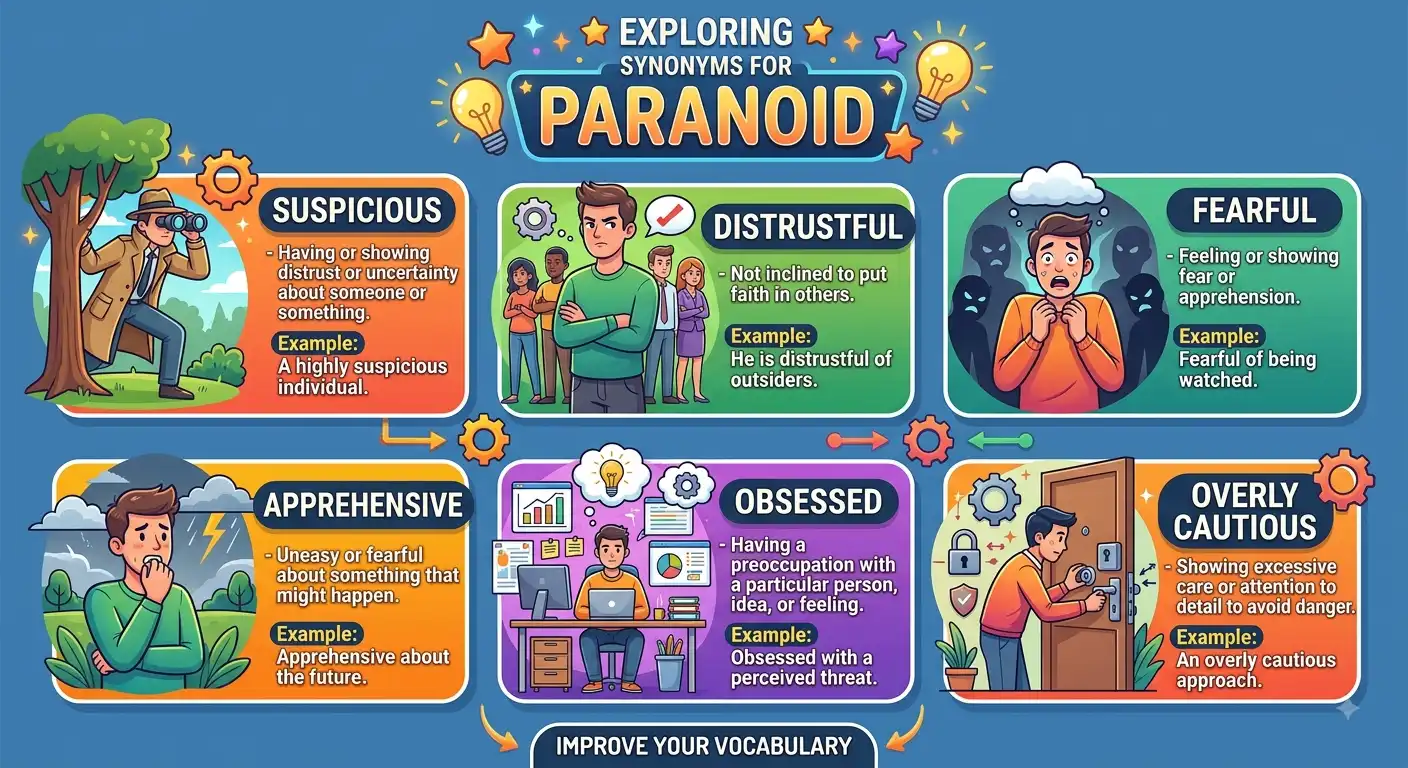
Exploring clear synonyms for paranoid helps you describe fear, suspicion, and worry with exact precision. When you learn diverse synonyms for paranoid, you can easily explain guarded feelings, write compelling fiction, and express complex human emotions. Using precise synonyms for paranoid keeps your everyday writing engaging and strengthens your communication skills.
Imagine walking down a dark quiet street late at night and suddenly hearing footsteps behind you. You might feel extremely paranoid about who is following you. The word paranoid means feeling an irrational distrust or fear that others want to harm you. Repeating the word paranoid constantly can make your writing feel repetitive and dull.
Replacing it with descriptive terms like suspicious, distrustful, or hypervigilant gives much more life to your thoughts. Understanding these word choices benefits four key groups of people:
- Students write deeper literary analysis essays and character studies.
- Bloggers create engaging psychology, health, and lifestyle articles.
- Content writers boost search rankings by using natural, varied phrasing.
- Daily English users express subtle feelings accurately in conversations.
“The right word turns a basic thought into a vivid human experience.”
“A rich vocabulary grants you the power to describe every shade of emotion.”
Linguistic Breakdown of “Paranoid”
Connotative Meaning
The word paranoid carries intense, defensive, anxious, and guarded connotations. It implies an overwhelming sense of unreasonable danger, deep mistrust, and hyper-awareness of imaginary threats.
Etymology
- Origin: Derived from Ancient Greek paranoia in the late 19th century.
- Root Words: Para- (meaning irregular, abnormal, or beside) + noos (meaning mind or thought).
- Historical Shift: Originally used as a psychiatric term for medical delusions, it later entered everyday English to describe extreme everyday suspicion and worry.
Pronunciation
- US (IPA): /ˈpær.ə.nɔɪd/
- UK (IPA): /ˈpær.ə.nɔɪd/
Syllables & Affixation Pattern
- Syllables: 3 syllables (par-a-noid)
- Base Structure: Root noun paranoia + Adjective suffix -oid
- Grammatical Patterns:
- Adjective: Paranoid behavior / Paranoid thoughts
- Noun Form: Paranoia / Paranoid (person)
- Adverb Form: Paranoidly
Comparison Table: Common Synonyms for Paranoid
| Keyword | Meaning | Usage Type | Context |
| Suspicious | Distrusting others or expecting bad motives | Casual / Daily | Personal Safety, Mystery Novels, & Daily Life |
| Distrustful | Lacking faith or trust in people | Emotional / Relational | Broken Friendships, Workplaces, & Secrets |
| Wary | Watching closely for possible danger | Practical / Professional | Business Deals, Unknown Places, & Safety |
| Hypervigilant | Extremely alert to any sign of trouble | Clinical / Formal | Psychology, High-Stress Jobs, & Trauma |
| Guarded | Very careful not to reveal thoughts | Professional / Casual | Job Interviews, First Dates, & Negotiations |
| Apprehensive | Feeling nervous about a future outcome | Emotional / Daily | Exams, Public Speaking, & Big Changes |
| Skeptical | Doubting the truth of a claim | Analytical / Formal | News Reviews, Debates, & Science |
50 Best Synonyms for Paranoid
1. Suspicious
- Pronunciation: US /səˈspɪʃ.əs/ | UK /səˈspɪʃ.əs/
- Meaning: Suspicious means believing that someone or something cannot be trusted.
- Examples:
- The store guard gave the stranger a suspicious look.
- She felt suspicious when the phone rang at midnight.
2. Distrustful
- Pronunciation: US /dɪsˈtrʌst.fəl/ | UK /dɪsˈtrʌst.fəl/
- Meaning: Distrustful means having a strong lack of trust in other people.
- Examples:
- He grew distrustful of online deals after losing money.
- A bad experience made her distrustful of new neighbors.
3. Fearful
- Pronunciation: US /ˈfɪr.fəl/ | UK /ˈfɪə.fəl/
- Meaning: Fearful means feeling scared or expecting something bad to happen.
- Examples:
- The fearful puppy hid under the sofa during the storm.
- She felt fearful about walking home alone in the dark.
4. Anxious
- Pronunciation: US /ˈæŋk.ʃəs/ | UK /ˈæŋk.ʃəs/
- Meaning: Anxious means worried and uneasy about an uncertain event.
- Examples:
- He felt anxious before giving his speech to the class.
- Waiting for test results makes many students feel anxious.
5. Apprehensive
- Pronunciation: US /ˌæp.rəˈhen.sɪv/ | UK /ˌæp.rɪˈhen.sɪv/
- Meaning: Apprehensive means feeling worried or uneasy about the immediate future.
- Examples:
- The pilot felt apprehensive about flying through heavy fog.
- She was apprehensive about starting her brand new job.
6. Mistrustful
- Pronunciation: US /ˌmɪsˈtrʌst.fəl/ | UK /ˌmɪsˈtrʌst.fəl/
- Meaning: Mistrustful means doubting the honesty or good intentions of others.
- Examples:
- He was mistrustful of salespeople offering free prizes.
- Her past experiences made her mistrustful of rumors.
7. Oversensitive
- Pronunciation: US /ˌoʊ.vɚˈsen.sə.t̬ɪv/ | UK /ˌəʊ.vəˈsen.sɪ.tɪv/
- Meaning: Oversensitive means easily upset or offended by small comments.
- Examples:
- Do not be oversensitive about friendly advice.
- He became oversensitive after working late for days.
8. Insecure
- Pronunciation: US /ˌɪn.səˈkjʊr/ | UK /ˌɪn.sɪˈkjʊə/
- Meaning: Insecure means lacking confidence and feeling safe in yourself.
- Examples:
- Moving to a new town made the boy feel insecure.
- She felt insecure about singing in front of people.
9. Hypervigilant
- Pronunciation: US /ˌhaɪ.pɚˈvɪdʒ.əl.ənt/ | UK /ˌhaɪ.pəˈvɪdʒ.əl.ənt/
- Meaning: Hypervigilant means remaining constantly alert for potential danger.
- Examples:
- Night security guards must stay hypervigilant on duty.
- The soldier remained hypervigilant in the quiet forest.
10. Watchful
- Pronunciation: US /ˈwɑːtʃ.fəl/ | UK /ˈwɒtʃ.fəl/
- Meaning: Watchful means paying close attention to everything around you.
- Examples:
- The mother bird kept a watchful eye on her nest.
- Stay watchful while walking on icy sidewalk paths.
11. Guarded
- Pronunciation: US /ˈɡɑːr.dɪd/ | UK /ˈɡɑː.dɪd/
- Meaning: Guarded means careful not to give away personal thoughts or feelings.
- Examples:
- He gave a guarded answer during the news interview.
- She remained guarded when meeting her new teammates.
12. Wary
- Pronunciation: US /ˈwer.i/ | UK /ˈweə.ri/
- Meaning: Wary means cautious and careful because of potential danger.
- Examples:
- Be wary of emails asking for your account password.
- The wild rabbit was wary of the approaching dog.
13. Cautious
- Pronunciation: US /ˈkɑː.ʃəs/ | UK /ˈkɔː.ʃəs/
- Meaning: Cautious means taking great care to avoid risks or mistakes.
- Examples:
- A cautious driver always slows down in wet weather.
- He took a cautious step onto the thin river ice.
14. Timid
- Pronunciation: US /ˈtɪm.ɪd/ | UK /ˈtɪm.ɪd/
- Meaning: Timid means shy and lacking courage to face new situations.
- Examples:
- The timid kitten peeked out from behind the door.
- He was too timid to ask the teacher a question.
15. Nervous
- Pronunciation: US /ˈnɝː.vəs/ | UK /ˈnɜː.vəs/
- Meaning: Nervous means worried, easily frightened, or lacking calm.
- Examples:
- She felt nervous before taking her driving test today.
- Loud noises make the small puppy very nervous.
16. Uneasy
- Pronunciation: US /ʌnˈiː.zi/ | UK /ʌnˈiː.zi/
- Meaning: Uneasy means feeling worried, uncomfortable, or troubled.
- Examples:
- An uneasy silence filled the room after the argument.
- He felt uneasy about leaving his front door unlocked.
17. Skeptical
- Pronunciation: US /ˈskep.tɪ.kəl/ | UK /ˈskep.tɪ.kəl/
- Meaning: Skeptical means doubting that something is true or useful.
- Examples:
- Scientists stay skeptical until they see clear test data.
- She was skeptical about the quick weight-loss claim.
18. Doubtful
- Pronunciation: US /ˈdaʊt.fəl/ | UK /ˈdaʊt.fəl/
- Meaning: Doubtful means feeling uncertain about an outcome or fact.
- Examples:
- The dark rain clouds made a sunny picnic doubtful.
- He felt doubtful that his team could win the game.
19. Cynical
- Pronunciation: US /ˈsɪn.ɪ.kəl/ | UK /ˈsɪn.ɪ.kəl/
- Meaning: Cynical means believing that people only act out of selfish motives.
- Examples:
- He gave a cynical laugh when promised a free meal.
- Old age made the retired reporter somewhat cynical.
20. Defensive
- Pronunciation: US /dɪˈfen.sɪv/ | UK /dɪˈfen.sɪv/
- Meaning: Defensive means quick to protect yourself against criticism or attack.
- Examples:
- He became defensive when asked about his late homework.
- Her defensive tone showed that she felt accused.
“Careful words help us explore the hidden corners of human emotion with kindness.”
21. Hyper-cautious
- Pronunciation: US /ˌhaɪ.pɚˈkɑː.ʃəs/ | UK /ˌhaɪ.pəˈkɔː.ʃəs/
- Meaning: Hyper-cautious means being far more careful than normal situation requires.
- Examples:
- New parents are often hyper-cautious about germs.
- He was hyper-cautious when spending his savings.
22. On edge
- Pronunciation: US /ɑːn edʒ/ | UK /ɒn edʒ/
- Meaning: On edge means feeling very tense, nervous, and easily annoyed.
- Examples:
- Working long hours left the whole office team on edge.
- The stormy weather kept the family pet on edge.
23. Jumpy
- Pronunciation: US /ˈdʒʌm.pi/ | UK /ˈdʒʌm.pi/
- Meaning: Jumpy means easily startled by small sudden movements or sounds.
- Examples:
- Too much morning coffee made him feel jumpy.
- Watching scary movies leaves me jumpy for hours.
24. Skittish
- Pronunciation: US /ˈskɪt̬.ɪʃ/ | UK /ˈskɪt.ɪʃ/
- Meaning: Skittish means easily nervous and quick to run away from danger.
- Examples:
- The skittish horse jumped at the sound of thunder.
- Investors felt skittish after the stock market drop.
25. Agitated
- Pronunciation: US /ˈædʒ.ə.teɪ.t̬ɪd/ | UK /ˈædʒ.ɪ.teɪ.tɪd/
- Meaning: Agitated means feeling deeply troubled, restless, and disturbed.
- Examples:
- The loud construction noise made the hospital patients agitated.
- He became agitated when he lost his house keys.
26. Edgy
- Pronunciation: US /ˈedʒ.i/ | UK /ˈedʒ.i/
- Meaning: Edgy means nervous, irritable, and unable to relax peacefully.
- Examples:
- She felt edgy while waiting for her flight news.
- The team was edgy right before the championship final.
27. Worried
- Pronunciation: US /ˈwɝː.iːd/ | UK /ˈwʌr.iːd/
- Meaning: Worried means troubled about actual or possible future problems.
- Examples:
- The worried father waited by the front door late.
- She was worried about failing her main math test.
28. Terrified
- Pronunciation: US /ˈter.ə.faɪd/ | UK /ˈter.ɪ.faɪd/
- Meaning: Terrified means feeling extreme, overpowering fear or fright.
- Examples:
- The child was terrified of the dark attic room.
- He felt terrified during the sudden airplane bump.
29. Spooked
- Pronunciation: US /spuːkt/ | UK /spuːkt/
- Meaning: Spooked means suddenly frightened or made fearful by something odd.
- Examples:
- The sudden shadow spooked the young camper.
- The deer got spooked and ran deep into the forest.
30. Suspicion-filled
- Pronunciation: US /səˈspɪʃ.ən fɪld/ | UK /səˈspɪʃ.ən fɪld/
- Meaning: Suspicion-filled means completely full of doubt, fear, and distrust.
- Examples:
- They shared a suspicion-filled glance across the room.
- The letter contained a suspicion-filled warning message.
31. Unsettled
- Pronunciation: US /ʌnˈset̬.əld/ | UK /ʌnˈset.əld/
- Meaning: Unsettled means lacking peace of mind or feeling mentally disturbed.
- Examples:
- Strange creaks in the floor left her feeling unsettled.
- The sudden news left everyone in an unsettled state.
32. Threat-obsessed
- Pronunciation: US /θret əbˈsest/ | UK /θret əbˈsest/
- Meaning: Threat-obsessed means focusing constantly on potential harm or enemies.
- Examples:
- A threat-obsessed mindset makes everyday living exhausting.
- The movie character acted like a threat-obsessed leader.
33. Hyper-aware
- Pronunciation: US /ˌhaɪ.pɚ.əˈwer/ | UK /ˌhaɪ.pə.əˈweə/
- Meaning: Hyper-aware means noticing every single small detail due to high stress.
- Examples:
- Walking alone in a forest makes you hyper-aware of sounds.
- He was hyper-aware of people sitting behind him.
34. Distrusting
- Pronunciation: US /dɪsˈtrʌs.tɪŋ/ | UK /dɪsˈtrʌs.tɪŋ/
- Meaning: Distrusting means actively showing a lack of trust in someone.
- Examples:
- She gave the salesman a cold, distrusting look.
- His distrusting nature prevented him from making close friends.
35. Unresting
- Pronunciation: US /ʌnˈres.tɪŋ/ | UK /ʌnˈres.tɪŋ/
- Meaning: Unresting means unable to calm down or stop worrying.
- Examples:
- An unresting mind keeps you awake all through the night.
- He spent an unresting evening waiting for news.
36. Tense
- Pronunciation: US /tens/ | UK /tens/
- Meaning: Tense means feeling nervous, strained, and unable to relax muscles.
- Examples:
- His shoulders felt tense before the job interview.
- The room grew tense as the argument escalated.
37. Overcautious
- Pronunciation: US /ˌoʊ.vɚˈkɑː.ʃəs/ | UK /ˌəʊ.vəˈkɔː.ʃəs/
- Meaning: Overcautious means taking excessive care to avoid small non-existent risks.
- Examples:
- An overcautious driver causes traffic delays behind them.
- Being overcautious can stop you from taking good chances.
38. Over-fearful
- Pronunciation: US /ˌoʊ.vɚˈfɪr.fəl/ | UK /ˌəʊ.vəˈfɪə.fəl/
- Meaning: Over-fearful means experiencing far more fear than a situation warrants.
- Examples:
- An over-fearful child may struggle to make friends easily.
- She became over-fearful after reading bad news online.
39. Over-suspicious
- Pronunciation: US /ˌoʊ.vɚ.səˈspɪʃ.əs/ | UK /ˌəʊ.və.səˈspɪʃ.əs/
- Meaning: Over-suspicious means suspecting bad intentions without having any proof.
- Examples:
- He was over-suspicious of his coworker’s kind gift.
- An over-suspicious attitude damages good long-term relationships.
40. Hesitant
- Pronunciation: US /ˈhez.ə.tənt/ | UK /ˈhez.ɪ.tənt/
- Meaning: Hesitant means slow to speak or act because of uncertainty or fear.
- Examples:
- She felt hesitant to cross the busy city street.
- He gave a hesitant nod when asked to help.
41. Panic-prone
- Pronunciation: US /ˈpæn.ɪk proʊn/ | UK /ˈpæn.ɪk prəʊn/
- Meaning: Panic-prone means easily overwhelmed by sudden fear and confusion.
- Examples:
- Panic-prone travelers should plan their trips early.
- Loud alarms can upset panic-prone pets during storms.
42. Rattled
- Pronunciation: US /ˈræt̬.əld/ | UK /ˈræt.əld/
- Meaning: Rattled means confused, nervous, or upset by a sudden surprise.
- Examples:
- The loud near-miss crash left the driver shaken and rattled.
- She felt rattled by the unexpected harsh questions.
43. Unconfident
- Pronunciation: US /ʌnˈkɑːn.fə.dənt/ | UK /ʌnˈkɒn.fɪ.dənt/
- Meaning: Unconfident means lacking belief in your own ability or safety.
- Examples:
- The unconfident speaker spoke in a very quiet voice.
- He felt unconfident about taking the advanced test.
44. Self-protective
- Pronunciation: US /ˌself.prəˈtek.tɪv/ | UK /ˌself.prəˈtek.tɪv/
- Meaning: Self-protective means acting to shield yourself from physical or emotional harm.
- Examples:
- Her self-protective nature made it hard to share secrets.
- Holding your hands up is a natural self-protective habit.
45. Vigilant
- Pronunciation: US /ˈvɪdʒ.əl.ənt/ | UK /ˈvɪdʒ.ɪ.lənt/
- Meaning: Vigilant means keeping careful watch for possible dangers or difficulties.
- Examples:
- Lifeguards stay vigilant while watching kids in the pool.
- Farmers remain vigilant against crop pests in summer.
46. Untrusting
- Pronunciation: US /ʌnˈtrʌs.tɪŋ/ | UK /ʌnˈtrʌs.tɪŋ/
- Meaning: Untrusting means refusing to place faith or belief in anyone.
- Examples:
- An untrusting attitude makes teamwork difficult for everyone.
- He gave the new software an untrusting look.
47. Frightened
- Pronunciation: US /ˈfraɪ.tənd/ | UK /ˈfraɪ.tənd/
- Meaning: Frightened means feeling sudden fear or being made afraid.
- Examples:
- The frightened cat ran under the bed quickly.
- She felt frightened by the loud thunder noise.
48. Disquieted
- Pronunciation: US /dɪsˈkwaɪ.ə.t̬ɪd/ | UK /dɪsˈkwaɪ.ə.tɪd/
- Meaning: Disquieted means feeling anxious, worried, or lacking mental peace.
- Examples:
- The news left her disquieted about the future.
- He felt disquieted by the strange quiet in the house.
49. Trepidatious
- Pronunciation: US /ˌtrep.əˈdeɪ.ʃəs/ | UK /ˌtrep.ɪˈdeɪ.ʃəs/
- Meaning: Trepidatious means feeling hesitation and fear about a future action.
- Examples:
- She took a trepidatious step into the dark cave.
- He felt trepidatious about meeting his new boss.
50. Alarmist
- Pronunciation: US /əˈlɑːr.mɪst/ | UK /əˈlɑː.mɪst/
- Meaning: Alarmist means causing unnecessary fear and anxiety in other people.
- Examples:
- Do not listen to alarmist headlines on social media.
- The report was criticized for taking an alarmist tone.
Antonyms of “Paranoid”
Knowing opposite words helps you describe calm, trust, and confidence accurately:
- Trusting: Willing to believe that people are good and honest.
- Confident: Feeling sure of yourself, your safety, and your abilities.
- Unconcerned: Free from worry, fear, or anxiety about outcomes.
- Relaxed: Calm, comfortable, and free from nervous tension.
- Secure: Safe from harm and feeling protected from danger.
- Unsuspecting: Trusting completely without suspecting any trick or threat.
Prototype Meaning & Categorization of “Paranoid”
The central meaning of paranoid revolves around perceived threat, defensive fear, mistrust, and hyper-awareness. Depending on your goals, these 50 synonyms divide into four main operational categories:
- Active Suspicion & Mistrust: Suspicious, distrustful, mistrustful, skeptical, doubtful, cynical, distrusting, suspicion-filled, untrusting, over-suspicious.
- Fear & Anxiety States: Fearful, anxious, apprehensive, timid, nervous, uneasy, worried, terrified, spooked, frightened, trepidatious, alarmist, panic-prone, disquieted.
- High Alert & Caution: Hypervigilant, watchful, wary, cautious, hyper-cautious, hyper-aware, overcautious, over-fearful, vigilant, self-protective.
- Tension & Emotional Restlessness: Oversensitive, insecure, guarded, defensive, on edge, jumpy, skittish, agitated, edgy, unsettled, threat-obsessed, unresting, tense, rattled, unconfident, hesitant.
Frequently Asked Questions (FAQs)
1. What is the most common formal synonym for “paranoid”?
In professional, medical, or academic writing, “hypervigilant,” “apprehensive,” or “distrustful” work best. They describe fear and suspicion without sounding like everyday slang.
2. What is the difference between “paranoid” and “suspicious”?
Paranoid implies an exaggerated or unreasonable fear that people want to harm you. Suspicious simply means doubting someone’s honesty based on real clues or bad behavior.
3. Which synonym for “paranoid” works best in fiction writing?
For fiction and creative writing, expressive words like “jumpy,” “skittish,” “unsettled,” or “spooked” build tense atmosphere and vivid character moments.
4. Can “wary” be used as a direct synonym for “paranoid”?
While wary means being careful and watching for danger, it is usually a smart, normal safety habit. Paranoid implies fear that goes far beyond what is normal or necessary.
5. What does “hypervigilant” mean in psychology?
Hypervigilant describes a state where an individual’s nervous system is constantly scanning the surroundings for potential danger or hidden threats.
6. How does using diverse synonyms for “paranoid” improve SEO?
Using diverse synonyms prevents keyword stuffing, answers different user search queries, improves semantic topic coverage, and keeps readers engaged longer on your website.
Conclusion
Mastering a rich collection of synonyms for paranoid brings clarity, precision, and depth to your everyday language. Swapping out repetitive words for clear options like suspicious, wary, distrustful, or hypervigilant ensures your message connects with readers every time.
Whether you write professional articles, draft academic essays, publish blog posts, or chat in daily life, choosing precise vocabulary builds instant confidence. Varied vocabulary removes fluff and turns basic thoughts into powerful statements. Start using these 50 synonyms today to elevate your English writing and speaking skills!
“Clear and varied vocabulary gives quiet authority to every sentence you write.”
“Mastering exact words transforms simple descriptions into unforgettable stories.”

Robert Hayes is an ESL educator and curriculum developer with over nine years of experience teaching English to beginners and intermediate learners across multiple countries ( Biography ).