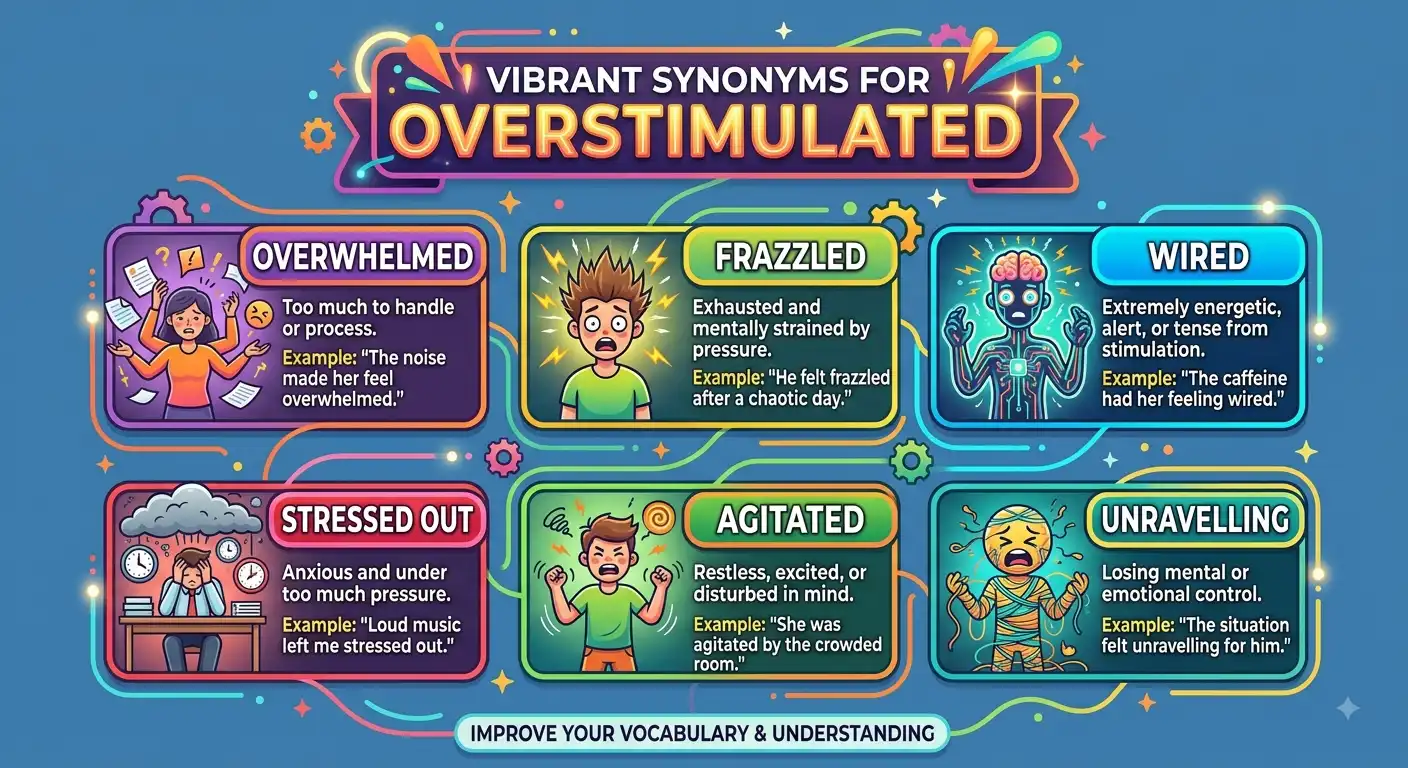
Finding exact synonyms for overstimulated helps you express mental fatigue and sensory burnout with total precision. When you learn diverse synonyms for overstimulated, you can easily explain feeling overwhelmed by loud sounds, bright lights, or excessive activity. Using clear synonyms for overstimulated strengthens your daily communication and elevates your personal writing.
Imagine sitting in a crowded shopping mall during the holiday rush. Loud music blares from speakers, neon signs flash in every window, and hundreds of people bump into your shoulders. Your mind suddenly feels completely full, tired, and unable to focus. Instead of just saying you feel tired, using exact words like “frazzled,” “overwhelmed,” or “sensory-overloaded” explains your exact state immediately.
The term overstimulated means that your brain or body receives more sensory input, information, or activity than it can comfortably process. Expanding your knowledge of synonyms for overstimulated provides strong value for many groups of readers:
- Students describe feelings of stress and test pressure accurately in personal essays.
- Bloggers craft relatable wellness and mental health content that connects deeply with readers.
- Content writers expand search traffic through natural, high-intent vocabulary choices.
- Daily English users communicate personal limits and emotional boundaries clearly to friends and coworkers.
“The right word brings immediate clarity to complex human feelings.”
“A precise vocabulary gives voice to subtle emotions that standard words miss.”
Linguistic Breakdown of “Overstimulated”
Connotative Meaning
The word overstimulated carries negative, uncomfortable, and exhausting connotations. It describes a temporary state of mental, emotional, or sensory excess where a person feels tense, distracted, or drained.
Etymology
- Prefix: Over- (From Old English ofer, meaning beyond, excess, or too much).
- Root: Stimulate (From Latin stimulatus, past participle of stimulare, meaning to prick, urge, or incite).
- Suffix: -ed (Adjective marker showing a state or condition).
- Historical Shift: Originally used in biological and medical texts to describe bodily organs receiving excess physical stimulation, now widely used in psychology and daily conversation.
Pronunciation
- US (IPA): /ˌoʊ.vɚˈstɪm.jə.leɪ.t̬ɪd/
- UK (IPA): /ˌəʊ.vəˈstɪm.jʊ.leɪ.tɪd/
Syllables & Affixation Pattern
- Syllables: 5 syllables (o-ver-stim-u-lat-ed)
- Base Structure: Prefix over- + verb root stimulate + suffix -ed
- Grammatical Patterns:
- Active State: Feeling overstimulated / Becoming overstimulated
- Noun Form: Overstimulation
- Verb Form: Overstimulate
Comparison Table: Common Synonyms for Overstimulated
| Keyword | Meaning | Usage Type | Context |
| Overwhelmed | Defeated or crushed by too much input | General / Personal | School, Workplace, & Daily Stress |
| Frazzled | Extremely tired and easily annoyed | Informal / Conversational | Busy Parenting, Overwork, & Crowds |
| Flustered | Nervous, confused, and agitated | Emotional / Social | Public Speaking, Exams, & Social Events |
| Sensory-overloaded | Brain flooded by noise, light, or touch | Clinical / Descriptive | Autism, ADHD, & Loud Environments |
| Agitated | Feeling restless, angry, or disturbed | Emotional / Behavioral | Conflicts, Noise Pollution, & Anxiety |
| Overworked | Tired from doing too many physical tasks | Professional / Physical | Jobs, Studies, & Heavy Schedules |
| Scatterbrained | Unable to think clearly or focus | Casual / Mental | Multitasking, Busy Days, & Lack of Sleep |
50 Best Synonyms for Overstimulated
1. Overwhelmed
- Pronunciation: US /ˌoʊ.vɚˈwelmd/ | UK /ˌəʊ.vəˈwelmd/
- Meaning: Overwhelmed means feeling like you have too much noise or activity around you to handle.
- Examples:
- The bright lights made the small child feel overwhelmed.
- She felt overwhelmed after working in a noisy room all day.
2. Frazzled
- Pronunciation: US /ˈfræz.əld/ | UK /ˈfræz.əld/
- Meaning: Frazzled means feeling completely exhausted and easily upset by small things.
- Examples:
- Loud traffic left the driver feeling frazzled.
- The teacher felt frazzled after the noisy school trip.
3. Flustered
- Pronunciation: US /ˈflʌs.tɚd/ | UK /ˈflʌs.təd/
- Meaning: Flustered means feeling nervous, upset, and confused due to sudden noise or rush.
- Examples:
- He became flustered when everyone spoke at the same time.
- The store clerk looked flustered during the holiday rush.
4. Agitated
- Pronunciation: US /ˈædʒ.ə.teɪ.t̬ɪd/ | UK /ˈædʒ.ɪ.teɪ.tɪd/
- Meaning: Agitated means feeling restless, nervous, and easily annoyed by your surroundings.
- Examples:
- The loud music made the puppy feel agitated.
- She grew agitated after standing in the noisy crowd.
5. Overloaded
- Pronunciation: US /ˌoʊ.vɚˈloʊ.dɪd/ | UK /ˌəʊ.vəˈləʊ.dɪd/
- Meaning: Overloaded means having too much information or sensory input given to you at once.
- Examples:
- His mind felt overloaded by all the flashing screens.
- The computer user felt overloaded by constant pop-up ads.
6. Overexcited
- Pronunciation: US /ˌoʊ.vɚ.ɪkˈsaɪ.t̬ɪd/ | UK /ˌəʊ.və.ɪkˈsaɪ.tɪd/
- Meaning: Overexcited means feeling so full of energy that you lose your calm focus.
- Examples:
- The kids became overexcited at the loud birthday party.
- Eating too much sugar can make children overexcited.
7. Rattled
- Pronunciation: US /ˈræt̬.əld/ | UK /ˈræt.əld/
- Meaning: Rattled means feeling shaken up, worried, and unable to think clearly.
- Examples:
- The sudden loud crash left her feeling rattled.
- He felt rattled after the intense debate.
8. Jittery
- Pronunciation: US /ˈdʒɪt̬.ɚ.i/ | UK /ˈdʒɪt.ər.i/
- Meaning: Jittery means feeling nervous, shaky, and unable to sit still.
- Examples:
- Drinking three cups of coffee made him jittery.
- She felt jittery before going on the stage.
9. Restless
- Pronunciation: US /ˈrest.ləs/ | UK /ˈrest.ləs/
- Meaning: Restless means unable to relax or remain still because of excess energy.
- Examples:
- The long flight made the travelers feel restless.
- He spent a restless night tossing in bed.
10. Hyperactive
- Pronunciation: US /ˌhaɪ.pɚˈæk.tɪv/ | UK /ˌhaɪ.pərˈæk.tɪv/
- Meaning: Hyperactive means moving around with too much restless energy.
- Examples:
- The playful dog became hyperactive in the park.
- Bright colors can make young kids hyperactive.
“Recognizing your mental boundaries turns overwhelming chaos into calm control.”
11. Overtaxed
- Pronunciation: US /ˌoʊ.vɚˈtækst/ | UK /ˌəʊ.vəˈtækst/
- Meaning: Overtaxed means pushed beyond your normal limit of energy or strength.
- Examples:
- Her mind was overtaxed from hours of study.
- The doctor said his body was completely overtaxed.
12. Wound up
- Pronunciation: US /waʊnd ʌp/ | UK /waʊnd ʌp/
- Meaning: Wound up means filled with intense tension, worry, or restless energy.
- Examples:
- He was too wound up to sleep after the game.
- She gets wound up when working under deadlines.
13. Edgy
- Pronunciation: US /ˈedʒ.i/ | UK /ˈedʒ.i/
- Meaning: Edgy means nervous, sharp, and quick to snap at others.
- Examples:
- Constant phone notifications made her feel edgy.
- He felt edgy after sitting in heavy traffic.
14. Overheated
- Pronunciation: US /ˌoʊ.vɚˈhiː.t̬ɪd/ | UK /ˌəʊ.vəˈhiː.tɪd/
- Meaning: Overheated means feeling uncomfortably hot, angry, or mentally intense.
- Examples:
- The warm, crowded bus left everyone feeling overheated.
- Arguments quickly become overheated in noisy places.
15. Frantic
- Pronunciation: US /ˈfræn.tɪk/ | UK /ˈfræn.tɪk/
- Meaning: Frantic means wildly excited, anxious, or rushed due to excess activity.
- Examples:
- She made a frantic search for her lost keys.
- The kitchen staff felt frantic during lunch hours.
16. Overstrung
- Pronunciation: US /ˌoʊ.vɚˈstrʌŋ/ | UK /ˌəʊ.vəˈstrʌŋ/
- Meaning: Overstrung means extremely sensitive, tense, and close to breaking.
- Examples:
- The young musician felt overstrung before the concert.
- Loud shouting makes overstrung people feel sick.
17. Overwrought
- Pronunciation: US /ˌoʊ.vɚˈrɑːt/ | UK /ˌəʊ.vəˈrɔːt/
- Meaning: Overwrought means deeply upset, nervous, and filled with strong emotion.
- Examples:
- She became overwrought after hearing the bad news.
- The tired toddler was overwrought from missed naps.
18. Scatterbrained
- Pronunciation: US /ˈskæt̬.ɚ.breɪnd/ | UK /ˈskæt.ə.breɪnd/
- Meaning: Scatterbrained means disorganized and unable to keep your focus on one thought.
- Examples:
- Loud background noise made her feel scatterbrained.
- He felt scatterbrained after answering ten calls.
19. Discombobulated
- Pronunciation: US /ˌdɪs.kəmˈbɑː.bjə.leɪ.t̬ɪd/ | UK /ˌdɪs.kəmˈbɒb.jʊ.leɪ.tɪd/
- Meaning: Discombobulated means thoroughly confused, mixed up, and off-balance.
- Examples:
- The sudden time change left him discombobulated.
- She felt discombobulated in the massive airport.
20. Burned-out
- Pronunciation: US /bɝːnd aʊt/ | UK /bɜːnd aʊt/
- Meaning: Burned-out means emotionally and physically exhausted from long periods of stress.
- Examples:
- Working weekends made the nurse feel burned-out.
- Studying without breaks leaves students burned-out.
21. Saturated
- Pronunciation: US /ˈsætʃ.ə.reɪ.t̬ɪd/ | UK /ˈsætʃ.ər.eɪ.tɪd/
- Meaning: Saturated means completely filled with thoughts or sensory details to capacity.
- Examples:
- Her brain felt saturated after the long training.
- The market was saturated with news updates.
22. Wired
- Pronunciation: US /waɪɚd/ | UK /waɪəd/
- Meaning: Wired means feeling artificially alert, tense, and full of nervous energy.
- Examples:
- Energy drinks made him feel wired all evening.
- She was too wired to sleep after watching the thriller.
23. Keyed up
- Pronunciation: US /kiːd ʌp/ | UK /kiːd ʌp/
- Meaning: Keyed up means excited, nervous, and waiting intensely for something to happen.
- Examples:
- The players were keyed up before the championship game.
- He felt keyed up while waiting for his test scores.
24. Unsettled
- Pronunciation: US /ʌnˈset̬.əld/ | UK /ʌnˈset.əld/
- Meaning: Unsettled means feeling calm-free, worried, and physically uncomfortable.
- Examples:
- The noisy wind made the children feel unsettled.
- An unsettled stomach often follows heavy stress.
25. Sensory-overloaded
- Pronunciation: US /ˈsen.sɚ.i ˌoʊ.vɚˈloʊ.dɪd/ | UK /ˈsen.sər.i ˌəʊ.vəˈləʊ.dɪd/
- Meaning: Sensory-overloaded means flooded by sights, sounds, smells, or physical touches.
- Examples:
- Fireworks can leave sensitive pets sensory-overloaded.
- Arcades often leave young toddlers sensory-overloaded.
26. Drained
- Pronunciation: US /dreɪnd/ | UK /dreɪnd/
- Meaning: Drained means completely emptied of energy, strength, or spirit.
- Examples:
- A long day in the crowd left her feeling drained.
- He felt emotionally drained after the long argument.
27. Exhausted
- Pronunciation: US /ɪɡˈzɑː.stɪd/ | UK /ɪɡˈzɔː.stɪd/
- Meaning: Exhausted means extremely tired in body or mind.
- Examples:
- The runners were exhausted after finishing the race.
- Too much noise makes sensitive people feel exhausted.
28. Overworked
- Pronunciation: US /ˌoʊ.vɚˈwɝːkt/ | UK /ˌəʊ.vəˈwɜːkt/
- Meaning: Overworked means worn out from doing too much physical or mental labor.
- Examples:
- The overworked staff needed a restful summer break.
- An overworked mind struggles to make good choices.
29. Dazed
- Pronunciation: US /deɪzd/ | UK /deɪzd/
- Meaning: Dazed means unable to think clearly because of shock, noise, or light.
- Examples:
- He stood dazed after the sudden flash of light.
- The loud concert left audience members dazed.
30. High-strung
- Pronunciation: US /ˌhaɪˈstrʌŋ/ | UK /ˌhaɪˈstrʌŋ/
- Meaning: High-strung means very sensitive, nervous, and easily upset.
- Examples:
- High-strung dogs bark at every small noise.
- She felt high-strung during the important presentation.
31. Distracted
- Pronunciation: US /dɪˈstræk.tɪd/ | UK /dɪˈstræk.tɪd/
- Meaning: Distracted means unable to give your full attention to one thing.
- Examples:
- Loud TV commercials kept him feeling distracted.
- She was too distracted by the noise to read her book.
32. Overburdened
- Pronunciation: US /ˌoʊ.vɚˈbɝː.dənd/ | UK /ˌəʊ.vəˈbɜː.dənd/
- Meaning: Overburdened means carrying too many worries, tasks, or physical weights.
- Examples:
- Single parents often feel overburdened by daily chores.
- His overburdened mind needed a quiet nature walk.
33. Overcharged
- Pronunciation: US /ˌoʊ.vɚˈtʃɑːrdʒd/ | UK /ˌəʊ.vəˈtʃɑːdʒd/
- Meaning: Overcharged means filled with excessive emotional tension or physical electricity.
- Examples:
- The classroom felt overcharged with pre-holiday excitement.
- Her emotions were overcharged after the long week.
34. Stressed
- Pronunciation: US /strest/ | UK /strest/
- Meaning: Stressed means worried and unable to relax because of life problems.
- Examples:
- Final exams leave many college students feeling stressed.
- He gets stressed when his schedule is full.
35. Overextended
- Pronunciation: US /ˌoʊ.vɚ.ɪkˈsten.dɪd/ | UK /ˌəʊ.və.ɪkˈsten.dɪd/
- Meaning: Overextended means taking on more jobs or duties than you can manage.
- Examples:
- She felt overextended after joining three clubs.
- Buying extra items left his bank account overextended.
36. Overstrained
- Pronunciation: US /ˌoʊ.vɚˈstreɪnd/ | UK /ˌəʊ.vəˈstreɪnd/
- Meaning: Overstrained means stretched past safe limits in body or mind.
- Examples:
- His overstrained eyes hurt from looking at screens.
- The team felt overstrained after three matches.
37. Overfatigued
- Pronunciation: US /ˌoʊ.vɚ.fəˈtiːɡd/ | UK /ˌəʊ.və.fəˈtiːɡd/
- Meaning: Overfatigued means extremely tired due to lack of rest and quiet.
- Examples:
- Night shifts leave workers feeling overfatigued.
- The overfatigued child cried for her blanket.
38. Bothered
- Pronunciation: US /ˈbɑː.ðɚd/ | UK /ˈbɒð.əd/
- Meaning: Bothered means feeling annoyed, disturbed, or slightly upset.
- Examples:
- He was bothered by the loud buzzing insect.
- She felt bothered by the bright street lamps.
39. Overpressed
- Pronunciation: US /ˌoʊ.vɚˈprest/ | UK /ˌəʊ.vəˈprest/
- Meaning: Overpressed means forced to hurry and finish tasks under heavy pressure.
- Examples:
- Overpressed workers often make minor grammar errors.
- She felt overpressed during the quick store clearance.
40. Over-aroused
- Pronunciation: US /ˌoʊ.vɚ.əˈraʊzd/ | UK /ˌəʊ.və.əˈraʊzd/
- Meaning: Over-aroused means having a nervous system that is overly active.
- Examples:
- An over-aroused toddler has trouble settling down.
- Watching scary movies leaves the brain over-aroused.
41. Overdone
- Pronunciation: US /ˌoʊ.vɚˈdʌn/ | UK /ˌəʊ.vəˈdʌn/
- Meaning: Overdone means carried out to an extreme or excessive degree.
- Examples:
- Her bright makeup felt a bit overdone for morning.
- Party decorations looked overdone in the small room.
42. Perturbed
- Pronunciation: US /pɚˈtɝːbd/ | UK /pəˈtɜːbd/
- Meaning: Perturbed means worried and disturbed by unexpected noises or news.
- Examples:
- He looked perturbed by the barking stray dogs.
- She felt perturbed by the sudden room changes.
43. Crowded
- Pronunciation: US /ˈkraʊ.dɪd/ | UK /ˈkraʊ.dɪd/
- Meaning: Crowded means feeling squished, packed, or lacking personal space.
- Examples:
- The crowded train made her feel trapped and hot.
- His crowded mind needed ten minutes of quiet time.
44. Overfilled
- Pronunciation: US /ˌoʊ.vɚˈfɪld/ | UK /ˌəʊ.vəˈfɪld/
- Meaning: Overfilled means packed beyond normal capacity.
- Examples:
- The overfilled room felt hot and stuffy.
- Her overfilled schedule allowed no lunch break.
45. Over-spent
- Pronunciation: US /ˌoʊ.vɚˈspent/ | UK /ˌəʊ.vəˈspent/
- Meaning: Over-spent means completely out of personal energy, money, or resources.
- Examples:
- She felt over-spent after hosting the family reunion.
- His energy was over-spent after running errands.
46. Rattled mentally
- Pronunciation: US /ˈræt̬.əld ˈmen.t̬əl.i/ | UK /ˈræt.əld ˈmen.təl.i/
- Meaning: Rattled mentally means having your inner peace disturbed by loud sounds.
- Examples:
- The car horn left her rattled mentally.
- He felt rattled mentally after the intense quiz.
47. Senses-flooded
- Pronunciation: US /ˈsen.sɪz ˈflʌd.ɪd/ | UK /ˈsen.sɪz ˈflʌd.ɪd/
- Meaning: Senses-flooded means experiencing too many smells, sounds, and visuals together.
- Examples:
- The spice market left the tourist senses-flooded.
- Theme parks often leave visitors senses-flooded.
48. Over-energized
- Pronunciation: US /ˌoʊ.vɚˈen.ɚ.dʒaɪzd/ | UK /ˌəʊ.vəˈen.ə.dʒaɪzd/
- Meaning: Over-energized means having more excitement than your body can manage comfortably.
- Examples:
- The win left the whole team over-energized.
- Cold weather can make young puppies over-energized.
49. Overrun
- Pronunciation: US /ˌoʊ.vɚˈrʌn/ | UK /ˌəʊ.vəˈrʌn/
- Meaning: Overrun means taken over completely by excess crowds or demands.
- Examples:
- The beach town is overrun with tourists in summer.
- Her mind felt overrun with worry before her speech.
50. Over-taxed emotionally
- Pronunciation: US /ˌoʊ.vɚˈtækst ɪˈmoʊ.ʃən.əl.i/ | UK /ˌəʊ.vəˈtækst ɪˈməʊ.ʃən.əl.i/
- Meaning: Over-taxed emotionally means feeling unable to handle any more feelings or demands.
- Examples:
- Supporting sad friends left her over-taxed emotionally.
- He felt over-taxed emotionally after the hard day.
Antonyms of “Overstimulated”
Knowing opposite terms helps you express calmness, rest, and peaceful mental states accurately.
- Calm: Free from excitement, worry, or noisy distraction.
- Relaxed: Feeling comfortable, peaceful, and free from bodily tension.
- Tranquil: Quiet, peaceful, and completely undisturbed by noise.
- Unmoved: Not affected by external stimulation, noise, or excitement.
- Rested: Having full energy restored through peace and sleep.
- Understimulated: Lacking enough interest, activity, or mental input.
Prototype Meaning & Categorization of “Overstimulated”
The core concept of overstimulated rests on excessive sensory input, emotional overload, and mental fatigue. Depending on your intent, these 50 synonyms divide into four operational categories:
- Sensory & Physical Input: Overloaded, sensory-overloaded, senses-flooded, overheated, crowded, overfilled, hyperactive, over-energized, wired, overdone.
- Mental Confusion & Disorganization: Overwhelmed, scatterbrained, discombobulated, rattled, flustered, distracted, dazed, rattled mentally, saturated, overrun.
- Emotional Strain & Nervousness: Agitated, frazzled, jittery, restless, wound up, edgy, frantic, overstrung, overwrought, keyed up, high-strung, perturbed, bothered, overcharged, over-aroused.
- Burnout & Physical Exhaustion: Overtaxed, burned-out, drained, exhausted, overworked, overburdened, overextended, overstrained, overfatigued, overpressed, over-spent, over-taxed emotionally, unsettled.
Frequently Asked Questions (FAQs)
1. What is the most formal synonym for “overstimulated”?
In medical, psychological, or academic settings, “sensory-overloaded,” “overburdened,” or “overtaxed” work best. They explain sensory limits without using slang.
2. Which synonym for “overstimulated” should I use in casual conversations?
In everyday speech, terms like “frazzled,” “burned-out,” “flustered,” or “wired” sound natural, relatable, and clear.
3. What is the difference between “overstimulated” and “overwhelmed”?
“Overstimulated” specifically involves excess sensory details like noise, light, or crowd movement. “Overwhelmed” can apply to any heavy burden, such as work duties or sadness.
4. Can “wired” mean the same thing as “overstimulated”?
Yes, “wired” describes an artificial state of restless energy, often caused by caffeine, sugar, or intense screens, leading directly to overstimulation.
5. Why is learning synonyms for “overstimulated” helpful for mental health writers?
Using varied synonyms helps writers describe mental states accurately, avoid repeating words, and connect with readers experiencing sensory fatigue.
6. Is “understimulated” the exact opposite of “overstimulated”?
Yes, “understimulated” means feeling bored, dull, or unengaged due to a lack of activity or sensory interest.
Conclusion
Expanding your collection of synonyms for overstimulated brings emotional precision, vocabulary variety, and clarity to your everyday communication. Replacing generic words with accurate terms like frazzled, sensory-overloaded, overwhelmed, or discombobulated ensures your writing connects with readers every time.
Whether you are writing blog posts about wellness, drafting student essays, crafting work emails, or speaking with friends, exact words help you share personal limits with confidence. Precise language turns basic comments into clear, memorable thoughts. Start practicing these 50 synonyms today to elevate your English skills.
“Clear emotional vocabulary turns silent feelings into powerful connections.”
“Choosing exact words builds instant understanding and lasting empathy.”

Robert Hayes is an ESL educator and curriculum developer with over nine years of experience teaching English to beginners and intermediate learners across multiple countries ( Biography ).