Quick Intro: Why ‘Location’ Synonyms Matter
The word location appears in daily speech, academic writing, travel blogs, and business reports. It describes where something exists or happens.
Learning synonyms for location helps you avoid repetition. It also makes your writing clearer and more natural.
Direct Answer
Location means the place or position where something is.
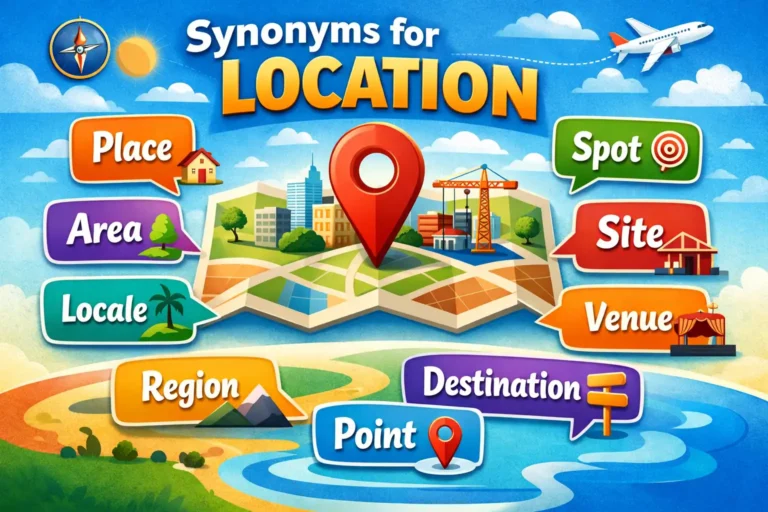
Common synonyms for location include:
- Place
- Site
- Position
- Area
- Spot
- Venue
- Setting
- Region
- Address
- Locale
Meaning of Location
Location refers to the exact place or position of something. It can describe a physical space or a general area.
Example:
The restaurant’s location is near the city center.
Categories of Synonyms
1. Physical Place
These words describe a real, visible place in the world.
Examples include site, spot, and address.
2. Geographic Area
These words describe larger areas such as parts of cities, countries, or regions.
Examples include region, area, and district.
3. Functional or Event Space
These words describe places used for activities or events.
Examples include venue, setting, and premises.
Synonyms Table
| Word | Simple Meaning | Example Sentence |
| Place | A general area | This is a quiet place to study. |
| Site | A specific piece of land | The company chose a new site for the factory. |
| Position | Exact point or location | The statue’s position faces the park. |
| Area | A part of a town or region | This area is known for good schools. |
| Spot | A small or exact place | We found a perfect spot by the lake. |
| Venue | A place for events | The venue holds 500 guests. |
| Setting | Surrounding environment | The beach setting looks beautiful. |
| Region | A large geographic area | The region has cold winters. |
| Address | Official location details | Please send it to my new address. |
| Locale | A particular place or setting | The café is popular among locals in the area. |
Master Synonyms List (Grouped by Level)
Beginner / Simple
Place
Simple meaning: A general location.
Example: We met at a nice place downtown.
Spot
Simple meaning: A small exact area.
Example: She saved me a spot in the front row.
Area
Simple meaning: Part of a town or city.
Example: The hotel is in a safe area.
Intermediate
Site
Simple meaning: A specific land location.
Example: The new school site is under construction.
Position
Simple meaning: Exact physical point.
Example: The camera’s position affects the photo.
Region
Simple meaning: A large geographic zone.
Example: This region produces excellent wine.
Address
Simple meaning: Official place information.
Example: I changed my address last week.
Setting
Simple meaning: Surrounding environment.
Example: The mountain setting feels peaceful.
Advanced / Formal
Venue (Formal)
Simple meaning: Place for events.
Example: The wedding venue overlooks the ocean.
Locale (Formal)
Simple meaning: Particular place or scene.
Example: The film was shot in a historic locale.
Premises (Formal)
Simple meaning: Land or buildings owned by someone.
Example: Smoking is not allowed on the premises.
District (Neutral)
Simple meaning: Administrative part of a city.
Example: The business district stays busy at night.
Formal vs Informal Synonyms
In casual conversation, people use simple words like place, spot, or area.
In academic or business writing, more precise words such as site, venue, or premises sound better.
For example:
- Informal: Let’s meet at that place near the mall.
- Formal: The event will take place at a private venue.
Always match the word to your audience and context.
Real-Life Usage Examples
Conversation
Let’s choose a better place for dinner.
Academic Writing
The study examined climate patterns in a coastal region.
Business Writing
The company plans to relocate its offices to a central district.
Blogging
This hidden spot offers the best sunset views.
Emotional Expression
This city still feels like home, no matter the location.
Similar Words Comparison
Understanding small differences between similar words helps you choose the most accurate term in each situation.
Location vs Place
Location sounds more neutral and slightly formal. It often appears in writing, instructions, or descriptions.
Place is very common and informal. People use it in daily conversation.
Examples:
- The office location is easy to find.
- This is a nice place to relax.
Use place for casual talk. Use location for clarity or professionalism.
Location vs Site
Location is general and flexible.
Site is specific and often technical. It usually refers to land, construction, or projects.
Examples:
- The store changed its location last year.
- The construction site is closed to the public.
Use site when talking about buildings, land, or development.
Location vs Address
Location describes where something is in a general sense.
Address gives exact and official details, such as street name and number.
Examples:
- Share your location so I can find you.
- Please write your full address on the form.
Use address for mail, documents, or legal purposes. Use location for general direction.
Location vs Area
Location refers to a specific point or place.
Area refers to a wider space or section of a city or region.
Examples:
- The hotel’s location is near the airport.
- This area has many restaurants.
Use area when talking about neighborhoods or larger zones, not exact points.
Example Sentences
- The clinic’s location makes it easy for patients to reach in an emergency.
- The package is still at the distribution center’s site.
- Please confirm your address before we ship the order.
- The doctor asked about the exact position of the pain in my shoulder.
- This region experiences frequent earthquakes.
- The event venue requires advance booking.
- Mark the correct spot on the map before you submit it.
- The business district becomes crowded during office hours.
- The filming setting gives the movie a peaceful tone.
- The company relocated its offices to a safer neighborhood area.
- For privacy reasons, she did not share her live location online.
- The rescue team identified the exact place using GPS coordinates.
- The warehouse premises remain closed after midnight.
- The restaurant changed to a more central locale last month.
- The meeting point is shown clearly on the digital map.
Common Mistakes
- Using “site” for casual situations
Do not say “Let’s meet at the site.” Use place instead. - Confusing “address” with “location”
An address is official information. A location can be general. - Overusing one word
Repeating location many times makes writing boring. Use variety. - Using formal words in casual talk
Avoid saying “venue” in normal daily conversation unless needed. - Using geographic words incorrectly
A region is large. Do not use it for a small room or house.
Tips / Best Practices
Choosing the right synonym for location depends on three key factors: precision, tone, and audience.
1. Choose by Precision
Ask yourself: How exact does this need to be?
- Use address when you need official details.
- Use position when describing an exact point.
- Use region for large geographic areas.
- Use spot for small, informal references.
More precision creates clearer communication.
2. Choose by Tone
Tone changes how professional or casual you sound.
- Use place or spot in everyday conversation.
- Use site in technical or project contexts.
- Use venue for formal events.
- Use premises in legal or policy writing.
Avoid using formal words in relaxed conversations.
3. Choose by Audience
Think about who is reading or listening.
- For friends: simple words like place work best.
- For academic readers: region, site, or district sound appropriate.
- For business clients: location, premises, or venue are clearer.
Always match vocabulary to your audience’s expectations.
4. Avoid Overuse
Do not repeat location in every sentence.
Vary your wording naturally, but only when it improves clarity.
Replacing a word just to sound advanced can confuse readers.
Clarity is more important than variety.
5. Check Context Before Replacing
Not all synonyms work in every sentence.
Incorrect:
The company changed its address to a better area.
Correct:
The company moved to a better location.
Make sure the replacement keeps the original meaning.
When NOT to Use Location
Avoid using location when another word sounds more natural or more precise for the situation.
1. When You Mean an Exact Address
Use address instead of location when official or postal details matter.
- Less precise: Please confirm your location.
- More precise: Please confirm your address.
This is important in shipping, forms, and legal documents.
2. When Talking About a Small, Informal Place
In everyday speech, place or spot often sounds more natural.
- Less natural: Let’s meet at that location.
- More natural: Let’s meet at that place.
Native speakers prefer simpler words when precision is not required.
3. When Referring to a Large Area
Use area, region, or district when the reference is broad.
- Less clear: This location has a high population.
- Clearer: This region has a high population.
Location can feel too narrow in these cases.
4. When Referring to Land or Construction
Use site when talking about land use, projects, or development.
- Less accurate: The factory location is restricted.
- More accurate: The factory site is restricted.
This distinction matters in technical and professional contexts.
5. When Describing Legal or Property Boundaries
Use premises for rules, ownership, or access.
- Less specific: Smoking is not allowed at this location.
- More specific: Smoking is not allowed on these premises.
Key Takeaway
Location is correct in many situations, but it is not always the best choice.
When another word is clearer, more natural, or more specific, use that word instead.
Related Contrasts (Instead of Antonyms)
Location does not have a true opposite. Instead, English uses contrast phrases to show uncertainty, absence, or mismatch of place.
1. Unknown Location
Used when the place is not identified or cannot be confirmed.
- The missing hiker’s location remains unknown.
- Authorities are still searching for the exact location.
Common in news, investigations, and emergencies.
2. Undisclosed Location
Used when the place is known but intentionally not shared.
- The witness was moved to an undisclosed location.
- The meeting took place at an undisclosed location for security reasons.
Common in legal, military, and privacy-sensitive contexts.
3. Unspecified Location
Used when details are not provided or not important.
- The incident occurred at an unspecified location.
- The file was uploaded from an unspecified location.
Often used in reports and technical writing.
4. Out of Place
Describes something that does not fit its surroundings.
- He felt out of place at the formal event.
- The modern building looks out of place in the old town.
This phrase focuses on appropriateness, not geography.
5. Location Not Available
Used in technology, apps, or systems when data cannot be accessed.
- Location not available due to privacy settings.
- The device cannot determine your current location.
Common in GPS, mobile apps, and privacy notices.
Key Insight
Instead of opposites, English relies on contrast phrases to express:
- lack of information
- intentional secrecy
- missing data
- social or contextual mismatch
Using these phrases sounds more natural and precise than forcing an antonym.
FAQs
What does location mean?
Location means the place or position where something exists or happens.
Is location formal or informal?
Location is neutral. It works in conversation, business writing, and academic contexts without sounding too casual or too formal.
How can I use location in conversation?
Use it when you want to be clear but not overly detailed.
Example: “Share your location so I can find you.”
What is the best synonym for location?
There is no single best synonym.
- Use place for casual speech.
- Use site for projects or land.
- Use address for exact details.
The best choice depends on context.
Can location be replaced with place?
Yes, in most everyday situations.
However, location sounds more precise and works better in instructions or descriptions.
Is address the same as location?
No. An address gives exact official details. A location can be general or approximate.
Which word is best for academic writing instead of location?
Use site, region, district, or position, depending on what you describe. These sound more specific and formal in academic contexts.
Which synonym is best for business or professional writing?
Location, premises, and venue are the most natural choices for reports, emails, and contracts.
Should I avoid repeating location in writing?
Yes. Repeating it too often reduces clarity. Replace it only when another word is more precise or natural.
Can location refer to online or digital spaces?
Yes. It is commonly used for digital contexts like GPS, data tracking, or file access.
Example: “Your location data is protected.”
Is location used in medical or emergency contexts?
Yes. Professionals use it to describe where pain, incidents, or patients are found.
What is the safest word to use if I’m unsure?
Location is usually the safest choice because it is neutral, clear, and widely understood.
Conclusion
Understanding synonyms for location helps you speak and write with more accuracy. The right word makes your message clearer, more natural, and more professional. Small choices improve both meaning and tone.
Quick Selector: Which Word Should You Use?
- Place → everyday conversation, informal situations
- Site → land, construction, projects, or research
- Venue → events, meetings, or formal gatherings
- Address → exact, official location details
Use location when you want a safe, neutral option. Switch to a more specific word when precision matters.
Try using three different synonyms in your next sentence to build confidence and fluency.

**Author Biography — Lucas Reed**
Lucas Reed is a research-focused language writer specializing in word meaning, synonym comparison, and semantic accuracy. His work centers on helping readers understand how similar words differ in definition, tone, and usage across real communication contexts. With a background in editorial research and language analysis, Lucas has spent years studying how vocabulary choices shape clarity in writing and interpretation.
Before contributing to research-based language publications, Lucas worked in editorial support roles where precision in wording, fact-checking, and source validation were essential. This experience strengthened his methodical approach to explaining language concepts through structured comparison and evidence-based examples. He focuses on how definitions evolve through usage, how context affects interpretation, and how small differences between synonyms can change meaning in practical writing.
Lucas’s writing process combines dictionary research, corpus-based language observation, and style-guide alignment. Rather than presenting vocabulary as interchangeable, he examines nuance, connotation, and grammatical function to help readers build confident word selection skills. His articles are designed to support students, writers, educators, and English learners who want reliable explanations grounded in linguistic accuracy.
As a contributor in the word-synonyms informational niche, Lucas prioritizes clarity, neutrality, and verifiable language references. His work reflects strong editorial standards and a commitment to producing helpful, trustworthy content that aligns with modern search quality expectations. By focusing on semantic relationships between words, he helps readers understand not only what words mean, but when and why one word is more appropriate than another.
Lucas continues to research English usage patterns and synonym distinctions, contributing structured language resources that emphasize accuracy, readability, and practical understanding.