Why “Land” Needs Synonyms in Writing
The word land appears in daily speech, news, geography, travel writing, and legal documents. It can describe soil, property, territory, or a country. Learning synonyms for land helps you write more clearly and avoid repetition.
Direct Answer
Land means the solid ground of the earth or an area used for a specific purpose, such as farming or building.
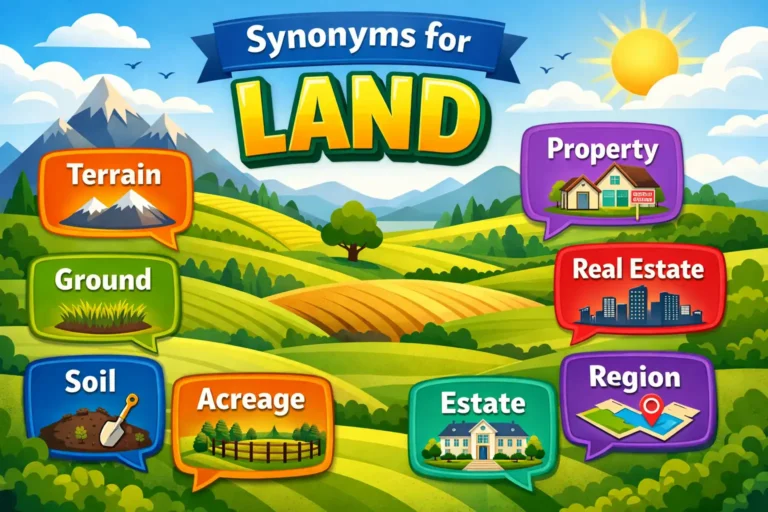
Common synonyms for land:
- ground
- soil
- earth
- terrain
- territory
- property
- acreage
- field
- plot
- lot
- estate
- region
- country
- farmland
- real estate
Meaning of Land
Land refers to the solid surface of the earth that is not covered by water. It can also mean an area owned or used for farming, building, or living.
Example:
They bought a piece of land near the river.
Categories of Synonyms
1. Physical Surface or Nature
These words describe the natural ground or physical surface of the earth.
Examples: ground, soil, earth, terrain
2. Ownership or Property
These synonyms focus on land as something owned, bought, or sold.
Examples: property, real estate, lot, plot, estate, acreage
3. Geographic Areas (Country/Region/Territory)
These words describe larger areas such as countries or regions.
Examples: territory, region, country, farmland, field
Synonyms Table
| Word | Simple Meaning | Example Sentence |
| Ground | Surface of the earth | The ball fell to the ground. |
| Soil | Dirt used for growing plants | The soil is rich and dark. |
| Earth | The planet or ground | The farmer worked the earth all day. |
| Terrain | Type of land surface | The terrain is rocky and steep. |
| Territory | Area controlled by a group | The tribe protected its territory. |
| Property | Land owned by someone | The house stands on private property. |
| Acreage | Area measured in acres | The farm has large acreage. |
| Field | Open area of land | Cows grazed in the field. |
| Plot | Small piece of land | They bought a plot for their home. |
| Lot | Small area for building | The lot is ready for construction. |
| Estate | Large area of owned land | The estate includes a garden. |
| Region | Large geographic area | The region grows rice. |
| Country | Nation or rural area | She loves living in the country. |
| Farmland | Land used for farming | The farmland produces corn. |
| Real estate | Property and buildings | Real estate prices are rising. |
Master Synonyms List (Grouped by Level)
Beginner / Simple
Ground
Simple meaning: the surface of the earth
Example: The kids sat on the ground.
Soil
Simple meaning: dirt where plants grow
Example: The flowers grow in rich soil.
Field
Simple meaning: open area of land
Example: The horses ran across the field.
Country
Simple meaning: rural area outside cities
Example: They moved to the country for peace.
Intermediate
Property
Simple meaning: land owned by someone
Example: The fence marks our property.
Plot
Simple meaning: small piece of land
Example: She purchased a plot near the lake.
Lot
Simple meaning: building area
Example: The house stands on a corner lot.
Region
Simple meaning: large area
Example: The region is known for vineyards.
Terrain
Simple meaning: type of surface
Example: The desert terrain is dry and flat.
Advanced / Formal
Territory (Formal)
Simple meaning: controlled area
Example: The army defended its territory.
Estate (Formal)
Simple meaning: large owned land
Example: The royal estate covers many acres.
Acreage (Formal)
Simple meaning: size of land
Example: The ranch has vast acreage.
Farmland
Simple meaning: agricultural land
Example: The family owns productive farmland.
Real estate (Business/Formal)
Simple meaning: land and buildings for sale
Example: She works in real estate.
Formal vs Informal Synonyms
Use simple words like ground or field in casual conversation.
Use formal terms like territory, estate, or real estate in business, academic, or legal writing.
Always match the tone of your audience.
Real-Life Usage Examples
Conversation
We found some cheap land outside town.
Academic Writing
The study examined land use across the coastal region.
Business Writing
The company invested in commercial real estate.
Blogging
Owning farmland can provide long-term income.
Emotional Expression
He dreamed of owning land in the mountains.
Similar Words Comparison
Land vs Soil
Land refers to an area.
Soil refers to the dirt used for planting.
Example:
The land is wide and open.
The soil is perfect for tomatoes.
Land vs Property
Land can mean natural ground.
Property means owned land or buildings.
Example:
They walked across the land.
They sold their property last year.
Example Sentences
- The land stretches for miles.
- Farmers depend on healthy soil.
- The terrain becomes rough near the hills.
- She invested in real estate early.
- The estate includes forests and gardens.
- The property needs a new fence.
- The field turns green in spring.
- This region receives heavy rain.
- The country roads are quiet.
- They measured the acreage carefully.
- The plot is ready for construction.
- The territory borders the river.
- Farmland supports local food production.
- The lot is too small for a large house.
Common Mistakes
- Using soil when talking about ownership. Soil means dirt, not property.
- Using country when you mean nation versus rural area. Context matters.
- Confusing plot and lot. Plot is general; lot often refers to building land.
- Using formal words like territory in casual speech where simple words work better.
Tips for Choosing the Right Synonym
- Consider tone: formal or informal?
- Think about context: nature, ownership, or geography?
- Choose clarity over complexity.
- Avoid repeating the same word too often.
- Do not force advanced words into simple sentences.
When NOT to Use Land
Do not use land when referring to areas that are primarily water. In coastal or shoreline contexts, it is better to use more specific words.
For example:
- Use shore or shoreline when talking about the edge where land meets the sea.
- Use coast when describing a large area along the ocean.
Incorrect:
They walked along the land watching the waves.
Correct:
They walked along the shore watching the waves.
Also, avoid using land when you only mean dirt quality. In farming or gardening contexts, use soil instead.
Opposite Words (Related Opposites)
The word land does not have a strict opposite in all contexts. However, these words function as natural opposites when describing Earth’s surface:
- water
- sea
- ocean
Example:
The island is surrounded by water.
Sailors traveled across the ocean before reaching land.
These are best understood as related opposites, since they contrast with land geographically rather than grammatically.
FAQs
What does land mean?
Land means the solid ground of the earth or an area used for farming or building.
Is land formal or informal?
Land is neutral. It works in both formal and informal contexts.
How can I use it in conversation?
You can say, “They bought land near the city.”
What is the best synonym for land?
It depends on context. Property works for ownership. Soil works for farming.
Can land be replaced with property?
Yes, when talking about owned land.
Can land mean country?
Yes, in poetic or older language, but not always in modern use.
What is the difference between land and terrain?
Land is general ground. Terrain describes the type of surface.
Is real estate the same as land?
Real estate includes land plus buildings.
What synonym works in academic writing?
Territory or region often works well.
What synonym works in farming context?
Farmland or soil works best.
Conclusion
Learning synonyms for land helps you write and speak with better accuracy and confidence. Different situations need different words, whether you are talking about nature, property, or geography. Choosing the right synonym makes your message clearer and more natural.
CTA: Pick one synonym per context and practice using it in a sentence today.

Michael Torres is a research-focused language writer specializing in word meaning, semantic comparison, and usage clarity in modern English. His work centers on helping readers understand subtle differences between similar words, phrases, and expressions through structured analysis and evidence-based explanations. With a background in editorial research and academic language study, Torres has spent years examining how vocabulary evolves across professional, educational, and everyday communication contexts.
His writing approach combines linguistic research, dictionary authority sources, and real-world usage examples to ensure accuracy and reliability. Rather than simplifying language topics superficially, he focuses on explaining how meaning, tone, and context influence word choice. This method supports readers who want to write more precisely, avoid confusion between similar terms, and build stronger communication skills.
Torres has contributed to multiple informational language platforms where clarity, neutrality, and accuracy are editorial priorities. His work often involves comparing commonly confused words, analyzing synonyms with overlapping meanings, and documenting contextual differences that affect interpretation. He follows a structured editorial process that includes source verification, usage validation, and readability review to ensure information remains accessible while maintaining linguistic accuracy.
At Word Synonyms, Michael Torres contributes research-based content designed to help students, writers, educators, and professionals make informed vocabulary decisions. His articles focus on practical language understanding rather than opinion, allowing readers to confidently distinguish between similar terms and apply them correctly in writing and speech.
Through careful research and consistent editorial standards, Torres supports readers seeking dependable explanations of word meaning, semantic nuance, and language accuracy in everyday communication.