Learning strong alternatives to common verbs improves both speaking and writing. The word justify appears in daily conversation, academic essays, business reports, and online content.
If you understand its synonyms, you can express ideas more clearly and sound more natural in English.
Direct Answer: Best Synonyms for Justify
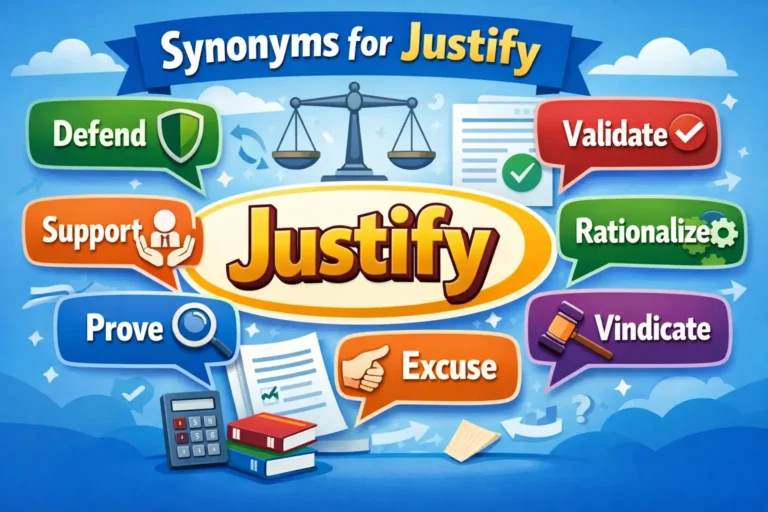
Synonyms for justify include words that mean to give reasons, defend an action, or prove something is right.
Common synonyms:
- explain
- defend
- support
- prove
- excuse
- validate
- rationalize
- warrant
- substantiate
- vindicate
Meaning of Justify
Justify means to give a good reason for something or to show that something is right or reasonable.
Example:
She tried to justify her decision to leave early.
Synonym Categories by Meaning (Reason, Defense, Proof, Formal)
1. Giving Reasons or Evidence
These words focus on explaining or proving why something is correct.
2. Defending an Action
These words emphasize protecting or defending a choice or behavior.
3. Formal or Legal Context
These words are often used in academic, professional, or legal writing.
Synonyms Table
| Word | Simple Meaning | Example Sentence |
| explain | make something clear | She explained her choice clearly. |
| defend | protect from criticism | He defended his actions. |
| support | give reasons or evidence | The data supports the claim. |
| prove | show something is true | She proved her point. |
| excuse | give a reason for a mistake | He excused his late arrival. |
| validate | confirm as correct | The results validated the theory. |
| rationalize | give logical reasons | She rationalized her spending. |
| warrant | make something necessary | The situation warrants action. |
| substantiate | support with evidence | The lawyer substantiated the claim. |
| vindicate | clear from blame | The evidence vindicated him. |
Master Synonyms List (Grouped by Level)
Beginner / Simple
Explain
Meaning: Make something clear.
Sentence: She explained why she was late.
Level: Neutral
Defend
Meaning: Protect from criticism.
Sentence: He defended his decision strongly.
Level: Neutral
Support
Meaning: Give reasons or evidence.
Sentence: The facts support her argument.
Level: Neutral
Prove
Meaning: Show something is true.
Sentence: He proved that he was right.
Level: Neutral
Intermediate
Excuse
Meaning: Give a reason for a mistake.
Sentence: She tried to excuse her behavior.
Level: Neutral
Validate
Meaning: Confirm as correct.
Sentence: The experiment validated the results.
Level: Formal
Rationalize
Meaning: Give logical reasons for actions.
Sentence: He rationalized his poor choice.
Level: Neutral
Advanced / Formal
Warrant
Meaning: Make something necessary.
Sentence: The issue warrants further discussion.
Level: Formal
Substantiate
Meaning: Support with strong evidence.
Sentence: She substantiated her claims with data.
Level: Formal
Vindicate
Meaning: Clear from blame or doubt.
Sentence: The investigation vindicated him.
Level: Formal
Formal vs Informal Synonyms
Use simple words like explain, prove, or defend in daily conversation.
In academic or business writing, choose more formal options like substantiate, validate, or warrant.
Avoid very formal words in casual speech. They may sound unnatural.
Real-Life Usage Examples
Conversation
“I need to explain my decision.”
Academic Writing
“The researcher substantiated the hypothesis with evidence.”
Business Writing
“The data supports our proposal.”
Blogging
“You do not need to justify your personal goals.”
Emotional Expression
“She tried to defend her feelings.”
Similar Words Comparison
Justify vs Explain
Justify means to show something is right.
Explain means to make something clear.
Example:
She explained the rule.
She justified breaking the rule.
Justify vs Defend
Justify focuses on giving reasons.
Defend focuses on protection from criticism.
Example:
He justified his actions with facts.
He defended himself against accusations.
Conclusion
Learning strong synonyms for justify helps you write with more precision and confidence. Instead of repeating the same verb, you can choose a word that fits the tone, context, and purpose of your sentence. That improves clarity in conversation, academic writing, and professional communication.
Mini Practice Exercise
Replace justify in these sentences with a better synonym:
- She tried to justify her mistake.
- The data justifies the conclusion.
- He justified his spending habits.
- The evidence justified his innocence.
- The situation justifies immediate action.
Challenge:
Try these 5 replacements — explain, substantiate, rationalize, vindicate, warrant — and see which fits best in each sentence.
Write your new sentences out loud or on paper. Practice builds confidence.
CTA:
Now try using at least 5 different synonyms for justify in your next paragraph. The more you practice, the more natural your English will sound.
- The lawyer substantiated the claim in court.
- The evidence vindicated the accused man.
- He tried to justify his behavior.
- She defended her opinion respectfully.
- The research supports the argument.
Common Mistakes
- Using excuse when you mean prove.
Excuse is often negative. - Using formal words like substantiate in casual speech.
It may sound unnatural. - Repeating justify too often in writing.
Use synonyms instead. - Confusing validate with approve.
Validate means confirm correctness, not agree personally.
Tips for Choosing the Right Synonym
- Match the tone. Use simple words for conversation.
- Check the context. Legal writing needs formal vocabulary.
- Think about clarity. Choose the word your reader understands.
- Avoid repeating the same word too often.
- Do not force complex vocabulary if simple words work better.
When NOT to Use Justify
Do not use justify when you only want to describe something.
Wrong: She justified the instructions.
Correct: She explained the instructions.
Use justify only when giving reasons to defend or prove something.
Opposite Words (Antonyms)
- condemn
- criticize
- blame
- disapprove
- reject
FAQs
What does justify mean?
It means to give reasons for something or prove it is right.
Is justify formal or informal?
It is neutral. It works in both casual and formal contexts.
How can I use it in conversation?
You can say, “I need to justify my choice.”
What is the best synonym for justify?
It depends on context. Explain works in most situations.
Can justify be replaced with prove?
Sometimes yes, but only when you mean showing something is true.
Conclusion
Learning synonyms for justify helps you write more clearly and speak more confidently. You avoid repetition and choose better words for each situation.
Practice using three new synonyms in your next sentence. It will improve your English quickly.

Ethan Collins is a research-focused language writer specializing in word meaning, semantic comparison, and precise usage in modern English. His work centers on helping readers understand subtle differences between similar words, phrases, and expressions through structured analysis and reliable linguistic references. With a background in editorial research and informational content development, he has contributed extensively to educational resources that prioritize clarity, accuracy, and reader comprehension.
Collins’ writing approach is grounded in careful vocabulary study, contextual analysis, and the practical application of language in everyday communication. He focuses on explaining how words function in real usage rather than relying solely on dictionary definitions. By comparing synonyms, examining tone and context, and highlighting usage patterns, he helps readers make confident word choices in both academic and professional writing.
Over the years, Collins has developed experience in research-based informational publishing, particularly in content designed to simplify complex language concepts for general readers. His work emphasizes verification, consistency, and linguistic accuracy, ensuring that explanations remain useful for students, writers, and English learners alike.
As an author in the word-synonym and language-reference space, Collins contributes to building reliable educational content that aligns with modern search standards and reader intent. His editorial process prioritizes clarity, structured formatting, and meaningful examples that support understanding without unnecessary complexity.
Through his writing, Ethan Collins helps readers navigate English vocabulary with greater precision, enabling them to distinguish between closely related words and use language more effectively. His work reflects a commitment to research-driven content, editorial integrity, and the practical value of clear communication.