Finding exact synonyms for cunning helps you describe cleverness, secrecy, and sharp thinking with total confidence. When you learn diverse synonyms for cunning, you can easily explain tricky characters, smart moves, and strategic plans in your writing. Using precise synonyms for cunning keeps your sentences fresh, engaging, and clear for every reader.
Imagine a classic story where a hungry fox tricks a raven into dropping a piece of cheese. Calling the fox “cunning” works well, but using the word repeatedly makes your writing sound flat. Switching to vivid alternatives like “sly,” “crafty,” or “wily” gives your narrative much more energy and depth.
For example, when a chess player makes a smart trap to win a match, you can say it was a shrewd move. Using exact choices like “astute” or “calculating” helps listeners understand the player’s sharp mind immediately.
The word cunning means using cleverness, skill, or secrecy to get what you want, often by outsmarting others. Expanding your knowledge of synonyms for cunning benefits many groups of language learners:
- Students write more descriptive essays and character analysis papers for English class.
- Bloggers write exciting stories and reviews that capture reader attention.
- Content writers improve search rankings with natural, varied vocabulary.
- Daily English users speak expressively and pick the right words for any situation.
“Choosing exact words turns basic thoughts into powerful stories.”
“A rich vocabulary brings clarity, depth, and confidence to every sentence.”
Linguistic Breakdown of “Cunning”
Connotative Meaning
The word cunning carries mixed connotations. In a negative sense, it implies deceit, trickery, and dishonesty. In a neutral or positive sense, it shows quick intelligence, resourcefulness, and sharp practical skill.
Etymology
- Origin: Derived from Middle English cunning or conning (meaning knowledge, learning, or skill).
- Root Word: From Old English cunnan (meaning to know or to be able).
- Historical Shift: Originally meant knowledgeable or skilled, but over centuries shifted toward slyness, trickery, and deceptive cleverness.
Pronunciation
- US (IPA): /ˈkʌn.ɪŋ/
- UK (IPA): /ˈkʌn.ɪŋ/
Syllables & Affixation Pattern
- Syllables: 2 syllables (cun-ning)
- Base Structure: Verb/Noun root can or Old English cunnan + Present participle/Adjective suffix -ing
- Grammatical Patterns:
- Adjective: Cunning plan / Cunning enemy
- Noun form: Cunningness / Cunning
- Adverb form: Cunningly
Comparison Table: Common Synonyms for Cunning
| Keyword | Meaning | Usage Type | Context |
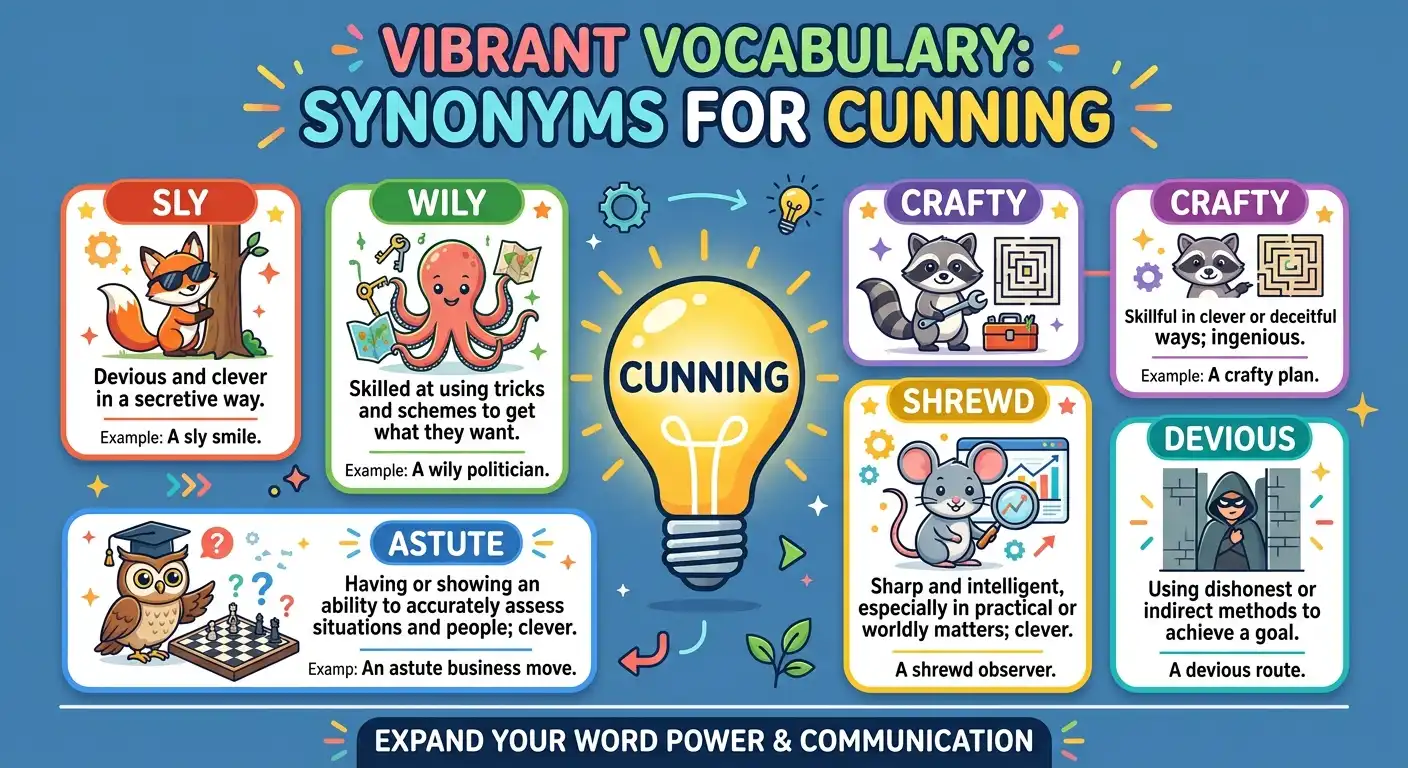
| Sly | Clever in a secretive or sneaky way | Casual / Expressive | Fables, Secrets, & Playful Tricks |
| Crafty | Skilled at solving problems using tricks | Casual / Descriptive | Storytelling, Negotiations, & Strategy |
| Wily | Full of clever tricks to gain an edge | Literary / Casual | Competitions, Mythology, & Games |
| Shrewd | Showing sharp, practical intelligence | Professional / Formal | Business Deals, Investments, & Careers |
| Astute | Quick to notice and understand things | Formal / Analytical | Academic Work, Analysis, & Leadership |
| Devious | Using indirect and dishonest methods | Negative / Dramatic | Drama, Politics, & Rivalries |
| Resourceful | Able to solve problems using any tool | Positive / Professional | Workplace, Survival, & Team Projects |
50 Best Synonyms for Cunning
1. Sly
- Pronunciation: US /slaɪ/ | UK /slaɪ/
- Meaning: Sly means clever at keeping secrets or doing things in a hidden way.
- Examples:
- The sly fox hid behind the tall bushes.
- He gave a sly smile before opening the box.
2. Crafty
- Pronunciation: US /ˈkræf.ti/ | UK /ˈkrɑːf.ti/
- Meaning: Crafty means good at getting what you want through clever tricks.
- Examples:
- The crafty salesman convinced everyone to buy his goods.
- My brother had a crafty plan to win the game.
3. Wily
- Pronunciation: US /ˈwaɪ.li/ | UK /ˈwaɪ.li/
- Meaning: Wily means skilled at outsmarting others through smart moves.
- Examples:
- The wily coyote tried to catch the fast bird.
- Our coach used a wily tactic to beat the top team.
4. Devious
- Pronunciation: US /ˈdiː.vi.əs/ | UK /ˈdiː.vi.əs/
- Meaning: Devious means using dishonest or round-about ways to reach a goal.
- Examples:
- She saw right through his devious scheme.
- The movie villain used devious tricks against the hero.
5. Shrewd
- Pronunciation: US /ʃruːd/ | UK /ʃruːd/
- Meaning: Shrewd means showing sharp judgment and practical understanding.
- Examples:
- Buying land near the new road was a shrewd decision.
- He is a shrewd businessman who knows how to save money.
6. Astute
- Pronunciation: US /əˈstuːt/ | UK /əˈstjuːt/
- Meaning: Astute means very quick to notice details and understand situations.
- Examples:
- Her astute observations helped us solve the puzzle.
- An astute observer can spot small visual changes easily.
7. Calculating
- Pronunciation: US /ˈkæl.kjə.leɪ.t̬ɪŋ/ | UK /ˈkæl.kjə.leɪ.tɪŋ/
- Meaning: Calculating means carefully planning every action for personal advantage.
- Examples:
- He gave a cold and calculating response to the question.
- She made a calculating decision to join the winning team.
8. Tricky
- Pronunciation: US /ˈtrɪk.i/ | UK /ˈtrɪk.i/
- Meaning: Tricky means fond of playing tricks or hard to deal with.
- Examples:
- That tricky game host loves to test your memory.
- Navigating the narrow mountain trail was tricky.
9. Artful
- Pronunciation: US /ˈɑːrt.fəl/ | UK /ˈɑːt.fəl/
- Meaning: Artful means clever and skillful at guiding things secretly.
- Examples:
- The young pickpocket was artful and fast.
- She gave an artful dodge when asked about her secret.
10. Scheming
- Pronunciation: US /ˈskiː.mɪŋ/ | UK /ˈskiː.mɪŋ/
- Meaning: Scheming means constantly making secret plans to trick people.
- Examples:
- The scheming neighbor tried to take over the yard.
- Keep an eye on those scheming characters in the play.
“A rich vocabulary gives you the exact word for every quiet thought.”
11. Clever
- Pronunciation: US /ˈklev.ɚ/ | UK /ˈklev.ər/
- Meaning: Clever means quick at learning, understanding, and solving problems.
- Examples:
- She found a clever way to fix the broken toy.
- The student gave a clever answer to the hard question.
12. Foxy
- Pronunciation: US /ˈfɑːk.si/ | UK /ˈfɒk.si/
- Meaning: Foxy means sly, smart, and clever like a wild fox.
- Examples:
- The detective warned us about the foxy thief.
- He came up with a foxy plan to escape the room.
13. Guileful
- Pronunciation: US /ˈɡaɪl.fəl/ | UK /ˈɡaɪl.fəl/
- Meaning: Guileful means behaving with secret trickery and deceit.
- Examples:
- The guileful ruler tricked his rivals into dropping their weapons.
- We must avoid guileful promises made by untrusted sources.
14. Designing
- Pronunciation: US /dɪˈzaɪ.nɪŋ/ | UK /dɪˈzaɪ.nɪŋ/
- Meaning: Designing means plotting secret plans for personal benefit.
- Examples:
- Beware of designing people who pretend to be friends.
- The designing rival tried to steal credit for the work.
15. Subtle
- Pronunciation: US /ˈsʌt̬.əl/ | UK /ˈsʌt.əl/
- Meaning: Subtle means clever in a gentle way that is hard to notice.
- Examples:
- She made a subtle hint that it was time to leave.
- The painter used subtle shades of blue for the sky.
16. Sharp
- Pronunciation: US /ʃɑːrp/ | UK /ʃɑːp/
- Meaning: Sharp means mentally quick, alert, and hard to trick.
- Examples:
- My grandmother has a sharp mind even at eighty.
- Be sharp and watch out for store price changes.
17. Canny
- Pronunciation: US /ˈkæn.i/ | UK /ˈkæn.i/
- Meaning: Canny means quiet, careful, and clever with money or decisions.
- Examples:
- The canny shopper bought all her supplies on sale.
- He gave a canny assessment of the housing market.
18. Slick
- Pronunciation: US /slɪk/ | UK /slɪk/
- Meaning: Slick means smooth and persuasive in a way that feels tricky.
- Examples:
- The slick speaker convinced the audience to invest.
- That movie featured a slick trick during the heist scene.
19. Machiavellian
- Pronunciation: US /ˌmæk.i.əˈvel.i.ən/ | UK /ˌmæk.i.əˈvel.i.ən/
- Meaning: Machiavellian means using sneaky power tactics without caring about rules.
- Examples:
- The novel features a Machiavellian king who rules by fear.
- Politics can sometimes involve Machiavellian maneuvers.
20. Sharp-witted
- Pronunciation: US /ʃɑːrpˈwɪt̬.ɪd/ | UK /ʃɑːpˈwɪt.ɪd/
- Meaning: Sharp-witted means having a fast mind and quick humor.
- Examples:
- The sharp-witted child solved the math puzzle first.
- She gave a sharp-witted reply to her challenger.
21. Resourceful
- Pronunciation: US /rɪˈsɔːrs.fəl/ | UK /rɪˈzɔːs.fəl/
- Meaning: Resourceful means good at finding quick ways to overcome problems.
- Examples:
- The resourceful camper built a shelter out of branches.
- A resourceful worker finds solutions without waiting for help.
22. Deep
- Pronunciation: US /diːp/ | UK /diːp/
- Meaning: Deep means keeping thoughts and intentions hidden below the surface.
- Examples:
- He is a deep thinker who rarely shares his true plans.
- The story has a deep plot full of hidden motives.
23. Underhanded
- Pronunciation: US /ˌʌn.dɚˈhæn.dɪd/ | UK /ˌʌn.dəˈhæn.dɪd/
- Meaning: Underhanded means done secretly and unfairly to gain an edge.
- Examples:
- He used underhanded tricks to win the school election.
- The company faced penalties for underhanded deals.
24. Deceitful
- Pronunciation: US /dɪˈsiːt.fəl/ | UK /dɪˈsiːt.fəl/
- Meaning: Deceitful means telling lies or keeping truth hidden on purpose.
- Examples:
- A deceitful friend will break your trust quickly.
- The ads were found to be deceitful to buyers.
25. Sneaky
- Pronunciation: US /ˈsniː.ki/ | UK /ˈsniː.ki/
- Meaning: Sneaky means acting quietly and secretly so no one notices.
- Examples:
- The sneaky cat stole a piece of fish off the table.
- He took a sneaky look at his birthday gift early.
26. Cagey
- Pronunciation: US /ˈkeɪ.dʒi/ | UK /ˈkeɪ.dʒi/
- Meaning: Cagey means unwilling to give direct answers or reveal secrets.
- Examples:
- The suspect remained cagey during the police interview.
- She was cagey about her weekend plans.
27. Smart
- Pronunciation: US /smɑːrt/ | UK /smɑːt/
- Meaning: Smart means having quick intelligence and good sense.
- Examples:
- Wearing a warm jacket on a cold day is a smart idea.
- The smart dog learned to fetch the morning paper.
28. Inventive
- Pronunciation: US /ɪnˈven.t̬ɪv/ | UK /ɪnˈven.tɪv/
- Meaning: Inventive means good at thinking of new and creative ideas.
- Examples:
- The inventive cook made a meal out of leftover food.
- An inventive designer creates unique clothes every season.
29. Disingenuous
- Pronunciation: US /ˌdɪs.ɪnˈdʒen.ju.əs/ | UK /ˌdɪs.ɪnˈdʒen.ju.əs/
- Meaning: Disingenuous means pretending to know less or be more honest than you are.
- Examples:
- His apology felt disingenuous to the hurt team members.
- It was disingenuous to claim he never saw the warning message.
30. Strategic
- Pronunciation: US /strəˈtiː.dʒɪk/ | UK /strəˈtiː.dʒɪk/
- Meaning: Strategic means planned carefully to achieve a clear goal.
- Examples:
- The chess master made a strategic move across the board.
- Setting a daily budget is a strategic choice for saving money.
31. Smooth
- Pronunciation: US /smuːð/ | UK /smuːð/
- Meaning: Smooth means confident and charming in a way that hides motives.
- Examples:
- The smooth talker convinced the guard to let him enter.
- He made a smooth exit from the long meeting.
32. Ingenious
- Pronunciation: US /ɪnˈdʒiː.ni.əs/ | UK /ɪnˈdʒiː.ni.əs/
- Meaning: Ingenious means extremely clever, original, and well-designed.
- Examples:
- She came up with an ingenious plan to recycle old rain water.
- The clockwork mechanism was truly ingenious.
33. Treacherous
- Pronunciation: US /ˈtretʃ.ɚ.əs/ | UK /ˈtretʃ.ər.əs/
- Meaning: Treacherous means guilty of betrayal or dangerous and untrustworthy.
- Examples:
- The treacherous advisor planned to overthrow the king.
- Walking on the icy road was treacherous work.
34. Unscrupulous
- Pronunciation: US /ʌnˈskruː.pjə.ləs/ | UK /ʌnˈskruː.pjə.ləs/
- Meaning: Unscrupulous means lacking moral principles or honesty.
- Examples:
- An unscrupulous trader sold fake gold rings to tourists.
- The reporter exposed the unscrupulous practices of the firm.
35. Sharp-minded
- Pronunciation: US /ʃɑːrpˈmaɪn.dɪd/ | UK /ʃɑːpˈmaɪn.dɪd/
- Meaning: Sharp-minded means having a clear and alert brain.
- Examples:
- The sharp-minded lawyer caught the mistake in the contract.
- She remained sharp-minded throughout the long debate.
36. Nimble-minded
- Pronunciation: US /ˈnɪm.bəlˈmaɪn.dɪd/ | UK /ˈnɪm.bəlˈmaɪn.dɪd/
- Meaning: Nimble-minded means able to think and react very quickly.
- Examples:
- A nimble-minded leader adapts fast when plans change.
- His nimble-minded answers impressed the interview board.
37. Duplicitous
- Pronunciation: US /duːˈplɪs.ə.t̬əs/ | UK /djuːˈplɪs.ɪ.təs/
- Meaning: Duplicitous means acting in two different ways to trick people.
- Examples:
- The duplicitous spy worked for both sides during the war.
- Her duplicitous behavior cost her many close friends.
38. Cautious
- Pronunciation: US /ˈkɑː.ʃəs/ | UK /ˈkɔː.ʃəs/
- Meaning: Cautious means taking great care to avoid risks or traps.
- Examples:
- Be cautious when crossing the busy city street.
- The driver was cautious on the wet roads.
39. Sharp-sighted
- Pronunciation: US /ʃɑːrpˈsaɪ.t̬ɪd/ | UK /ʃɑːpˈsaɪ.tɪd/
- Meaning: Sharp-sighted means quick to spot errors or hidden details.
- Examples:
- The sharp-sighted editor noticed every small typo.
- An eagle is a sharp-sighted bird that spots tiny prey easily.
40. Intuitive
- Pronunciation: US /ɪnˈtuː.ɪ.t̬ɪv/ | UK /ɪnˈtjuː.ɪ.tɪv/
- Meaning: Intuitive means able to understand things instinctively without formal proof.
- Examples:
- She has an intuitive feel for solving team conflicts.
- The phone app has an easy and intuitive layout.
41. Perspicacious
- Pronunciation: US /ˌpɝː.spəˈkeɪ.ʃəs/ | UK /ˌpɜː.spɪˈkeɪ.ʃəs/
- Meaning: Perspicacious means having a ready insight into complex matters.
- Examples:
- The judge gave a perspicacious summary of the law case.
- Her perspicacious mind saw the true reason behind the delay.
42. Quick-witted
- Pronunciation: US /kwɪkˈwɪt̬.ɪd/ | UK /kwɪkˈwɪt.ɪd/
- Meaning: Quick-witted means ready with fast and smart replies.
- Examples:
- The quick-witted actor made the audience laugh with ease.
- He is quick-witted enough to answer any surprise question.
43. Insightful
- Pronunciation: US /ˈɪn.saɪt.fəl/ | UK /ˈɪn.saɪt.fəl/
- Meaning: Insightful means showing a deep understanding of a topic.
- Examples:
- She wrote an insightful essay about history and art.
- The teacher offered insightful feedback on my draft.
44. Tactful
- Pronunciation: US /ˈtækt.fəl/ | UK /ˈtækt.fəl/
- Meaning: Tactful means careful not to say things that upset people.
- Examples:
- He gave a tactful answer to avoid hurting his friend’s feelings.
- A tactful manager handles team complaints with care.
45. Diplomatic
- Pronunciation: US /ˌdɪp.ləˈmæt̬.ɪk/ | UK /ˌdɪp.ləˈmæt.ɪk/
- Meaning: Diplomatic means skilled at dealing with sensitive situations peacefully.
- Examples:
- She took a diplomatic approach to solve the disagreement.
- Keeping a diplomatic tone keeps business meetings calm.
46. Polished
- Pronunciation: US /ˈpɑː.lɪʃt/ | UK /ˈpɒl.ɪʃt/
- Meaning: Polished means refined, smooth, and skillful in presentation.
- Examples:
- He gave a polished presentation in front of the whole school.
- Her polished manners impressed all the dinner guests.
47. Adaptive
- Pronunciation: US /əˈdæp.tɪv/ | UK /əˈdæp.tɪv/
- Meaning: Adaptive means able to change easily to fit new conditions.
- Examples:
- Good workers are adaptive when new technology arrives.
- The plant is adaptive and grows well in hot weather.
48. Discerning
- Pronunciation: US /dɪˈsɝː.nɪŋ/ | UK /dɪˈsɜː.nɪŋ/
- Meaning: Discerning means showing good judgment and taste.
- Examples:
- The discerning reader picked out the finest book on the shelf.
- She has a discerning eye for quality furniture.
49. Keensighted
- Pronunciation: US /kiːnˈsaɪ.t̬ɪd/ | UK /kiːnˈsaɪ.tɪd/
- Meaning: Keensighted means sharp in perception and quick to notice danger.
- Examples:
- A keensighted guard spotted the broken lock immediately.
- He proved to be a keensighted judge of human nature.
50. Brainy
- Pronunciation: US /ˈbreɪ.ni/ | UK /ˈbreɪ.ni/
- Meaning: Brainy means having high intelligence and academic smarts.
- Examples:
- The brainy student won the national science trophy.
- She comes from a very brainy family of scientists.
Antonyms of “Cunning”
Knowing opposite terms helps you describe honesty, openness, and simplicity accurately.
- Naive: Showing a lack of experience, wisdom, or judgment.
- Guileless: Free of deceit and completely honest.
- Honest: Truthful, direct, and free from deceit.
- Candid: Straightforward, open, and sincere in speech.
- Innocent: Free from guilt, bad intentions, or trickery.
- Direct: Clear, honest, and going straight to the point without secrets.
Prototype Meaning & Categorization of “Cunning”
The core concept of cunning centers on cleverness, strategic thinking, hidden motives, and practical skill. Depending on your intent, these 50 synonyms divide into four operational categories:
- Secretive & Sneaky Trickery: Sly, crafty, wily, devious, artful, scheming, foxy, guileful, designing, underhanded, deceitful, sneaky, cagey, disingenuous, duplicitous, treacherous, unscrupulous.
- Practical Smartness & Strategy: Shrewd, astute, calculating, canny, slick, Machiavellian, strategic, smooth, cautious, polished.
- Mental Quickness & Intelligence: Clever, sharp, sharp-witted, resourceful, smart, inventive, ingenious, sharp-minded, nimble-minded, sharp-sighted, quick-witted, brainy, keensighted.
- Perceptive & Social Skill: Subtle, deep, intuitive, perspicacious, insightful, tactful, diplomatic, adaptive, discerning.
Frequently Asked Questions (FAQs)
1. What is the most formal synonym for “cunning”?
In formal or academic contexts, “astute,” “shrewd,” or “perspicacious” work best. They describe sharp intelligence without sounding informal or overly negative.
2. Is “cunning” always a negative word?
Not always. While cunning often implies sneaky behavior or deceit, it can also describe impressive problem-solving skills, resourcefulness, and quick thinking in challenging situations.
3. Which synonym for “cunning” is best for business writing?
For professional emails and business reports, terms like “strategic,” “shrewd,” “astute,” or “resourceful” express sharp decision-making without negative connotations.
4. What is the difference between “sly” and “shrewd”?
“Sly” emphasizes keeping secrets and using sneaky methods to trick others. “Shrewd” focuses on practical intelligence, good judgment, and making smart business or financial choices.
5. Can I use “crafty” in casual daily conversation?
Yes, “crafty” is a common, versatile word used in everyday speech to describe someone who finds clever or unexpected ways to solve a problem or win a game.
6. How does learning synonyms for “cunning” help SEO content writing?
Using a diverse set of synonyms prevents keyword stuffing, satisfies user search intent across different query styles, improves content depth, and keeps readers engaged on your site longer.
Conclusion
Expanding your vocabulary with synonyms for cunning brings precision, power, and variety to your daily language. Replacing repetitive words with exact choices like sly, shrewd, astute, or resourceful ensures your writing hits the mark every single time.
Whether you write academic essays, craft engaging blog posts, send professional workplace emails, or talk with friends, using precise words builds instant confidence. Strong vocabulary removes unnecessary fluff and turns simple statements into memorable arguments. Start practicing these 50 synonyms today to express your thoughts with lasting clarity.
“Clear words build trust and bring lasting power to your voice.”
“Mastering new vocabulary opens doors to better writing every single day.”

Robert Hayes is an ESL educator and curriculum developer with over nine years of experience teaching English to beginners and intermediate learners across multiple countries ( Biography ).