

Most small business owners pay their suppliers on time, yet many still overpay without knowing it. Duplicate invoices, forgotten credit notes and payments applied to the wrong bill slip through quietly. Regular supplier statement reconciliation catches these errors early, and bookkeeping outsourcing services can make that monthly check easier to keep up.
Why Do Small Businesses End Up Overpaying Suppliers?
There are very few cases where there will be deliberate fraud by the supplier to overpay you. It tends to occur due to the processes of purchasing, invoice processing and bookkeeping being out of sync.
Duplicate Invoices
Often suppliers will send the same invoice via email, post and an online portal. If two people process separate copies they won’t know about each other. Minor variations in the invoice reference makes it more difficult to identify duplicates. This doesn’t mean that you have paid twice to check payment records first.
Forgotten credit notes
Credit notes arise from returned goods, damaged stock or agreed discounts. They often sit unread in an inbox. The business then pays the full invoice and never recovers what it was owed.
Wrong prices and quantities
Sometimes a supplier will send through old prices or charge for more units than they should. Comparing the invoice to the purchase order will help pick up on this issue quickly.
Payment to incorrect invoices.
You may have paid the correct amount however your supplier may have applied the payment to the incorrect invoice. This can cause confusion in your records as they will show as being paid when they actually aren’t. A remittance advice will help prevent this from happening.
How a £1,200 Mistake Becomes a Bigger Problem?
Picture a small retailer in Leeds that receives a £1,200 stock invoice. The bookkeeper records and pays it. A week later, a second copy arrives through the supplier’s portal, gets processed by someone else, and is paid too.
Nobody notices straight away. The invoices carry slightly different references, and the bank statement looks normal. Three months later, the supplier’s statement shows a balance the owner does not recognise.
Checking individual invoices would not have stopped this. Only a review of the whole supplier account reveals the problem.
What a Supplier Statement Check Involves?
A supplier’s statement is a summary of all of your transactions with one particular supplier. It will include details of your opening balance, any invoices received, payments made, credit notes, adjustments and closing balance.
When you reconcile your supplier’s statement you are comparing it with the amounts you owe each of your suppliers (your purchase ledger). Any discrepancies will need to be investigated. This could be due to missing invoices or payments not being made.
The table below shows how this differs from invoice checking:
| Invoice checking | Supplier statement checking | |
| What it reviews | One individual charge | The whole supplier account |
| What it checks | Prices and quantities | Invoices, payments and credits together |
| When it happens | During invoice approval | During a regular review |
| What it catches | Incorrect single payments | Account-wide errors |
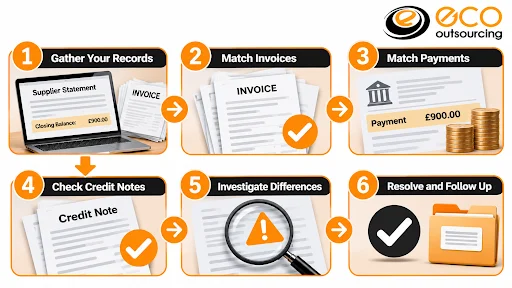
How to Check a Supplier Statement, Step by Step
1. Retrieve the latest statement and open a matching supplier account. The statements need to be for the same date, if they’re not then discrepancies will occur.
2. Check that the invoice numbers are matching and that the dates and amounts match. Note any discrepancies where there is a difference between the statement and the books. Check for duplicate invoices.
3. Match payments to the invoice references. Many times unallocated payments will be sitting in the account for months.
4. Check that all credit notes have been applied to the correct invoice.
5. Investigate any discrepancies. Often reasons for this can be due to discrepancies, missing invoices, duplicate invoices, incorrect allocations or issues at the suppliers.
6. Put the discrepancies right. Ask for any missing documentation, provide proof of payment and record any outstanding queries with who owns it and when it needs to be followed up. Check the next statement to confirm everything has been put right.
When the Statement Doesn’t Match Your Software?
A mismatch does not automatically mean the supplier is wrong, or that you owe more. Most differences trace back to a few common causes.
| Possible reason | What to investigate |
| Missing invoice | Check whether you received and recorded it. |
| Unrecorded credit note | Request the credit note and update your account. |
| Unallocated payment | Send remittance advice and confirm how the supplier applied it. |
| Timing difference | Compare transaction dates with the statement cut-off. |
| Duplicate entry | Check whether you recorded the same invoice twice. |
| Incorrect charge | Compare the amount against the original agreement or purchase order. |
Investigate each difference before paying anything extra. If a supplier refuses to acknowledge a payment, send copies of your bank records and keep everything in writing.
What to Do After You Spot an Overpayment?
After verifying that you have been overpaid by matching the invoice, payments and statement, contact your supplier with details of the invoice number, date paid, overpayment, supporting bank documentation and a brief reason. Request a refund or credit note towards an upcoming invoice. Agree how this will be done in writing.
Once the adjustment has been made, ensure it is only made once and that it shows on the next statement.
Why Bank Reconciliation Alone Won’t Catch It?
Bank Reconciliation matching up your transactions from your bank to your accounts
Supplier Statement Reconciliation matching up your supplier to your purchase ledger.
Although you have correctly recorded the £900 payment, the supplier may have applied it to a previous invoice. This will cause your Bank Reconciliation to be perfect, but your supplier account will need to be investigated.
VAT and Record-Keeping: What to Keep
These are not VAT invoices. They provide a summary of your account. You will still need the actual invoices. As stated in HMRC’s VAT Notice 700/21 it is required to keep a record of your VAT. This means keeping all VAT invoices and credit notes. Credit notes are used to adjust the amount of VAT you have been charged. Please consult HMRC or a qualified adviser for information about reclaiming VAT as it depends on your situation.
Should You Outsource Bookkeeping?
Supplier reconciliations need to be consistent. When suppliers aren’t responding, someone needs to be chasing them up. An overloaded owner trying to manage sales, team members and cashflow often means this process is the first to suffer.
Getting some help could be a good idea if you’re frequently behind on your records, spending many hours reconciling invoices, losing track of credit notes. If there are inconsistencies which aren’t resolved, and no specific finance member of staff then this is a big indicator.
Eco Outsourcing offers bookkeeping outsourcing services including regular supplier account reviews, tracking invoices and credits, and month end reconciliations. Whilst no provider will ensure there are zero errors, having a set time each month to review accounts and written follow ups ensures there are less avoidable mistakes.
Frequently Asked Questions
How frequently should I reconcile my supplier statements?
Monthly is ideal for most small businesses. If you have high volume suppliers or have had issues with discrepancies in the past you may want to reconcile more frequently.
How do I identify duplicate payments to suppliers?
Compare your invoice numbers, amounts and dates of payment. Duplicate payments are usually identified by matching invoice numbers and amounts.
Can I reclaim money if I have overpaid?
Yes generally you can. Once you have confirmed that you have overpaid send your evidence to your supplier and put in place an agreement for a refund or credit going forward.
Why is my supplier statement not matching with Xero/QuickBooks?
Most commonly due to missing invoices, unpaid payments, timing differences and unentered credit notes. Go through these to identify what is causing the discrepancy.
Can outsourcing bookkeeping help avoid errors when paying suppliers?
Yes it can help greatly. You will be regularly checking your accounts and will have a record of any follow up. However no service can guarantee there will be 0 errors.
Conclusion
Overpayments are often a hidden problem. There could be double invoicing or missed credits across your accounts. By checking the statements on a monthly basis you will prevent any small mistakes becoming costly issues. Eco Outsourcing can help you get into place if you do not want to have to manage each ledger.