Introduction
Finding the right synonyms for sentimental helps you describe deep feelings with clarity. When you explore fresh synonyms for sentimental, your writing becomes warm, emotional, and easy to understand. Using varied synonyms for sentimental allows you to share special memories without repeating the same basic words over and over again.
An old wooden box sits on a dusty attic shelf. Inside, a handful of faded letters and a rusted key hold decades of family history. Reading those old pages brings back quiet joy and sweet memories. Choosing the right word lets your audience feel that exact tender moment instantly.
The word sentimental means holding strong feelings connected to past memories or personal items. A simple item like a plastic ring can hold great value because of who gave it to you. Learning new terms for this concept helps you express those feelings cleanly.
Students, bloggers, content writers, and everyday English speakers need clear words to share real emotions. Clear words help students score higher on creative essays. Bloggers build trust when they share honest feelings. Content writers connect better with readers, and daily speakers express their love easily.
“Choosing the right word for your feelings turns quiet thoughts into powerful connections.”
“A rich vocabulary lets you share your heart with truth, clarity, and grace.”
Linguistic Breakdown of Sentimental
Connotative Meaning
The word sentimental carries a warm, emotional tone. It usually describes positive feelings of tenderness and nostalgia. Sometimes, in professional settings, it can gently suggest that someone is guided by feelings rather than cold logic.
Etymology
- Origin: Derived from the Latin verb sentire, which means “to feel” or “to perceive.”
- French Influence: Passed through Middle French as sentiment.
- English Entry: Formed in 18th-century English by adding the adjective suffix -al.
Pronunciation (IPA)
- US IPA: /ˌsen.t̬əˈmen.t̬əl/
- UK IPA: /ˌsen.tɪˈmen.təl/
Syllables
- Count: 4 Syllables
- Breakdown: sen-ti-men-tal
Affixation Pattern
- Root Word: Sentiment (Noun marker for feeling)
- Suffix: -al (Adjective marker meaning “relating to” or “characterized by”)
Comparison Table of Key Synonyms
| Keyword | Meaning | Usage Type | Context |
| Nostalgic | Longing for sweet moments in the past | Emotional | Childhood memories, old songs, and family photo albums |
| Tender | Showing gentle love and quiet care | Casual | Quiet moments with family, pets, or close friends |
| Touching | Causing warm feelings or sympathy | General | Act of kindness, movies, speeches, and gift giving |
| Heartfelt | Deeply sincere and honest in feeling | Professional | Apologies, thank-you notes, speeches, and letters |
| Mawkish | Overly emotional in an annoying way | Casual | Dramatic movies, exaggerated stories, and forced art |
| Poignant | Sharp and deep in emotional meaning | Literary | Books, historical events, art, and quiet goodbyes |
| Affectionate | Showing fondness and physical care | Daily Use | Hugs, friendly greetings, pet care, and family love |
50 Best Synonyms for Sentimental
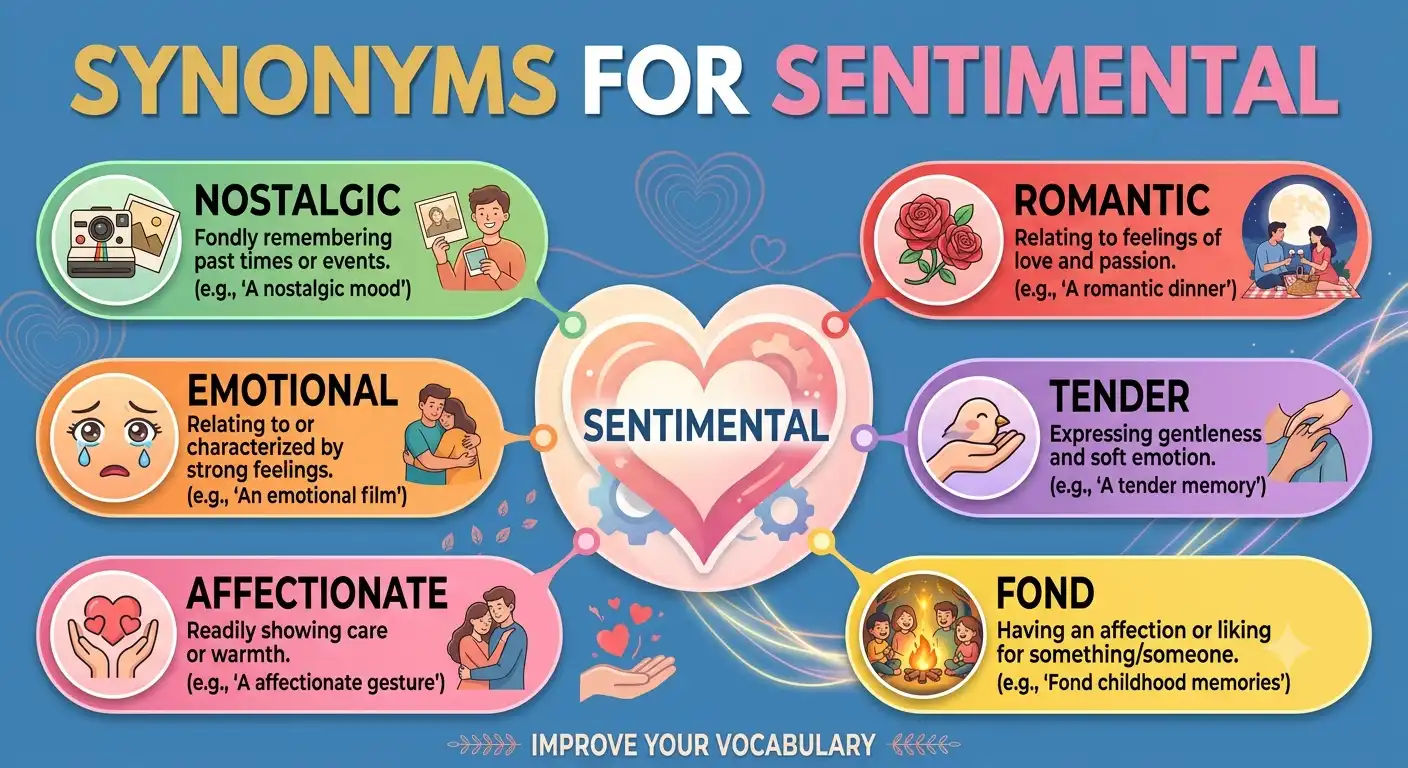
1. Emotional
- Pronunciation: US: /ɪˈmoʊ.ʃən.əl/ | UK: /ɪˈməʊ.ʃən.əl/
- Meaning: Showing or feeling strong human feelings.
- Examples:
- She gave an emotional speech at her sister’s wedding.
- He felt emotional while looking at old baby photographs.
2. Nostalgic
- Pronunciation: US: /nɑːˈstæl.dʒɪk/ | UK: /nɒˈstæl.dʒɪk/
- Meaning: Thinking fondly about happy events from the past.
- Examples:
- Listening to that song made him feel nostalgic for summer camp.
- They enjoyed a nostalgic walk through their old school hallway.
3. Tender
- Pronunciation: US: /ˈten.dɚ/ | UK: /ˈten.də/
- Meaning: Showing gentle kindness and loving care.
- Examples:
- The mother shared a tender hug with her young child.
- He wrote a tender note inside the birthday card.
4. Affectionate
- Pronunciation: US: /əˈfek.ʃən.ət/ | UK: /əˈfek.ʃən.ət/
- Meaning: Readily showing warmth, liking, or gentle love.
- Examples:
- Their dog is very affectionate and loves head pats.
- She gave her grandmother an affectionate cheek kiss.
5. Touching
- Pronunciation: US: /ˈtʌtʃ.ɪŋ/ | UK: /ˈtʌtʃ.ɪŋ/
- Meaning: Causing warm feelings of gratitude or sadness.
- Examples:
- The movie had a touching story about two loyal friends.
- Neighbors made a touching effort to help the family.
6. Moving
- Pronunciation: US: /ˈmuː.vɪŋ/ | UK: /ˈmuː.vɪŋ/
- Meaning: Producing strong feelings of pity or happiness.
- Examples:
- The singer gave a moving performance on stage tonight.
- He told a moving tale about rescuing stray animals.
7. Warm
- Pronunciation: US: /wɔːrm/ | UK: /wɔːm/
- Meaning: Showing friendliness, affection, or kind care.
- Examples:
- She offered a warm smile to every guest at the door.
- We received a warm greeting from our old neighbors.
8. Fond
- Pronunciation: US: /fɑːnd/ | UK: /fɒnd/
- Meaning: Having a strong liking or love for something.
- Examples:
- He keeps fond memories of his summer visits to the farm.
- She is very fond of her tiny pet hamster.
9. Softhearted
- Pronunciation: US: /ˌsɑːftˈhɑːr.t̬ɪd/ | UK: /ˌsɒftˈhɑː.tɪd/
- Meaning: Easily moved by pity, love, or kindness.
- Examples:
- The softhearted teacher always helps students after class.
- He is too softhearted to leave stray cats in the rain.
10. Sappy
- Pronunciation: US: /ˈsæp.i/ | UK: /ˈsæp.i/
- Meaning: Excessively sweet or emotional in a silly way.
- Examples:
- My brother hates watching sappy romance movies on TV.
- She wrote a sappy poem for her anniversary gift.
11. Mawkish
- Pronunciation: US: /ˈmɑː.kɪʃ/ | UK: /ˈmɔː.kɪʃ/
- Meaning: Exaggerated in feeling to an unpleasant degree.
- Examples:
- The book suffered from a mawkish and unreal ending.
- He avoided mawkish speeches during the company dinner.
12. Mushy
- Pronunciation: US: /ˈmʌʃ.i/ | UK: /ˈmʌʃ.i/
- Meaning: Oversweet and emotional in informal style.
- Examples:
- They love sending mushy text messages to each other.
- The film got too mushy during the final scene.
13. Romantic
- Pronunciation: US: /roʊˈmæn.t̬ɪk/ | UK: /rəʊˈmæn.tɪk/
- Meaning: Expressing ideal love, mystery, and affection.
- Examples:
- He planned a romantic dinner by the quiet lake.
- She loves reading romantic stories on rainy weekends.
14. Heartfelt
- Pronunciation: US: /ˈhɑːrt.felt/ | UK: /ˈhɑːt.felt/
- Meaning: Sincere, deeply felt, and deeply honest.
- Examples:
- He offered a heartfelt apology to his best friend.
- She expressed her heartfelt thanks to the rescue team.
15. Tenderhearted
- Pronunciation: US: /ˌten.dɚˈhɑːr.t̬ɪd/ | UK: /ˌten.dəˈhɑː.tɪd/
- Meaning: Having a quick capacity for gentleness and love.
- Examples:
- The tenderhearted boy saved a small bird with a broken wing.
- She gave a tenderhearted look to the crying toddler.
16. Poignant
- Pronunciation: US: /ˈpɔɪn.jənt/ | UK: /ˈpɔɪn.jənt/
- Meaning: Deeply affecting and touching the heart sharply.
- Examples:
- The museum displayed poignant letters written during war time.
- It was a poignant moment when the old friends parted.
17. Melodramatic
- Pronunciation: US: /ˌmel.ə.drəˈmæt̬.ɪk/ | UK: /ˌmel.ə.drəˈmæt.ɪk/
- Meaning: Overly dramatic and full of exaggerated feelings.
- Examples:
- He made a melodramatic exit by slamming the door.
- The actor gave a melodramatic line during the play.
18. Tearful
- Pronunciation: US: /ˈtɪr.fəl/ | UK: /ˈtɪə.fəl/
- Meaning: Filled with tears or showing sad feelings.
- Examples:
- They shared a tearful goodbye at the train station.
- She gave a tearful nod when she heard the good news.
19. Schmaltzy
- Pronunciation: US: /ˈʃmɑːlt.si/ | UK: /ˈʃmɔːlt.si/
- Meaning: Excessively emotional or cheesy in art or song.
- Examples:
- The radio played a schmaltzy holiday song all morning.
- I find those greeting card messages a bit schmaltzy.
20. Overemotional
- Pronunciation: US: /ˌoʊ.vɚ.ɪˈmoʊ.ʃən.əl/ | UK: /ˌəʊ.vər.ɪˈməʊ.ʃən.əl/
- Meaning: Reacting with far more feeling than necessary.
- Examples:
- He got overemotional when his favorite team lost the game.
- Try not to become overemotional during business talks.
21. Soft
- Pronunciation: US: /sɑːft/ | UK: /sɒft/
- Meaning: Gentle, kind, and easily affected by feelings.
- Examples:
- He has a soft spot for stray dogs in the neighborhood.
- Her soft voice comforted the crying child quickly.
22. Sympathetic
- Pronunciation: US: /ˌsɪm.pəˈθet̬.ɪk/ | UK: /ˌsɪm.pəˈθet.ɪk/
- Meaning: Showing care and understanding for someone’s pain.
- Examples:
- The doctor gave a sympathetic listening ear to the patient.
- She wrote a sympathetic note after her friend’s loss.
23. Loving
- Pronunciation: US: /ˈlʌv.ɪŋ/ | UK: /ˈlʌv.ɪŋ/
- Meaning: Showing deep affection and strong caring feelings.
- Examples:
- They raised their children in a loving home environment.
- He gave his dog a loving pat on the back.
24. Caring
- Pronunciation: US: /ˈker.ɪŋ/ | UK: /ˈkeə.rɪŋ/
- Meaning: Displaying kindness and concern for other people.
- Examples:
- A caring nurse checked on the elderly woman every hour.
- She is a caring person who always helps her neighbors.
25. Compassionate
- Pronunciation: US: /kəmˈpæʃ.ən.ət/ | UK: /kəmˈpæʃ.ən.ət/
- Meaning: Showing deep sympathy and desire to help others.
- Examples:
- The leader showed a compassionate heart to the poor.
- He made a compassionate choice to give extra time.
26. Sensitive
- Pronunciation: US: /ˈsen.sə.t̬ɪv/ | UK: /ˈsen.sɪ.tɪv/
- Meaning: Aware of and easily affected by feelings.
- Examples:
- The sensitive artist paints pictures full of soft emotion.
- Be sensitive when you talk about difficult topics.
27. Warmhearted
- Pronunciation: US: /ˌwɔːrmˈhɑːr.t̬ɪd/ | UK: /ˌwɔːmˈhɑː.tɪd/
- Meaning: Kind, friendly, and naturally loving in character.
- Examples:
- Our warmhearted neighbor bakes cookies for the whole block.
- She is a warmhearted host who makes everyone feel welcome.
28. Effusive
- Pronunciation: US: /ɪˈfjuː.sɪv/ | UK: /ɪˈfjuː.sɪv/
- Meaning: Expressing feelings of gratitude or praise openly.
- Examples:
- He gave an effusive thank-you to all his supporters.
- The crowd offered effusive applause for the young singer.
29. Wistful
- Pronunciation: US: /ˈwɪst.fəl/ | UK: /ˈwɪst.fəl/
- Meaning: Sad and longing for something in a quiet way.
- Examples:
- She cast a wistful look at her old childhood playground.
- He felt a wistful regret as summer came to an end.
30. Yearning
- Pronunciation: US: /ˈjɝː.nɪŋ/ | UK: /ˈjɜː.nɪŋ/
- Meaning: Having a strong and tender desire for something.
- Examples:
- He felt a yearning desire to visit his home country.
- Her yearning eyes watched the ship sail far away.
“Words filled with genuine warmth build bridges between distant hearts.”
31. Soulful
- Pronunciation: US: /ˈsoʊl.fəl/ | UK: /ˈsəʊl.fəl/
- Meaning: Full of deep, expressive, and meaningful feeling.
- Examples:
- The musician played a soulful tune on his acoustic guitar.
- She gave him a soulful look across the quiet room.
32. Passionate
- Pronunciation: US: /ˈpæʃ.ən.ət/ | UK: /ˈpæʃ.ən.ət/
- Meaning: Showing intense, strong, and active feelings.
- Examples:
- He gave a passionate speech about protecting clean water.
- She is passionate about teaching young kids to read.
33. Expressive
- Pronunciation: US: /ɪkˈspres.ɪv/ | UK: /ɪkˈspres.ɪv/
- Meaning: Showing thoughts and feelings clearly and openly.
- Examples:
- The actor had an expressive face that showed joy easily.
- She wrote an expressive letter about her trip abroad.
34. Demonstrative
- Pronunciation: US: /dɪˈmɑːn.strə.t̬ɪv/ | UK: /dɪˈmɒn.strə.tɪv/
- Meaning: Freely showing feelings of affection or love.
- Examples:
- They are a very demonstrative family who hug often.
- Dogs are naturally demonstrative when their owners return home.
35. Melancholy
- Pronunciation: US: /ˈmel.ən.kɑː.li/ | UK: /ˈmel.ən.kɒl.i/
- Meaning: A quiet, gentle, and thoughtful sadness.
- Examples:
- Rainy days bring a feeling of melancholy to the town.
- He played a melancholy song on the piano tonight.
36. Pensive
- Pronunciation: US: /ˈpen.sɪv/ | UK: /ˈpen.sɪv/
- Meaning: Thinking deeply about quiet or sad things.
- Examples:
- She sat by the window in a pensive mood all afternoon.
- He took a pensive walk through the quiet forest trail.
37. Reminiscent
- Pronunciation: US: /ˌrem.əˈnɪs.ənt/ | UK: /ˌrem.ɪˈnɪs.ənt/
- Meaning: Reminding you of past people, places, or events.
- Examples:
- The smell of fresh bread is reminiscent of my bakery job.
- Her smile was reminiscent of her mother’s kind face.
38. Evocative
- Pronunciation: US: /ɪˈvɑː.kə.t̬ɪv/ | UK: /ɪˈvɒk.ə.tɪv/
- Meaning: Bringing strong images or memories to mind clearly.
- Examples:
- The book contains evocative descriptions of ocean life.
- Old pine scent is evocative of cozy winter holidays.
39. Syrupy
- Pronunciation: US: /ˈsɪr.ə.pi/ | UK: /ˈsɪr.ə.pi/
- Meaning: Overly sweet or emotional in tone.
- Examples:
- The singer added syrupy lyrics to the pop song.
- He disliked the syrupy dialogue in the romance novel.
40. Corny
- Pronunciation: US: /ˈkɔːr.ni/ | UK: /ˈkɔː.ni/
- Meaning: Old-fashioned, silly, and overly emotional.
- Examples:
- My dad tells corny jokes that make everyone smile.
- It sounds corny, but love really makes people happy.
41. Cheesy
- Pronunciation: US: /ˈtʃiː.zi/ | UK: /ˈtʃiː.zi/
- Meaning: Too sentimental and lacking real depth or originality.
- Examples:
- We laughed at the cheesy lines in the old television show.
- He gave her a cheesy plastic ring as a joke present.
42. Tear-jerking
- Pronunciation: US: /ˈtɪrˌdʒɝː.kɪŋ/ | UK: /ˈtɪəˌdʒɜː.kɪŋ/
- Meaning: Designed to make people cry or feel deep sorrow.
- Examples:
- The drama was a tear-jerking film from start to finish.
- She wrote a tear-jerking story about a rescued puppy.
43. Heart-melting
- Pronunciation: US: /ˈhɑːrtˌmel.tɪŋ/ | UK: /ˈhɑːtˌmel.tɪŋ/
- Meaning: Causing someone to feel deep love and warmth.
- Examples:
- The baby gave us a heart-melting smile from the crib.
- Seeing the kitten sleep on the duck was heart-melting.
44. Deeply-feeling
- Pronunciation: US: /ˌdiːp.liˈfiː.lɪŋ/ | UK: /ˌdiːp.liˈfiː.lɪŋ/
- Meaning: Having powerful emotional reactions to life.
- Examples:
- She is a deeply-feeling person who cares about everyone.
- The poet wrote deeply-feeling lines about nature.
45. Gentle
- Pronunciation: US: /ˈdʒen.t̬əl/ | UK: /ˈdʒen.təl/
- Meaning: Calm, soft, and careful not to cause pain.
- Examples:
- He gave a gentle touch to the fragile glass vase.
- The horse has a gentle nature around young kids.
46. Devoted
- Pronunciation: US: /dɪˈvoʊ.t̬ɪd/ | UK: /dɪˈvəʊ.tɪd/
- Meaning: Showing deep love, loyalty, and steady care.
- Examples:
- He is a devoted father who attends every ball game.
- The dog remained devoted to his owner for years.
47. Earnest
- Pronunciation: US: /ˈɝː.nɪst/ | UK: /ˈɜː.nɪst/
- Meaning: Serious, sincere, and honest in purpose or feeling.
- Examples:
- She made an earnest attempt to learn the local language.
- He gave an earnest promise to finish his chores on time.
48. Emotionalist
- Pronunciation: US: /ɪˈmoʊ.ʃən.əl.ɪst/ | UK: /ɪˈməʊ.ʃən.əl.ɪst/
- Meaning: Driven strongly by feelings rather than reason.
- Examples:
- An emotionalist writer focuses on human heart decisions.
- He approached art like a true emotionalist painter.
49. Sentimentalist
- Pronunciation: US: /ˌsen.t̬əˈmen.t̬əl.ɪst/ | UK: /ˌsen.tɪˈmen.təl.ɪst/
- Meaning: Someone who loves nostalgic items or tender feelings.
- Examples:
- As a sentimentalist, she saved every ticket stub from movies.
- My grandfather is a sentimentalist who keeps every old postcard.
50. Softheartedness
- Pronunciation: US: /ˌsɑːftˈhɑːr.t̬ɪd.nəs/ | UK: /ˌsɒftˈhɑː.tɪd.nəs/
- Meaning: The quality of being gentle, kind, and easily moved.
- Examples:
- Her softheartedness made her take in lost street cats.
- He was loved by all for his natural softheartedness.
Antonyms of Sentimental
While synonyms for sentimental help you highlight soft emotions, knowing opposite terms helps you create clear contrast in your writing:
- Unemotional: Showing no physical or verbal feelings.
- Pragmatic: Guided by practical logic rather than emotions.
- Unsentimental: Free from nostalgic feelings or sweet sentiment.
- Callous: Hardened, cold, and unfeeling toward others.
- Cynical: Believing that people are motivated purely by self-interest.
- Detached: Remaining separate and objective without feeling attached.
- Apathetic: Showing no interest, care, or excitement.
Prototype Meaning and Categorization
To pick the best synonyms for sentimental, group your word choices by context and tone:
1. Casual & Daily Word Choice
- Words: Warm, Soft, Corny, Cheesy, Mushy, Sappy.
- Best Used For: Daily text messages, casual conversations, and friendly notes.
2. Emotional & Heartfelt Focus
- Words: Tender, Affectionate, Touching, Heartfelt, Loving, Heart-melting.
- Best Used For: Wedding speeches, love letters, family gifts, and thank-you notes.
3. Professional & Thoughtful Context
- Words: Emotional, Sympathetic, Compassionate, Earnest, Devoted, Caring.
- Best Used For: Work emails, sympathy cards, charity reports, and customer notes.
4. Literary & Storytelling Style
- Words: Nostalgic, Poignant, Melancholy, Wistful, Evocative, Reminiscent.
- Best Used For: Novels, poetry, memoirs, personal essays, and book reviews.
Frequently Asked Questions (FAQ)
What is the most common synonym for sentimental?
The most common synonym for sentimental is emotional. Words like tender, touching, and heartfelt are also widely used in everyday conversations.
What is the main difference between sentimental and nostalgic?
Sentimental describes holding strong feelings or love for items, people, or events. Nostalgic specifically means longing for happy moments that happened in the past.
Can sentimental be used in business writing?
Yes, but it is best used carefully. In business, positive words like heartfelt, earnest, or compassionate usually sound more professional than sentimental.
Is sappy a negative word?
Sappy is an informal word. It gently teases something for being overly sweet or dramatic, but people often use it in a friendly, lighthearted way.
What is the opposite of a sentimental person?
The opposite of a sentimental person is an unsentimental, pragmatic, or unemotional person who relies strictly on facts and logic rather than feelings.
Is sentimental a positive or negative word?
Sentimental is mostly positive or neutral. It celebrates love and tender care, though it can mean overly dramatic if used in formal critiques.
Conclusion
Building a strong collection of synonyms for sentimental expands how you share thoughts and feelings every day. Replacing basic words with precise emotional choices keeps your writing fresh, clear, and engaging. Varied vocabulary allows you to describe special moments without repeating yourself.
Students who use precise emotional words write better essays and earn higher marks in school. Bloggers and content writers who master these terms connect deeper with their audience. Daily speakers communicate warmth, build trust, and express love more easily in conversations.
Start practicing these new words today. Try using heartfelt in your next thank-you email, or describe a sweet memory as nostalgic in a letter to a friend. Small daily practice builds your confidence quickly. With every new word you use, your writing will grow stronger and more clear.
“Expanding your emotional vocabulary opens new doors to meaningful human connection.”
“Every thoughtful word you practice gives your writing greater beauty and purpose.”

Robert Hayes is an ESL educator and curriculum developer with over nine years of experience teaching English to beginners and intermediate learners across multiple countries ( Biography ).