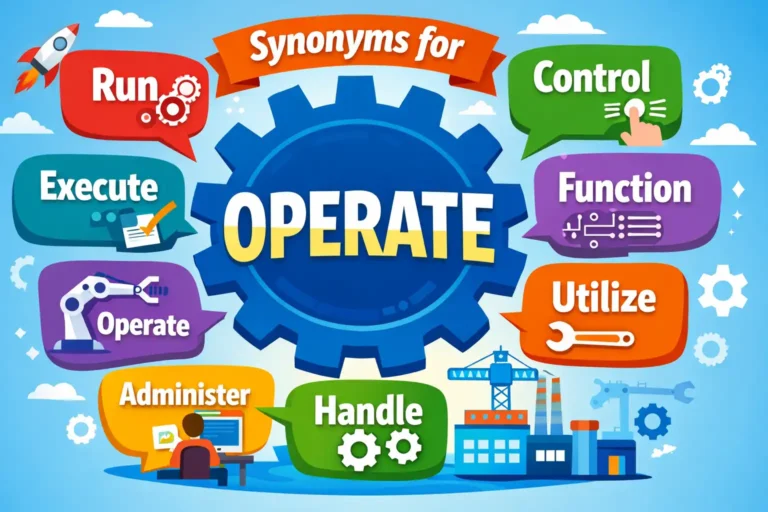
What “Operate” Means (Quick Overview)
The verb operate appears in daily speech, school writing, business, and technology.
It can mean running a machine, managing a system, or performing a task.
Learning clear synonyms helps you write with accuracy and avoid repetition.
Operate: Quick Meaning + Top Synonyms
Operate means to run, control, or manage something so it works correctly.
Common synonyms include:
- run
- manage
- control
- handle
- function
Operate (verb): meaning + common patterns
Operate means to make something work or to be in charge of how it works.
It often refers to machines, systems, businesses, or medical actions.
Example:
She knows how to operate the new printing machine.
Synonym Groups by Context (Machines, Business, Function)
1. Running Machines or Systems
These synonyms focus on making equipment, tools, or systems work.
2. Managing or Controlling Activities
These words relate to directing people, processes, or organizations.
3. Functioning or Working Normally
These synonyms describe something that works as expected.
Operate Synonyms Table (Meaning + Example)
| Word | Simple Meaning | Example Sentence |
| run | make something work | He can run the engine safely. |
| manage | be in charge of | She manages the store daily. |
| control | direct actions | The pilot controls the plane. |
| handle | deal with | He handles the equipment well. |
| function | work properly | The system functions well. |
| conduct | carry out | They conducted the experiment. |
| administer | manage officially | She administers the program. |
| execute | carry out a plan | He executed the task carefully. |
| oversee | watch and manage | She oversees the project. |
| perform | do an action | The doctor performed surgery. |
Master Synonyms List (Grouped by Level)
Beginner / Simple
- run – make something work
She runs the washing machine every night. - handle – deal with something
He handles customer calls politely. - work – function properly (informal)
The remote works again.
Intermediate
- manage – be responsible for
She manages a small team. - control – direct movement or action
He controls the robot remotely. - perform – do a task
The actor performed well.
Advanced / Formal
- administer – manage officially (formal)
The nurse administers medication. - execute – carry out a plan (formal)
The manager executed the strategy. - oversee – supervise operations (formal)
She oversees company operations.
Formal vs Informal Synonyms
Use run, handle, or work in daily conversation.
Choose to administer, execute, or oversee for academic or business writing.
Formal words sound professional but may feel heavy in casual speech.
Real-Life Usage Examples
- Conversation: “Can you run the projector?”
- Academic Writing: “The study was conducted carefully.”
- Business Writing: “She oversees regional operations.”
- Blogging: “I manage multiple tools daily.”
- Emotional Expression: “I can’t handle this pressure today.”
Similar Words Comparison
Operate vs Run
Operate sounds more technical or professional.
Running is simpler and more conversational.
He operates heavy machinery. / He runs the machine.
Operate vs Manage
Operate focuses on action and function.
Manage focuses on responsibility and planning.
She operates the system. / She manages the team.
Example Sentences (Expanded with Medical, Business, Legal & Tech Contexts)
General & Daily Use
- She operates the washing machine confidently.
- The device operates quietly at night.
Medical Context
- The surgeon will operate on the patient tomorrow morning.
- Doctors operate only when non-surgical treatment fails.
- The clinic operates under strict safety protocols.
Business & Corporate Use
- The company operates in multiple international markets.
- They operate a small logistics firm in Texas.
- The board approved how the division will operate next year.
Legal & Regulatory Context
- The organization operates under federal law.
- The license allows the business to operate legally.
- The court ruled that the agency must operate independently.
Technology & Systems
- This software operates on a cloud-based platform.
- The server operates at full capacity during peak hours.
- The robot operates through remote commands.
Academic & Professional Writing
- The system operates according to predefined rules.
Why This Matters (Quick Insight)
- Medical English uses operate mainly for surgery or clinical systems
- Business English uses it for companies and processes
- Legal English pairs it with rules, licenses, and authority
- Technical English uses it for machines, software, and systems
This range helps ESL learners choose accurate, natural usage in real contexts.
Common Mistakes
- Using operate for emotions instead of actions.
- Choosing formal synonyms in casual conversation.
- Repeating operate too often in one paragraph.
- Using execute in friendly speech.
Tips / Best Practices
- Match the word to the context.
- Check formality before writing.
- Prefer simple words for clarity.
- Avoid overusing one synonym.
When NOT to Use Operate
Do not use operate for feelings, opinions, or relationships.
It suits actions, systems, or controlled processes only.
Opposite Words (Antonyms) of Operate (With Context Notes)
The opposite of operate depends on why something does not work:
Is it broken, stopped on purpose, or no longer allowed?
Each antonym fits a different situation.
1. Malfunction (Technical / Mechanical)
Meaning: Stop working correctly because of a fault or defect.
Use when: A machine or system fails unexpectedly.
- The engine malfunctioned during the test.
- The software malfunctioned after the update.
🔹 Common in technology, engineering, and medicine
🔹 Not used for people or businesses
2. Cease (Formal / Legal / Business)
Meaning: Stop completely, often by order or decision.
Use when: Activities or operations end officially.
- The factory ceased operations last year.
- The company must cease operating without a license.
🔹 Very common in legal and formal business writing
🔹 Rare in casual conversation
3. Stop (General / Everyday)
Meaning: No longer work or continue.
Use when: Speaking casually or generally.
- The machine stopped suddenly.
- The service stopped after midnight.
🔹 Neutral and widely used
🔹 Less precise than cease or malfunction
4. Shut Down (Business / Technical)
Meaning: Close or turn off, often planned.
Use when: Systems or businesses end operations temporarily or permanently.
- The server was shut down for maintenance.
- The plant shut down due to high costs.
🔹 Common in business and IT
🔹 Often intentional, not accidental
5. Fail (General / Technical)
Meaning: Not work as expected.
Use when: Emphasizing lack of success or performance.
- The backup system failed during the outage.
- The device failed under pressure.
🔹 Broader meaning than malfunction
🔹 Can apply to people, systems, or plans
Quick Comparison Table
| Antonym | Best Context | Key Difference |
| malfunction | machines, tech | accidental failure |
| cease | legal, business | official or ordered stop |
| stop | daily speech | neutral, general |
| shut down | IT, business | planned or controlled |
| fail | general, technical | outcome-focused |
ESL Tip
Before choosing an antonym for operate, ask:
- Did it break? → malfunction
- Did it end officially? → cease
- Did it just stop? → stop
FAQs
What does operate mean?
It means to make something work or control it.
Is operate formal or informal?
It is neutral and fits both styles.
Can I use operate in conversation?
Yes, especially for machines or tools.
What is the best synonym for operate?
“Run” is the most common and simple.
Can operate mean managing a business?
Yes, it often does.
Is operate used in medicine?
Yes, doctors operate during surgery.
Can operate replace manage?
Sometimes, but not always.
Does operate mean function?
Yes, when something works properly.
Is operate used in technology?
Very often, especially for systems.
Conclusion
Learning synonyms for operate improves clarity and confidence.
You can choose words that match tone, purpose, and audience.
Try using three new synonyms in your next sentence.

**Author Biography — Olivia Carter**
Olivia Carter is a research-focused editorial writer specializing in word meanings, synonyms, and semantic distinctions in everyday and academic English. Her work centers on helping readers understand how language functions in context, with particular attention to subtle differences between similar words and expressions. She contributes to informational content designed to improve vocabulary clarity, writing accuracy, and confident language use.
With a background in research-based writing and editorial analysis, Olivia has spent years studying how word choice influences meaning, tone, and communication effectiveness. Her approach combines linguistic reference materials, usage examples, and comparative explanation methods to make complex language concepts accessible to a broad audience. She is particularly interested in how synonyms differ in nuance, formality, and real-world usage rather than simple dictionary equivalence.
Olivia’s editorial process emphasizes verification, clarity, and consistency. She relies on established dictionaries, corpus-based language references, and style guides to ensure accuracy in definitions and comparisons. This research-driven method supports readers who want reliable explanations of commonly confused words, similar terms, and precise vocabulary choices.
Through her work, Olivia helps students, writers, educators, and professionals develop a deeper understanding of English semantics. Her articles are structured to answer practical language questions while maintaining editorial neutrality and factual clarity. By focusing on meaning differences and contextual usage, she enables readers to make informed decisions about word selection in both formal and everyday communication.
As part of an editorial team dedicated to helpful informational content, Olivia Carter contributes carefully researched language resources designed to build reader trust and support clear, accurate writing.