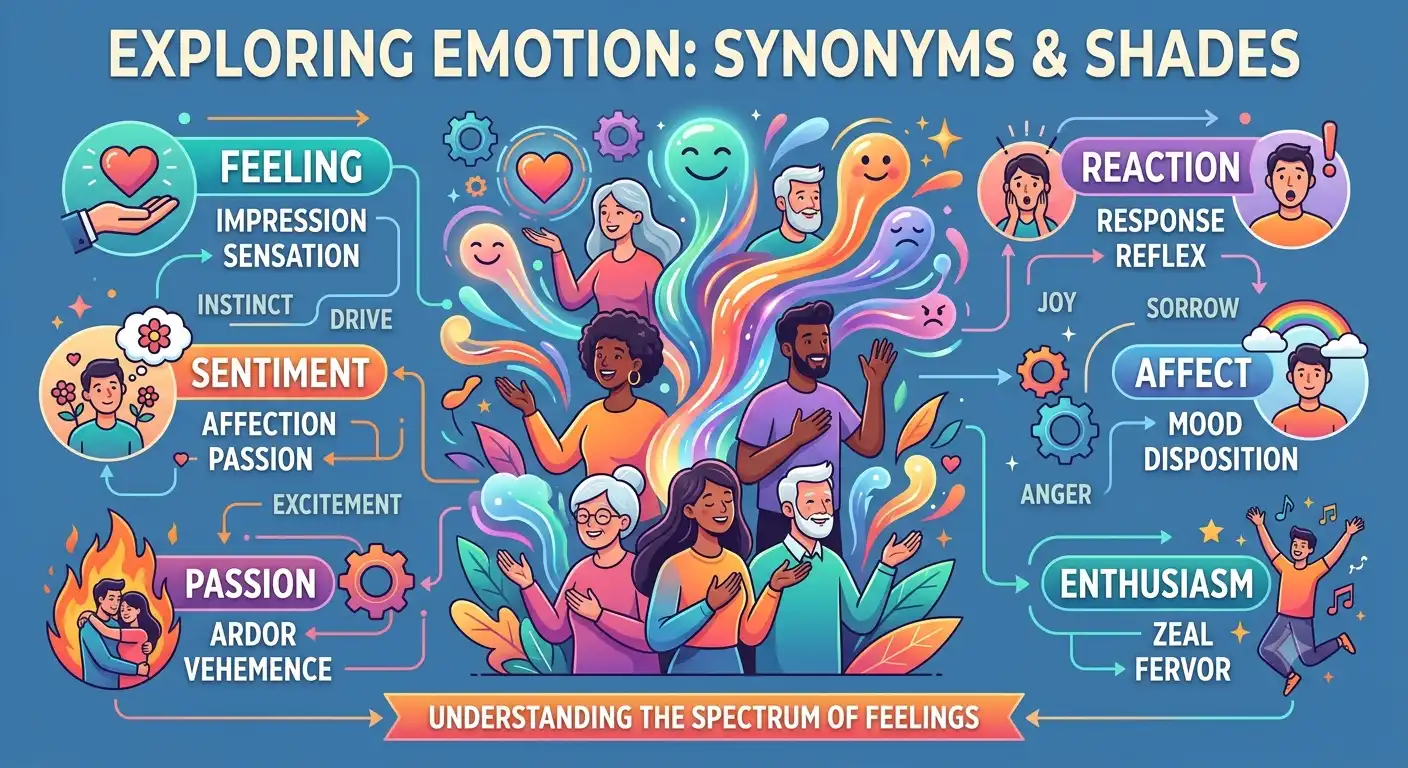
Finding exact synonyms for emotion helps you express your inner feelings and mental states with clarity. When you learn diverse synonyms for emotion, you can describe joy, sadness, excitement, and sympathy effortlessly. Using precise synonyms for emotion upgrades your daily writing, improves your speeches, and keeps your communication fresh.
Imagine a fiction writer describing a character who hears great news. If the writer uses the word “emotion” in every single sentence, the story feels flat and boring. Switching to vivid alternatives like “passion,” “thrill,” or “feeling” makes the narrative come alive for the reader.
For example, when a close friend shares happy news, saying you feel deep warmth explains your reaction right away. Choosing accurate words like “sentiment” or “mood” helps listeners connect with your exact state of mind.
The word emotion means a strong feeling that comes from your mood, relationships, or experiences. Expanding your personal list of synonyms for emotion offers clear benefits for four key groups:
- Students write deeper creative essays and express thoughts clearly in assignments.
- Bloggers craft engaging posts that connect with readers on a personal level.
- Content writers improve search rankings by using rich, natural vocabulary.
- Daily English users speak smoothly and share their feelings with confidence.
“The right word paints a clear picture of what the heart feels.”
“A rich vocabulary brings real power and warmth to every conversation.”
Linguistic Breakdown of “Emotion”
Connotative Meaning
The word emotion carries psychological, personal, and expressive connotations. It refers to intense human feelings, natural reactions to news or events, and inner mental states.
Etymology
- Origin: Derived from Middle French émotion.
- Root Words: French émouvoir (to stir up or excite), from Latin emovere (e- meaning out + movere meaning to move).
- Historical Shift: Originally used in English to describe physical motion or public agitation, then evolved in the 17th century to mean strong mental agitation or feeling.
Pronunciation
- US (IPA): /ɪˈmoʊ.ʃən/
- UK (IPA): /ɪˈməʊ.ʃən/
Syllables & Affixation Pattern
- Syllables: 3 syllables (e-mo-tion)
- Base Structure: Root emote + Noun suffix -ion
- Grammatical Patterns:
- Adjective form: Emotional
- Adverb form: Emotionally
- Plural form: Emotions
Comparison Table: Common Synonyms for Emotion
| Keyword | Meaning | Usage Type | Context |
| Feeling | An awareness of a physical or mental state | Casual / General | Everyday chats, personal health, & relationships |
| Sentiment | An opinion or feeling shaped by emotion | Intellectual / Reflective | Family letters, speeches, & public opinions |
| Passion | Strong or powerful emotion or desire | Intense / Expressive | Hobbies, love life, careers, & creative arts |
| Sensation | A physical feeling or mental excitement | Physical / Descriptive | Health, sports, outdoor activities, & news |
| Mood | A temporary state of mind or feeling | Casual / Daily | Daily life, weather effects, & workplace atmosphere |
| Pathos | A quality that evokes pity or sadness | Formal / Literary | Creative writing, books, theatre, & speeches |
| Vibe | The general mood or atmosphere felt from a person | Casual / Conversational | Social gatherings, music, & casual meetings |
50 Best Synonyms for Emotion
1. Feeling
- Pronunciation: US /ˈfiː.lɪŋ/ | UK /ˈfiː.lɪŋ/
- Meaning: Feeling means a physical or emotional awareness inside your body and mind.
- Examples:
- She had a warm feeling after helping her neighbor.
- He spoke about his home with deep feeling.
2. Sentiment
- Pronunciation: US /ˈsen.t̬ə.mənt/ | UK /ˈsen.tɪ.mənt/
- Meaning: Sentiment means a gentle thought or feeling about a person or event.
- Examples:
- Her thank-you card was full of sweet sentiment.
- Public sentiment changed after the mayor spoke.
3. Passion
- Pronunciation: US /ˈpæʃ.ən/ | UK /ˈpæʃ.ən/
- Meaning: Passion means a very strong feeling of enthusiasm or love for something.
- Examples:
- He plays the piano with great passion every evening.
- Teaching children is her true passion in life.
4. Sensation
- Pronunciation: US /senˈseɪ.ʃən/ | UK /senˈseɪ.ʃən/
- Meaning: Sensation means a clear feeling that you notice in your body or mind.
- Examples:
- Cold water gave him a sudden sensation of energy.
- Winning the game was an amazing sensation for the team.
5. Mood
- Pronunciation: US /muːd/ | UK /muːd/
- Meaning: Mood means your current emotional state or overall feeling for the day.
- Examples:
- Bright sunshine always puts me in a good mood.
- He was in a quiet mood after reading the book.
6. Reaction
- Pronunciation: US /riˈæk.ʃən/ | UK /riˈæk.ʃən/
- Meaning: Reaction means an instant feeling or action caused by something else.
- Examples:
- Her happy reaction to the gift brought smiles to everyone.
- His first reaction was to laugh at the funny joke.
7. Affection
- Pronunciation: US /əˈfek.ʃən/ | UK /əˈfek.ʃən/
- Meaning: Affection means a gentle feeling of liking or loving someone.
- Examples:
- The dog shows great affection to its owner.
- She hugs her little brother with deep affection.
8. Warmth
- Pronunciation: US /wɔːrmθ/ | UK /wɔːmθ/
- Meaning: Warmth means a friendly and loving feeling toward other people.
- Examples:
- The host greeted every visitor with genuine warmth.
- Her smile added warmth to the dark room.
9. Temperament
- Pronunciation: US /ˈtem.pɚ.ə.mənt/ | UK /ˈtem.prə.mənt/
- Meaning: Temperament means the natural mood and emotional nature of a person.
- Examples:
- She has a calm temperament and never gets angry easily.
- The kitten has a playful temperament.
10. State of Mind
- Pronunciation: US /steɪt əv maɪnd/ | UK /steɪt əv maɪnd/
- Meaning: State of mind means your emotional condition at a specific moment.
- Examples:
- Quiet music puts me in a peaceful state of mind.
- Sleep well so you wake up in a clear state of mind.
11. Heart
- Pronunciation: US /hɑːrt/ | UK /hɑːt/
- Meaning: Heart means the center of a person’s deepest feelings and kindness.
- Examples:
- He spoke from the heart during his wedding speech.
- She put her whole heart into her art project.
12. Spirit
- Pronunciation: US /ˈspɪr.ət/ | UK /ˈspɪr.ɪt/
- Meaning: Spirit means the lively emotional energy inside a person or group.
- Examples:
- The team played the match with strong team spirit.
- Her cheerful spirit lifted everyone in the office.
13. Compassion
- Pronunciation: US /kəmˈpæʃ.ən/ | UK /kəmˈpæʃ.ən/
- Meaning: Compassion means a strong feeling of sympathy and care for suffering people.
- Examples:
- The nurse showed great compassion to the sick man.
- Helping poor families requires real compassion.
14. Sympathy
- Pronunciation: US /ˈsɪm.pə.θi/ | UK /ˈsɪm.pə.θi/
- Meaning: Sympathy means a feeling of sadness for someone who faces trouble.
- Examples:
- We offered our sympathy to the family after their loss.
- She felt deep sympathy for the lost dog.
15. Empathy
- Pronunciation: US /ˈem.pə.θi/ | UK /ˈem.pə.θi/
- Meaning: Empathy means the ability to share and understand another person’s feelings.
- Examples:
- Good doctors show empathy when talking to patients.
- Listening closely builds empathy between friends.
16. Soul
- Pronunciation: US /soʊl/ | UK /səʊl/
- Meaning: Soul means the deep emotional and spiritual part of a human being.
- Examples:
- The song has so much soul and feeling.
- She pours her soul into every story she writes.
17. Frame of Mind
- Pronunciation: US /freɪm əv maɪnd/ | UK /freɪm əv maɪnd/
- Meaning: Frame of mind means a temporary mental or emotional mood.
- Examples:
- Try to enter a relaxed frame of mind before taking the test.
- He was not in the right frame of mind to discuss work.
18. Vibe
- Pronunciation: US /vaɪb/ | UK /vaɪb/
- Meaning: Vibe means the general mood or feeling given off by a person or place.
- Examples:
- The beach café has a very peaceful vibe.
- She brings a positive vibe wherever she goes.
19. Impulse
- Pronunciation: US /ˈɪm.pʌls/ | UK /ˈɪm.pʌls/
- Meaning: Impulse means a sudden emotional urge to do something fast.
- Examples:
- He bought the blue shirt on a sudden impulse.
- Her first impulse was to run and hug her mother.
20. Sensitivity
- Pronunciation: US /ˌsen.səˈtɪv.ə.t̬i/ | UK /ˌsen.sɪˈtɪv.ə.ti/
- Meaning: Sensitivity means being easily aware of feelings and small changes.
- Examples:
- The writer shows great sensitivity to human sadness.
- He handled the hard question with gentle sensitivity.
21. Pathos
- Pronunciation: US /ˈpeɪ.θɑːs/ | UK /ˈpeɪ.θɒs/
- Meaning: Pathos means a sad quality in life or art that causes deep pity.
- Examples:
- The film ending was full of soft pathos.
- The actor expressed pathos through his tearful eyes.
22. Attachment
- Pronunciation: US /əˈtætʃ.mənt/ | UK /əˈtætʃ.mənt/
- Meaning: Attachment means a strong feeling of closeness or love for someone.
- Examples:
- The child formed a quick attachment to the new puppy.
- Her attachment to her childhood home remained strong.
23. Excitement
- Pronunciation: US /ɪkˈsaɪt.mənt/ | UK /ɪkˈsaɪt.mənt/
- Meaning: Excitement means a strong feeling of happiness and eager energy.
- Examples:
- The children jumped with excitement on holiday morning.
- News of the trip created high excitement in class.
24. Tenderness
- Pronunciation: US /ˈten.dɚ.nəs/ | UK /ˈten.də.nəs/
- Meaning: Tenderness means a soft, gentle, and loving emotional state.
- Examples:
- The mother held her baby with immense tenderness.
- He spoke to his grandmother with real tenderness.
25. Response
- Pronunciation: US /rɪˈspɑːns/ | UK /rɪˈspɒns/
- Meaning: Response means an emotional answer or reaction to an experience.
- Examples:
- The crowd gave a warm response to the singer.
- Her tearful response showed how much she cared.
“Expressing your feelings clearly turns simple words into lasting connections.”
26. Disposition
- Pronunciation: US /ˌdɪs.pəˈzɪʃ.ən/ | UK /ˌdɪs.pəˈzɪʃ.ən/
- Meaning: Disposition means a person’s natural mood and character traits.
- Examples:
- She has a cheerful disposition that brightens the room.
- His quiet disposition makes him a calm listener.
27. Outburst
- Pronunciation: US /ˈaʊt.bɝːst/ | UK /ˈaʊt.bɜːst/
- Meaning: Outburst means a sudden strong display of emotion like anger or joy.
- Examples:
- He apologized for his angry outburst at the office.
- Her sudden outburst of laughter made everyone smile.
28. Fire
- Pronunciation: US /ˈfaɪ.ɚ/ | UK /ˈfaɪər/
- Meaning: Fire means intense emotional energy, drive, or deep anger.
- Examples:
- You can see the fire in her eyes when she speaks.
- The speech filled the crowd with new fire.
29. Desire
- Pronunciation: US /dɪˈzaɪr/ | UK /dɪˈzaɪər/
- Meaning: Desire means a strong emotional wanting for a person or goal.
- Examples:
- He has a strong desire to travel around the world.
- Her deep desire for success helped her study hard.
30. Fervor
- Pronunciation: US /ˈfɝː.vɚ/ | UK /ˈfɜː.və/
- Meaning: Fervor means a very strong and sincere emotional belief.
- Examples:
- The fans cheered for their team with great fervor.
- She spoke about clean energy with real fervor.
31. Enthusiasm
- Pronunciation: US /ɪnˈθuː.zi.æz.əm/ | UK /ɪnˈθjuː.zi.æz.əm/
- Meaning: Enthusiasm means an energetic feeling of interest and fun.
- Examples:
- He showed great enthusiasm for learning English.
- Her enthusiasm made the science project fun for all.
32. Tone
- Pronunciation: US /toʊn/ | UK /təʊn/
- Meaning: Tone means the underlying emotional quality of a voice or text.
- Examples:
- Her voice had a gentle tone during the call.
- The letter had a polite but firm tone.
33. Visceral response
- Pronunciation: US /ˌvɪs.ɚ.əl rɪˈspɑːns/ | UK /ˌvɪs.ər.əl rɪˈspɒns/
- Meaning: Visceral response means a deep emotional feeling coming straight from the gut.
- Examples:
- The scary movie gave her a visceral response of shock.
- He had a visceral response of joy when he won.
34. Internal feeling
- Pronunciation: US /ɪnˈtɝː.nəl ˈfiː.lɪŋ/ | UK /ɪnˈtɜː.nəl ˈfiː.lɪŋ/
- Meaning: Internal feeling means a quiet emotion kept inside your mind.
- Examples:
- She hid her internal feeling of sadness behind a smile.
- His internal feeling told him to trust the new plan.
35. Agitation
- Pronunciation: US /ˌædʒ.əˈteɪ.ʃən/ | UK /ˌædʒ.ɪˈteɪ.ʃən/
- Meaning: Agitation means a restless and disturbed feeling of worry.
- Examples:
- Noise outside caused her much agitation during work.
- He tried to hide his inner agitation from his boss.
36. Joy
- Pronunciation: US /dʒɔɪ/ | UK /dʒɔɪ/
- Meaning: Joy means a bright and intense feeling of happiness.
- Examples:
- Watching the birds bring her pure joy.
- The good news filled the family home with joy.
37. Grief
- Pronunciation: US /ɡriːf/ | UK /ɡriːf/
- Meaning: Grief means deep emotional sadness caused by a big loss.
- Examples:
- Time helps heal the heavy pain of grief.
- She expressed her grief through a quiet poem.
38. Thrill
- Pronunciation: US /θrɪl/ | UK /θrɪl/
- Meaning: Thrill means a sudden wave of exciting and happy emotion.
- Examples:
- Riding the roller coaster gave him a big thrill.
- Winning first prize was a huge thrill for her.
39. Concern
- Pronunciation: US /kənˈsɝːn/ | UK /kənˈsɜːn/
- Meaning: Concern means a feeling of worry or care for someone’s safety.
- Examples:
- Her mother voiced concern over the stormy weather.
- Thank you for showing genuine concern for my health.
40. Regard
- Pronunciation: US /rɪˈɡɑːrd/ | UK /rɪˈɡɑːd/
- Meaning: Regard means an emotional feeling of respect and admiration.
- Examples:
- He holds his old teacher in high regard.
- She sends her best regard to your family.
41. Mental state
- Pronunciation: US /ˈmen.təl steɪt/ | UK /ˈmen.təl steɪt/
- Meaning: Mental state means your emotional health and thought condition right now.
- Examples:
- Walking in nature improves your overall mental state.
- Sleep is vital for a healthy mental state.
42. Stirring
- Pronunciation: US /ˈstɝː.ɪŋ/ | UK /ˈstɜː.rɪŋ/
- Meaning: Stirring means a waking up of soft feelings or thoughts inside.
- Examples:
- He felt a stirring of hope after reading the news.
- The old photo caused a gentle stirring of memories.
43. Gut feeling
- Pronunciation: US /ɡʌt ˈfiː.lɪŋ/ | UK /ɡʌt ˈfiː.lɪŋ/
- Meaning: Gut feeling means an instant feeling about a situation without slow thinking.
- Examples:
- Trust your gut feeling when choosing a new path.
- Her gut feeling told her that the answer was right.
44. Sentimentality
- Pronunciation: US /ˌsen.t̬ə.menˈtæl.ə.t̬i/ | UK /ˌsen.tɪ.menˈtæl.ə.ti/
- Meaning: Sentimentality means an extra soft or tender feeling toward memories.
- Examples:
- She kept old movie tickets out of simple sentimentality.
- The song has a sweet sense of nostalgia and sentimentality.
45. Intensity
- Pronunciation: US /ɪnˈten.sə.t̬i/ | UK /ɪnˈten.sə.ti/
- Meaning: Intensity means the strong degree or depth of a feeling.
- Examples:
- The intensity of his love was clear to everyone.
- She painted the sky with great color intensity.
46. Intimacy
- Pronunciation: US /ˈɪn.t̬ə.mə.si/ | UK /ˈɪn.tɪ.mə.si/
- Meaning: Intimacy means a close and deep emotional connection between people.
- Examples:
- Quiet talks help build strong emotional intimacy.
- They shared a moment of warmth and intimacy.
47. Devotion
- Pronunciation: US /dɪˈvoʊ.ʃən/ | UK /dɪˈvəʊ.ʃən/
- Meaning: Devotion means deep emotional love, loyalty, and care over time.
- Examples:
- Her devotion to her family is truly inspiring.
- He showed great devotion to his daily music practice.
48. Humors
- Pronunciation: US /ˈhjuː.mɚz/ | UK /ˈhjuː.məz/
- Meaning: Humors mean changing emotional moods or states of mind.
- Examples:
- He is a man of unpredictable humors in the morning.
- Sunny days put everyone in good humors.
49. Warmheartedness
- Pronunciation: US /ˌwɔːrmˈhɑːr.t̬ɪd.nəs/ | UK /ˌwɔːmˈhɑː.tɪd.nəs/
- Meaning: Warmheartedness means a kind and loving emotional nature.
- Examples:
- Her warmheartedness made every guest feel welcome.
- We love him for his endless patience and warmheartedness.
50. Emotionality
- Pronunciation: US /ɪˌmoʊ.ʃəˈnæl.ə.t̬i/ | UK /ɪˌməʊ.ʃəˈnæl.ə.ti/
- Meaning: Emotionality means the tendency to show strong feelings openly.
- Examples:
- The drama actor is famous for his high emotionality.
- She expressed her thoughts with open emotionality.
Antonyms of “Emotion”
Knowing opposite terms helps you describe cold logic, lack of feeling, or emotional balance accurately.
- Apathy: Complete lack of interest, feeling, energy, or concern.
- Indifference: Lack of sympathy, preference, or emotional concern for something.
- Coldness: A lack of friendly warmth, love, or human affection.
- Detachment: Staying emotionally distant or objective in a situation.
- Logic: Using cold facts and clear reason instead of inner feelings.
- Stoicism: Showing great self-control without expressing pain or emotion.
Prototype Meaning & Categorization of “Emotion”
The core concept of emotion rests on internal feelings, social reactions, natural temperament, and emotional drive. Depending on your essay or conversation topic, these 50 synonyms divide into four clear categories:
- General Feeling & Internal State: Feeling, mood, state of mind, frame of mind, internal feeling, mental state, gut feeling, visceral response, humors, sensation, vibe, reaction.
- Deep Love, Warmth & Empathy: Affection, warmth, compassion, sympathy, empathy, tenderness, intimacy, devotion, warmheartedness, attachment, regard, sentimentality.
- Passion, Energy & Strong Reaction: Passion, spirit, excitement, fire, desire, fervor, enthusiasm, thrill, outburst, intensity, emotionality, agitation.
- Character, Tone & Inner Nature: Sentiment, temperament, heart, soul, sensitivity, pathos, response, disposition, tone, concern, stirring.
Frequently Asked Questions (FAQs)
1. What is the most common formal synonym for “emotion” in essays?
In formal college essays, terms like “sentiment,” “disposition,” or “pathos” work best. They describe mental states and feelings without sounding casual.
2. Is “feeling” the exact same thing as “emotion”?
While very close, “feeling” can refer to physical touch or simple mental states. “Emotion” usually refers to a stronger, complex psychological response.
3. Which synonym for “emotion” works best in creative stories?
In creative fiction, specific words like “passion,” “fervor,” “pathos,” or “visceral response” add vivid detail to character actions.
4. Can I use “vibe” instead of “emotion” in writing?
“Vibe” is an informal term best for casual conversations or social media. Use “mood,” “tone,” or “atmosphere” in clear, formal writing.
5. How does learning synonyms for “emotion” help SEO content?
Using diverse synonyms prevents word repetition, targets varied reader search queries, and helps search engines understand the exact topic of your article.
6. What is a synonym for “strong emotion”?
Strong emotion can be described as “passion,” “fervor,” “intensity,” or “an outburst.”
Conclusion
Expanding your collection of synonyms for emotion brings clarity, color, and strength to your daily language. Replacing overused words with precise choices like feeling, sentiment, passion, or empathy ensures your message connects deeply with your audience.
Whether you write academic essays, craft engaging blog posts, send professional emails, or speak in daily conversations, using exact vocabulary builds instant trust. Varied words remove repetitive phrasing and transform simple statements into touching thoughts. Practice these 50 synonyms today to express your feelings with lasting confidence.
“Choosing precise words turns basic feelings into inspiring stories.”
“Mastering vocabulary gives gentle power and authority to every phrase you share.”

Robert Hayes is an ESL educator and curriculum developer with over nine years of experience teaching English to beginners and intermediate learners across multiple countries ( Biography ).