Quick Intro: What “Destination” Means
The word “destination” is common in daily speech, travel writing, business English, and academic essays.
It describes a place someone is going to.
Learning synonyms helps you avoid repetition and sound more natural.
It also improves clarity and vocabulary range.
Definition: What Does “Destination” Mean?
Destination means the place where someone is going or where something is sent.
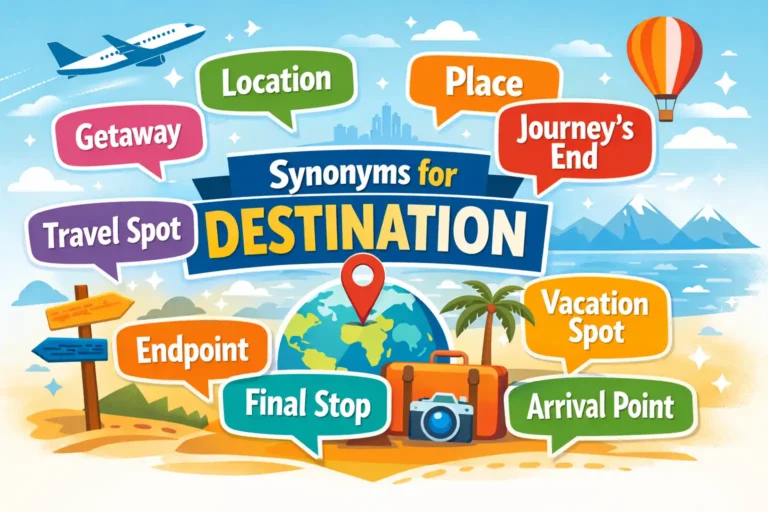
Common synonyms include:
- place
- location
- site
- venue
- endpoint
- target
- goal
- objective
- stop
- terminus
Meaning of Destination
A destination is the final place someone plans to reach after traveling.
Example:
Our final destination is Chicago.
Categories of Synonyms
1. Physical Place
These words describe an actual location you can visit.
Examples include words used in travel, maps, or directions.
2. Purpose or Goal
These words describe a result someone wants to achieve.
They are common in business and academic writing.
3. Transport or Route End
These words describe the final stop in a journey.
They are common in travel and transportation contexts.
Synonyms Table
| Word | Simple Meaning | Example Sentence |
| Place | A general location | This park is a great place to relax. |
| Location | A specific area | The hotel’s location is perfect. |
| Site | A particular area | The building site is downtown. |
| Venue | Event place | The wedding venue looks beautiful. |
| Endpoint | Final point | The river’s endpoint is the sea. |
| Target | Aim or goal | Our sales target increased. |
| Goal | Desired result | Her goal is graduation. |
| Objective | Planned aim | The objective is clear. |
| Stop | Pause in travel | Paris is our first stop. |
| Terminus | Final station | The train reached its terminus. |
Synonyms by Context + Formality (Simple → Advanced)
Beginner / Simple
Place
Simple meaning: Any area or spot
Example: We finally reached our place by the lake.
Stop
Simple meaning: A pause during travel
Example: Our next stop is Dallas.
Goal
Simple meaning: Something you want to achieve
Example: His goal is to finish college.
Intermediate
Location
Simple meaning: A specific position
Example: The location of the cafe is convenient.
Site
Simple meaning: A particular area
Example: The construction site is busy.
Target
Simple meaning: Something you aim for
Example: The company met its sales target.
Endpoint
Simple meaning: The final point
Example: The trail’s endpoint is near the river.
Advanced / Formal
Venue (Formal for events)
Simple meaning: A place where events happen
Example: The conference venue is fully booked.
Objective (Formal)
Simple meaning: A planned result
Example: The project’s main objective is growth.
Terminus (Formal / Transport)
Simple meaning: Final station
Example: The bus arrived at its terminus.
Formal vs Informal Synonyms
Use simple words like place and stop in conversation.
Use formal words like objective or venue in academic or business writing.
In professional emails, avoid casual language if discussing goals. Choose formal vocabulary for clarity.
Real-Life Usage Examples
Conversation
“Is London your final destination?”
Academic Writing
“The primary objective of the study was data analysis.”
Business Writing
“Our target market is young professionals.”
Blogging
“This beach town is a top travel destination.”
Emotional Expression
“Success became her ultimate goal.”
Similar Words Comparison
Destination vs Goal
A destination is usually a physical place.
A goal is something you want to achieve.
Example:
Paris is our destination.
Graduation is her goal.
Destination vs Location
A destination suggests movement toward a place.
A location simply describes where something is.
Example:
Rome is our destination.
The office location is downtown.
Example Sentences (Grouped by Context)
Below are clearer, non-repetitive examples organized by real-life situations.
Travel & Transportation
- Our final destination is San Francisco.
- The train reached its terminus late at night.
- This island has become a popular tourist site.
- The delivery truck arrived at the correct location.
- Dubai is their dream vacation place.
Academic & Professional Goals
- Her main objective is to complete her degree on time.
- The company exceeded its annual sales target.
- His long-term goal is to start his own business.
- The project’s clear endpoint helped the team stay focused.
Events & Social Settings
- The wedding venue overlooks the ocean.
- Chicago will be our next conference stop.
Everyday Conversation & General Use
- We finally reached the right place after getting lost.
- Please confirm the drop-off location before leaving.
- Success feels better when the journey to the destination is meaningful.
Common Mistakes
- Using “goal” for physical travel
Incorrect: My goal is Paris.
Correct: My destination is Paris. - Overusing “destination” in writing
Avoid repeating the same word. Use alternatives naturally. - Using formal words in casual speech
“Terminus” sounds too formal in daily conversation. - Confusing location and destination
Location does not always mean movement.
Tips for Choosing the Right Synonym
- Consider tone. Formal writing needs formal words.
- Check context. Travel, business, or personal?
- Keep clarity first. Choose simple words when possible.
- Avoid overusing the same word repeatedly.
Good writing uses variety but remains clear.
When NOT to Use Destination
Do not use destination when talking about abstract goals unless metaphorical.
Incorrect: Happiness is my destination.
Better: Happiness is my goal.
Avoid it when discussing static positions. Use location instead.
Opposite Words (Antonyms)
Antonyms of destination describe where something begins rather than where it ends. These words focus on the starting point of movement, action, or creation.
1. Origin
Simple meaning: The place where something begins.
Nuance: Often used for birth, creation, or historical beginnings.
Example Sentences:
- The product’s origin is Italy.
- Scientists studied the origin of the river.
- We returned to our point of origin after the hike.
2. Source
Simple meaning: The starting point or cause of something.
Nuance: Common in academic, technical, and research contexts.
Example Sentences:
- The source of the problem was unclear.
- This website is a reliable source of information.
- The source of the package shipment was New York.
3. Starting Point
Simple meaning: The place where something begins.
Nuance: Neutral and common in everyday speech.
Example Sentences:
- The race starting point is near the stadium.
- Every journey has a starting point.
- Let’s go back to the starting point of the discussion.
4. Departure
Simple meaning: The act or place of leaving.
Nuance: Often used in travel contexts.
Example Sentences:
- The airport departure gate was crowded.
- The flight departure time changed.
- Paris was our point of departure.
Source vs Origin: Key Difference
Both words relate to beginnings, but they are not identical.
- Origin usually refers to where something first began historically or naturally.
- Source often refers to where something comes from right now or what causes it.
Example:
The river’s origin is in the mountains.
The source of the water supply is a nearby lake.
Understanding these nuances helps you choose the correct opposite of destination based on context.
FAQs
What does destination mean?
It means the place someone is traveling to.
Is the destination formal or informal?
It is neutral and works in both formal and casual contexts.
How can I use it in conversation?
You can ask, “What is your destination?”
What is the best synonym for destination?
It depends on context. “Place” works in most casual situations.
Can destination mean a goal?
Sometimes metaphorically, but usually it means a physical place.
Can destination be replaced with location?
Only when referring to a place, not movement.
Is terminus commonly used?
It is formal and mostly used in transport contexts.
What synonym should I use in business writing?
Use objective or target when discussing goals.
Is the venue the same as the destination?
Not exactly. Venue is used for events.
Conclusion
Understanding synonyms for destination helps you choose the right word for the right situation.
Use place, location, or stop in daily conversation.
Use objective, target, or venue in academic or professional writing.
Knowing antonyms like origin and source also improves accuracy and meaning.
Quick Practice (1–2 minutes)
Replace destination with a better word in each sentence:
- Paris is our final _______.
- The company’s main _______ is to increase revenue.
- The concert _______ can hold 5,000 people.
- The train reached its final _______.
Answers (sample):
- destination / place
- objective / goal
- venue
- terminus
Try writing one sentence about travel, one about work, and one about goals—each with a different synonym.
This small habit builds stronger vocabulary and clearer English fast.

**Author Biography — Olivia Carter**
Olivia Carter is a research-focused editorial writer specializing in word meanings, synonyms, and semantic distinctions in everyday and academic English. Her work centers on helping readers understand how language functions in context, with particular attention to subtle differences between similar words and expressions. She contributes to informational content designed to improve vocabulary clarity, writing accuracy, and confident language use.
With a background in research-based writing and editorial analysis, Olivia has spent years studying how word choice influences meaning, tone, and communication effectiveness. Her approach combines linguistic reference materials, usage examples, and comparative explanation methods to make complex language concepts accessible to a broad audience. She is particularly interested in how synonyms differ in nuance, formality, and real-world usage rather than simple dictionary equivalence.
Olivia’s editorial process emphasizes verification, clarity, and consistency. She relies on established dictionaries, corpus-based language references, and style guides to ensure accuracy in definitions and comparisons. This research-driven method supports readers who want reliable explanations of commonly confused words, similar terms, and precise vocabulary choices.
Through her work, Olivia helps students, writers, educators, and professionals develop a deeper understanding of English semantics. Her articles are structured to answer practical language questions while maintaining editorial neutrality and factual clarity. By focusing on meaning differences and contextual usage, she enables readers to make informed decisions about word selection in both formal and everyday communication.
As part of an editorial team dedicated to helpful informational content, Olivia Carter contributes carefully researched language resources designed to build reader trust and support clear, accurate writing.