Quick Intro
The word abyss appears in books, news articles, movies, and daily speech. People use it to describe something very deep or serious. Learning synonyms for abyss helps you write clearly and avoid repeating the same word. It also improves your speaking skills.
Direct Answer
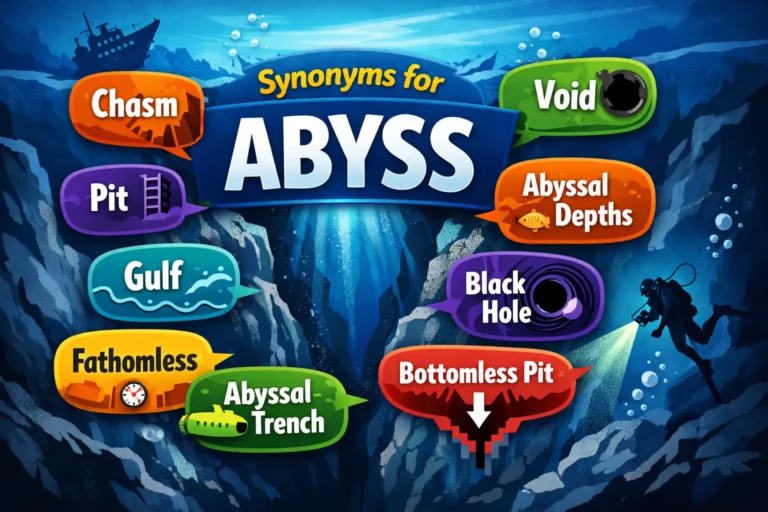
Synonyms for abyss include words that describe a deep hole, a great distance, or a serious emotional state.
Common synonyms:
- chasm
- void
- gulf
- pit
- depth
- ravine
- trench
- crater
- hole
- precipice
Meaning of Abyss
An abyss is a very deep hole or an endless space. It can also describe a serious emotional or difficult situation.
Example:
He stared into the dark abyss below the cliff.
Categories of Synonyms
Physical Depth
These words describe real, deep spaces in the ground or sea.
Emotional Depth
These words describe strong feelings such as sadness or hopelessness.
Social or Situational Gap
These words describe large differences between people, groups, or ideas.
Synonyms Table
| Word | Simple Meaning | Example Sentence |
| Chasm | Deep crack in the ground | The bridge crossed a wide chasm. |
| Void | Empty space | The rocket moved through the void of space. |
| Gulf | Large gap or distance | There is a gulf between rich and poor. |
| Pit | Deep hole | He fell into a deep pit. |
| Depth | Deep area | The lake’s depth surprised us. |
| Ravine | Narrow valley | Water flowed through the ravine. |
| Trench | Long narrow hole | Soldiers hid in the trench. |
| Crater | Large hole from impact | The volcano left a crater. |
| Hole | Empty space in ground | The dog dug a hole. |
| Precipice | Steep cliff edge | She stood near the precipice. |
Master Synonyms List (Grouped by Level)
Beginner / Simple
Hole
Simple meaning: An empty space in the ground.
Example: The rabbit hid in a hole.
Pit
Simple meaning: A deep hole.
Example: He almost stepped into a pit.
Depth
Simple meaning: The distance from top to bottom.
Example: The depth of the water scared me.
Intermediate
Chasm
Simple meaning: A deep crack or opening.
Example: A narrow bridge crossed the chasm.
Gulf
Simple meaning: A large gap or separation.
Example: There is a gulf between their opinions.
Ravine
Simple meaning: A deep narrow valley.
Example: The hikers walked beside a ravine.
Trench
Simple meaning: A long deep ditch.
Example: Workers dug a trench for pipes.
Advanced / Formal
Void (Formal)
Simple meaning: Complete emptiness.
Example: The astronaut floated in the silent void.
Precipice (Formal)
Simple meaning: A dangerous edge or situation.
Example: The company stood on the precipice of failure.
Crater
Simple meaning: A large round hole.
Example: The explosion created a huge crater.
Formal vs Informal Synonyms
Some synonyms for abyss sound formal and serious. Others feel simple and natural. Choosing the right word depends on your audience and purpose.
Informal / Everyday Words
Use these in daily conversation or casual writing:
- hole
- pit
- depth
These words are clear and easy to understand.
Formal / Academic Words
Use these in essays, reports, or professional writing:
- chasm
- gulf
- void
- precipice
These words sound more serious and precise.
Clear “Use This When…” Rules
- Use “hole” or “pit” when you are describing something simple and physical in everyday speech.
- Use “chasm” or “gulf” when you are writing about a large difference between ideas, groups, or opinions.
- Use “void” or “precipice” when you want a formal, dramatic, or academic tone.
Always match your word choice to the situation. Clear language improves both speaking and writing.
Real-Life Usage Examples
Conversation
“I felt like I was staring into an emotional void.”
Academic Writing
The economic gulf between nations continues to grow.
Business Writing
The company faced a financial precipice after the loss.
Blogging
Travelers stood at the edge of a massive chasm.
Emotional Expression
After the breakup, she felt like she had fallen into a dark pit.
Similar Words Comparison
Many words seem similar to abyss, but their meanings and usage are different. Understanding these differences helps you choose the most accurate word.
Abyss vs Pit
An abyss suggests extreme depth and often feels endless or serious. It can be physical or emotional.
A pit usually describes a simple, physical hole and sounds more casual.
Example:
- The climber looked into the abyss below the cliff.
- The worker dug a pit in the ground.
Abyss vs Void
An abyss focuses on depth and danger. It often carries emotional weight.
A void focuses on emptiness, not depth. It often describes space or lack of content.
Example:
- She felt like she was falling into an emotional abyss.
- Outer space is a silent void.
Abyss vs Chasm
An abyss can feel endless and overwhelming.
A chasm usually describes a visible, physical crack or separation.
Example:
- Fear opened an abyss in his mind.
- A narrow bridge crossed the chasm.
Abyss vs Gulf
An abyss emphasizes depth or crisis.
A gulf emphasizes distance or difference, often between people or ideas.
Example:
- The nation faced an economic abyss.
- There is a gulf between their political views.
Important Note: Precipice ≠ Abyss
A precipice is not the same as an abyss.
A precipice means a dangerous edge or a risky situation, not the deep space below it.
Example:
- The company stood on the precipice of collapse.
- The abyss lay far beneath the cliff.
Understanding these differences improves accuracy and clarity in writing and speech.
Example Sentences
- The diver disappeared into the ocean’s abyss.
- A deep chasm separated the two cliffs.
- The crater filled with rainwater.
- The trench stretched for miles.
- The ravine was narrow but very deep.
- The depth of the canyon amazed tourists.
- He felt trapped in a pit of sadness.
- The gulf between generations keeps growing.
- She stood carefully near the precipice.
- The void of space is silent.
- The hole was too deep to climb out of.
- Fear pulled him toward an emotional abyss.
- The company avoided the precipice of bankruptcy.
- The hikers explored the rocky ravine.
- The trench protected soldiers during the storm.
Common Mistakes
- Using formal words in casual speech.
Saying “void” in everyday conversation can sound unnatural. - Confusing physical and emotional meaning.
A trench is physical, not emotional. - Overusing dramatic words.
Not every problem is a precipice. - Using rare or incorrect vocabulary.
Stick to common, natural words.
Tips / Best Practices
- Match the tone to your audience.
- Choose simple words for conversation.
- Use formal synonyms in academic or business writing.
- Focus on clarity, not complexity.
- Avoid repeating the same word too often.
Good writing balances variety and clarity.
When NOT to Use Abyss
Do not use abyss for small problems.
Avoid it in technical writing unless it describes real depth.
Do not use it when a simpler word like “hole” works better.
Opposite Words (Antonyms)
- surface
- height
- peak
- top
- summit
FAQs
What does abyss mean?
It means a very deep hole or a serious emotional state.
Is abyss formal or informal?
It is neutral but sounds more formal or literary.
Can I use abyss in daily conversation?
Yes, but mostly in serious or dramatic situations.
What is the best synonym for abyss?
Chasm works well in many contexts.
Can abyss be replaced with hole?
Sometimes, but hole is more basic and less dramatic.
Is abyss only physical?
No. It can describe emotional or financial difficulty.
Is void stronger than abyss?
Void focuses on emptiness. Abyss focuses on depth.
Can gulf replace abyss?
Yes, when describing a gap between people or ideas.
Is precipice the same as abyss?
No. Precipice often means danger or risk.
Why learn synonyms for abyss?
They help you write clearly and avoid repetition.
Conclusion
Learning synonyms for abyss improves your vocabulary and helps you write with more precision. You can sound clearer in conversation, stronger in academic writing, and more natural in blogs and business messages.
Stronger CTA: Pick based on meaning: depth vs emptiness vs gap. Try using three new synonyms today and notice how your sentences become sharper and easier to understand.

Grace Mitchell is a research-focused editorial writer specializing in language clarity, word usage, and semantic distinctions in modern English. Her work centers on helping readers understand how similar words differ in meaning, tone, and context, with a strong emphasis on accuracy, readability, and linguistic precision. With a background in humanities research and professional content editing, she has spent years analyzing vocabulary patterns, reference materials, and real-world usage examples to produce reliable informational resources.
Grace’s editorial approach is grounded in careful comparison of synonyms, supported by dictionary sources, corpus examples, and style-guide conventions. She focuses on explaining subtle meaning differences between commonly confused words, ensuring that explanations remain practical and easy to apply in everyday writing. Her work prioritizes clarity over opinion, presenting language information in a structured, neutral format that readers can trust.
As part of a research-driven publishing team, Grace contributes to long-form informational content designed to improve vocabulary understanding for students, writers, professionals, and English learners. Her writing reflects consistent editorial standards, fact-checking practices, and attention to semantic accuracy. She is particularly interested in how context, tone, and usage frequency influence word choice in both formal and informal communication.
Grace believes that understanding word relationships strengthens communication and reduces ambiguity in writing. Through detailed synonym comparisons and meaning explanations, she helps readers make informed language decisions with confidence. Her work supports readers who want precise vocabulary guidance without unnecessary complexity, making language learning more accessible and reliable.
Her editorial contributions focus on maintaining linguistic accuracy, research-based writing practices, and reader trust across all published content.