
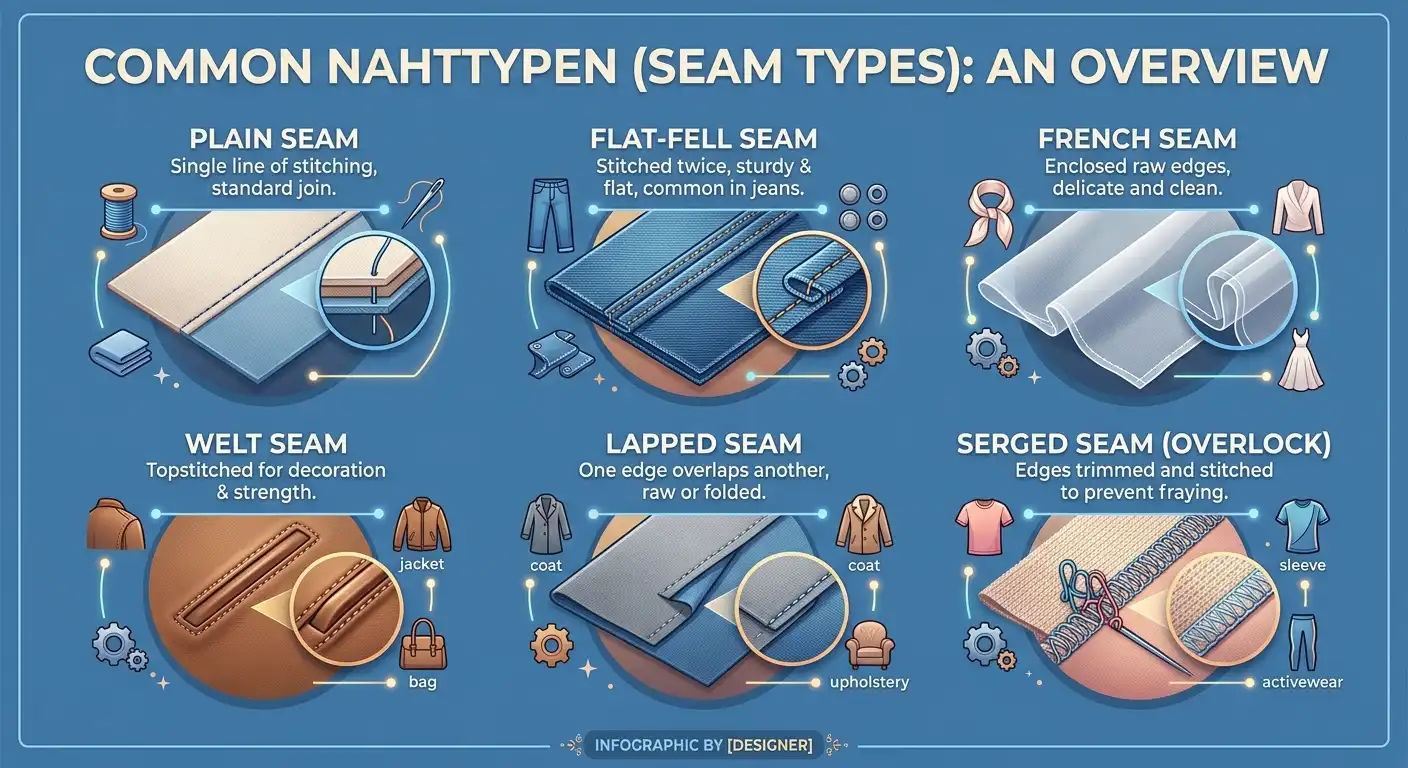
Featured Snippet Answer
Nahttypen is a German term translating directly to “seam types” or “joining methods.” In sewing, fashion design, and textile engineering, it describes how two or more layers of fabric are arrange, fold, and stitched together. Common Nahttypen include plain seams (Steppnaht), French seams (Französische Naht), and flat-felled seams (Kappnaht).
Key Takeaways
- Nahttypen translates to “seam types,” defining how textile layers are position and join.
- The choice of seam determines garment durability, edge finishing, comfort, and visual appeal.
- Professional garment manufacturers use the ISO 4916 standard to classify seams into eight distinct structural classes.
- Beyond sewing, the term Nahttypen also refers to weld joint types in engineering and suture techniques in medicine.
- Selecting the right seam depends on fabric weight, elasticity, garment stress points, and skin contact.
What Does Nahttypen Mean?
Understanding technical vocabulary is essential for fashion designers, tailors, and textile engineers. The word Nahttypen combines two German words: Naht (seam or join line) and Typen (types or categories). In English, it translates to seam types or joining methods.
A seam is create whenever two or more pieces of material are held together by thread, adhesive, or thermal welding. While a seam might seem like a simple line of thread on the surface, its internal structure determines how a garment fits, stretches, and handles daily wear.
[Fabric Layer A] =============> Top Material
===================================== (Seam Allowance)
————————————- Line of Stitching
===================================== (Seam Allowance)
[Fabric Layer B] =============> Bottom Material
German-to-English Linguistic Breakdown
In technical documentation, understanding Nahttypen prevents translation errors. In textile contexts, Naht almost always means a sewn seam. However, because German uses compound words, Naht can also describe a seam in other industries:
- Textile Engineering: Nähnaht (sewn seam)
- Metalworking: Schweißnaht (welded joint)
- Medicine: Chirurgische Naht (surgical suture)
Seam Types vs. Stitch Types
It is common to confuse seam types with stitch types, but they are distinct concepts in garment construction:
- Stitch Type (Stichart): Describes how the thread itself loops or locks together (e.g., lockstitch, chainstitch, or zig-zag stitch).
- Seam Type (Nahttyp): Describes how the pieces of fabric are fold, stack, and orient relative to one another before or during stitching.
Essential Sewing Nahttypen (Seam Types)
Every sewing project requires choosing an appropriate seam structure. Below are the primary seam types use in garment production and dressmaking.
Plain Seam (Steppnaht)
The plain seam—known in German as a Steppnaht or einfache Naht—is the most fundamental seam type in home and commercial sewing.
- Construction: Two fabric layers are place with their right sides facing together. A straight line of stitching is sewn at a fixed distance from the edge (the seam allowance). The seam allowances are then pressed open or to one side.
- Best Uses: Everyday garments, shirts, dresses, skirts, and woven fabrics that do not fray easily.
- Pros & Cons: Quick to sew and easy to alter, but leaves raw edges exposed inside the garment unless finished with zig-zag stitching or pinking shears.
French Seam (Französische Naht)
A French seam is an enclose seam designed to hide raw fabric edges completely without using an overlock machine.
- Construction: The fabric pieces are first placed wrong sides together and sewn near the edge. The seam allowance is trim short, pressed open, and folded so the fabric pieces are right sides together. A second seam is sewn, enclosing the raw edges inside a tidy fabric envelope.
- Best Uses: Lightweight, sheer, or delicate fabrics like silk, chiffon, organza, and lace.
- Pros & Cons: Delivers a smooth, luxury finish with zero fraying. However, it adds bulk to heavy fabrics and requires high sewing accuracy.
Flat-Felled Seam (Kappnaht)
Known as a Kappnaht or Jeansnaht in German, the flat-felled seam is famous for exceptional strength and clean appearance on both sides.
- Construction: The fabric layers are overlap, trimmed asymmetrically, folded over one another, and stitched down flat on the exterior face with two parallel rows of stitching.
- Best Uses: Jeans, denim jackets, workwear, sport shirts, and heavy canvas gear.
- Pros & Cons: Extremely durable, flat, and lie comfortable against the skin. However, it requires precise trimming and is difficult to alter later.
Overlock and Flatlock Seams (Überwendling- und Flatlocknaht)
Modern knitwear relies heavily on specialized machine seams designed for stretchable materials.
- Overlock Seam: Uses multiple threads to stitch a seam while simultaneously trimming and encasing the raw edge. It stretches easily without thread breakage.
- Flatlock Seam: Joins two fabric pieces edge-to-edge (butt-joined) without overlapping seam allowances, producing a completely flat seam.
- Best Uses: Activewear, leggings, swimwear, t-shirts, and underwear.
Bound and Piped Seams (Eingefasste Naht und Paspelnaht)
Decorative and edge-finishing seams add visual flair while strengthening structural seams.
- Bound Seam (Eingefasste Naht): Encloses the raw edge of a single fabric piece or seam allowance inside a folded strip of bias tape.
- Piped Seam (Paspelnaht): Inserts a narrow folded strip of fabric—often containing a cord—between two main fabric layers to create a raised decorative line.
German-to-English Seam Terminology Reference
When working with international patterns or technical specification sheets, this table provides direct translations for common seam terms:
| German Term (Nahttyp) | English Technical Name | Construction Method | Primary Application |
| Steppnaht / Einfache Naht | Plain Seam | Right sides together, single straight stitch line | Shirts, trousers, general dressmaking |
| Französische Naht | French Seam | Two-pass enclosed seam (wrong sides first, then right sides) | Delicate, sheer, silk, and chiffon garments |
| Kappnaht | Flat-Felled Seam | Folded over, double-stitched flat seam | Jeans, workwear, outerwear, canvas |
| Überwendlingnaht | Overlock / Serger Seam | Loop-stitched thread encasing trimmed edge | T-shirts, knitwear, interior edge finishing |
| Flatlocknaht | Flatlock Seam | Butt-joined edges with multi-thread coverstitch | Athletic wear, yoga pants, thermals |
| Eingefasste Naht | Bound Seam | Raw edge enclosed in bias binding | Unlined jackets, pocket edges, necklines |
| Paspelnaht | Piped Seam | Corded fabric strip inserted into joint | Upholstery, jacket collars, pillows |
Professional Seam Classification: The ISO 4916 Standard
In commercial textile manufacturing, descriptive names like “French seam” are replaced by the international standard ISO 4916. This system categorizes all industrial seam types into eight main structural classes.
ISO 4916 SEAM CLASSIFICATION
Class 1 Class 2 Class 3
Superposed Seams Lapped Seams Bound Seams
(Stacked layers) (Overlapped) (Tape wrapped)
Class 4 Class 5 Class 6
Flat Seams Decorative Stitches Edge Finishing
(Edge-to-edge) (Ornamental) (Hemming & serging)
Class 7 Class 8
Single-Ply Joints , Double-Folded
Class 1: Superposed Seams
Fabric layers are stack on top of one another with their edges align, then sewn along the same edge. The standard plain seam (Steppnaht) belongs to Class 1.
Class 2: Lapped Seams
Fabric layers overlap, facing either the same or opposite directions, and are stitch together. The flat-felled seam (Kappnaht) is the classic example of a Class 2 seam.
Class 3: Bound Seams
A narrow strip of binding material is folded around the edge of one or more fabric layers and stitched in place.
Class 4: Flat Seams
Two fabric edges are placed side-by-side without overlapping and joined across the gap by coverstitching threads. Flatlock activewear seams belong to Class 4.
Classes 5–8: Decorative, Edge, and Structural Seams
- Class 5: Decorative stitching added to a single layer of fabric.
- Class 6: Edge finishing constructions, including blind hems and overlocked edges.
- Class 7: Seams where one layer is folded over another single layer edge.
- Class 8: Seams constructed with double-folded construction on both fabric edges.
How to Choose the Right Nahttyp for Your Fabric
Selecting the wrong seam type can lead to puckered fabric, broken threads, or uncomfortable garments. Consider these key factors when choosing a seam:
[SEAM SELECTION DECISION MATRIX]
|
[Woven Fabric] [Knit Fabric]
(Heavy) (Light/Shear) (High Stretch) (Low Stretch)
Flat-Felled French Flatlock Overlock
Seam Seam Seam Seam
Fabric Weight and Structure
- Lightweight Fabrics (Chiffon, Silk, Voile): Require narrow, enclosed seams like French seams to prevent fraying without adding heavy thread bulk.
- Heavyweight Fabrics (Denim, Canvas, Wool): Need strong, structural seams like flat-felled or welt seams that can handle thick layers without tearing.
Stretch and Elasticity
- Woven Fabrics: Do not stretch significantly. Plain, flat-felled, and French seams work well because rigid threads will not restrict the material.
- Knit Fabrics (Jersey, Spandex, Ribbing): Require elastic seams like overlock, flatlock, or narrow zig-zag seams that expand and contract with the fabric.
Garment Stress Points and Wearability
High-tension areas—such as pants crotches, armholes, and side seams on activewear—benefit from reinforced flat-felled or double-stitched seams. For inner garments worn directly against sensitive skin, low-profile flatlock seams prevent chafing.
Nahttypen in Other Technical Fields: Welding and Medicine
While Nahttypen primarily refers to sewing, the German term extends to other technical industries where two materials or tissues are joined.
Welding Seams (Schweißnähte)
In metalworking and structural engineering, a welded seam is called a Schweißnaht. Welding Nahttypen refer to joint geometry and edge preparation:
- I-Naht (Square Butt Weld): Flat metal sheets joined edge-to-edge without beveling.
- V-Naht (V-Groove Weld): Metal edges are ground into a V shape before welding to ensure deep penetration.
- Kehlnaht (Fillet Weld): Joins two pieces of metal at a right angle (such as T-joints or lap joints).
Surgical Sutures (Chirurgische Nähte)
In medical terminology, Nahttypen describes surgical suture patterns used by doctors to close surgical incisions:
- Einzelknopfnaht (Interrupted Suture): Individual, separate stitches tied independently to ensure wound stability if one stitch breaks.
- Fortlaufende Naht (Continuous Suture): A single continuous thread used to complete a row of stitches quickly.
- Matratzennaht (Mattress Suture): Provides deep tissue approximation and edge eversion for clean wound healing.
Frequently Asked Questions (FAQs)
What does Nahttypen mean in English?
Nahttypen is a German plural noun that translates directly to “seam types” or “joining methods.” In sewing, it describes how layers of fabric are folded, stacked, and sewn together. In engineering, it refers to weld joint types, and in medicine, it means suture techniques.
What are the most common Nahttypen in garment making?
The most widely used seam types in clothing construction include the plain seam (Steppnaht), French seam (Französische Naht), flat-felled seam (Kappnaht), overlock seam (Überwendlingnaht), and flatlock seam.
Which Nahttyp is best for knit or stretch fabrics?
Overlock seams and flatlock seams are best for knit and stretch fabrics. These seams incorporate looped thread structures that expand and recover with the movement of elastane and knit fibers without snapping thread.
How does ISO 4916 organize seam types?
ISO 4916 classifies seams internationally into eight numerical classes based on structural design: Class 1 (superposed), Class 2 (lapped), Class 3 (bound), Class 4 (flat), Class 5 (decorative), Class 6 (edge finishing), Class 7 (single-ply folded), and Class 8 (double-folded).
Why are French seams used on sheer fabrics?
French seams completely enclose the raw fabric edges inside a narrow double-sewn seam allowance. Because sheer materials like chiffon and organza fray easily and show internal construction, the French seam provides an attractive, fray-proof finish visible through the fabric.

Robert Hayes is an ESL educator and curriculum developer with over nine years of experience teaching English to beginners and intermediate learners across multiple countries ( Biography ).