
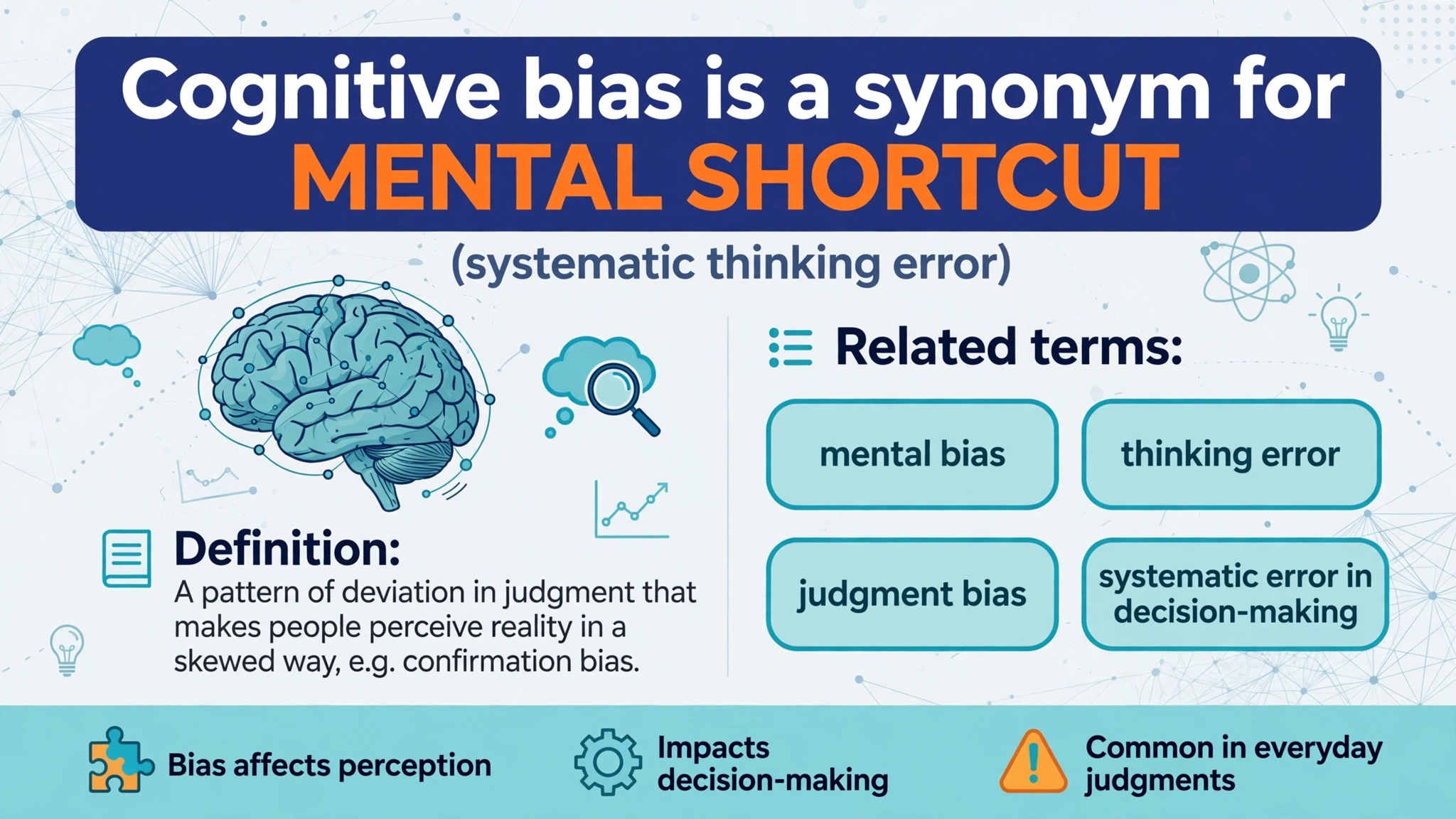
Cognitive bias is a synonym for a thinking error, mental bias, or biased judgment. It describes a predictable pattern in how people process information, interpret events, and make decisions.
Depending on the context, related phrases such as reasoning error or judgment bias may also work, although each term has a slightly different meaning.
Key Takeaways
- A cognitive bias is a systematic tendency that can influence thinking and decision-making.
- Common alternatives include thinking error, mental bias, biased judgment, and reasoning error.
- Mental shortcut is a related phrase, but it is not an exact synonym.
- Cognitive bias is broader than prejudice and differs from a logical fallacy.
- The best synonym depends on whether you are writing casually, academically, or professionally.
What Is a Synonym for Cognitive Bias?
The closest everyday synonym for cognitive bias is thinking error. Other useful alternatives include mental bias, biased judgment, and reasoning error.
A cognitive bias occurs when a person’s thinking follows a predictable pattern that can influence how they understand information or make decisions. These patterns may cause someone to overlook evidence, rely too heavily on a first impression, or favor information that supports an existing belief.
According to the Cambridge English Dictionary, cognitive bias involves understanding events, facts, and people through personal beliefs and experiences in ways that may not be reasonable or accurate. Source
For example, imagine buying a product because it has hundreds of positive reviews while ignoring several detailed complaints about its quality. Your decision may reflect a bias toward positive information.
Cognitive biases are not always intentional. They can affect ordinary decisions, even when someone genuinely tries to be fair and objective.
Best Words and Phrases Similar to Cognitive Bias
Here are seven alternatives you can use, depending on the meaning and tone of your sentence.
1. Thinking Error
Thinking error is one of the simplest alternatives to cognitive bias. It describes a mistake or problem in the way someone processes information.
Example: “Assuming the first solution is always the best one can be a thinking error.”
Use this phrase in general articles, educational content, and everyday conversations. However, a single thinking error does not necessarily represent a systematic cognitive bias.
2. Mental Bias
Mental bias refers to a tendency that influences how someone interprets information or forms opinions.
Example: “A mental bias can affect how a manager evaluates job applicants.”
This phrase is useful in discussions about judgment, decision-making, workplace behavior, and personal beliefs. It is close in meaning to cognitive bias, although cognitive bias is generally the more established technical term in psychology.
3. Biased Judgment
Biased judgment describes an evaluation that is influenced by assumptions, preferences, or incomplete consideration of evidence.
Example: “The hiring decision reflected biased judgment because the manager favored a candidate with a similar background.”
Use this alternative when the focus is on a decision or evaluation rather than the underlying mental process.
4. Reasoning Error
A reasoning error occurs when someone reaches a conclusion through flawed or incomplete reasoning.
Example: “Rejecting a scientific finding simply because it challenges an existing belief may involve a reasoning error.”
This phrase works well in academic writing, critical-thinking lessons, and discussions about arguments. However, not every reasoning error is caused by a cognitive bias.
5. Cognitive Distortion
Cognitive distortion is a related term often used in discussions of mental health and cognitive behavioral therapy. It describes an unhelpful or inaccurate pattern of thought.
Example: “Believing that one unsuccessful presentation proves you will fail at every future presentation may reflect an all-or-nothing thinking pattern.”
Cognitive distortion is not a perfect synonym for cognitive bias. The terms overlap, but they are used in different contexts and describe different aspects of thinking.
6. Mental Shortcut
A mental shortcut is a quick way of processing information without examining every detail. In psychology, these shortcuts are often called heuristics.
Example: “Choosing a familiar brand to save shopping time is a mental shortcut.”
Shortcuts can be useful because they make decisions faster. However, they can sometimes contribute to biased judgments. Therefore, mental shortcut describes a related process, not the bias itself.
7. Judgment Bias
Judgment bias describes a tendency that influences how someone evaluates information, probabilities, people, or situations.
Example: “Judgment bias may cause an investor to focus on recent market gains while overlooking longer-term risks.”
This phrase is particularly useful in business, finance, research, and decision-making discussions.
Cognitive Bias Synonyms Compared
The following table helps you choose the most suitable alternative.
| Alternative | Best use | Meaning |
|---|---|---|
| Thinking error | Everyday writing | A mistake or flaw in thought |
| Mental bias | General explanations | A tendency affecting thought |
| Biased judgment | Decisions and evaluations | An assessment influenced by bias |
| Reasoning error | Logic and critical thinking | Flawed reasoning leading to a conclusion |
| Cognitive distortion | Mental health contexts | An unhelpful or inaccurate thought pattern |
| Mental shortcut | Quick decision-making | A simplified way to process information |
| Judgment bias | Professional and academic writing | A tendency affecting evaluations |
Best overall choice: Use thinking error for simple, general writing and biased judgment when describing a particular decision. For technical psychology content, keep cognitive bias when that is the precise concept you mean.
Examples of Cognitive Bias in Everyday Life
Understanding examples makes it easier to recognize when a synonym fits.
Confirmation bias: A person searches for articles supporting their opinion but ignores reliable evidence that challenges it. You could describe the behavior as a tendency toward selective information processing.
Anchoring bias: A shopper sees a jacket originally priced at $200 and considers a $100 sale price an excellent deal without checking whether the jacket is worth $100. This illustrates how an initial number can influence judgment.
Availability bias: Someone hears about several airplane accidents in the news and begins to overestimate how often such accidents happen. Recent or memorable information influences their perception of risk.
Hindsight bias: After a sports team wins a championship, a fan insists the outcome was obvious all along, even though the result was uncertain beforehand.
Halo effect: An interviewer assumes a candidate is highly competent in every area because the candidate makes a confident first impression.
These examples show why cognitive bias is a useful umbrella term. Different biases affect memory, attention, risk assessment, and evaluations in different ways. They can influence decisions without proving that a person is careless or unintelligent.
Cognitive Bias vs. Prejudice, Heuristics, and Logical Fallacies
These terms are related, but they should not automatically replace one another.
Cognitive bias vs. prejudice: Prejudice generally involves a preconceived attitude toward a person or group. Cognitive bias is broader and can influence judgments about anything from prices to probabilities. Some biases involve prejudice, but many do not. The American Psychological Association explains implicit bias as an attitude or association that may operate without conscious awareness. Source
Cognitive bias vs. heuristic: A heuristic is a mental shortcut used to simplify a decision. A cognitive bias is a systematic tendency in judgment that may arise when information is processed in a particular way. A shortcut can be useful without producing a biased result.
Cognitive bias vs. logical fallacy: A cognitive bias concerns a pattern in human thinking or judgment. A logical fallacy is a flaw in an argument’s reasoning. The two may occur together, but they describe different things.
Choosing the correct term helps make your writing more accurate, especially in psychology, education, research, and professional communication.
How to Choose the Right Synonym
Use these simple guidelines when replacing cognitive bias in a sentence.
- For simple explanations: Choose thinking error or mental bias.
- For workplace decisions: Use biased judgment or judgment bias.
- For critical thinking: Choose reasoning error when the issue concerns flawed reasoning.
- For mental health discussions: Use cognitive distortion only when it accurately describes the thought pattern.
- For decision-making processes: Use mental shortcut when you mean a heuristic rather than the resulting bias.
Always consider the sentence’s meaning before changing the wording. Synonyms can be similar without being interchangeable in every situation.
Frequently Asked Questions
What is the closest synonym for cognitive bias?
The closest general synonym is thinking error. Other suitable alternatives include mental bias and biased judgment. The best choice depends on whether you want to describe a general pattern of thought, a tendency affecting perception, or a particular decision influenced by assumptions.
Is cognitive bias another word for prejudice?
No. Prejudice usually refers to a preconceived attitude toward a person or group, while cognitive bias is a broader term for systematic tendencies in judgment. A cognitive bias may contribute to prejudice, but it can also affect ordinary choices, memory, estimates, and decisions that have nothing to do with social groups.
Is a cognitive bias the same as a thinking error?
Not exactly. A thinking error can describe any flaw in thought, including an isolated mistake. A cognitive bias usually refers to a more systematic tendency that can influence judgments under particular conditions. The phrases overlap, so thinking error is useful for general writing but may be less precise in technical discussions.
What is the opposite of cognitive bias?
There is no single exact opposite of cognitive bias. Depending on the context, useful contrasting phrases include objective judgment, unbiased reasoning, and evidence-based decision-making. These expressions describe efforts to evaluate information fairly, although people cannot guarantee perfectly unbiased thinking in every situation.
How do you use cognitive bias in a sentence?
You could write, “The manager’s cognitive bias led her to favor familiar candidates over equally qualified applicants.” The sentence describes how a mental tendency may influence a decision. In a less technical context, you could replace cognitive bias with biased judgment, provided that the alternative preserves the intended meaning.
Conclusion
Cognitive bias is a synonym for a thinking error, mental bias, or biased judgment, depending on the context. These alternatives can make your writing easier to understand, but they are not always exact substitutes.
Use thinking error for a simple explanation, biased judgment for a decision, and cognitive bias when you need the established psychological term.
Choosing precise wording helps readers understand how thinking patterns influence everyday judgments and decisions.

Lily Parker edits and reviews language comparison content to maintain accuracy and readability.