Quick Definition + Best Synonyms
The word vicinity appears often in daily speech, news, and formal writing.
Learning its synonyms helps you sound clearer and more precise.
This guide explains simple alternatives with easy examples for ESL learners.
Direct Answer
Vicinity means the area close to a place.
You can replace it with common words that show nearness or closeness.
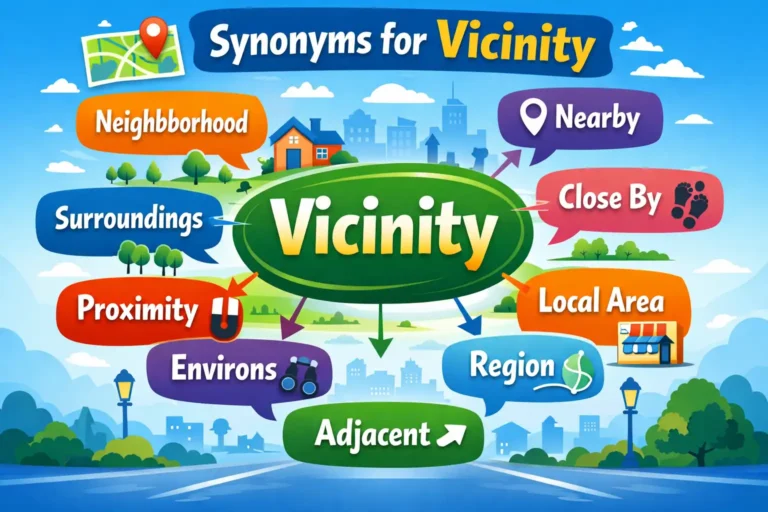
Common synonyms:
- area
- nearby
- neighborhood
- proximity
- surrounding area
- close by
Meaning of Vicinity
Vicinity refers to the space or area around a specific place. It focuses on closeness, not distance.
Example:
There are several restaurants in the vicinity of the hotel.
Categories of Synonyms (by Meaning)
1) Immediate Nearness
These words stress very close distance.
2) Local Area
These terms describe a general place or district around something.
3) Relative Closeness
These options sound more abstract or formal and often appear in writing.
Synonyms Table
| Word | Simple Meaning | Example Sentence |
| area | a place or region | The area has many shops. |
| nearby | close to something | A nearby park is open. |
| neighborhood | local community area | The neighborhood is quiet. |
| proximity | state of being near | The school is in close proximity. |
| surroundings | things around a place | The surroundings look peaceful. |
| close by | not far away | A café is close by. |
Master Synonyms List (Grouped by Level)
Beginner / Simple
- area – a place around something
There is a hospital in the area. - nearby (informal) – close in distance
A nearby store sells groceries. - close by (informal) – very near
The bus stop is close by.
Intermediate
- neighborhood – local residential area
The neighborhood has small parks. - surroundings – areas around a place
The surroundings are clean and safe.
Advanced / Formal
- proximity (formal) – nearness in space
The office values proximity to clients. - adjacent area (formal) – next to a place
Parking is available in the adjacent area.
Formal vs Informal Synonyms
Use nearby and close by in conversation.
Choose proximity or adjacent area for academic or business writing.
Match the word to your audience and purpose.
Real-Life Usage Examples
- Conversation: “Is there a bank nearby?”
- Academic Writing: “The samples were collected in close proximity.”
- Business Writing: “Our office is located in the surrounding area.”
- Blogging: “Cafés in the neighborhood are easy to find.”
- Emotional Expression: “I feel safe knowing help is close by.”
Similar Words Comparison
Vicinity vs Area
Vicinity focuses on closeness. Area is broader and less specific.
The vicinity of the station vs the area of the city.
Vicinity vs Proximity
Vicinity sounds neutral and common. Proximity sounds formal and technical.
Shops in the vicinity vs homes in close proximity.
Example Sentences
- The clinic is in the vicinity of the mall.
- Schools in the area are well rated.
- A nearby bus arrives every hour.
- The neighborhood feels friendly.
- Hotels in close proximity fill quickly.
- The surroundings remain calm at night.
- A pharmacy is close by.
- Offices value proximity to transport.
- Cafés line the adjacent area.
- The park improves the area.
- Residents enjoy the neighborhood events.
- A gym opened nearby.
- Safety improved in the surroundings.
Common Mistakes (with corrected examples: Wrong → Right)
- Using “vicinity” for far distances
- Wrong: The beach is in the vicinity of New York.
- Right: The beach is far from New York.
- Right (if it’s close): The beach is in the vicinity of New York.
- Using “area” when you need “near” (too broad)
- Wrong: There’s a café in the area of my house (meaning very close).
- Right: There’s a café nearby.
- Right (broader meaning): There’s a café in the area.
- Using informal options in academic/business writing
- Wrong (formal report): The lab is close to the station.
- Right: The lab is in close proximity to the station.
- Using “neighborhood” for non-residential places
- Wrong: The airport is in my neighborhood.
- Right: The airport is in the vicinity of my home.
- Right (if you mean your local community): My neighborhood has many parks.
- Using “proximity” without the correct structure
- Wrong: The office is close to the mall.
- Right: The office is in proximity to the mall.
- Right (more natural): The office is in close proximity to the mall.
- Confusing “surroundings” with “nearby places”
- Wrong: A bank is in the surroundings.
- Right: A bank is nearby.
- Right (correct use of surroundings): The surroundings are quiet and safe.
- Overusing one synonym (sounds repetitive)
- Wrong: There are shops nearby. The school is nearby. The clinic is nearby.
- Right: There are shops nearby. The school is in the area. The clinic is in close proximity.
Tips / Best Practices
- Pick a word that matches distance.
- Check tone: casual or formal.
- Use simple words for clarity.
- Avoid overuse; vary your language naturally.
When NOT to Use Vicinity
Do not use vicinity for large regions or cities.
Avoid it when exact distance or direction matters.
Opposite Words (Antonyms)
- distance
- remoteness
- far away
- isolation
FAQs
What does vicinity mean?
It means the area close to a place.
Is the vicinity formal or informal?
It is neutral and works in most contexts.
How can I use it in conversation?
Say it when talking about places near you.
What is the best synonym for vicinity?
Nearby is the simplest choice.
Can vicinity be replaced with area?
Yes, but the area is less specific.
Is proximity a good replacement?
Yes, in formal writing.
Can I use vicinity in business emails?
Yes, it sounds professional and clear.
Does vicinity mean walking distance?
Not always; it only shows closeness.
Is the neighborhood the same as the vicinity?
Neighborhoods are more specific to living areas.
Conclusion
Learning synonyms for vicinity helps you choose clearer, more natural words in both speaking and writing. The right synonym improves tone, precision, and reader understanding, whether you are chatting, studying, or writing professionally.
CTA: Pick 1 synonym for casual use (like nearby) and 1 for formal use (like proximity), then use both in your next sentence.

Sophia Bennett is a research-focused language writer specializing in word meanings, semantic distinctions, and practical vocabulary usage. Her work centers on helping readers understand how similar words differ in tone, context, and accuracy, making complex language concepts easier to apply in everyday writing and communication. With a background in editorial research and reference-based content development, she contributes carefully structured articles designed to improve clarity, precision, and language confidence.
Sophia’s experience in research-based writing involves analyzing dictionary sources, linguistic references, and real-world usage patterns to explain subtle differences between commonly confused words. She focuses on presenting information in a clear, neutral, and accessible way so readers can quickly understand not only definitions, but also context, connotation, and correct usage. Her writing emphasizes accuracy, readability, and consistency across topics related to synonyms, word comparisons, and meaning distinctions.
As part of an editorial content environment focused on informational language resources, Sophia approaches each article with careful source review and structured comparison methods. Her work prioritizes factual correctness and usefulness over opinion, ensuring readers can rely on the material for writing, learning, and vocabulary development. She regularly contributes explanatory content that breaks down similar terms into practical examples, helping learners recognize when one word is more appropriate than another.
Sophia Bennett’s writing supports students, writers, English learners, and professionals seeking clearer communication. By focusing on language accuracy and semantic clarity, she helps readers build confidence in word choice and develop a stronger understanding of meaning differences in modern English usage.