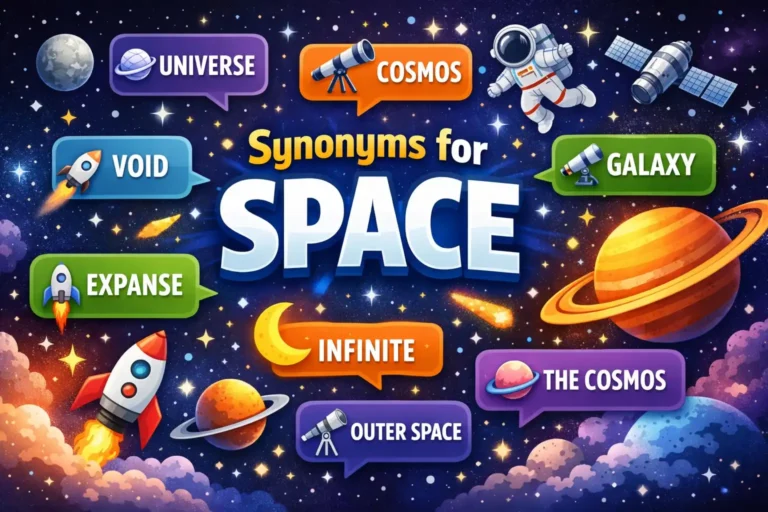
The word space is common in daily speech, writing, science, and business.
It can mean an empty area, outer space, or personal freedom.
Learning synonyms for space helps you speak and write more clearly.
Direct Answer
Space means an empty area, a place, or the distance between things. It can also mean outer space or personal freedom.
Common synonyms for space:
- area
- room
- place
- gap
- distance
- region
- location
- zone
- capacity
- cosmos
Meaning of Space
Dictionary-style definition:
According to the Merriam-Webster Dictionary, space is “a continuous area or expanse that is free, available, or unoccupied.”
In simple English, space means an empty area, the distance between things, or the universe beyond Earth.
Example:
There is not enough space in my bag for your laptop.
Categories of Synonyms
1. Physical Area
These words describe empty or available physical locations.
Examples: area, room, place, location.
2. Distance or Separation
These words describe the amount of separation between objects.
Examples: gap, distance.
3. Specific or Defined Sections
These words describe organized or defined parts of a larger place.
Examples: region, zone.
4. Outer Space
These words relate to the universe beyond Earth.
Example: cosmos.
5. Available Amount
These words describe how much can fit inside something.
Example: capacity.
Synonyms Table
| Word | Simple Meaning | Example Sentence |
| area | A part of a place | This area is very quiet. |
| room | Available place for something | We need more room for guests. |
| place | A specific location | This is a safe place. |
| gap | Empty space between things | There is a gap in the fence. |
| distance | The space between two points | The distance is five miles. |
| region | A large area | This region is famous for wine. |
| location | A specific position | The hotel has a great location. |
| zone | A special section | This is a no-parking zone. |
| capacity | The amount something can hold | The stadium has a large capacity. |
| cosmos | The universe | Scientists study the cosmos. |
Master Synonyms List (Grouped by Level)
Beginner / Simple
Area
Meaning: A part of a place
Example: This area is very clean.
Room
Meaning: Free place for something
Example: There is no room in the car.
Place
Meaning: A specific spot
Example: This park is a nice place to relax.
Gap
Meaning: An empty space between things
Example: There is a small gap between the doors.
Intermediate
Distance
Meaning: Space between two points
Example: The distance between the cities is short.
Location
Meaning: Exact position
Example: The store changed its location.
Region
Meaning: A large area
Example: This region gets a lot of snow.
Advanced / Formal
Zone (Neutral)
Meaning: An area with a special purpose
Example: This zone is for loading only.
Capacity (Formal)
Meaning: The amount something can hold
Example: The hall reached full capacity.
Cosmos (Formal/Literary)
Meaning: The universe
Example: Astronauts explore the cosmos.
Formal vs Informal Synonyms
- Place and room are common in conversation.
- Location and region sound more formal.
- Capacity is often used in business or technical writing.
- Cosmos is formal and used in science or literature.
Choose your synonym based on tone and situation.
Real-Life Usage Examples
Conversation
Do we have enough room in the car?
Academic Writing
The region has a unique climate pattern.
Business Writing
The event reached full capacity.
Blogging
This place is perfect for weekend trips.
Emotional Expression
I need some space to think.
Similar Words Comparison
Space vs Area
Space can mean empty room or outer space.
Area usually means a specific part of a place.
Example:
There is space on the table.
This area is reserved for staff.
Space vs Room
Space is general.
Room often means available capacity inside something.
Example:
We need more space in the office.
There is no room in the fridge.
Example Sentences (With Contextual Variety)
- Please leave some space between your car and mine in the parking lot.
- The baby needs space to crawl safely on the floor.
- There is limited space on my phone for new apps.
- The company rented extra office space downtown.
- She moved to a quiet area because she wanted more personal space.
- The distance between the two buildings creates open space for light.
- The museum redesigned the gallery to create more walking space.
- This storage box does not have enough room for winter clothes.
- Scientists continue to study outer space with advanced telescopes.
- Leave a small gap between each word on the page.
- The stadium reached full capacity before the concert started.
- This region has wide open spaces and beautiful mountains.
- The app saves space by compressing large files.
- We need a safe space for children to play after school.
- The table takes up too much space in the small kitchen.
These examples show how space can refer to physical areas, storage capacity, distance, personal boundaries, business use, and outer space.
Common Mistakes
- Using “room” for outdoor places
Incorrect: There is a lot of room in the park.
Better: There is a lot of space in the park. - Confusing “space” and “place”
Space is empty area.
Place is a location. - Using “cosmos” in casual speech
It sounds too formal for daily conversation. - Overusing “space” repeatedly
Use synonyms to avoid repetition in writing.
Tips / Best Practices
- Choose based on context (physical, distance, universe).
- Consider formality level.
- Keep your sentence clear and natural.
- Avoid repeating the same word many times.
- Do not replace words if the meaning changes.
When NOT to Use Space
Do not use space when you mean:
- A specific city or building (use place or location).
- Emotional privacy in formal reports (use privacy instead).
- Measured length (use distance if you mean miles or meters).
Opposite Words (Antonyms) of Space
The opposite of space depends on its meaning. Below are common antonyms with clear explanations.
1. Crowd
Meaning: A large number of people in one place.
Use it when there is no free area to move.
Example:
The crowd filled the street, leaving no space to walk.
2. Fullness
Meaning: The state of being completely filled.
Use it when there is no empty room left.
Example:
The fullness of the box showed there was no space inside.
3. Congestion
Meaning: Too many people or vehicles in one area.
Often used for traffic or busy cities.
Example:
Traffic congestion reduced road space during rush hour.
4. Limit
Meaning: The maximum amount allowed.
Used when something reaches its boundary.
Example:
The elevator reached its weight limit, so there was no extra space.
5. Closeness
Meaning: Very little distance between people or objects.
Used when things are near each other.
Example:
The closeness of the chairs made the room feel small.
6. Confinement
Meaning: The state of being restricted or kept in a small area.
Often used in emotional or physical contexts.
Example:
He felt confinement in the tiny apartment with no open space.
Quick Tip
- Use crowd and congestion for busy places.
- Use fullness and limit for capacity.
- Use closeness for distance.
- Use confinement for restricted movement or freedom.
Choosing the right antonym depends on whether you mean physical space, distance, or personal freedom.
FAQs
What does space mean?
It means an empty area, distance, or the universe beyond Earth.
Is space formal or informal?
It is neutral and used in both formal and informal situations.
How can I use it in conversation?
Example: I need some space to relax.
What is the best synonym for space?
It depends on context. Area and room are common choices.
Can space be replaced with room?
Sometimes yes, especially when talking about available capacity.
Conclusion
Learning synonyms for space helps you write and speak more clearly.
It improves vocabulary and avoids repetition.
Try using 3 new synonyms in your next sentence.

**Author Biography — Amelia Brooks**
Amelia Brooks is a research-focused language writer specializing in word meaning, semantic comparison, and clarity in English usage. Her work centers on helping readers understand subtle differences between similar words, phrases, and expressions through structured, evidence-based explanations. With a strong editorial background in informational publishing, she contributes carefully researched content designed to improve vocabulary accuracy and comprehension.
Amelia’s professional experience includes years of research-driven writing in educational and reference-style content. She focuses on analyzing how words function in context, how meanings shift across situations, and how synonyms differ in tone, precision, and practical usage. Her approach combines linguistic research, dictionary sourcing, corpus examples, and editorial verification to ensure consistency and accuracy.
She is particularly interested in semantic relationships between words, including synonym distinctions, contextual appropriateness, and common misunderstandings in everyday language. By breaking down meaning differences into clear explanations, Amelia helps readers make confident word choices in writing, academic work, and professional communication.
Her writing follows strict editorial standards that prioritize neutrality, clarity, and reliability. Each article is developed with reader intent in mind, focusing on usefulness rather than opinion. She emphasizes verifiable definitions, real usage patterns, and structured comparisons that support informed language learning.
Through her work in the Word Synonyms niche, Amelia supports readers who want practical, trustworthy guidance on English vocabulary. Her content is designed for students, writers, educators, and professionals who rely on precise language. By maintaining a research-based methodology and consistent editorial quality, she helps build reader trust while making complex language distinctions easier to understand.