Quick Intro: Why “Shore” Synonyms Matter
The word shore is common in daily speech, travel writing, geography, and storytelling. People use it when talking about the sea, lakes, or rivers.
Learning synonyms for shore helps you write more clearly and avoid repetition.
Direct Answer
Shore means the land along the edge of a sea, lake, or river.
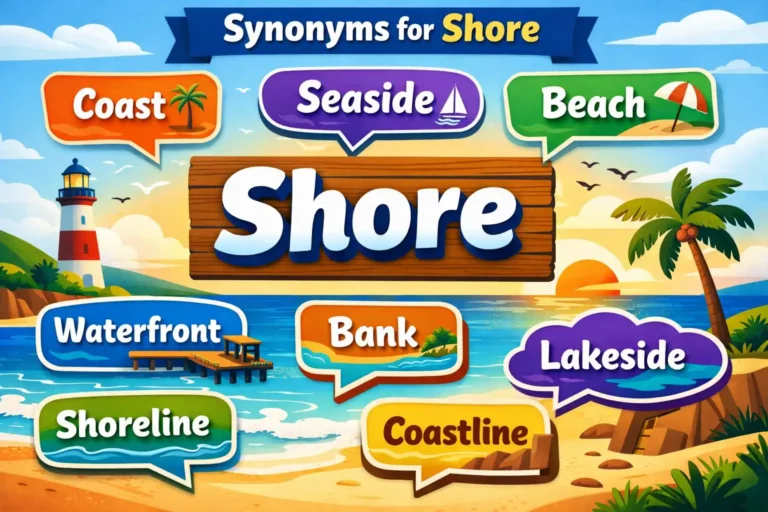
Common synonyms include:
- Coast
- Beach
- Seaside
- Waterfront
- Bank
- Coastline
- Seaboard
- Littoral
- Strand
Meaning of Shore
A shore is the land next to a large body of water such as an ocean, sea, lake, or river.
Example: We walked along the shore at sunset.
Categories of Synonyms
1. Ocean and Sea Edges
These words describe land next to oceans or seas. They are common in travel and geography.
Examples: coast, seaside, seaboard, coastline
2. Sandy or Recreational Areas
These focus on sandy areas where people relax or swim.
Examples: beach, strand
3. General Water Edges
These describe land next to rivers, lakes, or any body of water.
Examples: bank, waterfront, littoral
Synonyms Table
| Word | Simple Meaning | Example Sentence |
| Coast | Land along the sea | They drove along the coast. |
| Beach | Sandy area by water | The kids played on the beach. |
| Seaside | Area near the sea | We stayed in a seaside hotel. |
| Waterfront | Land next to water | The city has a beautiful waterfront. |
| Bank | Edge of a river | She sat on the river bank. |
| Coastline | The outline of a coast | The coastline stretches for miles. |
| Seaboard | Coastal region | The storm hit the eastern seaboard. |
| Littoral | Land near a sea (formal) | The region has rich littoral habitats. |
| Strand | Beach or shoreline | They walked along the quiet strand. |
Master Synonyms List (Grouped by Level)
Beginner / Simple
Coast
Simple meaning: Land next to the sea
Example: We walked along the coast at sunrise.
Beach
Simple meaning: Sandy area near water
Example: The children built castles on the beach.
Bank
Simple meaning: Edge of a river
Example: He stood on the river bank and watched the boats.
Intermediate
Seaside
Simple meaning: Area near the sea
Example: They bought a small seaside house.
Waterfront
Simple meaning: Area along water
Example: The restaurant sits on the waterfront.
Coastline
Simple meaning: The shape of land by the sea
Example: The island has a long coastline.
Strand
Simple meaning: Beach (often poetic)
Example: Tourists relaxed on the sunny strand.
Advanced / Formal
Seaboard (Formal)
Simple meaning: Coastal region
Example: The hurricane moved toward the southern seaboard.
Littoral (Formal/Scientific)
Simple meaning: Area close to the sea
Example: The littoral zone supports many plants.
Formal vs Informal Synonyms
Use simple words like beach and coast in everyday conversation.
Use more formal words like littoral or seaboard in academic writing, geography texts, or news reports.
Always match your word choice to your audience.
Real-Life Usage Examples
Conversation
“Let’s go to the beach this weekend.”
Academic Writing
“The coastline shows signs of erosion.”
Business Writing
“The hotel offers rooms overlooking the waterfront.”
Blogging
“We explored a quiet seaside village.”
Emotional Expression
“I felt calm walking along the coast.”
Similar Words Comparison
Shore vs Coast
Shore often refers to the immediate edge of water.
Coast usually means a larger coastal region.
Example:
- We sat on the shore.
- The west coast is famous for beaches.
Shore vs Beach
Shore can be rocky, sandy, or muddy.
Beach usually means a sandy recreational area.
Example:
- The shore was rocky.
- The beach was full of tourists.
Example Sentences (Varied and Context-Rich)
- We sat quietly on the lake shore and watched the sunset reflect on the water.
- Fishermen stood along the river bank early in the morning.
- Waves hit the rocky coast during the storm.
- Snow covered the icy shoreline after the cold night.
- The city built parks along the urban waterfront.
- Children searched for shells on the sandy beach.
- The eastern seaboard prepares every year for hurricane season.
- The island’s coastline curves around steep cliffs.
- Scientists studied plants in the littoral zone of the lake.
- Tourists walked along the quiet seaside promenade.
- Boats rested close to the harbor shore at dusk.
- The narrow strand stretched between the sea and the hills.
- Houses line the peaceful lakeside area.
- Birds gathered where the river meets the shore.
Common Mistakes
1. Using “bank” for the ocean
Bank is for rivers or lakes, not seas.
2. Using “beach” for rocky areas
A beach usually has sand. Not all shores are beaches.
3. Overusing one synonym
Repeating “coast” too often makes writing dull.
4. Using formal words in casual speech
Avoid saying “littoral zone” in normal conversation.
Tips for Choosing the Right Synonym
- Consider the type of water (river, sea, lake).
- Think about the tone (formal or casual).
- Choose clear, simple words for ESL writing.
- Avoid repeating the same word many times.
- Keep your language natural and accurate.
When NOT to Use “Shore”
Do not use shore when talking about land far from water.
Also avoid it when you specifically mean a sandy area. In that case, use beach.
Opposite Words (Antonyms)
The word shore does not have a perfect opposite in every situation, but these words work as opposites depending on context.
- Offshore – Away from the land, out in the water (most common contextual opposite)
Example: The boat moved offshore to avoid the rocks. - Inland – Away from the coast or water
Example: The storm weakened as it moved inland. - Open sea – Far from any shore or land
Example: The ship sailed into the open sea. - Interior – Inside a country, far from water
Example: The interior regions are much drier.
Important Note
Mainland is not always an antonym of shore. It means the main part of a country or continent and can still include coastal areas.
FAQs
What does shore mean?
It means land next to a sea, lake, or river.
Is shore formal or informal?
It is neutral and works in both formal and casual writing.
How can I use it in conversation?
Example: “We walked along the shore.”
What is the best synonym for shore?
It depends on context. Coast is very common.
Can shore be replaced with beach?
Only if the area is sandy.
Is shoreline the same as shore?
Yes, but shoreline focuses more on the boundary line.
What word should I use for a river edge?
Use bank.
Is littoral commonly used?
It is mostly used in scientific or academic writing.
Can I use coast for lakes?
No. Coast usually refers to seas or oceans.
What is a poetic synonym for shore?
Strand is often used in poetry.
Conclusion
Learning synonyms for shore improves your vocabulary and makes your writing more interesting. It helps you choose precise words for different situations.
Try using three new synonyms in your next sentence to strengthen your English skills.

**Author Biography — Noah Peterson**
Noah Peterson is a research-focused language writer and editorial contributor specializing in word meanings, synonym comparisons, and semantic clarity in modern English usage. His work centers on helping readers understand subtle differences between similar words, phrases, and expressions through structured, evidence-based explanations. By combining linguistic research with practical writing guidance, he supports learners, students, and professionals seeking precision in communication.
With a background in research-driven informational writing, Peterson has spent years studying vocabulary development, contextual meaning, and usage patterns across academic, professional, and everyday English. His editorial approach prioritizes clarity, accuracy, and neutrality, ensuring that explanations remain accessible while maintaining linguistic reliability. He is particularly interested in how small differences in wording can influence tone, intent, and interpretation.
Peterson’s contributions focus on breaking down complex language concepts into straightforward comparisons supported by real-world examples. His synonym analysis work emphasizes context-based meaning rather than simple dictionary substitution, helping readers choose words more confidently and appropriately. This method reflects a strong commitment to language accuracy and responsible informational publishing.
As part of a research-based editorial environment, Peterson collaborates with content teams to maintain consistency, factual correctness, and semantic relevance across educational articles. His writing follows structured content standards designed to support search clarity and reader comprehension while aligning with evolving digital publishing practices.
Through carefully researched explanations and clear word comparisons, Noah Peterson helps readers build stronger vocabulary awareness and a deeper understanding of meaning distinctions — skills that support effective writing, learning, and communication across academic and professional settings.