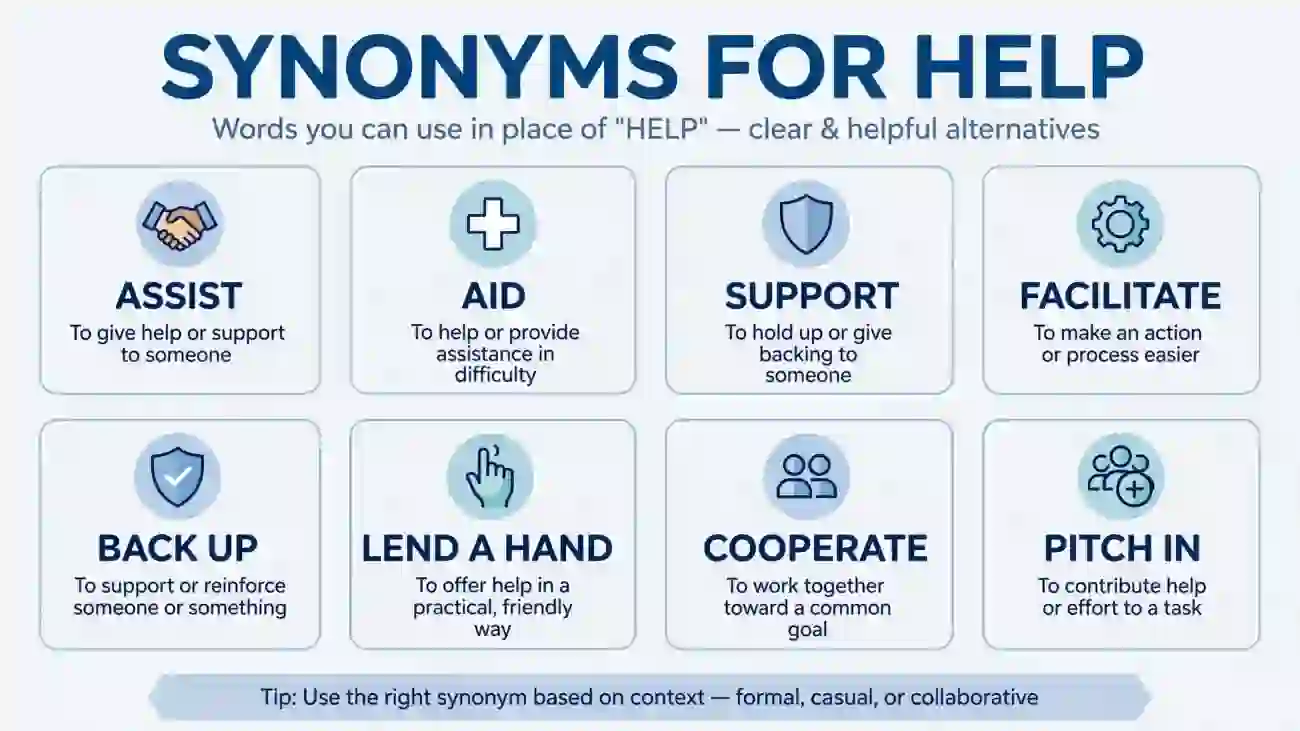
A synonym for help is assist, aid, or support. These words describe giving someone assistance, making a task easier, or helping a person achieve a goal. Other alternatives include guide, encourage, cooperate, facilitate, and lend a hand. The best synonym depends on your sentence, the level of formality, and the type of help you mean.
Key Takeaways
- Assist is a good choice for formal and professional situations.
- Aid often describes practical, financial, or emergency assistance.
- Support emphasizes encouragement, backing, or ongoing assistance.
- Lending a hand is a friendly, informal way to offer help.
- Choose a synonym based on meaning and context, not just variety.
What Does Help Mean?
The word help means making something easier for another person or providing what they need to complete a task, solve a problem, or improve a situation.
You can help someone by offering advice, sharing your knowledge, providing money, doing part of a job, or giving emotional support. For example, a teacher helps students understand a lesson, while a friend helps you through a difficult day.
Help works as both a noun and a verb. As a verb, it describes an action: “I help my brother with homework.” As a noun, it describes the assistance someone receives: “Thank you for your help.”
Because the word has several uses, no single synonym fits every sentence. Understanding the meaning you want to express makes choosing the right alternative much easier.
25 Synonyms for Help and Their Meanings
Here are 25 useful words and phrases you can use instead of help, depending on the situation.
Common Synonyms
- Assist: To help someone complete a task. Example: “The technician assisted me with the installation.”
- Aid: To provide practical assistance or make a difficult situation better. Example: “The organization aids families in need.”
- Support: To give assistance, encouragement, or backing. Example: “My coworkers support me when deadlines get tight.”
- Guide: To help someone by offering direction or advice. Example: “The mentor guided her through the application process.”
- Encourage: To give someone confidence or motivation. Example: “Her coach encouraged her to keep practicing.”
- Cooperate: To work together toward a shared goal. Example: “Both teams cooperated to finish the project.”
- Contribute: To provide something useful toward a goal. Example: “Several volunteers contributed their time.”
- Serve: To help meet someone’s needs. Example: “The staff serves customers throughout the day.”
- Relieve: To reduce pain, pressure, worry, or difficulty. Example: “A short break helped relieve his stress.”
- Facilitate: To make a process or activity easier. Example: “The new software facilitates communication between departments.”
Formal and Professional Synonyms
- Provide assistance: A polished phrase for giving practical help. Example: “Our team can provide assistance with your request.”
- Offer guidance: To share advice or direction. Example: “The supervisor offered guidance to the new employee.”
- Enable: To make something possible. Example: “The training enables employees to use the new system.”
- Advise: To recommend an action or provide informed guidance. Example: “The consultant advised us on the next steps.”
- Contribute to: To play a part in achieving a result. Example: “Regular feedback contributes to better performance.”
- Facilitate progress: To remove obstacles or make advancement easier. Example: “Clear instructions facilitate progress.”
- Reinforce: To strengthen an idea, effort, or existing support. Example: “The manager reinforced the team’s confidence.”
- Champion: To actively promote or defend a person, idea, or cause. Example: “She champions programs that support local students.”
Casual Synonyms
- Lend a hand: To help someone in a friendly, practical way. Example: “Can you lend a hand with these boxes?”
- Give a hand: To provide assistance, especially with a task. Example: “I’ll give you a hand cleaning the garage.”
- Pitch in: To join others in helping. Example: “Everyone pitched in to prepare for the party.”
- Help out: To provide assistance when someone needs it. Example: “My neighbor helped out while I was traveling.”
- Back up: To support someone or help them handle a situation. Example: “My teammate backed me up during the presentation.”
- Be there for: To provide emotional support or dependable assistance. Example: “My friends were there for me during a difficult week.”
- Come to someone’s aid: To step in when someone needs assistance. Example: “A passerby came to the cyclist’s aid.”
Remember that these alternatives are related in meaning, but they are not always interchangeable. For example, encouragement usually means providing emotional motivation, while assisting more often involves helping with a task.
Which Synonym for Help Should You Use?
The best alternative depends on your audience, writing style, and intended meaning.
For Professional Emails
In workplace communication, assisting, supporting, providing assistance, and offering guidance can sound appropriate and clear.
Instead of writing:
“Can you help me with this report?”
You could write:
“Could you assist me with this report?”
Or, if you want a polite and natural tone:
“Could you support me with the final review of this report?”
Choose the phrase that describes the actual request. You do not need a complicated word to sound professional.
For Essays and Academic Writing
In essays, alternatives such as support, facilitate, contribute to, and enable can make your meaning more precise.
For example:
- Basic: “Exercise helps people stay healthy.”
- More specific: “Regular exercise supports overall health.”
- Process-focused: “Exercise can contribute to better physical fitness.”
Use facilitates when something makes a process easier, and use contributes when something is one factor in a result. Avoid replacing every instance of help with a formal word simply to make your writing sound academic.
For Everyday Conversations
Simple expressions usually work best in casual situations.
Try these examples:
- “Can you help me?” → “Can you give me a hand?”
- “I’ll help you move.” → “I’ll pitch in.”
- “She helped me with dinner.” → “She helped out with dinner.”
- “Thanks for helping me.” → “Thanks for being there for me.”
These phrases sound friendly and natural in conversations, texts, and informal messages.
Help vs. Assist vs. Aid vs. Support
Although these four words are closely related, each emphasizes a slightly different kind of assistance.
| Word | Main meaning | Best use | Example |
| Help | Make something easier or provide assistance | Everyday situations | Can you help me study? |
| Assist | Help someone complete a task | Professional or formal situations | The clerk assisted the customer. |
| Aid | Provide practical or significant assistance | Emergencies, funding, and official contexts | The group provided disaster aid. |
| Support | Give backing, encouragement, or ongoing assistance | Personal, professional, or emotional situations | My family supports my goals. |
Which word is best? Use help for general situations, assist for a more formal tone, aid for practical or organized assistance, and support when the emphasis is on backing someone or helping them continue.
For example, “I support your decision” means you approve of or stand behind someone’s choice. “I assist your decision” would not express the same meaning naturally.
Examples of Help Synonyms in Sentences
Seeing alternatives in context can make it easier to choose the right word.
| Original sentence | Alternative sentence |
| Can you help me with my homework? | Can you assist me with my homework? |
| The program helps local families. | The program supports local families. |
| This tool helps us work faster. | This tool enables us to work faster. |
| She helped organize the meeting. | She coordinated the meeting. |
| He helped his friend feel confident. | He encouraged his friend. |
| We helped each other finish the job. | We cooperated to finish the job. |
| The instructions helped the process run smoothly. | The instructions facilitated the process. |
| My neighbor helped me carry the furniture. | My neighbor lent a hand with the furniture. |
Notice that some alternatives require changing the sentence structure. For instance, coordination may work when someone organizes a task, but it is not a universal replacement for help. Always check whether the revised sentence preserves your original meaning.
What Is the Opposite of Help?
The opposite of help depends on how the word is used.
Common antonyms include:
- Hinder: To make progress more difficult.
- Obstruct: To block a person or process.
- Prevent: To stop something from happening.
- Undermine: To weaken someone’s efforts or confidence.
- Oppose: To act against an idea, person, or plan.
- Discourage: To reduce someone’s confidence or motivation.
Examples:
- “The instructions helped us finish” becomes “The confusing instructions hindered our progress.”
- “She supported the plan” becomes “She opposed the plan.”
- “His advice encouraged me” becomes “His criticism discouraged me.”
The right antonym depends on whether help means providing assistance, improving a situation, or encouraging someone.
Frequently Asked Questions
What is another word for help?
The most common alternatives are assist, aid, and support. You can also guide, encourage, facilitate, or lend a hand. Choose the word that matches your intended meaning and tone. For everyday conversation, help out is natural, while providing assistance often fits formal communication.
What is a more formal word for help?
Assist is one of the best formal alternatives to help. Other choices include aid, provide assistance, and offer guidance. For example, “Our staff will assist you with your application” sounds professional without being unnecessarily complicated.
What is a professional way to say help?
Professional alternatives include assist, support, provide assistance, and offer guidance. In an email, you could write, “I’d be happy to assist you with this request.” For ongoing encouragement or backing, support may be more appropriate than assistance.
What is a stronger word for help?
The strongest alternative depends on the situation. Rescue suggests saving someone from danger, champion means actively supporting a person or cause, and coming to someone’s aid emphasizes stepping in during a difficult moment. For ordinary tasks, however, assist or support may be more accurate.
What is the best synonym for help in an essay?
Assist, support, facilitate, and contribute to are useful choices, but they serve different purposes. Use assist when someone helps with a task, support when something strengthens or backs an idea, and facilitate when something makes a process easier. Accuracy matters more than choosing the longest word.
Is help a noun or a verb?
Help can be both a noun and a verb. As a verb, it describes providing assistance: “I help my sister study.” As a noun, it refers to the assistance itself: “I appreciate your help.” This distinction matters because some synonyms work better as nouns than as verbs.
Final Thoughts
The best synonym for help is usually assist, aid, or support, but the right choice depends on what you want to say. Assist works well in professional situations, aid often describes practical assistance, and support emphasizes encouragement or backing.
For casual conversations, expressions such as lend a hand, pitch in, and help out sound natural. For essays, words such as facilitate and contribute to can add precision when they fit the meaning.
When choosing a synonym, focus on clarity first. A simple, accurate word will always serve your reader better than a complicated alternative that changes your meaning.

Lily Parker edits and reviews language comparison content to maintain accuracy and readability.