
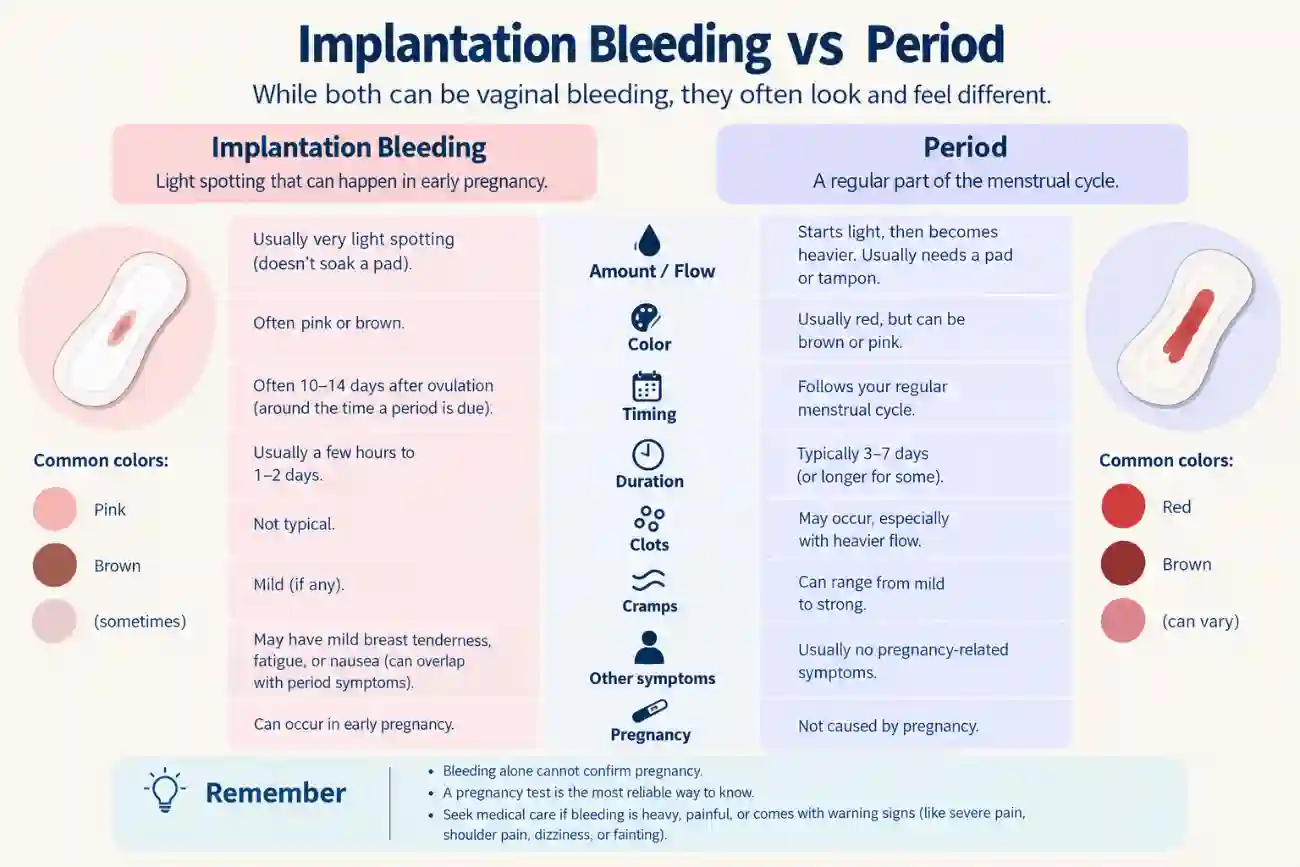
Implantation bleeding is usually much lighter and shorter than a normal period. It may appear as pink or brown spotting around the time a period is expected, while menstrual bleeding generally develops into a stronger flow and lasts several days. However, bleeding alone cannot confirm pregnancy. A pregnancy test is a more reliable way to check.
Key Takeaways
- Implantation bleeding is typically light spotting rather than a regular menstrual flow.
- It may happen around 10–14 days after ovulation, close to when a period is due.
- Pink or brown spotting is commonly described with implantation bleeding.
- A period generally becomes heavier and lasts longer than implantation spotting.
- You cannot confirm pregnancy based only on the color, amount, or timing of bleeding.
- A home pregnancy test can help determine whether pregnancy is likely.
- Heavy bleeding, severe pain, shoulder pain, dizziness, or fainting requires prompt medical attention.
What Is Implantation Bleeding?
Implantation bleeding refers to light vaginal spotting that can happen very early in pregnancy when a fertilized egg attaches to the lining of the uterus.
It usually happens around 10 to 14 days after ovulation, which can be close to the expected start of a menstrual period. That timing is one reason the two can be easy to confuse.
Not everyone who becomes pregnant experiences implantation bleeding. Some people have no spotting at all, so the absence of bleeding does not mean pregnancy has not occurred.
When implantation spotting happens, it is generally light. You might notice a small amount on toilet paper when wiping or on underwear rather than needing to change a regular pad repeatedly.
Implantation Bleeding vs Period: Key Differences
There is no single symptom that can always tell you which type of bleeding you have. Still, several patterns can provide useful clues.
| Feature | Implantation Bleeding | Menstrual Period |
| Amount | Usually very light spotting | Usually develops into a regular flow |
| Color | Often pink or brown | Often red, although color can vary |
| Duration | Often brief, sometimes a few hours to a couple of days | Commonly several days |
| Timing | Often around 10–14 days after ovulation | Follows the menstrual cycle |
| Clots | Not typical | May occur, especially with heavier flow |
| Cramps | If present, usually mild | Can range from mild to strong |
| Pregnancy | May occur in early pregnancy | Not caused by pregnancy |
These are general patterns, not diagnostic rules. Individual menstrual cycles and pregnancies can look different.
Flow and Amount
Flow is one of the most useful differences to consider.
Implantation bleeding is generally described as spotting or very light bleeding. It should not typically soak through several pads or resemble a normal heavy period.
A menstrual period usually has more noticeable flow. It may start lightly, become heavier, and then gradually become lighter again.
If bleeding is substantially heavier than your normal period, do not automatically assume it is implantation bleeding. Heavy bleeding can have other causes and may need medical evaluation.
Color and Appearance
Implantation spotting is often pink or brown. The blood may appear as a small mark on underwear or when wiping.
Period blood can also be brown, pink, or red at different points in the cycle, so color by itself is not a dependable way to distinguish the two.
For example, seeing brown spotting does not automatically mean you are experiencing implantation bleeding. The timing, amount, symptoms, menstrual history, and pregnancy testing all matter.
Timing
Timing can offer a clue, but it cannot prove what is happening.
Implantation bleeding may occur about 10 to 14 days after ovulation, often around the time someone expects their next period.
A period generally arrives according to your usual menstrual cycle. However, cycles can shift because of stress, hormonal changes, illness, birth control, changes in exercise, and other factors.
This is why counting days alone is not enough to determine whether light bleeding is implantation bleeding.
Duration
Implantation spotting is generally short-lived. It may happen for only a few hours or continue for a day or two.
A period usually lasts longer. Menstrual bleeding can vary from person to person, but several days of bleeding is common.
If bleeding continues, becomes progressively heavier, or is very different from your normal cycle, consider speaking with a healthcare professional rather than assuming it is implantation bleeding.
Cramps and Other Symptoms
Mild cramping can occur with early pregnancy, but cramps can also happen before or during a period. This makes cramps another symptom that cannot reliably distinguish the two.
Early pregnancy can also cause symptoms such as tender breasts, fatigue, nausea, bloating, and more frequent urination. However, some of these symptoms overlap with premenstrual symptoms.
In other words, having cramps plus spotting does not automatically mean pregnancy, just as having breast tenderness does not prove that a period is coming.
What Does Implantation Bleeding Look Like?
Implantation bleeding is usually much lighter than ordinary menstrual flow.
You might notice:
- A few spots when wiping
- Pink or brown discharge
- A small amount of blood on underwear
- Brief spotting
- Mild cramping, if any
It is less typical for implantation bleeding to produce a heavy flow, repeated pad soaking, or significant blood clots.
Still, appearance alone cannot establish that implantation has occurred. Other forms of spotting can look similar.
Can Implantation Bleeding Feel Like a Period?
It can sometimes feel similar, especially if you experience mild cramping.
The difficulty is that premenstrual symptoms and early pregnancy symptoms can overlap. Breast tenderness, fatigue, bloating, and mild cramps can occur around the same time.
The more useful difference is often the pattern of bleeding. Implantation bleeding is generally light and brief, while menstrual bleeding usually develops into a more recognizable period pattern.
If pregnancy is possible, testing is more reliable than trying to diagnose the cause from symptoms alone.
When Should You Take a Pregnancy Test?
A pregnancy test checks for human chorionic gonadotropin, or hCG. The hormone begins to be produced after a fertilized egg attaches to the uterine lining.
Home urine tests can be taken around the time of a missed period. Testing too early can produce a false-negative result because there may not yet be enough hCG for the test to detect.
If you get a negative result but your period does not arrive and pregnancy still seems possible, repeating the test later can be useful. MedlinePlus notes that hCG levels rise during early pregnancy, so testing later may provide a clearer result.
A positive pregnancy test should be followed up with appropriate healthcare.
When Bleeding May Need Medical Attention
Light spotting in early pregnancy does not automatically mean something is wrong. However, bleeding during pregnancy can have several causes, including miscarriage, ectopic pregnancy, infection, or cervical changes.
Possible Warning Signs
Seek urgent medical attention if bleeding occurs with:
- Severe abdominal or pelvic pain
- Sudden or intense pain on one side
- Shoulder pain
- Dizziness, weakness, or fainting
- Heavy bleeding
- Passing significant tissue or large amounts of blood
These symptoms can occur with serious pregnancy complications. ACOG specifically identifies severe abdominal or pelvic pain, shoulder pain, weakness, dizziness, or fainting as warning signs of a possible ruptured ectopic pregnancy.
If you know or suspect that you are pregnant and have unusual bleeding, contacting a healthcare professional is appropriate, especially when bleeding is heavy or accompanied by pain.
Other Causes of Spotting
Not every episode of light bleeding around your expected period is implantation bleeding.
Other possible causes include hormonal birth control, changes in hormone levels, infections, cervical irritation, ovulation spotting, and other gynecologic conditions.
For this reason, it is better to consider implantation bleeding as one possible explanation, rather than treating every instance of light spotting as proof of pregnancy.
Keeping track of your cycle, the timing of bleeding, its amount, and other symptoms can give your healthcare provider useful information if you need an evaluation.
Frequently Asked Questions
Can implantation bleeding be as heavy as a period?
Usually, no. Implantation bleeding is generally light spotting rather than a normal or heavy menstrual flow. Bleeding that becomes heavy or soaks pads should not automatically be labeled implantation bleeding and may need medical evaluation.
Does implantation bleeding have clots?
Blood clots are not typical of implantation bleeding. Light spotting without clots is more consistent with the usual description. However, the presence or absence of a clot alone cannot diagnose the cause of bleeding.
How long does implantation bleeding last?
It may last only a few hours or up to about two days. Some people notice only one episode of spotting. If bleeding continues or becomes heavier, consider another cause and contact a healthcare professional if you are concerned.
Can you be pregnant without implantation bleeding?
Yes. Not everyone experiences implantation bleeding. Pregnancy can occur without any noticeable spotting, so the absence of implantation bleeding does not rule out pregnancy.
Can a pregnancy test be negative after implantation bleeding?
Yes. A test can be negative if it is taken too early. Home pregnancy tests detect hCG, and there may not yet be enough hormone in the urine for a test to detect it. Testing around or after a missed period generally gives a more useful result than testing very early.
Conclusion
When comparing implantation bleeding vs period, the biggest clues are usually flow, duration, timing, and accompanying symptoms.
Implantation bleeding is typically light, brief, and pink or brown, while a period generally develops into a stronger flow over several days.
But these patterns overlap, and bleeding alone cannot confirm pregnancy. If pregnancy is possible, a pregnancy test is a much more useful next step.
If bleeding is heavy or comes with severe abdominal or pelvic pain, shoulder pain, dizziness, weakness, or fainting, seek urgent medical care.

Lily Parker edits and reviews language comparison content to maintain accuracy and readability.