The word righteous appears in daily speech, religion, ethics, and formal writing. It describes someone who acts morally right. Learning synonyms helps you sound clearer, more precise, and more natural in English. Browse the Emotions category to explore more personality traits.
Direct Answer
Righteous means morally right, fair, or honorable. It describes a person or action guided by strong ethics or justice.
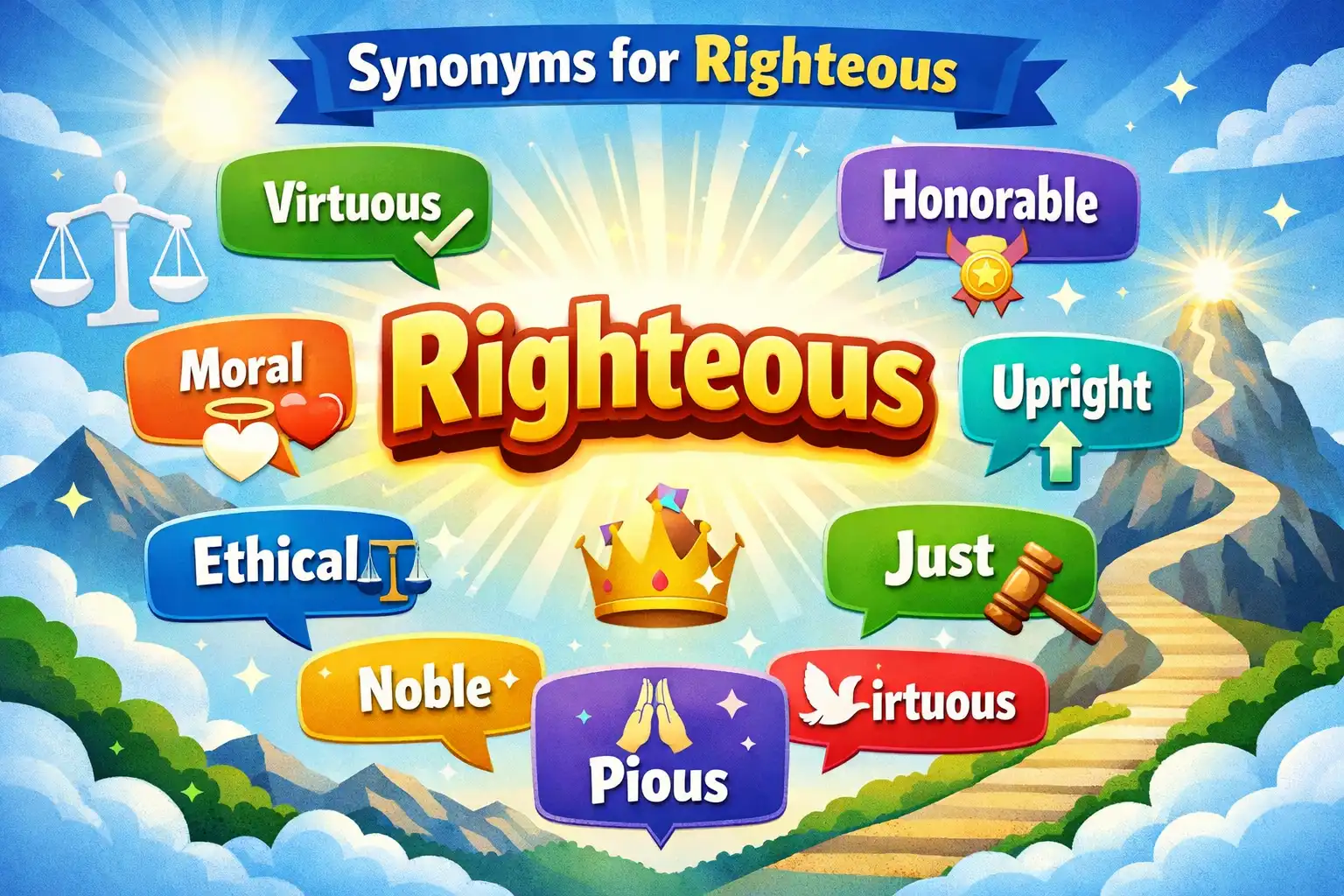
Common synonyms include:
- moral
- virtuous
- just
- upright
- ethical
- honorable
- principled
- decent
- noble
Meaning of Righteous
Righteous describes a person or action that follows strong moral values and fairness.
Example:
She made a righteous decision even though it was difficult.
Categories of Synonyms
Moral goodness
These words describe strong ethical character and good behavior.
Fairness and justice
These focus on treating people equally and doing what is right by law or principle.
Personal integrity
These highlight honesty and strong inner values.
Synonyms Table
| Word | Simple Meaning | Example Sentence |
| moral | following right behavior | He made a moral choice. |
| virtuous | having strong values | She lived a virtuous life. |
| just | fair and lawful | The judge was just. |
| upright | honest and honorable | He is an upright leader. |
| ethical | guided by rules of right and wrong | That was an ethical decision. |
| honorable | worthy of respect | She took an honorable path. |
| principled | guided by beliefs | He is a principled person. |
| decent | respectful and fair | She is a decent neighbor. |
| noble | morally admirable | He showed noble behavior. |
Master Synonyms List (Grouped by Level)
Beginner / Simple
moral — following right behavior
Sentence: She made a moral choice.
(Formal/Neutral)
decent — fair and respectful
Sentence: He is a decent person.
(Informal)
honorable — worthy of respect
Sentence: It was an honorable act.
(Formal)
Intermediate
just — fair and lawful
Sentence: The law must remain just.
(Formal)
ethical — guided by right and wrong
Sentence: She followed an ethical policy.
(Formal)
upright — honest and reliable
Sentence: He is known as an upright man.
(Formal)
Advanced / Formal
virtuous — morally excellent
Sentence: She lived a virtuous life.
(Formal)
principled — guided by strong beliefs
Sentence: He stayed principled under pressure.
(Formal)
noble — morally admirable
Sentence: It was a noble sacrifice.
(Formal/Literary)
Learn how synonyms for integrity align with being righteous.
Formal vs Informal Synonyms
Formal writing prefers words like virtuous, principled, and ethical.
Casual conversation often uses moral or decent.
Choosing the wrong tone can make your sentence sound too serious or too casual.
Real-Life Usage Examples
Conversation:
She is a decent and honest friend.
Academic Writing:
The study raises ethical concerns.
Business Writing:
We follow honorable and fair practices.
Blogging:
People admire leaders with moral courage.
Emotional Expression:
I respect your righteous decision.
Similar Words Comparison
Righteous vs Moral
Moral is general.
Righteous is stronger and suggests deep personal conviction.
Example:
He made a moral choice.
He made a righteous stand.
Righteous vs Just
Just focuses on fairness.
Righteous focuses on personal virtue.
Example:
The court was just.
Her actions were righteous.
Example Sentences
- He defended the weak in a righteous way.
- She felt proud of her moral decision.
- The leader remained upright during crisis.
- It was an honorable agreement.
- The judge gave a just ruling.
- Ethical behavior builds trust.
- He followed a principled path.
- She admired his noble courage.
- Decent people value fairness.
- A virtuous life requires discipline.
- The company promotes ethical values.
- He acted with honorable intent.
- Justice requires upright leadership.
- She respected his principled stand.
Common Mistakes
- Using righteous to sound angry
→ It means moral, not aggressive. - Confusing righteous with religious only
→ It can be moral without religion. - Overusing formal synonyms in casual speech
→ Words like virtuous may sound unnatural in conversation. - Using it sarcastically without context
→ Tone must be clear.
Tips / Best Practices
- Match the tone to the situation
- Use formal words in academic writing
- Use simple words in conversation
- Choose clarity over complexity
- Avoid repeating the same synonym too often
When NOT to Use Righteous
Do not use it when describing simple correctness or facts.
It refers to morality, not accuracy.
Wrong: The math answer is righteous.
Correct: The math answer is correct.
Opposite Words (Antonyms)
- immoral
- unjust
- corrupt
- dishonest
- unethical
FAQs
What does righteous mean?
It means morally right or guided by strong values.
Is righteous formal or informal?
It is neutral but often sounds serious.
How can I use it in conversation?
Use it to praise a strong moral choice.
What is the best synonym for righteous?
Moral is the most flexible choice.
Can righteous be replaced with moral?
Yes, in most everyday contexts.
Conclusion
Learning synonyms for righteous improves writing and speaking. It helps you express moral ideas clearly and naturally. Strong vocabulary creates stronger communication. Discover how synonyms for deserving connect with righteous actions.
Try using 3 new synonyms in your next sentence.

Robert Hayes develops easy-to-understand synonym lists and contextual examples to improve everyday writing.