Micro Introduction
The word protein appears often in nutrition, biology, fitness, and everyday health discussions. Writers, students, and bloggers may want alternative terms to avoid repetition. Learning synonyms helps you write more clearly and sound more natural in English.
Understanding these alternatives is especially helpful in academic writing, health blogs, and science discussions.
Direct Answer
Protein refers to a nutrient made of amino acids that helps build and repair body tissues.
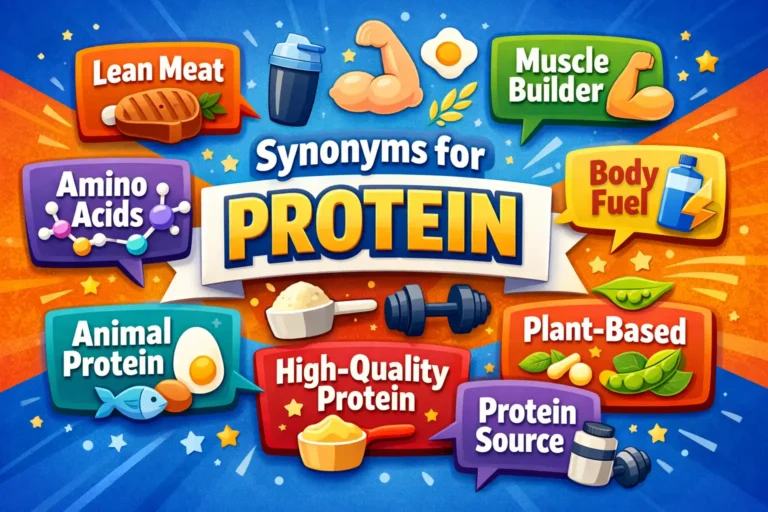
Common synonyms or related terms include:
- Nutrient
- Polypeptide
- Peptide
- Amino acid chain
- Macromolecule
- Albumen
Meaning of Protein
Protein is a nutrient made of amino acids that helps build muscles, repair tissues, and support many body functions.
Example sentence:
Chicken is a rich source of protein that helps the body build muscle.
Proteins are essential for human health and appear in many foods such as meat, beans, eggs, and dairy products.
Categories of Synonyms
Because protein is used in both science and everyday language, its synonyms fall into different categories.
Scientific Terms
These words appear mostly in biology and chemistry. They describe the structure of proteins.
Examples include polypeptide, peptide, and macromolecule.
Nutritional Terms
These words appear in health or diet discussions. They refer to protein as a type of food nutrient.
Examples include nutrient and albumen.
Structural Descriptions
Some terms describe how protein molecules are formed.
Examples include amino acid chain.
Each category helps explain protein from a different perspective: science, nutrition, or structure.
Synonyms Table
| Word | Simple Meaning | Example Sentence |
| Nutrient | Substance in food that helps the body grow | Beans provide an important nutrient for muscle health. |
| Polypeptide | Chain of amino acids forming a protein | Scientists studied a new polypeptide in the lab. |
| Peptide | Short chain of amino acids | This supplement contains a special peptide. |
| Amino acid chain | Linked amino acids forming protein | Every amino acid chain folds into a specific shape. |
| Macromolecule | Very large biological molecule | A macromolecule like protein plays many roles in cells. |
| Albumen | Protein found in egg white | The egg white contains albumen. |
Protein-Related Terms by Complexity
Beginner / Simple Synonyms
Nutrient
Meaning: A substance in food that supports body growth and health.
Example:
Milk contains an important nutrient for strong bones and muscles.
Usage note: Common in everyday health discussions.
Intermediate Synonyms
Amino Acid Chain
Meaning: A sequence of amino acids linked together.
Example:
The amino acid chain folds to create a functional protein.
Usage: Often used in biology explanations.
Peptide
Meaning: A short chain of amino acids.
Example:
Researchers created a peptide that may help repair tissue.
Usage: Common in medical and scientific writing.
Advanced / Formal Synonyms
Polypeptide
Meaning: A long chain of amino acids forming part of a protein.
Example:
The polypeptide structure determines the protein’s function.
Usage: Formal scientific term.
Macromolecule
Meaning: A very large molecule in living organisms.
Example:
Protein is an important macromolecule in every cell.
Usage: Academic or biology contexts.
Albumen
Meaning: Protein found in egg whites.
Example:
The chef separated the yolk from the albumen.
Usage: Mostly formal or scientific.
Formal vs Informal Synonyms
Understanding context helps you choose the correct synonym.
Informal or everyday use
- Nutrient
- Protein
Example:
Protein is an important nutrient for athletes.
Scientific or academic use
- Polypeptide
- Peptide
- Macromolecule
- Amino acid chain
Example:
The enzyme consists of several polypeptide chains.
Specialized usage
- Albumen
Example:
Egg whites contain albumen.
In casual conversation, most people simply say protein.
Real-Life Usage Examples
Conversation
“I need more protein in my breakfast.”
Academic Writing
“The polypeptide folds into a complex structure.”
Business Writing
“Our product contains plant-based protein.”
Blogging
“Adding beans to your meals increases your protein intake.”
Emotional Expression
“I feel stronger when I eat enough protein every day.”
Similar Words Comparison
Protein vs Peptide
Protein usually refers to the full biological molecule.
Peptide refers to a smaller chain of amino acids.
Example:
- This food contains a lot of protein.
- Scientists tested a healing peptide.
Protein vs Nutrient
Protein is a specific nutrient.
Nutrient is a broader category that includes vitamins, minerals, fats, and carbohydrates.
Example:
- Eggs are rich in protein.
- Vegetables provide many important nutrients.
Example Sentences
Here are natural examples showing how the word and its alternatives work.
- Fish contains a high amount of protein.
- Athletes often increase their protein intake.
- A peptide can influence cell communication.
- The lab studied a synthetic polypeptide.
- Protein is an important nutrient for muscle repair.
- Eggs contain a large amount of albumen.
- Each amino acid chain folds into a unique structure.
- Protein is one of the most important macromolecules in biology.
- Beans provide plant-based protein.
- Scientists examined how a peptide interacts with cells.
- The polypeptide structure determines its biological activity.
- Yogurt supplies protein for a healthy diet.
- Every living cell contains important macromolecules.
- The body breaks protein into amino acids during digestion.
- Tofu is a popular vegetarian protein source.
Common Mistakes
1. Using Nutrient as a Direct Replacement
Some learners replace protein with nutrient in every situation.
Incorrect:
“This food contains a lot of nutrient.”
Better:
“This food contains a lot of protein.”
2. Confusing Peptide with Protein
A peptide is smaller than a protein.
Incorrect:
“This meal contains many peptides.”
Correct:
“This meal contains a lot of protein.”
3. Using Scientific Terms in Casual Conversation
Words like polypeptide sound unnatural in everyday speech.
Better for daily use:
Protein
4. Using Albumen Too Broadly
Albumen refers specifically to egg white protein.
Incorrect:
“Chicken contains albumen.”
Correct:
“Egg whites contain albumen.”
Tips for Choosing the Right Synonym
Follow these simple rules.
Consider the Context
- Nutrition → protein, nutrient
- Biology → polypeptide, peptide
Think About Formality
- Everyday conversation → protein
- Scientific writing → polypeptide
Focus on Clarity
Choose the word your audience understands easily.
Avoid Overuse
Repeating protein too often can make writing dull. Use alternatives carefully when appropriate.
When NOT to Use “Protein”
Avoid replacing protein when precision is required.
Examples:
- Nutrition labels
- Medical advice
- Diet plans
In these situations, the exact word protein is usually best.
Example:
“The meal contains 25 grams of protein.”
Replacing it with “nutrient” would make the information less accurate.
Contrasting Nutritional Terms
Protein does not have a strict opposite, but contrasting nutritional terms include:
- Carbohydrate
- Fat
- Vitamin deficiency
- Malnutrition
These words describe different aspects of nutrition rather than the opposite of protein itself.
FAQs
What does protein mean?
Protein is a nutrient made of amino acids that helps build and repair tissues in the body.
Is protein a formal or informal word?
It is neutral and commonly used in both everyday speech and scientific writing.
What is the best synonym for protein?
The best general alternative is nutrient, but it is broader in meaning.
Can protein be replaced with peptide?
Not usually. A peptide is a smaller chain of amino acids.
Is polypeptide the same as protein?
A polypeptide is a chain of amino acids that forms part of a protein molecule.
How can I use protein in conversation?
Example:
“I try to eat enough protein every day.”
What foods contain protein?
Common sources include eggs, meat, fish, beans, dairy, and tofu.
Is albumen a synonym for protein?
It refers specifically to the protein found in egg whites.
Why is protein important?
Protein supports muscle growth, tissue repair, and many body processes.
Is protein a macromolecule?
Yes. In biology, protein is classified as a macromolecule.
Conclusion
Learning synonyms for protein helps improve both writing and understanding. While everyday language usually uses the word protein, scientific and academic contexts may use terms like polypeptide, peptide, or macromolecule.
By understanding when to use each word, you can write more clearly, avoid repetition, and communicate ideas more effectively.
Try using three new synonyms in your next sentence to strengthen your vocabulary.

Danial Karter is a research-focused language writer specializing in word meaning, semantic comparison, and precise usage in modern English. His work centers on helping readers understand subtle differences between similar words, phrases, and expressions so they can communicate more clearly and accurately. With a background in editorial research and reference-based writing, Danial has spent years studying how vocabulary evolves across academic, professional, and everyday contexts.
His approach combines linguistic research, dictionary-level verification, and real-world usage analysis. Rather than relying on opinion or simplified definitions, Danial examines how words function in context — including tone, connotation, grammatical role, and situational appropriateness. This method allows readers to see not only what words mean, but when and why one term is more suitable than another.
Danial’s work focuses heavily on synonym comparison, commonly confused words, and semantic clarity. He is particularly interested in the relationship between language precision and reader understanding, ensuring that explanations remain accessible without sacrificing accuracy. His writing style reflects editorial standards commonly used in reference publishing: clear structure, neutral tone, and evidence-based explanations.
Through research-based informational content, Danial helps students, writers, professionals, and language learners make confident vocabulary choices. His articles are designed to answer specific search questions about word differences while providing reliable linguistic context that supports long-term learning.
As part of an editorial content team dedicated to language accuracy, Danial contributes to maintaining consistency, factual correctness, and clarity across educational resources focused on English synonyms and meaning distinctions. His work supports readers who value careful wording, informed communication, and dependable explanations of language use.