The word places appears in daily speech, writing, and travel contexts. Learning synonyms for places helps ESL learners, students, and writers express ideas more clearly. Using alternatives can make your English sound more precise and natural. For broader geography vocabulary, explore our Places category for more related word lists.
Direct Answer: Best Synonyms for Places
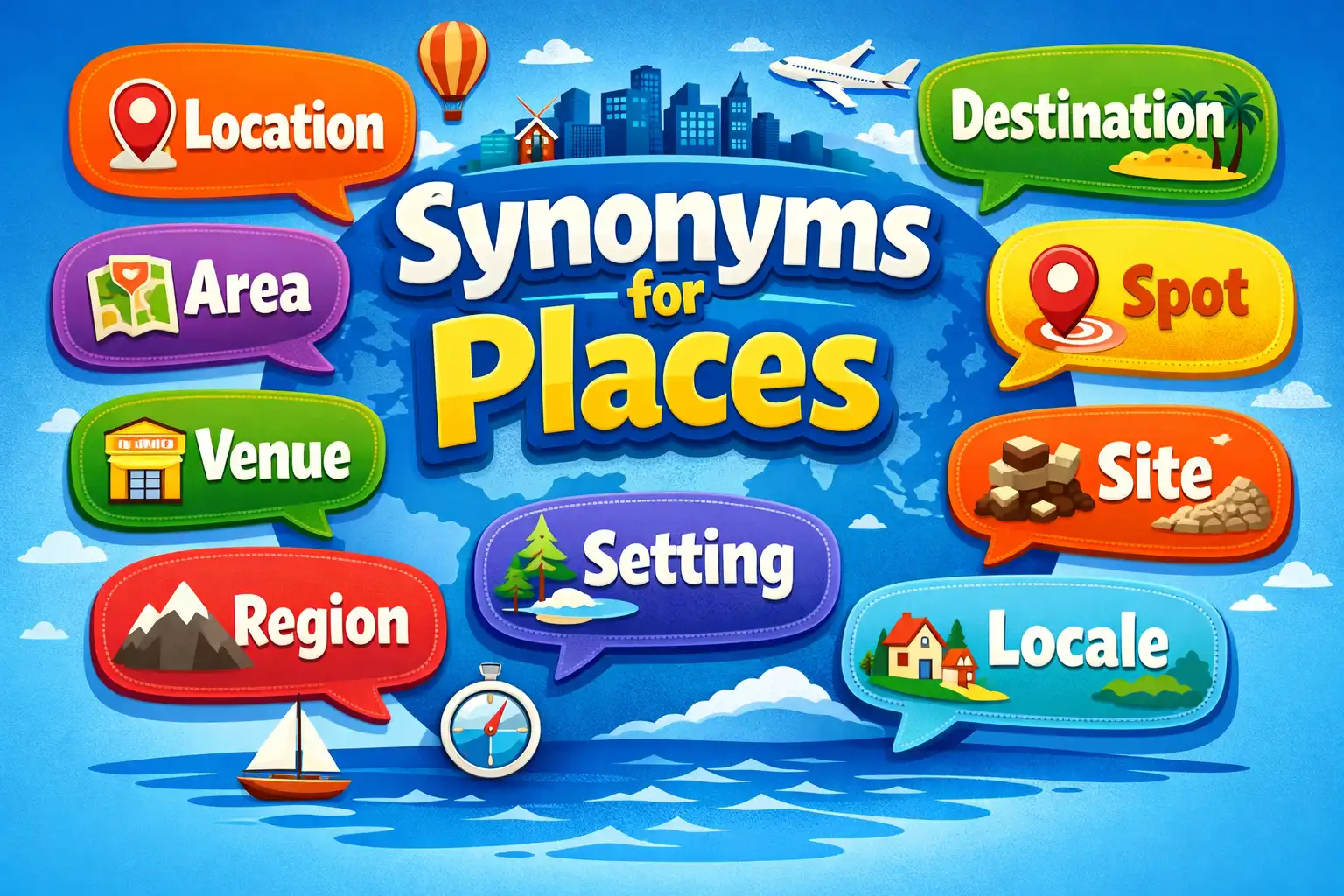
Places refer to locations, areas, or spots where people, objects, or events are found. Common synonyms include:
- Location
- Spot
- Area
- Site
- Venue
- Region
- Locale
- Destination
- Neighborhood
- Setting
Meaning of ‘Places’ (Simple Definition)”
Places are areas or locations where something exists or happens.
Example:
I love visiting new places on my vacation.
Types of Places Synonyms (Physical, Social, Event)
Physical Locations – Refers to real-world areas, like buildings, cities, or natural sites.
Social Locations – Refers to community, neighborhood, or gathering spaces.
Event/Activity Locations – Refers to venues, settings, or destinations where activities happen.
Places Synonyms Table (Meaning + Examples)
| Word | Simple Meaning | Example Sentence |
| Location | Exact position | The restaurant is in a great location. |
| Spot | Small area or point | This is the perfect spot for a picnic. |
| Area | General region | This area is full of shops and cafes. |
| Site | Specific place | The construction site is very busy today. |
| Venue | Place for events | The wedding was held at a beautiful venue. |
| Region | Large area or district | The northern region is very cold in winter. |
| Locale | Local environment | This locale has a lot of history. |
| Destination | Place people travel to | Paris is a famous tourist destination. |
| Neighborhood | Residential area | She lives in a quiet neighborhood. |
| Setting | Background place or scene | The story has a forest setting. |
Master Synonyms List (Grouped by Level)
Beginner / Simple
- Spot – small place – We found a nice spot for lunch. (Informal)
- Area – general place – This area is full of shops. (Neutral)
- Location – exact place – The hotel has a great location. (Neutral)
Intermediate
- Venue – place for events – The conference venue was large and modern. (Formal)
- Neighborhood – residential place – He grew up in a friendly neighborhood. (Neutral)
- Region – large area – The northern region is famous for skiing. (Formal)
Advanced / Formal
- Locale – local environment – The film is set in a rural locale. (Formal)
- Destination – travel location – Rome is a popular destination for tourists. (Formal)
- Site – specific place – The ancient ruins are a UNESCO World Heritage site. (Formal)
Formal vs Informal Synonyms
- Use formal synonyms (venue, destination, locale, site) in writing, presentations, or professional contexts.
- Use informal synonyms (spot, area) in conversation or casual writing.
- Always match the synonym with tone and context for clarity.
You can also read synonyms for location to find terms that fit specific settings more precisely.
Real-Life Usage Examples
Conversation:
- “Let’s meet at my favorite spot near the park.”
Academic Writing:
- “The study was conducted at several urban locations across the city.”
Business Writing:
- “We secured a new venue for the annual conference.”
Blogging:
- “Top 10 destinations to visit this summer.”
Emotional Expression:
- “I feel calm in this peaceful neighborhood.”
Similar Words Comparison
Places vs Location
- Places are general; location is exact.
- Example: “I visited many places in Spain.” vs “The hotel’s location is ideal for sightseeing.”
Places vs Spot
- Spot is smaller or more specific than places.
- Example: “We found a quiet spot by the lake.” vs “There are many places to explore in the park.”
Place vs Venue
- Venue refers to a place for events; place is general.
- Example: “The concert’s venue is near the river.” vs “We went to a lovely place downtown.”
Place vs Site
- Site is often formal or refers to a specific area for construction, history, or research. The place is more casual and broad.
- Example: “The ancient ruins are a UNESCO World Heritage site.” vs “I love visiting new places on vacation.”
Area vs Region
- Area is smaller or local; region refers to a larger geographic zone.
- Example: “This area has many restaurants.” vs “The northern region of the country is mountainous.”
Location vs Destination
- Location is where something is; destination emphasizes travel or where people go.
- Example: “The meeting’s location is on Main Street.” vs “Rome is a popular tourist destination.”
Example Sentences
- She enjoys exploring new places whenever she has free time.
- Will the concert be held at a large venue this weekend?
- This neighborhood offers excellent schools and parks for children.
- They have already visited the historic site in the city.
- Paris is not my only favorite destination for travel.
- The forest provides a beautiful setting where photographers love to work.
- We stopped at a scenic spot and took some amazing photos.
- Does the northern region often experience heavy snowfall?
- Our office has a convenient location downtown, but parking is limited.
- The festival happened in a lively locale full of music and dance.
- The new park covers a large area and includes walking trails.
- I love discovering hidden places in my city during weekends.
- The museum is a famous tourist site, yet some sections are closed today.
- The wedding’s venue was decorated beautifully with flowers and lights.
- Their cottage offers a peaceful rural setting, perfect for relaxing.
- They didn’t find any good spot for lunch nearby.
- I haven’t visited that remote destination yet, but I plan to.
Common Mistakes
- Using spots for large areas – use areas instead.
- Using a venue in casual conversation – prefer place or spot.
- Confusing destination with neighborhood – one is for travel, the other is residential.
- Overusing place – vary synonyms for clarity.
- Using locale in informal writing – best for formal or literary contexts.
Tips / Best Practices for Using Synonyms of Places
- Match the Tone – Choose formal synonyms (e.g., venue, locale, destination) for writing, business, or academic contexts. Use casual synonyms (e.g., spot, area) in conversation or blogs.
- Consider the Context – Think about why you are using the word. Travel? Use destination or region. Writing? Use location or site. Conversation? Spot or place works best.
- Avoid Overuse – Don’t repeat the same word multiple times. Mix alternatives naturally to keep your writing clear and engaging.
- Check Formality and Clarity – Always verify if the synonym fits the audience and context. Avoid formal words in casual texts and casual words in formal writing.
- Be Specific When Needed – Use precise synonyms to convey meaning. For example, use a venue for an event, a neighborhood for a residential area, or a setting for a story or scene.
- Balance Variety with Readability – Introducing too many different synonyms can confuse readers. Prioritize clarity over variety.
When NOT to Use Places
- Avoid places when referring to a single exact spot in formal writing (use location or site).
- Don’t use destinations for everyday spots like cafes or shops.
- Avoid locale in casual texts or conversations.
Antonyms / Contrast Ideas for Places
| Word / Phrase | Meaning / Context Example |
| Nowhere | Not any place; “I looked for the shop, but it was nowhere to be found.” |
| No location | Absence of a defined spot; “The files have no location on the server.” |
| Undefined location | A place that is not specified; “The meeting will happen at an undefined location.” |
| Nonexistent place | A place that doesn’t exist (used contextually); “The legend describes a nonexistent place on the map.” |
FAQs for places
What does places mean?
- Places are locations or areas where people, events, or objects exist.
Are places formal or informal?
- Neutral; works in conversation, writing, and academic contexts.
How can I use it in conversation?
- “I love visiting new places on vacation.”
What is the best synonym for places?
- Location or area depending on context.
Can places be replaced with spots?
- Yes, in informal or specific situations.
Conclusion
Learning synonyms for places improves speaking, writing, and clarity. Using the right word helps you sound more natural and precise. Check synonyms for destination if you want words that focus on where someone is heading.
Try using 3 new synonyms in your next sentence.

Robert Hayes develops easy-to-understand synonym lists and contextual examples to improve everyday writing.