Quick Overview
The word mobile is common in daily speech, writing, and technology.
It can describe people, devices, or things that move easily.
Learning synonyms for mobile helps you speak more clearly and avoid repetition.
Direct Answer
Mobile means able to move easily or freely. It can describe people, objects, or technology.
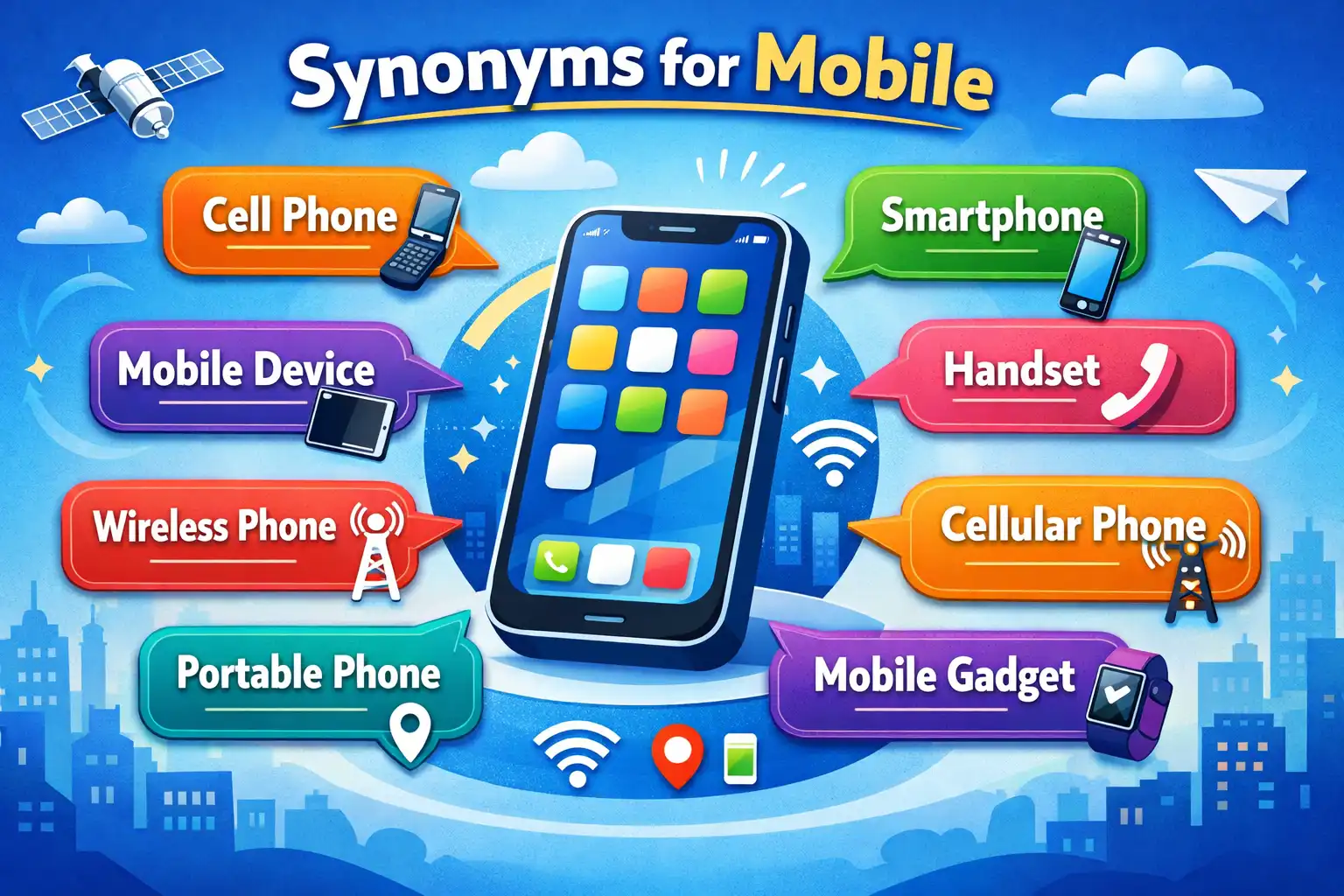
Common synonyms for mobile:
- Movable
- Portable
- Transportable
- Flexible
- Agile
- Roaming
- Wandering
- Nomadic
- Motile
Meaning of Mobile
Mobile describes something that can move easily from one place to another.
Example:
She needs a mobile phone for work.
It can describe:
- Devices (mobile phone)
- People (mobile workforce)
- Body movement (mobile joints)
Categories of Synonyms
1. Physical Movement
These words describe objects or people that can move physically.
Examples: movable, portable, agile, motile
2. Movement Across Places
These words describe movement between locations.
Examples: roaming, wandering, nomadic, transportable
3. Flexibility or Adaptability
These words describe flexibility in work or lifestyle.
Examples: flexible
Formality, Best for (object/people/science)
| Word | Simple Meaning | Example Sentence |
| Movable | Can be moved | The chair is movable. |
| Portable | Easy to carry | This speaker is portable. |
| Transportable | Can be transported | The machine is transportable. |
| Flexible | Can adjust easily | She has a flexible schedule. |
| Agile | Moves quickly and easily | The cat is very agile. |
| Roaming | Moving around | He is a roaming reporter. |
| Wandering | Moving without a fixed path | We saw a wandering dog. |
| Nomadic | Moving from place to place | They live a nomadic life. |
| Motile | Able to move by itself | Some bacteria are motile. |
Master Synonyms List (Grouped by Level)
Beginner / Simple
Movable
Meaning: able to be moved
Example: The table is movable.
Portable
Meaning: easy to carry
Example: This is a portable charger.
Flexible
Meaning: able to adjust
Example: She has a flexible work plan.
Intermediate
Transportable
Meaning: able to be transported
Example: The cabin is transportable by truck. (Formal)
Agile
Meaning: able to move quickly
Example: The gymnast is very agile.
Roaming
Meaning: moving from place to place
Example: He works as a roaming technician.
Advanced / Formal
Nomadic
Meaning: living without a fixed home
Example: They follow a nomadic lifestyle. (Formal)
Motile
Meaning: able to move independently
Example: The cells are motile under the microscope. (Technical)
Wandering
Meaning: moving without direction
Example: The wandering traveler explored the village.
Formal vs Informal Synonyms
- Use portable and movable in daily conversation.
- Use transportable in business or technical writing.
- Use motile in scientific contexts.
- Use nomadic in academic or cultural discussions.
Choose based on tone and audience.
Real-Life Usage Examples
Conversation
“I need a portable laptop.”
Academic Writing
“The species is highly motile.”
Business Writing
“Our company supports a mobile workforce.”
Blogging
“A nomadic lifestyle allows freedom.”
Emotional Expression
“I want a more flexible routine.”
Similar Words Comparison
Mobile vs Portable
- Mobile means able to move.
- Portable means easy to carry.
Example:
A phone is mobile.
A small speaker is portable.
Mobile vs Agile
- Mobile focuses on movement ability.
- Agile focuses on quick, skillful movement.
Example:
The robot is mobile.
The athlete is agile.
Example Sentences (Grouped by Context)
1. People
- After therapy, she became more mobile and could walk without help.
- Many young professionals prefer a nomadic lifestyle.
- The child is very agile during sports practice.
2. Devices
- I bought a portable speaker for travel.
- This desk is movable, so we can change the room layout.
- The company provides mobile devices to remote workers.
3. Science
- Under the microscope, the cells appeared motile.
- Some bacteria are highly motile in liquid environments.
4. Work & Business
- The company supports a mobile workforce.
- She prefers a flexible schedule.
- The equipment is transportable by truck.
These examples show how synonyms for mobile change depending on context: people, devices, science, or professional settings.
- .
- He enjoys a nomadic lifestyle.
Common Mistakes
- ❌ Using portable for people
✔ Use mobile workforce, not portable workforce. - ❌ Using nomadic for objects
✔ Nomadic describes people or lifestyles. - ❌ Using motile in normal conversation
✔ It is mostly scientific. - ❌ Confusing flexible with movable
✔ Flexible = adaptable. Movable = can be moved physically.
Tips / Best Practices: A Step-by-Step Synonym Picker for Mobile
Use this quick chooser to pick the most natural word.
- If it moves from place to place (general movement) → mobile
- Use for phones, services, teams, or people who can move.
Example: A mobile clinic visits different towns.
- If it has wheels or can be rolled/moved as a unit → movable
- Best for furniture and objects you can reposition.
Example: A movable desk makes the room easier to organize.
- If you can carry it easily (small, light) → portable
- Best for devices and tools you pick up and take with you.
Example: A portable charger fits in my bag.
- If it can be shipped or moved by vehicle (not necessarily easy to carry) → transportable (more formal)
- Best for equipment, cabins, machines, or large items.
Example: The unit is transportable by truck.
- If it moves quickly and smoothly (skillful movement) → agile
- Best for athletes, animals, or systems that react fast.
Example: The dancer is agile on stage.
- If it moves around an area without a fixed spot → roaming
- Best for people, signals, or services that move around.
Example: A roaming technician handles several locations.
- If it travels with no fixed route or direction → wandering
- Best for people/animals moving casually or aimlessly.
Example: We saw a wandering cat near the park.
- If someone lives by moving from place to place long-term → nomadic (often formal/neutral)
- Best for lifestyles and communities.
Example: They follow a nomadic way of life.
- If it moves by itself in biology/science → motile (technical)
- Use mainly in science classes and research writing.
Example: Some cells are motile in fluid.
Quick rule to avoid overuse:
If you already used mobile once in a paragraph, switch to the best-match synonym based on the checklist above (carry → portable, wheels → movable, science → motile).
When NOT to Use Mobile
Do not use mobile when describing:
- Permanent structures (e.g., fixed buildings).
- Abstract ideas that cannot move.
- Situations where flexibility, not movement, is meant.
Example:
Incorrect: “He has a mobile opinion.”
Correct: “He has a flexible opinion.”
Opposite Words (Antonyms)
- Immobile
- Stationary
- Fixed
- Static
- Immovable
FAQs
What does mobile mean?
It means able to move easily.
Is mobile formal or informal?
It is neutral and common in both speech and writing.
How can I use it in conversation?
Example: “I work in a mobile office.”
What is the best synonym for mobile?
It depends on context. Portable works well for objects.
Can mobile be replaced with portable?
Sometimes. Use portable only when something is easy to carry.
Conclusion
Learning synonyms for mobile helps you speak more clearly and write more naturally.
When you choose the right word—portable, movable, agile, or nomadic—your meaning becomes more precise and professional.
The key is simple: match the word to the situation. Think about movement, context, and formality before you decide.
Mini Challenge
Write 3 short sentences using different synonyms for mobile—one for a device, one for a person, and one for science.
Want to keep improving your vocabulary?
Check out our guide to synonyms for flexible to learn how adaptability words differ from movement words.

Robert Hayes develops easy-to-understand synonym lists and contextual examples to improve everyday writing.