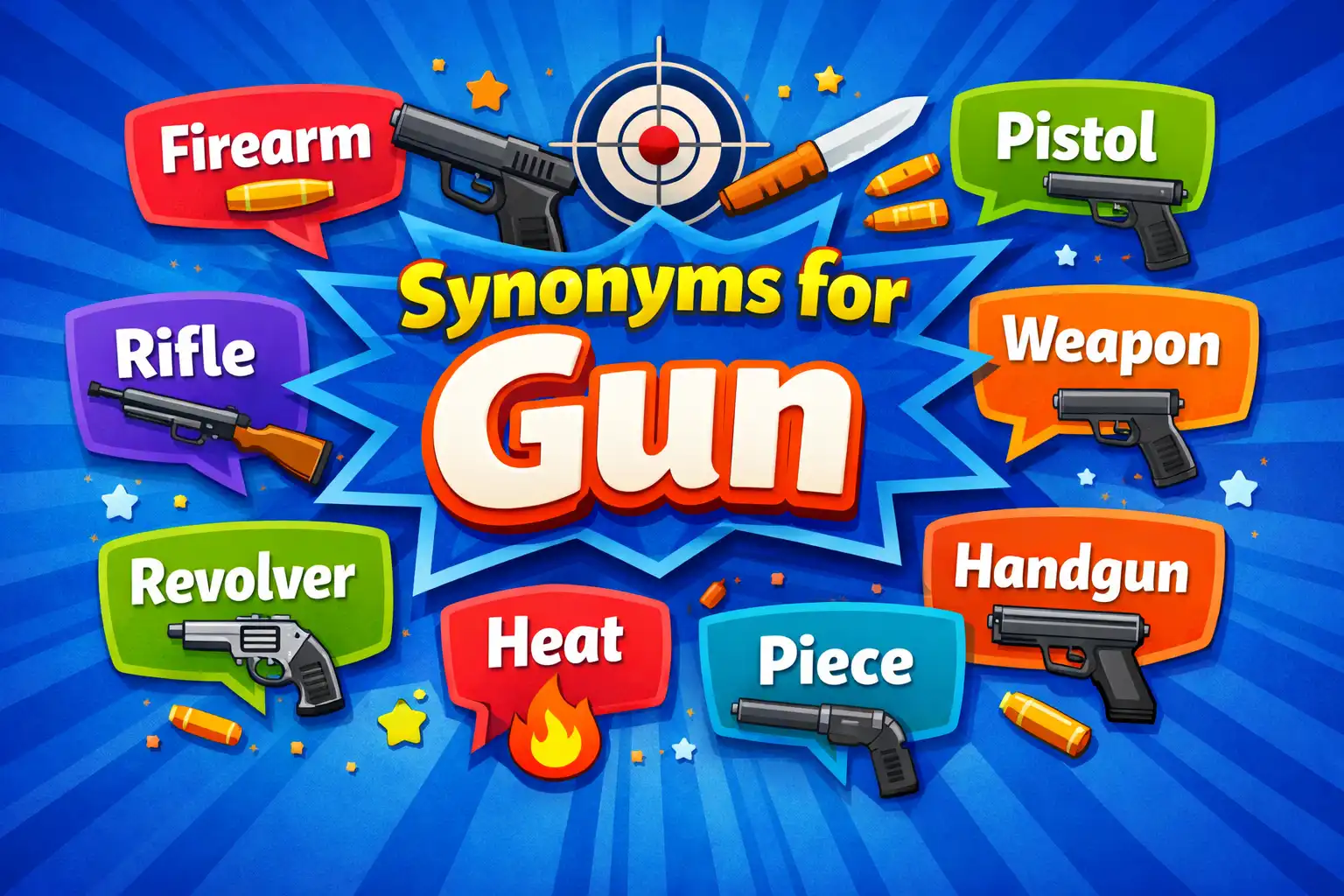
The word gun appears in daily news, movies, history lessons, and casual conversation. Knowing synonyms helps you speak and write more clearly. It also lets you choose the right word for formal or informal situations.
Direct Answer
A gun is a weapon that shoots bullets or other projectiles using explosive force. Common synonyms include:
- firearm
- pistol
- handgun
- rifle
- revolver
- shotgun
- weapon
Meaning of Gun
A gun is a tool or weapon designed to fire bullets by using pressure from an explosion.
Example:
He safely locked the gun in a storage case.
Categories of Synonyms
General weapon terms
These words refer to guns in a broad or legal sense.
Specific gun types
These describe a particular style or design of gun.
Formal or technical terms
These appear in law, military writing, or official reports.
Synonyms Table
| Word | Simple Meaning | Example Sentence |
| firearm | any weapon that shoots bullets | The officer carried a licensed firearm. |
| pistol | a small handheld gun | She placed the pistol in a secure drawer. |
| handgun | a gun held with one hand | The guard checked his handgun before duty. |
| rifle | a long gun fired from the shoulder | The hunter cleaned his rifle carefully. |
| revolver | a pistol with a rotating chamber | The antique revolver was in a museum. |
| shotgun | a gun that fires pellets | He used a shotgun for sport shooting. |
| weapon | a tool used for fighting | The guard was trained to handle a weapon. |
Master Synonyms List (Grouped by Level)
Beginner / Simple
firearm — a gun in general
Example: He stored the firearm in a locked cabinet. (Formal)
pistol — a small handheld gun
Example: The guard carried a pistol on his belt. (Neutral)
rifle — a long gun used for distance
Example: She practiced with a rifle at the range. (Neutral)
Intermediate
handgun — a gun designed for one hand
Example: The officer checked his handgun before leaving. (Formal)
shotgun — a gun that spreads pellets
Example: The farmer kept a shotgun for protection. (Neutral)
Advanced / Formal
revolver — a rotating-cylinder pistol
Example: The display featured a historic revolver. (Formal)
weapon — any tool used to harm or defend
Example: The law regulates every weapon carefully. (Formal)
Formal vs Informal Synonyms
In legal or academic writing, use firearm, handgun, or weapon. These sound neutral and official. In conversation, pistol or rifle feels more natural. Choosing the wrong tone can make writing sound dramatic or unclear.
Real-Life Usage Examples
Conversation:
He said the guard carried a pistol.
Academic Writing:
The study analyzed firearm safety laws.
Business Writing:
The company follows weapon storage regulations.
Blogging:
Movies often show characters using rifles.
Emotional Expression:
The scene felt tense when the gun appeared.
Similar Words Comparison
Gun vs Firearm
Gun is casual and general. Firearm is formal and legal.
Example: The law mentions firearms, not guns.
Gun vs Weapon
Weapon is broader and includes knives or tools.
Example: A weapon is not always a gun.
Example Sentences
- The guard locked the gun safely.
- The firearm required a permit.
- He cleaned the rifle after practice.
- The pistol stayed in a secure case.
- The museum displayed an old revolver.
- She trained with a handgun professionally.
- The shotgun was used for sport.
- Laws regulate every weapon strictly.
- The instructor explained gun safety.
- He never touched the firearm without training.
- The rifle rested against the wall.
- The pistol remained unloaded.
- The weapon was part of history.
- The revolver belonged to his grandfather.
- The handgun required certification.
Common Mistakes
- Using weapon when you specifically mean a gun
- Using casual words in legal writing
- Mixing up rifle and shotgun
- Overusing the same word repeatedly
- Ignoring tone and audience
Tips / Best Practices
- Match tone to context
- Use formal terms in academic writing
- Choose specific words for clarity
- Avoid repeating the same synonym
- Do not overuse the keyword
When NOT to Use Gun
Avoid using gun in formal legal writing or technical reports. Use firearm instead. Also avoid slang in serious contexts.
Opposite Words (Antonyms)
- peace tool
- safety device
- protective equipment
FAQs
What does gun mean?
A weapon that shoots bullets.
Is gun formal or informal?
It is neutral but casual compared to firearm.
How can I use it in conversation?
Use it when speaking casually about weapons.
What is the best synonym for gun?
Firearm is best for formal writing.
Can gun be replaced with firearm?
Yes, especially in legal or academic contexts.
Conclusion
Learning synonyms improves writing, speaking, and clarity. It helps you match tone and audience. Strong vocabulary gives you better control of meaning.
Try using 3 new synonyms in your next sentence.

Robert Hayes develops easy-to-understand synonym lists and contextual examples to improve everyday writing.