The word distance appears in daily speech, school writing, travel talk, and emotional conversations. It can describe space, time, or relationships. Learning synonyms helps you express ideas more clearly and avoid repeating the same word. For more travel and geography terms, browse our places category for related vocabulary ideas.
Direct Answer
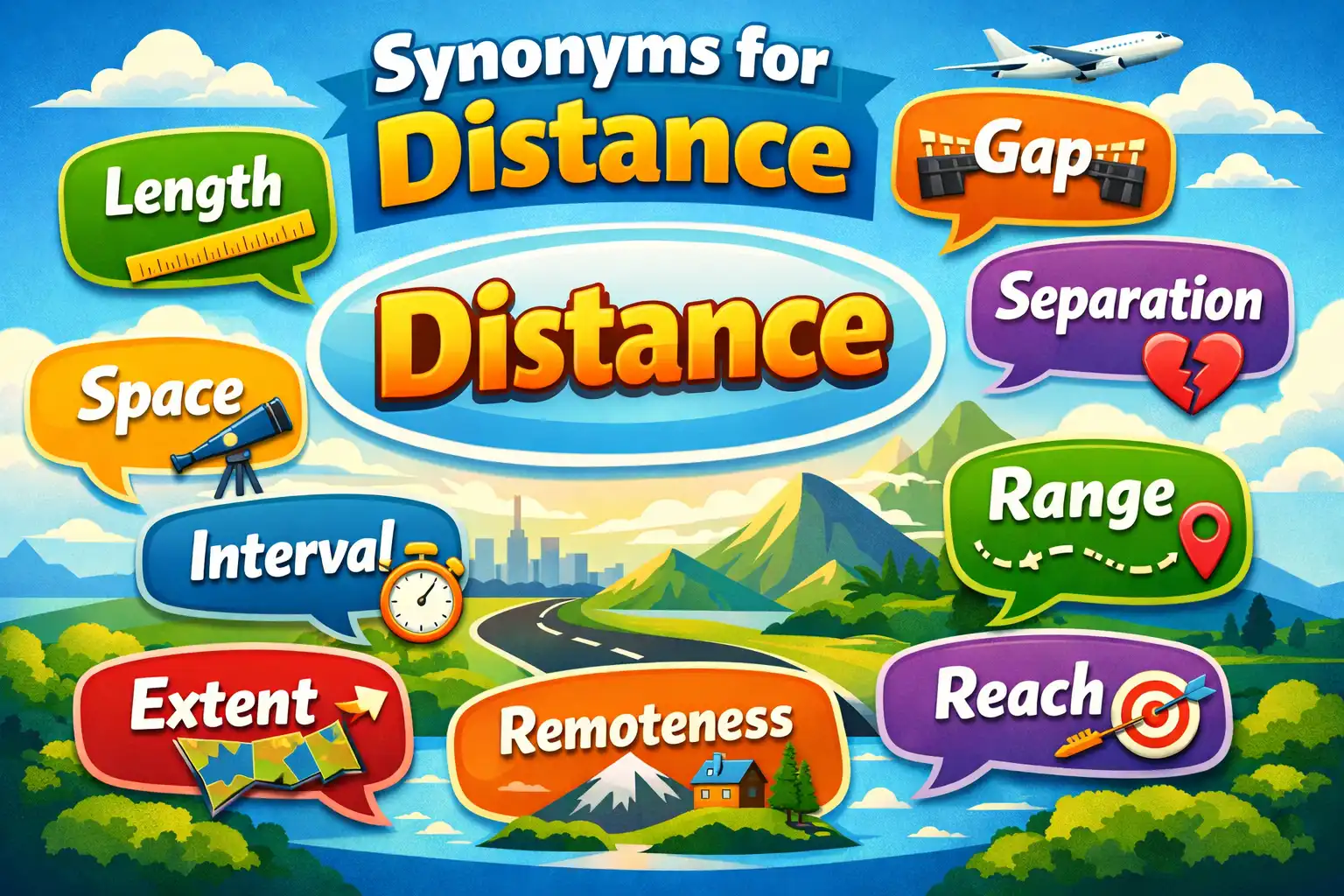
Distance means the amount of space or separation between two points, people, or things. Common synonyms include:
- space
- gap
- separation
- interval
- span
- range
- remoteness
- length
- reach
Meaning of Distance
Distance is the measurable space between two locations, objects, or people. It can also describe emotional or social separation.
Example: The distance between the two cities is about 300 miles.
Importance of Different Synonym Categories
Physical distance
Used for measurable space between places or objects. These words often appear in travel, science, and geography.
Emotional distance
Used when describing feelings, relationships, or personal connection.
Social distance
Used when talking about social boundaries, class, or interaction levels.
Synonyms Table
| Word | Simple Meaning | Example Sentence |
| space | area between things | There is space between the chairs. |
| gap | empty opening | A gap separated the buildings. |
| separation | state of being apart | The wall created separation. |
| interval | measured break | The interval was short. |
| span | full length | The bridge spans a long area. |
| range | extent or limit | The range is wide. |
| remoteness | being far away | The remoteness felt peaceful. |
| length | measured distance | The length surprised us. |
| reach | distance you can extend | The shelf was out of reach. |
Master Synonyms List (Grouped by Level)
Beginner / Simple
space
Simple meaning: area between objects
Example: The space between houses is small. (Neutral)
gap
Simple meaning: empty opening
Example: A gap appeared in the line. (Neutral)
length
Simple meaning: measured distance
Example: The length of the road is long. (Neutral)
Intermediate
span
Simple meaning: full stretch across
Example: The bridge span connects two towns. (Neutral)
range
Simple meaning: total extent
Example: The signal has a wide range. (Neutral)
reach
Simple meaning: distance you can touch
Example: The book was beyond reach. (Informal)
Advanced / Formal
separation
Simple meaning: condition of being apart
Example: Emotional separation can hurt relationships. (Formal)
interval
Simple meaning: measured space or time
Example: The interval between stops is short. (Formal)
remoteness
Simple meaning: state of being far away
Example: The island’s remoteness attracts visitors. (Formal)
Informal vs Formal Synonyms
Formal words like separation and interval work best in academic or professional writing. Informal words like gap and reach sound natural in conversation. Choose based on audience and context. You can also explore synonyms for space when describing the amount of room between points or objects.
Real-Life Usage Examples
Conversation: There is a big gap between our houses.
Academic Writing: The interval was precisely measured.
Business Writing: The separation affects workflow efficiency.
Blogging: The span of the trip amazed us.
Emotional Expression: I felt emotional distance from him.
Similar Words Comparison
Distance vs gap
Distance is neutral and measurable. Gap suggests a visible opening.
Example: The distance is five miles. / A gap formed in traffic.
Distance vs separation
Distance is general. Separation feels emotional or formal.
Example: Physical distance is small. / Emotional separation is large.
Example Sentences
- The distance felt longer at night.
- We measured the distance carefully.
- Emotional distance changed their friendship.
- The distance between desks is equal.
- He kept his distance politely.
- Distance improves perspective.
- The distance shocked the hikers.
- They respected personal distance.
- The distance looked short on the map.
- Long distance requires planning.
- Distance affects communication.
- She noticed a sudden distance.
- The distance was manageable.
- Distance builds independence.
Common Mistakes
- Using distance when you mean emotional separation without context
- Repeating the same synonym too often
- Choosing formal words in casual conversation
- Mixing physical and emotional meanings incorrectly
- Overcomplicating simple writing
Tips / Best Practices
- Match tone to audience
- Choose synonyms based on context
- Use formal words in academic writing
- Prefer simple words in conversation
- Avoid overuse to prevent keyword stuffing
- Focus on clarity over variety
When NOT to Use Distance
Learners often use distance correctly for physical space, but problems appear when the meaning becomes unclear. Here are clear situations where you should avoid it and choose a more precise word.
❌ When talking only about time
Do not use distance to describe time unless you clearly mean travel space.
Wrong: There is a long distance before the meeting starts.
Better: There is a long wait before the meeting starts.
Use words like delay, duration, or time gap instead.
❌ When you mean emotional conflict, not space
Distance suggests separation, but it does not always explain feelings clearly.
Weak: There is distance between us.
Better: There is tension between us.
If the problem is emotional, choose words like tension, conflict, or disconnect.
❌ When describing size or length of an object
Distance measures space between points, not the size of one object.
Wrong: The table has a long distance.
Better: The table has a long length.
Use length, width, or size for objects.
❌ When the meaning could confuse the listener
If someone might misunderstand whether you mean physical or emotional space, choose a clearer word.
Unclear: I feel distance at work.
(Do you mean location or emotion?)
Clear: I feel disconnected at work.
Clarity is more important than vocabulary variety.
❌ When a simpler word sounds more natural
Native speakers often prefer simple words in casual speech.
Less natural: Keep distance from the stove.
More natural: Stay away from the stove.
Use everyday alternatives when safety or instructions are involved.
Opposite Words (Antonyms)
- closeness
- nearness
- proximity
- connection
- contact
FAQs
What does distance mean?
It means the space or separation between points or people.
Is distance formal or informal?
It is neutral and works in both contexts.
How can I use it in conversation?
Say: “The distance is too far to walk.”
What is the best synonym for distance?
It depends on context, but space is the most general.
Can distance be replaced with gap?
Yes, when describing a visible opening.
Conclusion
To use distance well, first decide what you mean: physical space, emotional separation, or social boundaries. If your meaning is time-only, object size, or relationship conflict, pick a clearer word like duration, length, tension, or disconnect. This one choice makes your writing instantly easier to understand.
For practice, do this today: write 5 short sentences using distance, then rewrite each one with a different synonym (gap, separation, interval, range, or space). Read them out loud and keep the version that sounds most natural for your audience. Try using 3 new synonyms in your next sentence. See synonyms for horizon for words that help describe far off views and visual range.

Robert Hayes develops easy-to-understand synonym lists and contextual examples to improve everyday writing.