Quick Intro
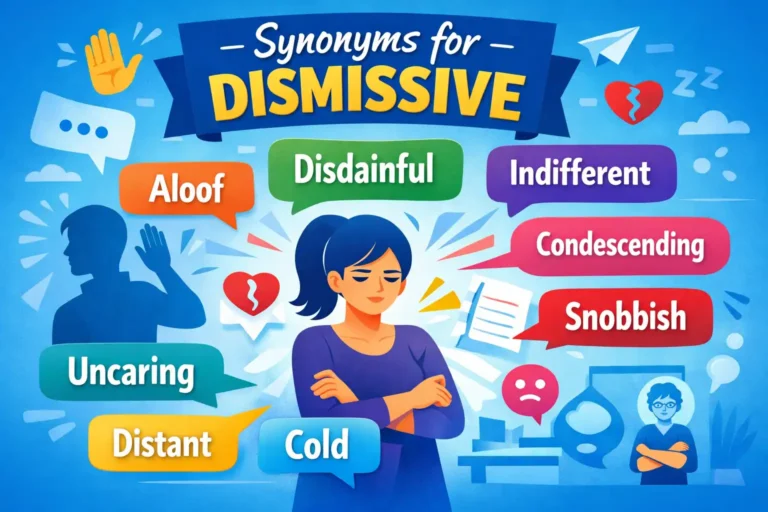
The word dismissive is commonly used in daily conversation, academic writing, and online communication. It describes behavior that shows a lack of respect, interest, or attention.
Learning synonyms for this word helps improve writing clarity and makes communication more precise. It also helps ESL learners understand subtle tone differences in English.
Direct Answer
Meaning of dismissive
Dismissive describes an attitude or response that shows someone thinks something is unimportant or not worth attention.
Common synonyms include:
- Disrespectful
- Indifferent
- Condescending
- Unconcerned
- Uninterested
- Curt
- Scornful
- Derisive
- Contemptuous
- Offhand
Categories of Synonyms
Emotional Disrespect
These synonyms describe attitudes that show lack of respect or value toward someone or their ideas.
Examples include words such as contemptuous and scornful.
Social or Communication Tone
These words describe short or cold communication styles, often used in conversation or professional settings.
Examples include curt and offhand.
Attitude of Indifference
These synonyms emphasize lack of interest or concern rather than open disrespect.
Examples include indifferent and unconcerned.
Synonyms Table
| Word | Simple Meaning | Example Sentence |
| Disrespectful | Showing lack of respect | His tone sounded disrespectful during the meeting. |
| Indifferent | Showing no interest or concern | She seemed indifferent to the feedback. |
| Condescending | Acting as if others are less intelligent | His condescending comment annoyed everyone. |
| Unconcerned | Not worried or interested | He looked unconcerned about the problem. |
| Uninterested | Lacking curiosity or enthusiasm | The manager appeared uninterested in the proposal. |
| Curt | Very brief and slightly rude | She gave a curt reply to the question. |
| Scornful | Showing strong dislike or disrespect | His scornful laugh upset the group. |
| Derisive | Mocking or insulting | The critic wrote a derisive review. |
| Contemptuous | Showing deep disrespect | Her contemptuous tone shocked the audience. |
| Offhand | Casual and slightly rude | He made an offhand remark about the idea. |
Master Synonyms List (Grouped by Level)
Beginner / Simple Synonyms
Disrespectful
Simple meaning: showing lack of respect
Example: His disrespectful comment offended the teacher.
Uninterested
Simple meaning: not interested in something
Example: She sounded uninterested during the discussion.
Unconcerned
Simple meaning: not worried or involved
Example: He remained unconcerned about the criticism.
Intermediate Synonyms
Indifferent
Simple meaning: having no strong interest or emotion
Example: The manager seemed indifferent to the complaints.
Curt
Simple meaning: short and slightly rude
Example: She gave a curt answer and ended the conversation.
Offhand
Simple meaning: casual and not carefully considered
Example: He made an offhand comment about the plan.
Advanced / Formal Synonyms
Condescending (Formal)
Simple meaning: acting as if others are less capable
Example: His condescending tone frustrated the students.
Scornful (Formal)
Simple meaning: expressing strong contempt or ridicule
Example: The politician gave a scornful response to the question.
Derisive (Formal)
Simple meaning: mocking or insulting
Example: The journalist wrote a derisive article about the proposal.
Contemptuous (Formal)
Simple meaning: showing deep disrespect or disdain
Example: She gave a contemptuous look during the debate.
Formal vs Informal Synonyms
Choosing the right synonym often depends on the level of formality.
Informal words
- disrespectful
- uninterested
- unconcerned
These are common in daily conversation and casual writing.
Formal words
- contemptuous
- derisive
- condescending
These are more common in academic writing, journalism, and professional analysis.
Using the correct tone helps avoid sounding too harsh or too casual.
Real-Life Usage Examples
Conversation
He sounded dismissive when he said the idea was “not important.”
Academic Writing
The study criticizes the dismissive attitude toward mental health research.
Business Writing
A dismissive response to client feedback can damage trust.
Blogging
Many readers dislike dismissive comments in online discussions.
Emotional Expression
Her dismissive tone made him feel ignored and undervalued.
Similar Words Comparison
Dismissive vs Indifferent
Dismissive shows rejection or disrespect.
Indifferent shows lack of interest without direct rejection.
Example
She was dismissive of the idea.
She seemed indifferent to the discussion.
Dismissive vs Condescending
Dismissive ignores or rejects something.
Condescending implies superiority over others.
Example
His dismissive reply ended the conversation.
His condescending tone made people uncomfortable.
Example Sentences
- The manager gave a dismissive response to the complaint.
- Her dismissive attitude discouraged the team.
- The teacher warned students not to sound dismissive.
- His dismissive laugh upset the audience.
- The critic wrote a dismissive review of the movie.
- She felt hurt by his dismissive tone.
- The leader avoided dismissive language in meetings.
- His dismissive gesture ended the discussion quickly.
- The article criticized dismissive attitudes toward science.
- He sounded dismissive during the interview.
- A dismissive reaction can damage professional relationships.
- The speaker avoided dismissive comments about competitors.
- Many readers find dismissive remarks offensive.
- She tried not to appear dismissive during the debate.
- The editor removed dismissive phrases from the article.
Common Mistakes
1. Using dismissive instead of indifferent
Some people use dismissive when they only mean lack of interest.
Dismissive implies rejection, not just indifference.
2. Choosing overly harsh synonyms
Words like contemptuous can sound much stronger than intended.
3. Repeating the same synonym
Writers often repeat one synonym instead of varying vocabulary.
4. Using formal words in casual conversation
Some synonyms sound too formal for everyday speech.
Tips / Best Practices
- Choose synonyms based on tone and context.
- Use formal synonyms in academic writing.
- Use simple synonyms in conversation.
- Focus on clarity and natural language.
- Avoid repeating the same word too often.
Using different synonyms improves readability and avoids keyword stuffing.
When NOT to Use Dismissive
Avoid using dismissive when describing neutral or polite disagreement.
Incorrect:
He was dismissive of the idea even though he politely explained his concerns.
Better:
He disagreed with the idea respectfully.
The word should only be used when clear disregard or rejection is present.
Opposite Words (Antonyms)
Common antonyms include:
- Respectful
- Considerate
- Attentive
- Supportive
- Appreciative
- Interested
- Encouraging
These words express attention, respect, or positive engagement.
FAQs
What does dismissive mean?
Dismissive means showing that something or someone is not important or worth attention.
Is dismissive formal or informal?
It is neutral and can be used in both conversation and formal writing.
How can I use dismissive in conversation?
Example: “His dismissive tone made the meeting uncomfortable.”
What is the best synonym for dismissive?
Common alternatives include indifferent, disrespectful, and condescending.
Can dismissive be replaced with indifferent?
Sometimes, but dismissive usually implies stronger rejection.
Is dismissive a negative word?
Yes. It usually describes a negative attitude toward people or ideas.
Can dismissive describe body language?
Yes. A dismissive gesture or expression can show disregard.
Is dismissive common in business communication?
Yes, often used when discussing professional tone or communication style.
What part of speech is dismissive?
It is an adjective.
Can dismissive describe behavior?
Yes. It often describes tone, reactions, or attitudes.
Conclusion
Learning synonyms for dismissive helps improve both speaking and writing. Different synonyms allow you to express subtle differences in tone, attitude, and intention.
Expanding vocabulary also improves clarity and communication.
Try using three new synonyms for dismissive in your next sentence to practice.

Robert Hayes develops easy-to-understand synonym lists and contextual examples to improve everyday writing.