Micro Introduction
The word coward appears often in everyday conversations, books, movies, and debates. It describes someone who avoids danger because they are afraid.
Learning synonyms for coward helps you speak and write more clearly. It also helps you choose the right tone in conversations, essays, and professional writing.
Direct Answer
A coward is a person who lacks courage and avoids facing danger, difficulty, or responsibility because of fear.
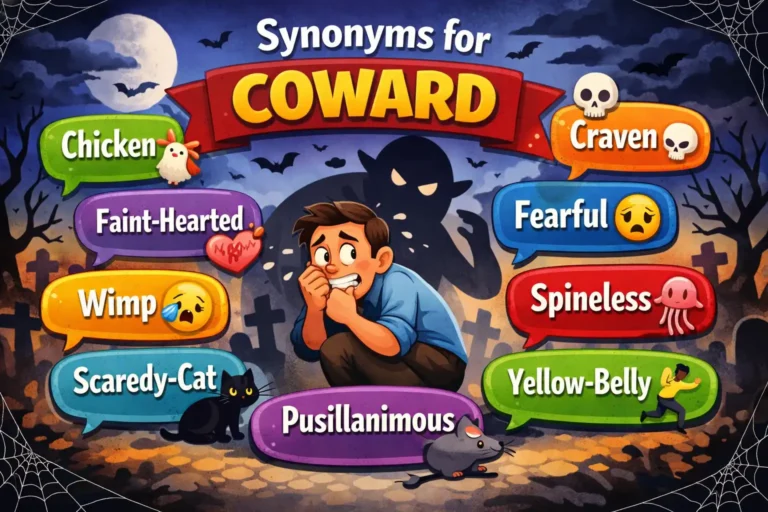
Common synonyms for coward include:
- Scaredy-cat
- Chicken
- Weakling
- Timid person
- Craven
- Pusillanimous
- Spineless person
- Yellow-belly
- Wimp
- Fainthearted
Meaning of Coward
A coward is someone who shows fear instead of courage, especially when facing danger, responsibility, or difficult situations.
Example sentence:
He refused to defend his friend, and everyone called him a coward.
The word often carries a negative tone because it criticizes someone’s lack of bravery.
Categories of Synonyms
Fear-Based Weakness
These words describe someone who avoids risk because they are afraid.
Examples: timid person, fainthearted.
Lack of Courage or Strength
These terms focus on weakness or inability to act bravely.
Examples: weakling, wimp.
Strong or Insulting Descriptions
These synonyms are stronger or more insulting and often appear in emotional or dramatic speech.
Examples: craven, yellow-belly.
Synonyms Table
| Word | Simple Meaning | Example Sentence |
| Scaredy-cat | Someone easily frightened | The kids teased him for being a scaredy-cat. |
| Chicken | Person afraid to try something | Don’t be a chicken—try the ride. |
| Weakling | Physically or mentally weak person | The bully thought he was a weakling. |
| Timid person | Someone shy and easily scared | The timid person stayed quiet in the debate. |
| Craven | Extremely cowardly | His craven behavior shocked the team. |
| Pusillanimous | Very lacking courage | The leader called the decision pusillanimous. |
| Spineless person | Someone who shows no courage | The voters saw him as a spineless person. |
| Yellow-belly | Slang for a coward | The villain mocked him as a yellow-belly. |
| Wimp | Person who avoids difficulty | Stop acting like a wimp and finish the task. |
| Fainthearted | Lacking bravery | The fainthearted soldier stepped back. |
Master Synonyms List (Grouped by Level)
Beginner / Simple Synonyms
Scaredy-cat
Meaning: someone who gets scared easily
Example: The children laughed because he acted like a scaredy-cat.
Tone: Informal
Chicken
Meaning: someone afraid to do something
Example: She called him a chicken for refusing the challenge.
Tone: Informal
Wimp
Meaning: a weak or easily frightened person
Example: Don’t be a wimp when things become difficult.
Tone: Informal
Weakling
Meaning: someone physically or mentally weak
Example: The bully thought the quiet boy was a weakling.
Intermediate Synonyms
Timid person
Meaning: someone shy or fearful
Example: The timid person avoided speaking during the meeting.
Spineless person
Meaning: someone who lacks courage or determination
Example: Many people considered the leader a spineless person.
Fainthearted
Meaning: lacking courage when facing challenges
Example: The climb was not for the fainthearted.
Yellow-belly
Meaning: slang term for a coward
Example: The hero told the villain he was a yellow-belly.
Tone: Informal
Advanced / Formal Synonyms
Craven
Meaning: extremely cowardly or fearful
Example: His craven refusal to help angered the group.
Tone: Formal
Pusillanimous
Meaning: showing extreme lack of courage
Example: The critic called the policy pusillanimous.
Tone: Very formal
Formal vs Informal Synonyms
Some synonyms for coward fit casual conversation, while others work better in formal writing.
Informal words include chicken, wimp, and scaredy-cat. These appear in everyday speech and friendly teasing.
Formal or academic words include craven and pusillanimous. These appear more often in literature, essays, or serious criticism.
Choosing the correct level of formality helps your message sound natural and appropriate.
Real-Life Usage Examples
Conversation
“Don’t be a chicken—just try the new food.”
Academic Writing
The historian described the ruler’s decision as craven.
Business Writing
A manager should not appear spineless when making important decisions.
Blogging
Readers admire leaders who show courage instead of acting like wimps.
Emotional Expression
She felt angry because he behaved like a coward when she needed support.
Similar Words Comparison
Coward vs Timid
A coward avoids danger or responsibility because of fear.
A timid person is naturally shy or nervous.
Example:
He was timid in conversations but not a coward in difficult situations.
Coward vs Weakling
A coward lacks courage.
A weakling usually refers to physical or emotional weakness.
Example:
He may look like a weakling, but he is not a coward.
Example Sentences
- The hero refused to act like a coward during the crisis.
- Stop being a chicken and take the challenge.
- The bully called the smaller boy a weakling.
- The timid person avoided the argument.
- The soldier proved he was not fainthearted.
- His craven actions disappointed the team.
- The crowd mocked him as a yellow-belly.
- Nobody respected the spineless leader.
- The climbers warned that the journey was not for wimps.
- The writer criticized the pusillanimous decision.
- A true friend never behaves like a coward.
- The coach told the team not to act like scaredy-cats.
- Facing problems bravely prevents people from becoming cowards.
Common Mistakes
Using Insulting Synonyms in Formal Writing
Words like chicken or wimp sound childish or rude in academic or professional writing.
Confusing “Timid” With “Coward”
A timid person may simply be shy. A coward avoids danger or responsibility.
Overusing Strong Words
Words like craven or pusillanimous sound dramatic. Use them carefully.
Using Slang in Professional Contexts
Terms such as yellow-belly belong mainly in casual speech or storytelling.
Tips / Best Practices
- Choose a synonym that matches the tone of your sentence.
- Consider the context: casual conversation or formal writing.
- Use formal words like craven only when appropriate.
- Prefer simple synonyms in everyday speech.
- Avoid repeating the same word too often.
- Use synonyms naturally instead of forcing them.
When NOT to Use “Coward”
Avoid using coward when describing someone who is simply careful or cautious.
For example, a person avoiding a dangerous situation may be acting wisely, not cowardly.
The word also sounds insulting, so it should not appear in professional feedback or respectful discussions.
Opposite Words (Antonyms)
Common antonyms for coward include:
- Brave person
- Hero
- Fearless person
- Courageous individual
- Bold person
- Adventurer
These words describe people who face danger or challenges with confidence.
FAQs
What does coward mean?
A coward is someone who lacks courage and avoids danger, responsibility, or difficulty because of fear.
Is coward formal or informal?
The word itself is neutral but often sounds insulting. It appears in both casual speech and literature.
How can I use coward in conversation?
You can use it when criticizing someone who avoids responsibility or acts out of fear.
Example: “He acted like a coward and refused to help.”
What is the best synonym for coward?
Simple synonyms include wimp, chicken, and timid person, depending on the context.
Can coward be replaced with timid?
Not always. Timid means shy or nervous, while coward implies avoiding danger.
Is wimp the same as coward?
They are similar, but wimp usually sounds more casual and less serious.
Is craven stronger than coward?
Yes. Craven describes extreme cowardice and often appears in formal or literary language.
Is coward always an insult?
Yes, the word usually carries a negative judgment about someone’s character.
What synonym is best for academic writing?
Formal options such as craven or pusillanimous work best in academic contexts.
Can coward describe fear of small things?
Usually no. The word typically refers to avoiding serious challenges or responsibilities.
Are coward and weakling identical?
Not exactly. Weakling focuses on weakness, while coward focuses on lack of bravery.
Conclusion
Learning synonyms for coward helps improve your vocabulary and communication. You can choose different words depending on tone, context, and formality.
Using the right synonym also makes your writing more precise and engaging. Try using three new synonyms in your next sentence to practice and strengthen your vocabulary.

Robert Hayes develops easy-to-understand synonym lists and contextual examples to improve everyday writing.