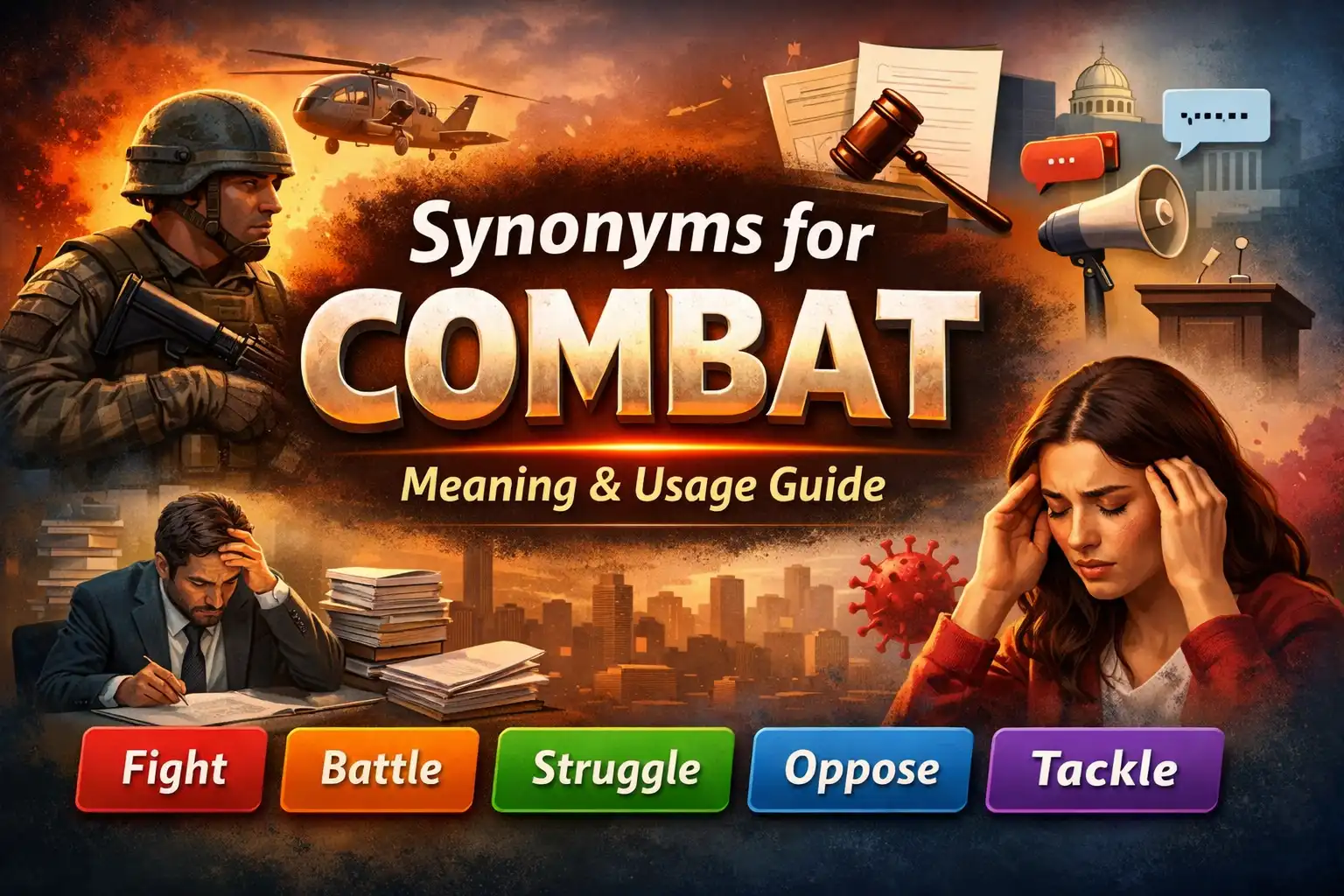
The word combat is common in news, history, movies, and daily speech. It can describe fighting, struggle, or effort against something difficult. Learning synonyms for combat helps you speak and write more clearly.
Direct Answer
Combat means to fight against someone or something, especially in a serious or organized way. It can refer to physical fighting or resisting a problem.
Common synonyms include:
- Fight
- Battle
- Struggle
- Clash
- Conflict
- Oppose
- Resist
- Confront
- Tackle
- Defend
Definition + Common Uses
Combat means to fight against an enemy, problem, or harmful situation.
Example:
The government is working to combat crime in the city.
Categories of Synonyms
1. Physical Combat
Used for actual fighting between people, armies, or groups.
Example context: war, boxing, street fights.
2. Emotional or Personal Struggle
Used when someone deals with fear, stress, or inner challenges.
Example context: combat anxiety or addiction.
3. Social or Political Action
Used when fighting against social problems or injustice.
Example context: combat poverty or discrimination.
Synonyms Table
| Word | Simple Meaning | Example Sentence |
| Fight | Try to win against someone | They fight for their rights. |
| Battle | Serious or long fight | She battled illness for years. |
| Struggle | Try hard against difficulty | He struggled to stay calm. |
| Clash | Sudden fight or disagreement | Protesters clashed with police. |
| Conflict | Serious disagreement | The conflict lasted for months. |
| Oppose | Act against something | Many people oppose the law. |
| Resist | Refuse to accept or give in | She resisted temptation. |
| Confront | Face something directly | He confronted his fears. |
| Tackle | Try to deal with a problem | The company tackled pollution. |
| Defend | Protect against attack | Soldiers defended the city. |
Master Synonyms List (Grouped by Context + Tone)
Instead of levels, these synonyms are grouped by how and where they are commonly used.
1. War / Military Context
These words are used in serious physical fighting, especially between armies or armed groups.
Battle
Simple meaning: A large or serious fight
Example: The soldiers prepared for a long battle.
Tone: Neutral / Military
Clash
Simple meaning: A short or sudden fight
Example: The forces clashed at the border.
Tone: Formal / News
Engage
Simple meaning: To begin fighting
Example: The troops engaged the enemy at dawn.
Tone: Formal / Military
Defend
Simple meaning: Protect against attack
Example: They defended their territory bravely.
Tone: Formal
2. Problems / Challenges Context
These words are used when dealing with difficulties, not physical fighting.
Tackle
Simple meaning: Try to deal with a problem
Example: The city must tackle traffic congestion.
Tone: Neutral / Business
Address
Simple meaning: Deal with an issue
Example: Leaders need to address rising costs.
Tone: Formal
Fight
Simple meaning: Try hard against something
Example: She is fighting a serious illness.
Tone: Neutral
Struggle
Simple meaning: Face difficulty
Example: Many families struggle with expenses.
Tone: Neutral
3. Debates / Arguments Context
These words are used in discussions, disagreements, or public debates.
Oppose
Simple meaning: Act against something
Example: Many citizens oppose the new policy.
Tone: Formal
Challenge
Simple meaning: Question or disagree publicly
Example: The lawyer challenged the evidence.
Tone: Formal
Confront
Simple meaning: Face directly
Example: She confronted the manager about the issue.
Tone: Neutral
Dispute
Simple meaning: Argue against something
Example: Experts disputed the report’s findings.
Tone: Formal
4. Law / Crime Context
These words are common in legal or official language.
Prosecute
Simple meaning: Take legal action against
Example: The state will prosecute the offender.
Tone: Formal / Legal
Suppress
Simple meaning: Stop by force
Example: Police worked to suppress the riot.
Tone: Formal
Enforce
Simple meaning: Make sure rules are followed
Example: Officers enforce traffic laws.
Tone: Formal
5. Health / Emotional Context
These words are used when fighting illness, fear, or emotional problems.
Overcome
Simple meaning: Successfully defeat a problem
Example: She overcame her anxiety.
Tone: Positive / Neutral
Resist
Simple meaning: Refuse to give in
Example: He resisted unhealthy habits.
Tone: Neutral
Cope with
Simple meaning: Manage a difficult situation
Example: She learned to cope with stress.
Tone: Neutral
Similar Words Comparison
Combat vs Fight
- Combat sounds more formal.
- Fight is common in daily speech.
Example:
The army engaged in combat.
They fought in the street.
Combat vs Struggle
- Combat suggests active resistance.
- Struggle suggests difficulty and effort.
Example:
The city combats crime.
He struggles with depression.
Example Sentences (Grouped by Context)
War / Military Context
- The soldiers prepared for combat at sunrise.
- The two armies clashed near the river.
- The troops defended the city walls bravely.
- The navy engaged the enemy fleet offshore.
Problems / Challenges Context
- The government is working to combat inflation.
- The company tackled the issue quickly.
- She struggled to balance work and study.
- Doctors are fighting a new virus outbreak.
Debates / Arguments Context
- Many citizens oppose the new regulation.
- The lawyer challenged the witness’s statement.
- She confronted him about the misunderstanding.
- Experts disputed the research findings.
Law / Crime Context
- Authorities moved to suppress illegal activity.
- The court will prosecute those responsible.
Health / Emotional Context
- He overcame his fear of public speaking.
- She resisted pressure from her peers.
Common Mistakes
- Using fight in formal academic writing when combat is better.
- Confusing conflict (noun) with combat (verb or noun).
- Using struggle when active resistance is intended.
- Repeating the same synonym too often.
Tip: Always match the word to the tone and context.
Tips / Best Practices for Choosing the Right Synonym
Choosing the correct synonym for combat depends on tone, situation, and audience. Do not replace words randomly. Choose with purpose.
Quick Checklist Before You Choose
Ask yourself:
- ✔ Is this about physical fighting or a problem?
- ✔ Is my tone formal, neutral, or casual?
- ✔ Am I writing for school, business, or conversation?
- ✔ Does the synonym clearly match the situation?
- ✔ Am I repeating the same word too often?
If the answer is unclear, use a simpler word like fight or tackle.
Think About Tone
- Use combat in formal writing or news style.
- Use fight in everyday conversation.
- Use tackle in business or solution-focused writing.
- Use oppose in academic or political discussion.
Use Natural Collocations
Certain word combinations sound more natural than others. These are called collocations.
Here are 3 common ones:
- combat crime
- fight corruption
- tackle a problem
Example sentences:
The city is working to combat crime.
Leaders must fight corruption at all levels.
We need to tackle a problem before it grows.
Avoid unnatural combinations like:
❌ combat homework
❌ fight a small inconvenience
Avoid Overuse
Repeating combat or any synonym too often can make writing sound unnatural.
Use variation for clarity — not just for style.
Clear writing is always better than complicated writing.
When NOT to Use Combat
Do not use combat for small disagreements.
Avoid it in very casual chat unless discussing serious issues.
Do not use it when no real opposition exists.
Incorrect:
I combated my coffee this morning. ❌
Correct:
I fought sleep this morning. ✅
Opposite Words (Antonyms) of Combat
Antonyms of combat describe accepting, allowing, or stopping resistance instead of fighting.
Surrender
Simple meaning: To stop fighting and give up.
Example: The army decided to surrender after heavy losses.
Submit
Simple meaning: To accept control or authority.
Example: He refused to submit to unfair rules.
Yield
Simple meaning: To give way or stop resisting.
Example: The company finally yielded to public pressure.
Accept
Simple meaning: To agree with or allow something.
Example: She chose to accept the situation calmly.
Agree
Simple meaning: To have the same opinion as someone else.
Example: The two leaders agreed on a peaceful solution.
Allow
Simple meaning: To permit something instead of stopping it.
Example: The policy would allow more freedom for workers.
Why These Are Opposites
While combat means to fight against something, these words suggest:
- Giving in
- Approving
- Not resisting
- Choosing peace instead of struggle
Understanding antonyms helps you see the full meaning range of a word.
FAQs
What does combat mean?
It means to fight against something, often seriously or formally.
Is combat formal or informal?
It is generally more formal than “fight.”
How can I use it in conversation?
You can say, “I’m trying to combat stress.”
What is the best synonym for combat?
It depends on context. “Fight” is common. “Tackle” works for problems.
Can combat be replaced with fight?
Yes, in many casual situations. But not always in formal writing.
Conclusion
Understanding synonyms for combat helps you choose the right word for the right situation. Some words fit war contexts, others work better for problems, debates, law, or health. The key is matching tone and meaning carefully.
When you expand your vocabulary, your writing becomes clearer and more precise. Your speaking also sounds more natural and confident.
Quick Action Step
Pick 1 synonym for each context:
- War / Military
- Problems / Challenges
- Debates / Arguments
- Law / Crime
- Health / Emotional
Try using all five in one short paragraph. This simple exercise will strengthen both your vocabulary and clarity.

Robert Hayes develops easy-to-understand synonym lists and contextual examples to improve everyday writing.