The word brave is common in daily conversation, books, movies, and speeches.
It describes people who face danger, fear, or difficulty with strength.
Learning synonyms for brave helps improve vocabulary and avoid repetition in writing.
Direct Answer: What Does Brave Mean?
Brave means showing courage and not being afraid in difficult or dangerous situations.
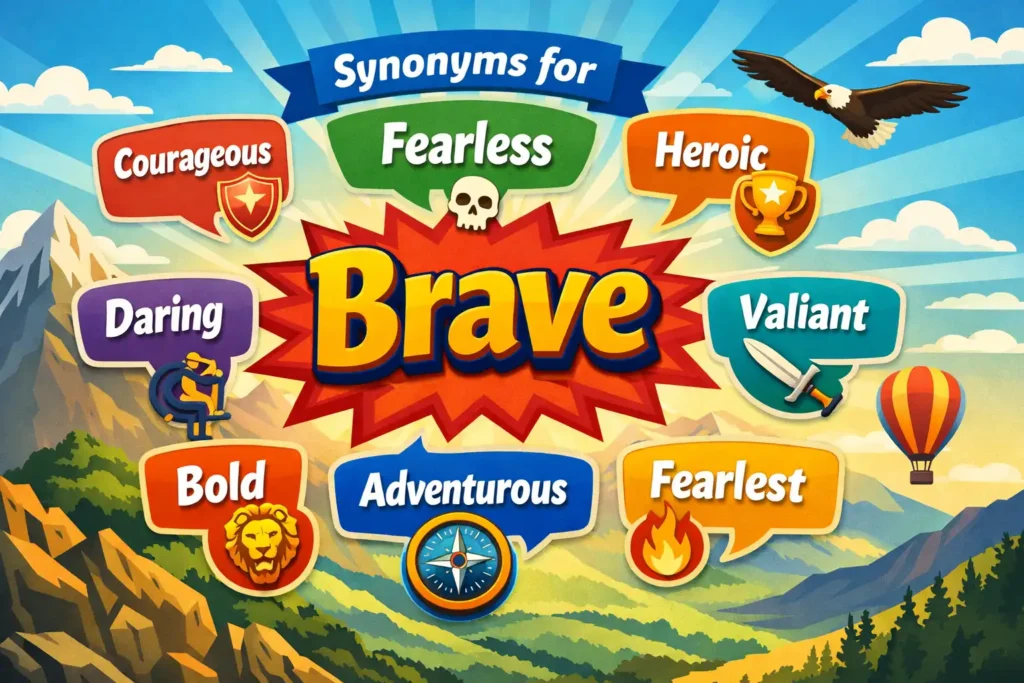
Common synonyms for brave:
- Courageous
- Bold
- Fearless
- Daring
- Heroic
- Valiant
- Gallant
- Confident
- Gutsy
- Determined
Meaning of Brave
Brave describes someone who faces fear, pain, or danger with courage.
Example:
She was brave enough to speak in front of the whole class.
Categories of Synonyms
1. Physical Courage
These words describe someone who faces physical danger or risk.
Example: soldiers, firefighters, rescue workers.
2. Emotional Courage
These describe inner strength when facing fear, pain, or personal struggles.
3. Social Courage
These words describe confidence in social or public situations.
Synonyms Table
| Word | Simple Meaning | Example Sentence |
| Courageous | Very brave in danger | The firefighter was courageous during the rescue. |
| Bold | Not afraid to take risks | She made a bold decision to quit her job. |
| Fearless | Without fear | He gave a fearless performance. |
| Daring | Willing to try risky things | The climber made a daring move. |
| Heroic | Like a hero | The doctor made a heroic effort. |
| Valiant | Very brave and strong | The knight made a valiant attempt. |
| Gallant | Brave and noble | The soldier made a gallant stand. |
| Confident | Sure of yourself | She felt confident before the interview. |
| Gutsy | Brave in a bold way | That was a gutsy choice. |
| Determined | Not giving up | He was determined to succeed. |
Master Synonyms List (Grouped by Level)
Beginner / Simple
1. Courageous
Meaning: Showing strong bravery
Example: She made a courageous decision to tell the truth.
2. Bold
Meaning: Willing to take risks
Example: It was bold to ask for a promotion.
3. Fearless
Meaning: Not afraid
Example: The child was fearless on the stage.
Intermediate
4. Daring
Meaning: Ready to take risks
Example: The pilot made a daring landing.
5. Confident
Meaning: Sure of yourself
Example: He felt confident during the debate.
6. Determined
Meaning: Strong-minded and focused
Example: She was determined to finish the race.
Advanced / Formal
7. Heroic (Formal)
Meaning: Extremely brave, like a hero
Example: The team made a heroic effort to save lives.
8. Valiant (Formal)
Meaning: Very brave in difficult situations
Example: He gave a valiant speech despite criticism.
9. Gallant (Formal)
Meaning: Brave and honorable
Example: The officer made a gallant attempt to protect others.
10. Gutsy (Informal)
Meaning: Brave in a bold or risky way
Example: It was gutsy to challenge the manager.
Formal vs Informal Synonyms
Use formal words like valiant or heroic in academic writing, speeches, or official documents.
Use informal words like gutsy in casual conversations or blogs.
Choose based on your audience and tone.
Real-Life Usage Examples
Conversation:
That was a bold move!
Academic Writing:
The study required courageous leadership.
Business Writing:
She made a determined effort to improve sales.
Blogging:
Starting a business is a daring decision.
Emotional Expression:
It takes courage to forgive someone.
Similar Words Comparison
Brave vs Bold
Brave focuses on facing fear.
Bold focuses on confidence and risk-taking.
Example:
She was brave during surgery.
She was bold in her fashion choices.
Brave vs Fearless
Brave means feeling fear but facing it.
Fearless suggests little or no fear.
Example:
He was brave despite his fear.
He appeared fearless during the speech.
Example Sentences
- She gave a brave speech.
- The firefighter acted courageously.
- He made a bold choice.
- The child was fearless at the dentist.
- It was a daring rescue mission.
- She stayed confident under pressure.
- The soldier was heroic in battle.
- He made a valiant effort to win.
- That was a gutsy response.
- She remained determined through hardship.
- It takes courage to admit mistakes.
- The leader made a gallant stand.
- He was brave enough to apologize.
- She showed bold leadership.
- The team made a heroic comeback.
Common Mistakes
- Using fearless when fear exists.
If someone feels fear but continues, use brave, not fearless. - Using formal words in casual speech.
Saying “valiant effort” in daily talk may sound unnatural. - Confusing bold with rude.
Bold means confident, not disrespectful. - Overusing brave repeatedly.
Use synonyms to improve variety and clarity.
Tips / Best Practices
- Choose words based on tone.
- Match the context (physical danger or emotional strength).
- Consider formality level.
- Keep clarity simple.
- Avoid repeating the same word too often.
When NOT to Use Brave
Do not use brave for simple daily actions.
Example: Going to the store is not brave unless there is real risk or fear involved.
Avoid exaggerating small situations.
Opposite Words (Antonyms)
- Cowardly
- Afraid
- Fearful
- Timid
- Weak
FAQs
What does brave mean?
Brave means showing courage in difficult or dangerous situations.
Is brave formal or informal?
It is neutral and works in both formal and informal contexts.
How can I use it in conversation?
You can say, “That was brave of you.”
What is the best synonym for brave?
Courageous is the closest and most common synonym.
Can brave be replaced with bold?
Sometimes, bold focuses more on confidence than fear.
Conclusion
Learning synonyms for brave improves your writing and speaking skills.
It helps you sound more natural, clear, and confident.
Try using 3 new synonyms in your next sentence.

Hannah Scott is a research-focused editorial writer specializing in language clarity, word meaning, and semantic comparison. Her work centers on helping readers understand subtle differences between commonly confused words, phrases, and expressions through structured, evidence-based explanations. With a background in English linguistics and editorial research, she has spent years analyzing how vocabulary functions across academic, professional, and everyday communication contexts.
Before contributing to educational publishing, Hannah worked on content research projects that required precise terminology review, source verification, and readability editing. This experience shaped her methodical approach to writing about synonyms, definitions, and usage distinctions. She combines dictionary research, corpus examples, and style-guide references to ensure accuracy and consistency in every article.
Hannah’s writing focuses on breaking down complex language concepts into accessible explanations without oversimplifying meaning. She regularly examines contextual usage, tone differences, grammatical roles, and regional variation when comparing related terms. Her work supports students, writers, educators, and non-native English learners who need reliable guidance when choosing the most appropriate word.
As part of the editorial team behind Word Synonyms, Hannah contributes research-driven articles designed to meet modern search quality standards while remaining genuinely helpful to readers. Her content follows structured semantic organization, clear definitions, and practical examples that improve comprehension and confidence in language use.
Hannah continues to study evolving English usage patterns, ensuring her work reflects both traditional reference standards and contemporary communication practices. Her editorial process emphasizes source transparency, careful citation review, and alignment with established dictionary authorities such as Merriam-Webster and the Oxford English Dictionary. She collaborates with editors to maintain consistency across terminology guides, synonym comparisons, and definition articles published on the site.
Through disciplined research and clear explanatory writing, Hannah aims to strengthen readers’ vocabulary decisions and deepen understanding of meaning relationships within English. Her work supports accurate communication in learning environments.